
Everest Base Camp Trek Cost From Switzerland: The Real All-In Numbers in Swiss Francs for 2027
Last updated 7 October 2026. I searched Zurich return fares on 7 October 2026. Swiss franc amounts are converted at US$1 = CHF 0.831 (European Central Bank, 6 October 2026) and will drift; the dollar prices are what we actually charge.
Here is the whole bill in francs. The Everest Holiday has been a registered Kathmandu company since 2016, and guiding runs through three generations of my family. The 12-day Everest Base Camp trek is charged per person at US$1,399 on the Budget tier, US$2,785 on Standard and US$4,999 on Luxury for one to four trekkers; in francs that is roughly CHF 1,160, CHF 2,080 and CHF 4,150. The 2027 prices are the same.
From Zurich, with return flights, a visa, insurance and tips, a single traveller should plan on roughly CHF 2,900 to CHF 3,670 on Budget, CHF 3,670 to CHF 4,350 on Standard and CHF 5,850 to CHF 6,580 on Luxury.
Our Europe representative, Shradha Simkhada, lives in Finland. Finland is one hour ahead of Switzerland. You can phone or WhatsApp her via +358 45 353 8606 or this WhatsApp link; she is the first contact for European travellers, and the language is English.
Where the francs go
Per traveller. The flight column shows the cheapest and the dearest Zurich fare I found, and the next one folds together the 30-day visa, insurance, tips, and either your own meals on the trail (Budget) or spending money (Standard, Luxury). Kathmandu hotels sit on top in every tier; the family homestay is US$15 a night, about CHF 10.
| Tier | Package | Zurich return fare | Visa, insurance, tips, trail costs | Total |
|---|---|---|---|---|
| Budget | CHF 1,160 | CHF 1,259 to CHF 1,722 | CHF 480 to CHF 790 | CHF 2,900 to CHF 3,670 |
| Standard, travelling solo | CHF 2,080 | CHF 1,259 to CHF 1,722 | CHF 340 to CHF 550 | CHF 3,670 to CHF 4,350 |
| Luxury | CHF 4,150 | CHF 1,259 to CHF 1,722 | CHF 440 to CHF 700 | CHF 5,850 to CHF 6,580 |
Meals on the trail are only your expense on Budget, at US$25 to US$40 a day (US$300 to US$480 in total). The other two tiers include food, so about NPR 20,000 to 30,000 (US$130 to US$195) is plenty for hot showers, charging, wifi and a snack or two. Rupees should be drawn in Kathmandu. Tips, paid on the last day, are US$15 to US$20 a day for your guide and US$10 to US$15 a day for a porter.
Zurich to Kathmandu: what the search returned
For Zurich I searched economy, one adult, one checked bag, leaving on Sunday 25 October 2026 and flying back on Wednesday 11 November, with no more than one change each way and no self-transfer. Nothing is nonstop; every result changes planes once.
The cheapest, CHF 1,259, was Air India out via Delhi: Zurich 20:40, Kathmandu 13:55 the next day, about 12 hours 30 minutes. The catch is the return on Qatar Airways, which leaves Kathmandu at 11:05 and, after a long wait in Doha, lands in Zurich at 13:40 the next day, about 31 hours 20 minutes. The same Qatar flight leaving at 19:00 cost CHF 1,405 and cut the trip to about 23 hours 25 minutes. Thai Airways home via Bangkok, about 22 hours, made it CHF 1,411.
A quicker way back is Turkish Airlines via Istanbul, leaving at 12:45 and landing in Zurich at 22:25 the same day, about 14 hours 25 minutes, for CHF 1,504 with Air India outbound. Air India outbound with Emirates home via Dubai ran CHF 1,541 to CHF 1,722, and Singapore Airlines home through Changi was CHF 1,563 for a trip of nearly 38 hours. Qatar out via Doha (15:10 from Zurich, 14:35 in Kathmandu, about 18 hours 40 minutes) with Thai home was CHF 1,421. Turkish out via Istanbul and Air India home was CHF 1,616, the one that lands in Zurich the same evening you leave Kathmandu. So the range that day was CHF 1,259 to CHF 1,722. Only Zurich was priced; Geneva and Basel travellers should check their own airports.
Visa for Swiss passports
Swiss citizens collect the visa at Kathmandu airport. A multiple-entry tourist visa from the Department of Immigration costs US$30 for 15 days, US$50 for 30 days (about CHF 40) or US$125 for 90 days, payable in dollars. Thirty days covers the trek comfortably. Filling in the online form in advance and printing the receipt shortens the queue. The passport should have six months left, and you need one photo. Switzerland is not among the 12 nationalities that must obtain a visa before departure. Further steps: the e-visa guide.
Compulsory Swiss health insurance is not travel insurance
The compulsory basic insurance you hold in Switzerland limits what it pays for treatment abroad and covers only a fraction of a rescue or repatriation, and the European card has no value in Nepal. Buy a proper travel policy at home before you fly; we do not recommend buying cover in Nepal.
In the conditions, look for trekking up to 6,000 metres (Kala Patthar is 5,545 m), helicopter evacuation, cover for illness and not just accident, and repatriation. Many Swiss walkers hold a Rega patron membership or belong to the Swiss Alpine Club, and both are useful, but neither is a travel policy; ask each organisation in writing exactly what it pays in Nepal and at what height. Should you pay yourself, the helicopter from Base Camp to Kathmandu is billed at US$3,000 to US$5,000 (about CHF 2,500 to CHF 4,150). A short trekking policy typically costs US$50 to US$100, and a comprehensive one US$100 to US$180. Send me the wording and I will read it. More on helicopter cover to 6,000 m.
Budget, Standard or Luxury
- Budget: your own pack, shared rooms, no meals, fixed-wing flight to Lukla.
- Standard: all meals, private rooms, a porter for every two trekkers, fixed-wing flight.
- Luxury: a porter of your own, private deluxe ensuite rooms, fruit, nuts, unlimited soft drinks and a helicopter both ways to Lukla.
The permits are in the price of every tier (Sagarmatha National Park NPR 3,000, Khumbu local fee NPR 3,000, TIMS NPR 2,000), as are a licensed guide, airport transfers, and a borrowed down jacket and sleeping bag rated to minus 15. Travelling solo on Standard, you have no porter, so the guide carries up to 10 kg of your kit; there is never a single supplement. Trek page.
How does it compare with the Alps?
The Gornergrat railway station is at 3,089 m and the Jungfraujoch at 3,454 m, but you ride up to them. The Dom, at 4,545 m the highest mountain wholly inside Switzerland, is a better test, and on the Matterhorn you reach 4,478 m. Even so, Gorak Shep at 5,164 m is well above any Alpine night, and the air holds about half the oxygen you breathe at sea level. That is why the itinerary has two acclimatisation days, and why a quick up-and-down does not work here. Expect five to seven hours of walking on most days. See how fit you need to be.
Group prices in francs
- 1 to 4 people: Budget CHF 1,160, Standard CHF 2,080, Luxury CHF 4,150, which is US$1,399, US$2,499 and US$4,999.
- 5 to 8 people: Budget CHF 1,080, Standard CHF 2,030, Luxury CHF 4,110, which is US$1,299, US$2,449 and US$4,949.
- 9 to 12 people: Budget CHF 1,000, Standard CHF 1,990, Luxury CHF 4,070, which is US$1,199, US$2,399 and US$4,899.
- 13 to 20 people: Budget CHF 830, Standard CHF 1,950, Luxury CHF 4,030, which is US$999, US$2,349 and US$4,849.
Whether the trip is private or with a group, the amount per person is identical; only the number of trekkers matters.
Swiss holidays and the Nepali calendar
Easter week suits the spring season: Good Friday is 26 March 2027 and Easter Monday 29 March. Ascension Day (Thursday 6 May) and Whit Monday (17 May) give two long weekends in May, and plenty of people take the Friday after Ascension as well. Cantonal school holidays vary, so check your own. Nepal has its own closures: Dashain from 17 to 23 October 2026, Tihar from 8 to 12 November. Permits take 48 hours of government working days.
On Sunday 25 October 2026 Swiss clocks go back; the gap to Nepal is 3 hours 45 minutes before that and 4 hours 45 minutes after. From Manthali, which is four to five hours by road from Kathmandu, our fixed-wing planes fly to Lukla throughout the autumn season; expect a pick-up in the small hours, between midnight and 2 am. Luxury avoids all that with a helicopter from Kathmandu. A spare day at the end costs little and covers weather.
Paying us from Switzerland
A deposit of 10 per cent confirms your trek. The balance falls due in Kathmandu, in US dollars or euros, in cash at no charge or by card at 3.5 per cent extra. Swiss francs and Nepali rupees are not accepted. We will move the trek free to any date within a year on 72 hours' warning, with a full week's warning for Tibet, Kailash and restricted areas. If you cancel instead, the deposit is forfeited and no refund is made. Where we are unable to run the trek, you receive back what you paid, minus taxes, bank or card charges and costs already spent on permits and flights.
Swiss help in Nepal
Switzerland has had an embassy in Kathmandu since 2009. Check the Federal Department of Foreign Affairs travel advice for Nepal before you book, and again a week before you fly.
Our credentials
Our registration dates from 2016 and we are TAAN member 1586; more than 300 travellers have reviewed us on TripAdvisor, Google and Trustpilot. The company registrar, TAAN, the tourism licence and the forex certificate are open to checking, and I will show you ours. Even licensed operators have been involved in scams, so talk to me first. Part of every booking supports the Nagarjun Learning Center in Saldum.
Questions about your own dates? Write to me on WhatsApp, +977 9810351300; the email address is [email protected]. A quote comes from me, not from a bot.
Next: the helicopter return, permits and fees, and the cost guide.
By Shreejan Simkhada, CEO, The Everest Holiday, Kathmandu. TAAN 1586.
Planning a trip to Nepal?
Drop us your details and tell us what you have in mind. We will put together a personalised plan and get back to you.
Not sure which Nepal trek is right for you?
Take our free 2-minute quiz and get personalised recommendations based on your fitness, experience, and travel style.
Find Your Perfect Trek →
Christmas and New Year Treks from Pokhara 2026/27: 3 to 5 Days
<p>Short treks from Pokhara for Christmas and New Year 2026/27: Panchase 3 days, Poon Hill 4 days and Mardi Himal 5 days. Weather, snow, what is open, and prices by group size.</p>
Read More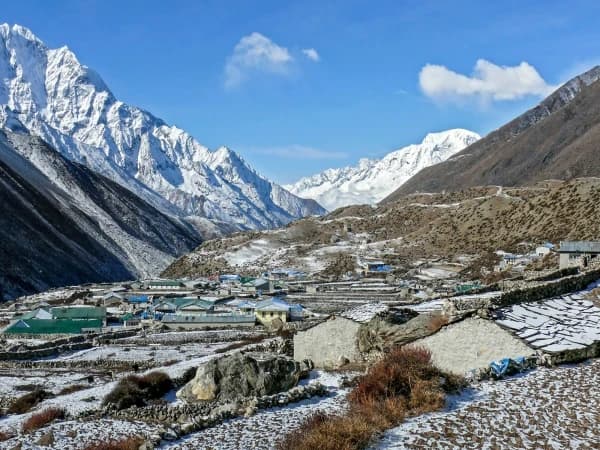
Thamdanda and Surke: The Road Head for Everest Base Camp by Road
Thamdanda is the road head where our Everest Base Camp trek by road starts and ends on foot. How to get there from Phaplu and what the first walk to Paiya is like.
Read MorePoon Hill Trek Permits 2027: ACAP, TIMS, Cost and What You Need
Poon Hill needs two permits: ACAP at NPR 3,000 and a TIMS card at NPR 2,000. Who arranges them, where they are checked, SAARC rates and the 2027 trek prices.
Read More Chat with Shreejan