
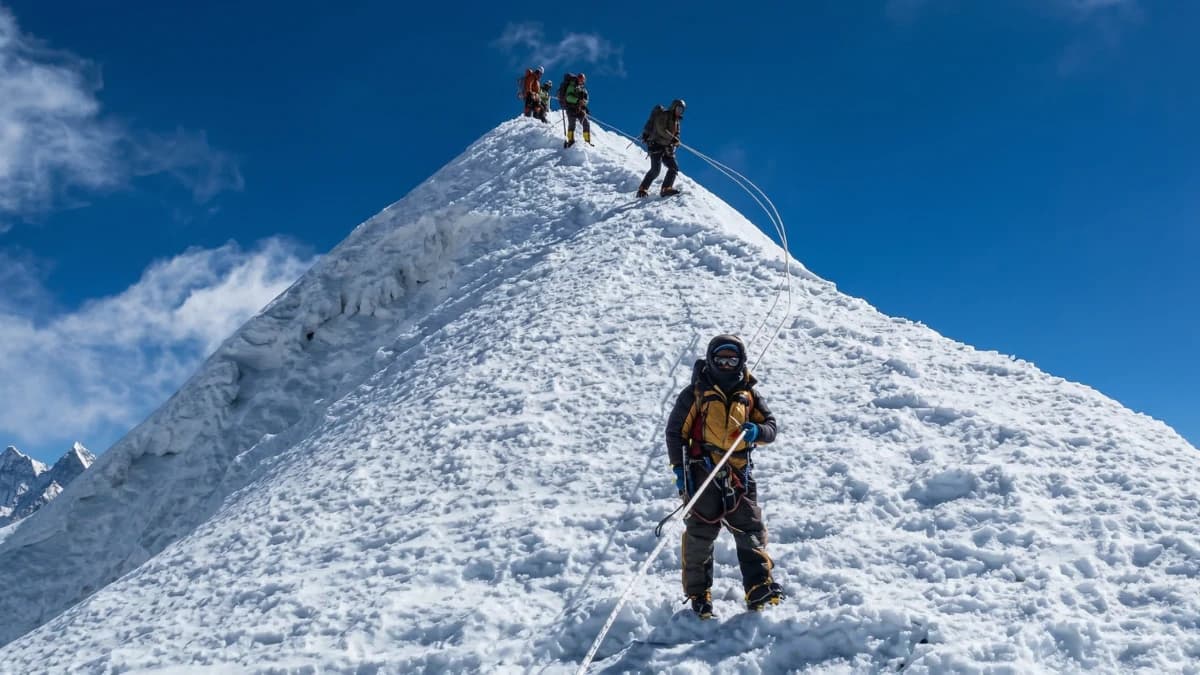
In short: the Island Peak climb suits fit trekkers who want a technical first summit above 6,000 m, with a steep headwall on fixed rope, after four days on the Everest trail. It runs 14 days from Kathmandu, tops out at 6,165 m and is graded technically challenging. Prices start from USD 3,900 per person on Budget, USD 5,175 on Standard and USD 9,999 on Luxury, with permits, all technical gear, emergency oxygen and the USD 500 garbage fee included.
Island Peak Trek Highlights
- Stand on the summit of Island Peak (Imja Tse) at 6,165 metres (20,226ft), with Lhotse, Nuptse and Ama Dablam framed directly above you
- Four days on the Everest Base Camp trail before turning toward Island Peak base camp; the acclimatisation profile is built into the route, not bolted on
- Pre-summit skills session at Island Peak Base Camp on the afternoon before the climb: fixed-rope ascent, jumar and descender technique, ice-axe arrest and glacier travel, taught by your own climbing Sherpa
- All technical gear included in every tier: double mountaineering boots, crampons, harness, jumar, figure-of-eight descender, ice axe, helmet
- One climbing Sherpa per trekker on summit day — not a shared rope team
- 14-day schedule with a built-in contingency day at Lukla, so a cancelled mountain flight does not cost you your international connection
Why I built this trek the way I did
I am Shreejan, the founder of The Everest Holiday. Island Peak and Mera Peak are the two trekking peaks most clients ask about, and people assume they are interchangeable. They are not. Island Peak is technically harder. The summit headwall is steep, the final 100 metres are on fixed rope, and the exposure on the summit ridge is real. Mera Peak is the altitude challenge with gentle technical terrain. Island Peak is the technical challenge with slightly lower altitude. If you have done a glacier travel course, Island Peak is the better fit. If you have not, please tell me before you book.
The route matters. We approach Island Peak via the standard EBC trail, then divert at Dingboche. By the time you reach Chhukung and Island Peak Base Camp, your body has already adjusted to 4,400 metres over eight days. I do not shorten it with helicopter assists or fewer rest days, because that is how summit chances are lost. The slow approach is what works.
The skills session at Island Peak Base Camp is part of every climb. You spend the afternoon before summit night with your climbing Sherpa. Crampon technique, fixed-rope ascent on jumar, descent on figure-of-eight, ice-axe arrest. If you have never done this before, the first time should not be at 4am on a steep snow slope in the dark. We teach it in daylight, on terrain that lets you make mistakes safely.
Every booking on this trip helps us pay the teacher's salary at our Nagarjun Learning Center in Saldum, where 70 children get free education. The salary is currently funded out of my own pocket. Your trek is what makes that sustainable.
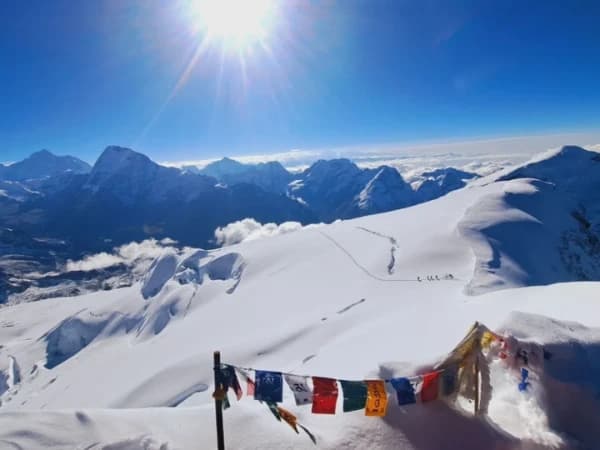
The summit ridge of Island Peak narrows to a blade of snow and ice at 6,165 metres (20,226ft). Your boots punch through the crust with each step, the rope stretches taut between you and your climbing Sherpa, and the world drops away on both sides, the Khumbu Glacier to the west, the Imja valley to the east, and the summit pyramid of Lhotse filling the sky directly ahead. This is the moment you cross the line from trekker to mountaineer. This is Island Peak.
Fourteen days from Lukla to the summit and back. The route follows the classic Everest trail through Phakding, Namche Bazaar, Tengboche, and Dingboche, then turns east to Chhukung and the base camp of Island Peak (Imja Tse). You will walk the same Sherpa trails and sleep in the same teahouses as every EBC trekker, eat dal bhat in dining rooms warmed by yak-dung stoves, cross prayer flag–draped suspension bridges over the Dudh Koshi River, and then, when the trekkers turn back, you keep going. Up onto the glacier. Up onto the headwall. Up onto the summit ridge where Nepal unfolds beneath you in every direction. All climbing gear is provided by The Everest Holiday. Your climbing Sherpas are expedition-qualified professionals from the Khumbu region.
What Makes This Climb Special
- Summit Island Peak (6,165m / 20,226ft), your first peak above 6,000 metres, with panoramic views of Everest, Lhotse, Makalu, Ama Dablam, and Baruntse
- Combine the classic Khumbu trek with real mountaineering, trekking through the Everest region before climbing a Himalayan summit
- All climbing gear provided by The Everest Holiday, ropes, harness, ice axe, crampons, helmet, and all technical equipment
- Climb with experienced TEH climbing Sherpas from the Khumbu region, expedition-qualified mountaineers who know this peak intimately
- Acclimatise through the classic Everest corridor, Namche Bazaar, Tengboche, Dingboche, which prepares your body for the summit push
- Visit Tengboche Monastery, the spiritual heart of the Khumbu, with Everest and Ama Dablam framed behind it
- Trek to Chhukung (4,730m / 15,518ft), a quiet, spectacular valley beneath the south face of Lhotse, away from the main EBC trail crowds
- From USD 3,900 per person on the Budget tier (2 to 4 people), with permits, technical gear and the garbage fee included
- Hike to the Everest View Hotel (3,880m / 12,730ft) on your Namche rest day, your first clear view of the summit
- Cross suspension bridges draped in prayer flags over the Dudh Koshi River, high above the river
- Clip into the fixed rope on the headwall and you are climbing, not trekking
14-Day Island Peak Climbing Overview
Fourteen days splits neatly into three phases: the approach, the acclimatisation, and the climb. The first phase follows the Everest trail from Lukla through Phakding (2,610m / 8,563ft), Namche Bazaar (3,440m / 11,286ft), Tengboche (3,860m / 12,664ft), and Dingboche (4,410m / 14,469ft). This is the same trail walked by EBC trekkers, the suspension bridges, the Sherpa villages, the slowly transforming landscape from rhododendron forest to glacial moraine, and it serves as your acclimatisation corridor.
At Dingboche, you turn east. While EBC trekkers continue north towards Lobuche, you head into the Chhukung valley (4,730m / 15,518ft), a quieter, less-travelled arm of the Khumbu that sits beneath the immense south face of Lhotse. From Chhukung, you climb to Island Peak Base Camp (5,087m / 16,690ft), where your climbing team sets up camp and you prepare for the summit push.
Summit day begins well before dawn. You climb the glacier in the dark, headlamp illuminating the ice, then ascend the headwall on fixed ropes, ice axe and crampons biting into the slope, before emerging onto the summit ridge. The ridge is narrow and exposed, with the Khumbu on one side and the Imja valley on the other. At the top, 6,165 metres above sea level, you see Everest, Lhotse, Makalu, Ama Dablam, Baruntse, and a horizon of Himalayan peaks stretching in every direction. It is the moment that separates this trip from every other Everest region trek.
After the summit, you descend to Chhukung and retrace the classic trail through Namche to Lukla, then fly back to Kathmandu. You return not just as a trekker, but as a climber who stood on a Himalayan summit.
Before You Arrive
Please arrive in Kathmandu by 4 PM the day before your trek. This gives you time for a final gear check, a climbing briefing with your guide and climbing Sherpa, and a good night’s rest before the early morning start.
Your Online Briefing
Think of this as our first coffee together, but online. After you book, we schedule a video call where we walk you through every detail: what to pack for both trekking and climbing, what the summit day is really like, how to prepare physically, what climbing experience (if any) you need, and anything else on your mind. No question is too small.
This is also when we learn about you. Our trek itinerary does not include your hotel in Kathmandu, during the briefing, share your preferences and budget, and we will arrange accommodation that fits. Whether you want a simple guesthouse in Thamel or a five-star hotel, we will set it up for you.
Lukla Flight, What You Need to Know
The flight to Lukla is a dramatic one, a short ride between mountain peaks that ends on a runway carved into a hillside at 2,860m (9,383ft). It is weather-dependent, and flights can be delayed by fog, cloud, or wind, sometimes for a full day. This is normal in the Himalayas and nothing to worry about, but it is something to plan for.
We strongly recommend keeping two buffer days at the end of your trip before your international flight home. During peak season (roughly 15 March–15 May and 25 September–30 November), flights may operate from Manthali Airport instead of Kathmandu. All ground transport is included in every package.
Your Trek, Your Way
Every climb we run is private, with your own party only. We never add strangers to your booking. If you would like company, you can choose to join one of our fixed departures instead. Whether you choose Budget, Standard, or Luxury, the mountains are yours and your companions’ alone.
Your hotel in Kathmandu is not included in the trek package, and that is intentional. Kathmandu has everything from USD 10 guesthouses in Thamel to five-star hotels with rooftop views. During the online briefing, tell us what you prefer and we will arrange it for you. Your trek package begins the moment you leave Kathmandu for the mountains.
Climbing Gear and Team
All climbing gear is provided by The Everest Holiday, ropes, harness, ice axe, crampons, helmet, and all technical equipment needed for the summit push. You do not need to bring or buy any climbing-specific gear.
Your climbing Sherpas are expedition-qualified professionals from the Khumbu region. Our team includes our climbing Sherpa and our expedition-qualified guides, all with mountaineering qualifications and deep experience on Island Peak and other Himalayan summits. If our main team is unavailable, we bring in other climbing Sherpas from the Khumbu.
Difficulty: Technically Challenging
This is one of the harder climbs we offer in the Everest region. The trekking portion is equivalent to the classic EBC route, 5-8 hours of walking per day over mountain trails. The climbing portion adds technical mountaineering: glacier travel, fixed rope ascent on a steep headwall, crampon and ice axe use, and an exposed summit ridge. Previous trekking experience is strongly recommended. Previous climbing experience is helpful but not essential, your climbing Sherpa will teach you everything on a training session before summit day. Excellent cardiovascular fitness is required.
Island Peak at a glance
| Duration | 14 days, Kathmandu to Kathmandu |
|---|---|
| Summit | Island Peak (Imja Tse), 6,165 m |
| Region | The Khumbu, Sagarmatha National Park; the Everest Base Camp route then east to Chhukung |
| Difficulty | Technically challenging; a real ice and summit day |
| Fly in and out | Lukla, 2,860 m |
| Guides and gear | our IFMGA/NNMGA-certified lead guides; all climbing gear provided free |
| Permits | NMA climbing permit, Sagarmatha National Park, Khumbu Pasang Lhamu Rural Municipality and a TIMS card |
| Best months | April to May and October to November |
| Group size | 1 to 20 people. Solo is welcome, and every climb is private |
| Starts and ends | Kathmandu, with the flight to Lukla and back, and a contingency day at Lukla |
| Royalty | NMA royalty USD 350 in spring and USD 175 in autumn, winter and summer, included in your price |
| Summit team | One climbing Sherpa per climber on summit day |
| From price | USD 3,900 Budget, USD 5,175 Standard, USD 9,999 Luxury (2 to 4 people; solo USD 5,005, USD 6,135, USD 9,999) |
Best time to climb Island Peak
| Season | Months | What it is like | Verdict |
|---|---|---|---|
| Spring | March to May | The main climbing season; warmer, stable snow on the summit slope, and the busy Base Camp window | Best overall |
| Autumn | October to November | Clear and cold, the second climbing season, and the NMA royalty is lower than spring | Great, second season |
| Winter | December to February | Very cold with high wind on the summit; only for experienced, well-equipped teams | Only with care |
| Monsoon | June to mid-September | Snow, cloud and avalanche risk on the approach | Avoid |
Month by month: when to go
| Month | Dingboche average night low (C, modelled) | On the climb | NMA royalty | Our view |
|---|---|---|---|---|
| January | -15.3 | Very cold, with high wind on the summit. Only for experienced, well-equipped teams. | USD 175 | Only with care |
| February | -14.2 | Very cold, with high wind on the summit. | USD 175 | Only with care |
| March | -10.5 | The spring climbing season begins. Cold early in the month and warming. | USD 350 | Yes |
| April | -7.0 | The main climbing season, warmer with stable snow on the summit slope. | USD 350 | Best |
| May | -3.5 | Still the main season, but the rain is building at Lukla (127.6 mm). | USD 350 | Best, early May |
| June | 1.1 | Monsoon. Snow, cloud and avalanche risk on the approach. | USD 175 | Avoid |
| July | 2.9 | Monsoon, with heavy rain at Lukla. | USD 175 | Avoid |
| August | 2.3 | Monsoon, the wettest month. | USD 175 | Avoid |
| September | 0.3 | The monsoon is clearing, but Lukla still gets 419.0 mm and the approach is wet. | USD 175 | Avoid until late September |
| October | -5.3 | Clear and cold. The second climbing season, and the royalty is lower than in spring. | USD 175 | Best |
| November | -11.0 | Clear and cold, with almost no rain at Lukla (6.2 mm) and much colder nights. | USD 175 | Yes, wrap up warm |
| December | -13.4 | Dry and very cold. Winter climbing is for experienced, well-equipped teams. | USD 175 | Only with care |
The approach follows the Everest trail to Dingboche, so the night lows are the Dingboche figures from our Everest weather page, modelled data you should treat as a guide and not a forecast. The royalty is the Nepal Mountaineering Association's published rate, and we pay it for you. See Everest weather month by month and Island Peak cost: the 2027 budget breakdown.
Permits
We arrange the NMA climbing permit, all park fees and your TIMS card, and include them in your climb price.
| Permit | Cost per climber |
|---|---|
| NMA climbing permit (Island Peak / Imja Tse, one of the climbing peaks NMA manages) | US$350 in spring, US$175 in autumn, winter and summer |
| Sagarmatha National Park entry | about USD 20 (official fee NPR 3,000; NPR 1,500 for SAARC) |
| Khumbu Pasang Lhamu Rural Municipality | about USD 20 (official fee NPR 3,000) |
| TIMS card | about USD 13 (official fee NPR 2,000; NPR 1,000 for SAARC) |
Dollar amounts are approximate, at the 17 October 2026 Nepal Rastra Bank rate; the official fee is set in rupees.
What the price covers, and what it does not
You need the NMA climbing permit (royalty USD 350 in spring, USD 175 in autumn, winter and summer), Sagarmatha National Park (about USD 20, official fee NPR 3,000), the Khumbu Pasang Lhamu Rural Municipality fee (about USD 20, official fee NPR 3,000) and a TIMS card (about USD 13, official fee NPR 2,000). The USD 500 garbage fee for the climb is included in your price on every tier, as are emergency oxygen and all technical gear. We arrange everything, and permits need 48 hours in government working days. See NMA rates for 2026.
Not in the price: your international flights, your Nepal visa (USD 50 for 30 days on arrival), climbing insurance bought at home, your Kathmandu hotel, tips for your team, and on Budget your meals on the trek. Meals on the climbing days above base camp are included on every tier.
A 10% deposit (about USD 390 on Budget) confirms your dates. You pay it by card through Himalayan Bank's secure gateway, and we cover the card charge on the deposit. You pay the balance when you arrive in Kathmandu, in US dollars or euros, in cash or by card (card payments carry a 3.5% bank charge). If your plans change we move your trip to any date within a year, free, with 72 hours' notice. The deposit itself is not refunded if you cancel. If we cannot run the trip ourselves, we refund what you have paid, less taxes, bank and card charges and any money already spent for you on permits and flights.
Getting there
You fly from Kathmandu to Lukla (2,860 m), about 35 minutes, and follow the Everest trail through Phakding, Namche, Tengboche and Dingboche before turning east to Chhukung. In the busy seasons, roughly 15 March to 15 May and 25 September to 30 November, flights may leave from Manthali (Ramechhap) instead, with a pickup between midnight and 2 am, depending on your flight time, and a 4 to 5 hour drive. Day 13 is a contingency day at Lukla, so a cancelled flight does not cost you your international connection, but keep a spare day or two after the climb as well. On Luxury you fly by helicopter between Kathmandu and Lukla both ways. See is the Lukla flight safe.
Safety and altitude
You sleep at Namche (3,440 m) with a rest day, Tengboche (3,860 m), Dingboche (4,410 m) with a rest day, Chhukung (4,730 m) and Island Peak Base Camp (5,087 m), so your body has had eight days to adjust before the summit at 6,165 m. Summit day crosses a glacier, climbs the steep headwall on fixed rope (the final 100 metres) and traverses a narrow summit ridge with drops on both sides. You climb with crampons, ice axe, jumar and descender, and one climbing Sherpa goes with each climber. We carry a pulse oximeter, first aid and emergency oxygen, and the climbing team's decision on summit night is final. Your insurance must cover helicopter evacuation to 6,500 m (the summit is 6,165 m, rounded up) with mountaineering and climbing included, and you should buy it at home. See is Island Peak dangerous and Chhukung, the Island Peak base.
Packing basics
All technical gear is ours and included on every tier: double mountaineering boots, crampons, harness, jumar, figure-of-eight descender, ice axe and helmet. You bring your own warm layers, a down jacket, a good sleeping bag, gloves and liner gloves, a warm hat, goggles and sunglasses, a head torch with spare batteries and boots for the trek. If you do not own a sleeping bag or down jacket, tell us at your online briefing and we will lend you one. We send the full list when you book.
Budget, Standard or Luxury: what actually changes
| Budget | Standard | Luxury | |
|---|---|---|---|
| Porter | None. You carry your own bag | 1 porter for every 2 trekkers | 1 dedicated porter for every trekker |
| Meals on the trek | Not included on the trek, but meals on the climbing days above base camp are included | All meals | All meals, fruit and nuts, and unlimited soft drinks |
| Rooms | Shared | Private | Private deluxe with ensuite bathroom |
| Transport | Local transfers and the flight to Lukla | Shared tourist vehicle and the flight to Lukla | Private vehicle and a round-trip helicopter to Lukla |
If you are going alone, Luxury still gives you your own dedicated porter. On Standard there is no porter, because porters are shared one between two trekkers, so your guide carries up to 10 kg of your bag instead. Budget never has a porter. You can add a porter of your own on any tier for USD 25 per day, plus 13% VAT and the 3.5% bank charge on top. On a climb your guide goes to base camp and a climbing Sherpa goes from base camp to the summit; you never climb alone.
Kathmandu hotel nights are not included in any trek tier, so tell us your budget at the online briefing and we will book them for you. We name your guide once you have booked.
Climbing as a group?
Bring your own group — friends, family, a club, a university society, your workplace, or a cause you are raising money for — and any of the three comfort levels can run as a private group on your own dates. Private or group, the price per person is the same; we never put strangers in your group. The more of you there are, the less each person pays:
| Group size | Budget (per person) | Standard (per person) | Luxury (per person) |
|---|---|---|---|
| 1 person | US$5,005 | US$6,135 | US$9,999 |
| 2-4 people | US$3,900 | US$5,175 | US$9,999 |
| 5-8 people | US$3,630 | US$4,815 | US$9,499 |
| 9-12 people | US$3,435 | US$4,615 | US$8,999 |
| 13-20 people | US$3,280 | US$4,600 | US$8,599 |
The organiser travels free. Get fourteen or more paying people together and whoever organised the group joins the trip free. The one thing the organiser still pays is their own flights and permits, since those are fixed costs we pay out for every person and cannot absorb, and we cover the rest. Your departure is guaranteed on your own dates — from a solo traveller up to a group of twenty, and we never merge you into another trip.
Planning a group? Message me on WhatsApp with the trip, roughly when, and how many of you, and I will send you a price and a plan.
Compare Our Three Packages
| Budget | Standard | Luxury | |
|---|---|---|---|
| Price from | USD 3,900 | USD 5,175 | USD 9,999 |
| Meals | Choose your own (approx. USD 15-25/day) | 3 meals + tea + fruits + 2L water daily | All meals + all drinks anytime (except alcohol) |
| Room | Shared teahouse | Private twin w/ bathroom | Private deluxe w/ bed heater |
| Porter | Not included | 1 per 2 trekkers | 1 per trekker (carry nothing) |
| Guide | 1 guide up to 8 trekkers (assistant from 9) | 1 guide per 6, assistant at 7+ | 1 guide per 2 trekkers, plus an assistant guide for every 2 more |
| Climbing Sherpa | Included, expedition-qualified | Included, expedition-qualified | Included, expedition-qualified |
| Climbing gear | All provided by TEH | All provided by TEH | All provided by TEH (premium quality) |
| Transport | Local vehicle + flight to Lukla | Shared tourist vehicle + flight to Lukla | Helicopter Kathmandu–Lukla both ways |
| SIM data | SIM only | Limited data | Unlimited data |
| Best for | Ambitious climbers on a budget | Comfort climbers, first-time summiteers | Premium climbing experience |
Himalayas for Every Budget, same climbing Sherpas, same gear, same summit, three comfort levels.
Difficulty: Technically Challenging
Island Peak combines a full multi-day Himalayan trek with technical mountaineering. The trekking section (Days 1-8) involves 5-8 hours of walking per day over mountain trails with significant altitude gain. The climbing section (Days 8 to 10) involves glacier travel, fixed rope ascent on a steep ice headwall, crampon and ice axe technique, and an exposed summit ridge at 6,165m. You should be in excellent cardiovascular condition and comfortable with sustained physical effort at altitude. Previous climbing experience is helpful but not essential, your climbing Sherpa provides training and guides you through every technical section. Two acclimatisation days are built into the itinerary, and our guides carry first aid kits, altitude medication, and pulse oximeters.
Six thousand metres, one school year
Island Peak (Imja Tse) is 6,165 metres. Every booking helps support the Nagarjun Learning Center in the village of Saldum, where roughly seventy local children study for free and eat two meals a day on us. The centre is registered with the Nepalese authorities, and verified and listed on the UN Partner Portal.