
Written by Shreejan Simkhada, CEO of The Everest Holiday and third-generation Himalayan guide. TAAN Member #1586.
The climb to Namche Bazaar is the first real test. Everything before it (the flight to Lukla, the gentle walk to Phakding, the suspension bridges over the Dudh Koshi) has been introduction. Pleasant, scenic, manageable. Then the trail turns uphill. Steeply uphill. And for three hours, through pine forest and past waterfalls and across the final suspension bridge that everyone photographs, you climb. Six hundred metres of altitude gain in a single morning. Your lungs burn. Your legs protest. Your pack, which felt light in Phakding, develops a gravitational intensity that suggests someone added rocks while you slept.
Namche Bazaar at a glance
| Altitude | 3,440 m (11,286 ft), built in a horseshoe bowl in the Khumbu |
| Region | Sagarmatha National Park, a UNESCO World Heritage Site |
| On the trail | Everest Base Camp route, the standard first acclimatisation stop (usually two nights) |
| What it is | The main Sherpa trading town and gateway to the whole Everest region |
| Saturday market | The weekly haat bazaar, where the valley has traded for generations |
| Last of everything | ATMs, bakeries, gear shops and reliable wifi before the high trail |
| Trek it on | Everest Base Camp Trek, Everest View Trek |
Namche sits inside Sagarmatha National Park, managed by Nepal's Department of National Parks and Wildlife Conservation.
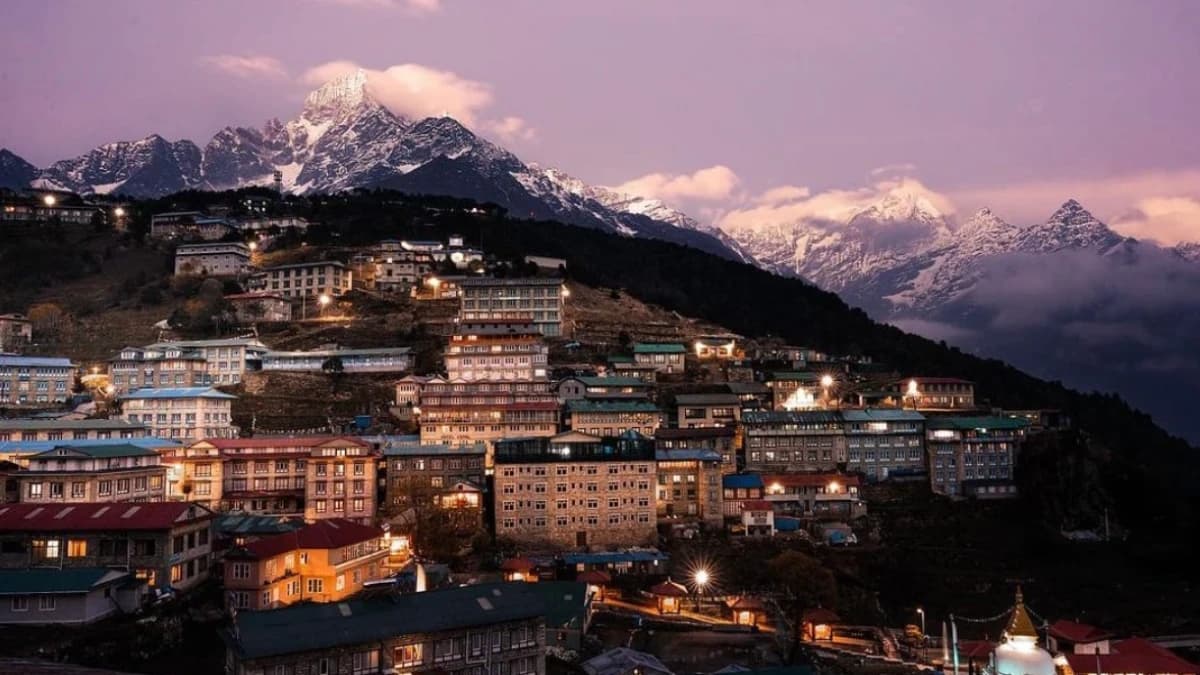
And then the trees part. The trail crests a ridge. And Namche Bazaar appears below you, a natural amphitheatre of stone and colour carved into the mountainside, with teahouses and lodges stacked in terraces from the river below to the ridge above, prayer flags crossing the gaps between buildings, and, above it all, the first clear view of Everest. A white triangle. Distant. Enormous. Real.
Namche Bazaar is not just a village on the trail. It is the capital of the Khumbu, the largest settlement in the Everest region, the trading hub that has connected the Sherpa people with the outside world for centuries, and, for every EBC trekker, the place where the trek transitions from walking to mountaineering. Not literal mountaineering, you are still on a trail, still sleeping in teahouses, still eating dal bhat. But the altitude at Namche (3,440 metres) is the altitude where your body begins the adaptive process that determines whether Gorak Shep and Kala Patthar are achievable. Everything above Namche is earned. The earning begins here.
What Should You Do on Your Acclimatisation Day in Namche?
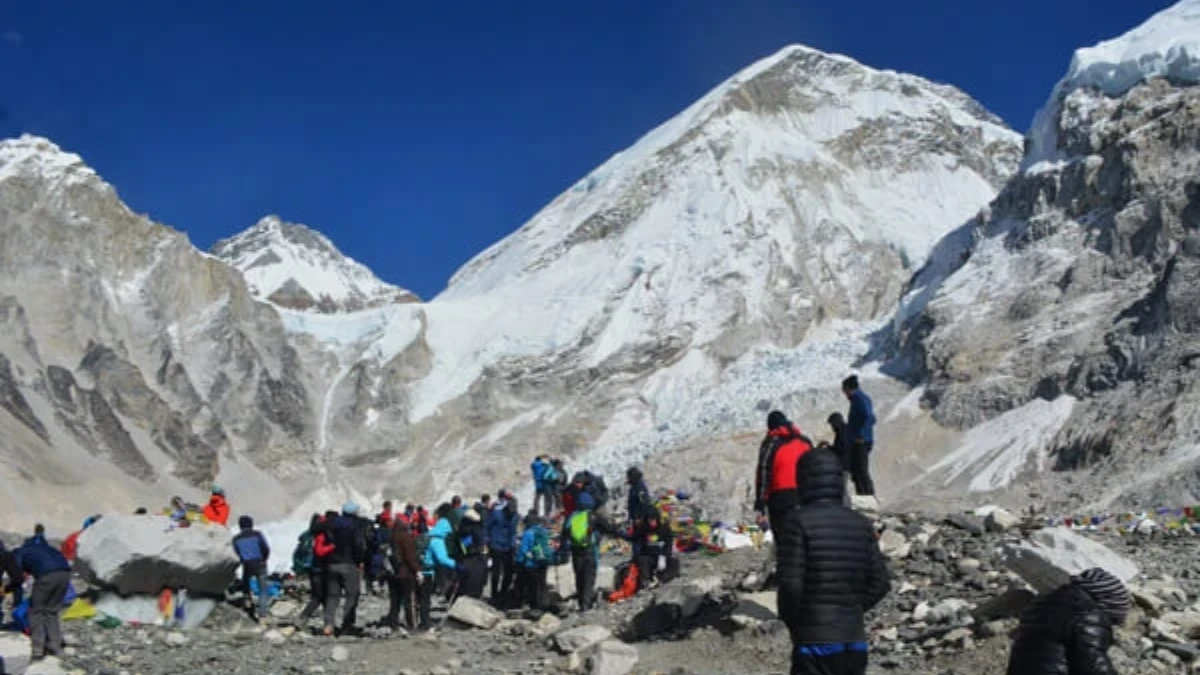
Day 4 of the standard EBC itinerary is the acclimatisation day at Namche, and it is the most important single day of the trek. Not the most dramatic, that is Kala Patthar. Not the most emotional, that is Base Camp. But the most important, because the acclimatisation that happens on this day determines how your body handles every altitude above Namche for the next eight days.
The standard acclimatisation hike goes to the Everest View Hotel at Syangboche (3,880 metres), a ninety-minute climb above Namche that gains 440 metres of altitude and delivers the first close-up view of Everest, Lhotse, Ama Dablam, and the Khumbu peaks. You walk up in the morning. Your body registers the reduced oxygen at 3,880 metres and triggers the adaptive responses, increased red blood cell production, adjusted blood pH, recalibrated breathing patterns. You walk back down to Namche to sleep at 3,440 metres. Climb high, sleep low. The principle that saves lives at altitude.
The Everest View Hotel itself is a curiosity, the highest-placed hotel in the world, built by Japanese investors in 1971, serving tea on a terrace with a view that justifies any price. The tea costs five dollars. The view is free. The combination, sitting in a wooden chair at 3,880 metres, hands wrapped around a hot cup, looking at four eight-thousanders across a valley that holds the entire Khumbu, is one of the defining moments of the EBC trek.
An alternative acclimatisation hike, less common but richer culturally, goes to Thame, the ancestral Sherpa village where Tenzing Norgay grew up. The altitude gain is similar, the acclimatisation benefit identical, and the cultural immersion incomparably deeper. Discuss this option with your guide before the trek.
What Is Namche Bazaar Like?
Namche Bazaar is a real town, not a trekking village. It has shops, not just trekking gear shops (though those line the main street, selling everything from yak-wool hats to North Face knockoffs) but hardware shops, grocery shops, and a surprising number of bakeries that produce fresh bread, cinnamon rolls, and apple pie in ovens powered by gas carried up from Lukla on someone's back.
The Saturday market is the oldest trading tradition in the Khumbu. For centuries, traders from the lowlands brought grain, vegetables, and manufactured goods up the valley, and traders from the highlands brought salt, wool, and yak products down. The market still operates, Saturday mornings, in the terraced square below the main street, though the goods now include Chinese electronics, Korean instant noodles, and the specific eclectic inventory that a market serving both local families and international trekkers produces.
The town has two ATMs, often non-functional, a post office, a dental clinic, a police station, and the Sagarmatha National Park headquarters. Mobile coverage is good (Ncell and NTC both work). Wi-Fi is available at most teahouses for a fee (two hundred to five hundred rupees). Electricity is reliable. Hot showers are available at most lodges (three hundred to five hundred rupees). Namche is the last point on the trail where the infrastructure feels urban, where you can buy what you forgot, charge what died, and wash what you have been wearing for three days.
Where Should You Stay and Eat in Namche Bazaar?
Namche has over thirty teahouses and lodges, the widest selection on the EBC trail. They range from basic (free room with meal purchase, shared bathroom, thin mattress) to comfortable (private room with ensuite bathroom, hot shower, heated common room, diverse menu). The quality difference between Namche's best and worst teahouses is significant, ask your guide to recommend a good one.
The food at Namche is the best on the trail. The lower altitude supports a wider range of fresh ingredients. The bakeries, particularly the Namche Bakery and the Everest Bakery, produce baked goods that would be creditable in a European city. Fresh bread. Cinnamon rolls glazed with sugar. Apple pie with actual apple. Brownies that are genuinely chocolatey. Coffee, real espresso, not instant Nescafe, is available at several cafes. After three days of teahouse menu food, the first bakery stop at Namche is a culinary revelation.
The restaurants serve Nepali, Tibetan, Indian, Italian (pizza from wood-fired ovens), Korean, and the generic "Continental" menu that Nepal defines as everything European. The prices are higher than Kathmandu but lower than the trail above. A full meal costs five hundred to one thousand rupees. A coffee costs three hundred to five hundred.
What Should You Do on Your Rest Day in Namche Bazaar?
Beyond the acclimatisation hike and the bakery pilgrimage, Namche offers enough activities to fill a rest day comfortably.
The Sherpa Culture Museum. A small museum above the town centre that documents Sherpa history, mountaineering achievements, and the cultural traditions of the Khumbu. The exhibits include photographs of early Everest expeditions, traditional Sherpa clothing and tools, and a model of the Khumbu region that helps you understand the geography of the valley you are walking through.
The viewpoints. Several viewpoints around Namche offer mountain panoramas without the full acclimatisation hike. The viewpoint above the Sagarmatha National Park headquarters provides clear views of Everest, Lhotse, and Ama Dablam. The viewpoint above the helipad offers views down the Dudh Koshi valley toward Lukla.
Gear shopping. If you forgot something, or if something broke on the first three days, Namche's gear shops are your last good opportunity to buy or rent. Down jackets, sleeping bags, trekking poles, gloves, and hats are available at prices well below Western retail (quality varies, inspect everything). Namche is also where you shed gear you are not using, some shops buy used gear, and the lodges often have a "free shelf" where trekkers leave items they no longer need.
Simply sitting. Find a south-facing terrace with a view. Order tea. Watch the trail, the trekkers arriving from below, the porters carrying impossible loads, the yak trains moving through the narrow streets. Namche is a confluence, every EBC trekker, every Gokyo trekker, every Three Passes trekker passes through, and the human traffic is as interesting as the mountain views.
How Did Namche Bazaar Become the Gateway to Everest?
Namche's history is the history of the Khumbu. The town was established as a trading post, the point where the high-altitude salt trade from Tibet met the lowland grain trade from the Solu. Its position, in a natural amphitheatre with a single trail entrance from the south, made it defensible, and its altitude, high enough to access the highland passes, low enough to grow crops, made it sustainable.
The arrival of mountaineering expeditions in the 1950s transformed Namche from a trading town into a logistics hub. The expeditions needed porters, food, equipment storage, and local knowledge, all of which Namche provided. When trekking tourism arrived in the 1960s and 1970s, Namche's infrastructure, already developed for expeditions, adapted to serve the new visitors. The trading families became lodge owners. The porter networks became guide agencies. And the town's central position in the Khumbu, the point through which every traveller must pass, guaranteed its economic survival as the old salt trade faded.
Today, Namche is both a living town and a tourism hub, and the tension between these roles is visible in every street. Traditional Sherpa houses with prayer wheels beside the door sit next to pizza restaurants with English menus. Elderly women spin wool on doorsteps while teenagers in North Face jackets serve espresso to Australian trekkers. The monastery above the town, where monks chant at dawn and dusk regardless of who is listening, sits within earshot of a bakery playing Bob Marley. The coexistence is not always comfortable, but it is genuine, a community adapting to change without abandoning its identity, at an altitude where change comes slowly and identity is anchored in mountains that do not change at all. Related: Phakding: Your First Night on the Everest Trail and Why It Matters More Than You Think.
What Comes After Namche on the EBC Trek?
You leave Namche on Day 5, heading north toward Tengboche. The trail climbs out of the amphitheatre on the eastern side, through a forest of rhododendron and pine, and contours along the hillside above the Dudh Koshi. For the first hour, you look back, at Namche dropping away below, at the trail you climbed to reach it, at the valley stretching south toward Lukla. Then the trail rounds a ridge, Namche disappears, and the Khumbu opens ahead, Tengboche, Dingboche, Lobuche, Everest, the next eight days of your life, laid out in altitude and distance, waiting.
You will return to Namche on the way down. Day 11 or Day 12, depending on your itinerary. You will arrive from above, faster, lighter, altitude-adapted, carrying the specific energy of a trekker who has been to Base Camp and back. And the bakery will be there. The hot shower will be there. The familiar streets and the familiar views will welcome you back with the warmth that Namche offers to every trekker who passes through, the warmth of a town that has been welcoming travellers since before the word "trekking" existed, and that will continue welcoming them long after the last trail sign fades.
Namche Bazaar is Day 3 on the Everest Base Camp Trek and the acclimatisation stop where you spend an extra day before continuing higher. If you are short on time, the Everest View Trek turns around at Namche after seven days. For the full Khumbu experience including Gokyo, see the EBC with Gokyo Lakes Trek.
Namche Bazaar is the Khumbu's capital. Saturday market, bakeries with real coffee, gear shops, pool tables, Wi-Fi that actually works: it is the last outpost of civilisation before the high mountains take over. Your acclimatisation day here is not a rest day. It is a day to explore, eat well, and let your body adjust to 3,440 metres. Walk up to the Everest View Hotel, visit the Sherpa museum, and eat the apple pie at the bakery near the stupa. Your body will thank you tomorrow.
Namche is days two and three on our Everest Base Camp Trek. We build in a full acclimatisation day here.
WhatsApp:+977 9810351300
Email:[email protected]
Written by Shreejan Simkhada, CEO of The Everest Holiday and third-generation Himalayan guide. TAAN Member #1586.
Namche has the best premium lodge options on the EBC route; for the full upmarket-trek treatment see our luxury Everest Base Camp trek guide.
Trekkers heading for the Gokyo lakes rather than Base Camp leave the main trail above Namche and climb the Gokyo valley through Dole to Machhermo, the key acclimatisation stop before Gokyo.
Namche is the heart of Khumbu and Day 3 on EBC. Our Everest Base Camp Trek (12 Days) is private (your group only, no strangers), 2027 dates open, From USD $1399. WhatsApp us for tailored 2027 dates and current departures.
 Chat with Shreejan