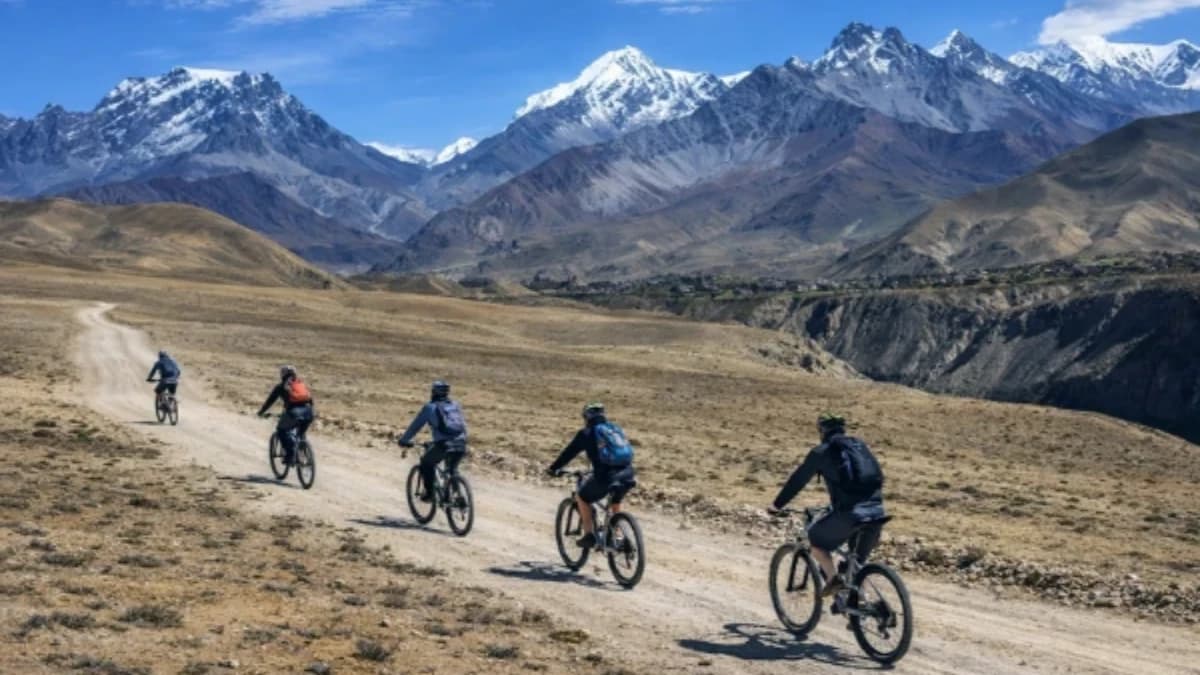
Mustang Cycling Tour - 19 Days Itinaray and Cost

Quick Overview
Duration19 Days
Trip GradeStrenuous
CountryNepal
Maximum Altitude4,660m / 15,288ft
Group Size2 - 20
StartsKathmandu
EndsKathmandu
ActivitiesCycling Tour
Best TimeSpring (March–May) and Autumn (September–November)

The Kathmandu to Mustang Cycling Tour is a difficult and beautiful high-altitude mountain bike trip that goes from Nepal's busy city to the dry, desolate kingdom of Upper Mustang. This epic journey includes tough climbs, exhilarating descents, and stunning scenery, such as lush valleys, deep gorges, and a weird desert plateau. It also offers rich cultural experiences rooted in ancient Tibetan Buddhist traditions.

Highlight

  • Ride through scenic hills, flowing rivers, and terraced farmlands.
  • Ride across a mesmerizing, rain-shadow desert of wind-sculpted cliffs, canyons, and eroded rock formations.
  • Cross the Kali Gandaki Gorge, which is one of the deepest gorges in the world.
  • In Mustang, visit distant communities and see real Tibetan culture.
  • See beautiful mountain views, such as the Annapurna, Dhaulagiri, and Nilgiri ranges.
  • In Tatopani, you can unwind in natural hot springs.
  • Along the way, you'll see Rupse Falls, a beautiful waterfall.
  • Go on an adventure across challenging mountain passes and roads along cliffs.

Overview of Mutsang Cycling Tour

The Kathmandu to Mustang Cycling Tour is a renowned adventure that blends pilgrimage with sport. It begins in the busy Kathmandu Valley, home to ancient temples, before climbing into the Himalayan foothills. From the moment cyclists set off, they enter a world where prayer wheels spin, snow-capped peaks tower overhead, and the thin mountain air challenges their lungs. This is not an ordinary journey; it is a true expedition that demands endurance, respect for the mountains, and a strong sense of adventure.

The route follows an ancient trade and pilgrimage trail along the deep Kali Gandaki River valley, where landscapes and ecosystems change constantly. The trail rises from the green Middle Hills near Pokhara into the dramatic gorge, passing through welcoming Thakali villages along the way. After the demanding yet rewarding ascent over the challenging Thorong La Pass, the scenery transforms completely. Lush, oxygen-rich valleys give way to the vast, arid beauty of Upper Mustang. Sheltered by a rain-shadow, this high-altitude region has preserved its Tibetan culture for generations. The journey concludes at the ancient walled city of Lo Manthang, a remarkable center of Tibetan Buddhist art and architecture and a symbol of the region’s isolation. More than a cycling challenge, the Upper Mustang tour is an immersive journey through history, landscapes, and culture, offering a rare and lasting insight into traditional Himalayan life.

Reminder

For a smooth and stress-free start, we highly recommend arriving in Kathmandu by 4 PM the day before we leave. This gives you enough time for a final gear check, a trip briefing with your guide, and to make sure you have everything you need before heading to the trek.

Online briefing

This is like our first coffee before the trip, but online! This online meeting is our chance to show you everything that will happen on the trip. We'll talk about everything from what gear to bring to what each day on the route will be like and how it will feel, and we'll answer any questions you have. After you book, we'll send you an email with a couple of times when we can talk. We'll set up the meeting after the booking process is completed. Also, our Cycling tour itinerary does not include your hotel stay in Kathmandu. During the online meeting, please share your preferences, budget, and the standard of the hotel you would like to stay at in Kathmandu. We will arrange it for you accordingly.

Short Itinerary
Day 01: Arrival in Kathmandu
Day 02: Kathmandu Sightseeing & Preparation
Day 03: Early Morning drive from Kathmandu to Pokhara
Day 04: Pokhara to Beni (Cycle: approx. 60 km)
Day 05: Beni to Tatopani (Cycle: approx. 50 km)
Day 06: Tatopani to Marpha (Cycle: approx. 45 km)
Day 07: Marpha to Kagbeni (Cycle: approx. 35 km)
Day 08: Kagbeni to Chele
Day 09: Chele to Chrang / Tsarang
Day 10: Chrang / Tsarang to Lo Manthang
Day 11: Lo-Manthang to Kora La and back to Lo-Manthang via Choser
Day 12: Rest day in Lo-Manthang
Day 13: Lo Manthang to Dhi Goan
Day 14: Dhi Goan to Tangge
Day 15: Tangge to Chhusang
Day 16: Chhusang to Jomson via Muktinath
Day 17: Drive from Jomsom to Pokhara
Day 18: Early Morning drive back to kathmandu from Pokhara
Day 19: Final Departure
Expand
Detailed Itinerary
Day 01:

Namaste and a happy welcome to Nepal! When you get to Tribhuvan International Airport, our representative will welcome you with a beautiful khada. After that, a private, comfortable vehicle will take you to your hotel. Upon arrival at the hotel, you may rest and get used to the lively bustle of Kathmandu.

Later, you'll meet your guide and the cycling crew for a welcome briefing, where they'll go over crucial information about the tour. This is also when you should get your bikes ready, check your gear, and make sure everything is set for the adventure ahead. In the evening, you may either relax and get ready for the fun days ahead or explore Thamel's lively streets, which are full of shops, cafés, and local flavor.

Day 02:

The second day is all about getting to know the culture and making last-minute plans before the trip starts. We take a short ride around the colorful and ancient Kathmandu Valley to get used to it. This is a great way to warm up our legs while we ride through busy city streets and calmer alleys. This trip is a touching introduction to the valley's living legacy. It takes us straight to its spiritual center, where we visit three famous UNESCO World Heritage Sites. We will see the stunning vistas and playful monkeys at the old Swayambhunath Stupa (Monkey Temple), feel the deep peace of the huge Boudhanath Stupa as pilgrims walk around it, and visit the renowned Pashupatinath Temple. At the end of the day, we go back to our hotel for a last check of all the bikes and a complete tour briefing. This makes sure that all of our technical and itinerary questions are answered, so we are ready to start our epic journey to the Himalayas the next morning.

Day 03:

We start our trip to the high mountains by going to the beautiful lakeside city of Pokhara. For the party, this usually means a beautiful 6- to 7-hour journey in a private car through the verdant foothills of the Himalayas, past traditional villages, and along the roaring rivers Trisuli and Marshyangdi. Very fit bikers might choose to ride this famous stretch of road, where they can tackle the tough but gorgeous hills and descents on their own. No matter how you get there, the day is full of changing scenery as you leave the Kathmandu Valley behind for the greener, calmer atmosphere of Pokhara. When we get there, everything settles down. We check into our hotel and are welcomed with the peaceful, famous views of Phewa Lake reflecting the beautiful Annapurna range. We may walk around the quiet lakeside in the evening, which will help us relax and get ready for the adventure ahead.

Day 04:

Today was the real start of our two-wheeled trip, when our wheels finally struck the road for real. We start by riding our bikes out of Pokhara, where we immediately trade views of lakes for a world of colorful, terraced farms carved into the rolling mountains. The route goes through traditional villages where people go about their everyday lives next to the road. This gives you a rhythmic and immersive start. As we head west along the Seti and then the Modi Khola rivers, things start to change slowly. The dense, subtropical plants start to thin out, the air gets warmer, and the sound of larger rivers in the distance hints at the magnificent vistas that are to come. A lengthy, enjoyable descent takes us to Beni, a busy administrative center where the Kali Gandaki and Myagdi rivers meet. We are getting a good introduction to the area by staying here overnight. We are resting in the shadow of the enormous gorge we will enter the following day, and our cycles are checked and ready for the rough paths ahead.

Day 05:

Leaving the busy city of Beni, our Mustang cycling adventure takes us deep into the Kali Gandaki gorge, which is known as one of the best places in the world to ride a bicycle through a deep gorge. The gravel road gives way to a magnificent, carved cliff-side track, turning this section into an amazing and difficult Himalayan mountain riding adventure. Every time you ride along this remote biking track in Nepal, you get to see amazing views: emerald terraced slopes, the thundering rapids of the Kali Gandaki River far below, and traditional suspension bridges swinging over the edge.

The famous natural hot springs in Tatopani, Nepal, are the last stop on this bucket-list descent. This refreshing paradise is the perfect reward for bikers, who can relax in heated, stone-lined pools just a few meters from the roaring river. It's a classic Himalayan adventure travel experience. In the afternoon, you may explore the relaxed village of Tatopani, meet other trekkers and cyclists on the Annapurna Circuit, and take in the stunning riverbank landscape of the Kali Gandaki. This important break gives our legs a chance to get ready for the big climb ahead. Tatopani is the final place we can relax in Nepal's lush, subtropical environment before we head up into the famous high desert scenery of Mustang, which is a hot spot for high-altitude cycling excursions.

Day 06:

We leave the warm, subtropical area of Tatopani and start a long, gratifying ascent that follows the Kali Gandaki River as it rises. This challenging uphill cycling route in Nepal has big changes in the landscape as we bike out of the deep gorge and into the valley that is getting wider and windier. The scenery around us changes in a very noticeable way. The thick woods and rivers slowly give way to pine trees, then juniper trees, and eventually to the dry, barren slopes of the Himalayan rain shadow. This amazing high-altitude bicycling segment gives you 360-degree vistas of the Nilgiri and Dhaulagiri mountains, with their snow-capped peaks guarding the valley.

We ride on cycles through historic Thakali villages like Ghasa and Lete, where we can see how the architecture and culture change. The last part of the journey is the famous Mustang region's afternoon winds, which really test our endurance as we make our way to our goal: the famous town of Marpha. Marpha, known as the "Apple Capital of Nepal," greets us with its clean whitewashed stone cottages, small flagstone streets, and the pleasant smell of apple fields. Our overnight stay here is a cultural immersion, giving us the chance to try local apple brandy, pie, and cider. It's a big day of climbing that has firmly pushed us into the spectacular, arid Tibetan Plateau scenery.

Day 07:

We leave the apple-scented air of Marpha and go north via the famous Upper Mustang bicycle track. This is a thrilling ride that is made even more exciting by the area's strong afternoon winds. We pedal over rough routes that have been dug into the Kali Gandaki riverbed on the sides of cliffs. The huge peaks of Nilgiri and Dhaulagiri are always in the background. This is a trip through Mustang's famous desert-like scenery, which is a unique view of eroded cliffs, ochre-colored hills, and huge, rocky plains that show how powerful the Himalayan rain shadow is.

On the way, we stop in Tibetan-influenced settlements such as Jomsom, the windswept administrative capital, and Ekle Bhatti. Our final stop of the day is Kagbeni (2,800m / 9,186ft), which is quite deep. This old town, which is the entrance to the banned Kingdom of Lo, feels like a door to another time. A network of small, flagstone lanes weaves between historic mud-brick homes and leads to the impressive Kag Chode Thupten Samphel Ling Gompa. An evening excursion lets you really get to know Tibetan Buddhist traditions. We really feel like we're on the edge of the famed Upper Mustang after spending the night in this secluded hamlet beneath a sky full of stars.

Day 08:

We officially pass the checkpoint and leave the medieval feel of Kagbeni behind. Our real Upper Mustang cycling experience begins with a long, challenging climb out of the Kali Gandaki valley. As we ride up to the dry, high-altitude plateaus, we follow the traditional salt trade route to Tibet. The topography changes a lot; the riverbed turns into a rough jeep route that winds up steep, crumbling cliffs made of bright ochre and rust-colored silt, giving you stunning vistas of the Kali Gandaki Gorge below. 

There are amazing, stark sights along the way. We'll ride through the old town of Tangbe, which looks like an ancient fort and has whitewashed buildings and narrow streets. We'll also see the gorgeous meeting of the Kali Gandaki and Jharkhong Khola rivers. The most challenging portion of the trip is the steep, quick climb to the Taklam La Pass (3,624m / 11,889ft), which is our first big high pass. After that, we have a thrilling descent into the magnificent Syangboche Gorge. After a long journey, we finally reach Chele (3,050m / 10,006ft), a small group of traditional dwellings in a secluded area. This is our first real night on the huge, quiet Tibetan Plateau.

Day 09:

Leaving the secluded village of Chele, today's ride is a breathtaking journey through the high-altitude desert gorges of Upper Mustang, where you'll face challenging climbs and learn about the area's rich culture. The path goes across some windswept passes that were once used by traders. One of these is the Dajori La (3,735m), which has breathtaking views of the Nilgiri, Tilicho, and Annapurna ranges. The scenery is a stunning mix of eroded cliffs, layered rock formations, and huge, quiet valleys that provide for a real "Mars on Earth" cycling experience.

The trip takes us to the Luri Gompa, a cliffside temple that is one of Mustang's most important cultural sites. A short, optional climb leads to this secret 14th-century monastery, which is known for its old paintings and peaceful, secluded location. At 3,620 meters, the last part of the trip takes us to the large, oasis-like settlement of Chrang (also called Tsarang). Tsarang feels like the capital of a long-gone time since it is home to a huge destroyed fortress and an ancient monastery with white walls. Walking through its tangle of poplar-shaded roads and irrigated fields gives you a strong impression of being in the cultural core of Lo.

Day 10:

Today's ride gets us to the most exciting part of our trip: the long-awaited arrival at the famous walled city of Lo-Manthang. As we leave Tsarang, we face one more, symbolic challenge: a steep, winding ascent out of the town's gorge to a huge, high-altitude plateau. This remote Himalayan bicycle path goes over a wide, windy plain, with the huge Annapurna range in the distance to the south, its peaks covered in snow. With each stroke of the pedal, the feeling of excitement grows as you ride across this stark, gorgeous desert.

The most memorable part of the trip is when you first see Lo-Manthang (3,810m / 12,500ft). The city has huge, 8-meter-high mud-brick walls that look like a mirage rising from the plateau. They protect the old royal capital of the Kingdom of Lo. We ride our bikes through the only old northern gate, which leads us into a living museum of Tibetan Buddhist culture. The afternoon is for awe-inspiring exploring. You may walk through small paths, see old monasteries like Thubchen and Chhoede, and look up at the stunning four-story Royal Palace. We spend the night inside these old walls, taking in the deep aura of a civilization that has been maintained in the Himalayas.

Day 11:

The Mustang cycling tour's challenging day is today. It includes a spectacular out-and-back trip to the Kora La pass (4,660m / 15,288ft), which is the old trade route and cycling route that marks the boundary between Nepal and Tibet. We leave Lo-Manthang and ride across the northern plateau on a rough path that progressively rises into the thin air. The views of the wide, dry countryside reaching into the snow-capped peaks of the Tibetan boundary are memorable. Getting to Kora La, which is covered with prayer flags, is a huge accomplishment. It gives you a deep sensation of being far away and is one of the highest spots in the Mustang region where you can ride a bike.

After going down, we take a different way back and explore the interesting Choser cave complex. We can see old monasteries built into cliffs and caves that are home to people who lived in the area long ago. The voyage ends with a return to the comfort and familiarity of Lo-Manthang, where we may think over the day's tremendous achievements in the ageless setting of the walled city.

Day 12:

This day off in Lo-Manthang is a much-needed break in your bicycle trip, giving you time to recuperate and really explore this famous walled city. You may take your time taking in the deep ambiance of the "Last Forbidden Kingdom" because there are no planned rides. This is the best time to view all of the city's famous monuments inside its historic mud-brick walls. You may tour the impressive Royal Palace, think about the beautiful, centuries-old murals in Thubchen Gompa, and find the calmer Chhoede Gompa.

Day 13:

Today, we leave behind the famous walls of Lo Manthang and begin our magnificent trek home through the secluded eastern loop of Upper Mustang. This path takes you away from the major commerce route and onto quieter, more intimate trails that give you a better look at the typical village life in the area. The trip is a mix of smooth descents and simple climbs along rocky jeep paths that go through broad, quiet valleys and along beautiful, multi-colored cliffs.

We are going to the beautiful village of Dhi Goan (sometimes spelled Dhi or Ghami) at 3,400m / 11,154ft. Dhi is an agricultural oasis located in a side valley. It is known for its long, old mani walls, which are some of the longest in Nepal, and its medieval monastery. The ambiance here is really calm and real, and it's a great place to see how Mustang's culture works daily, away from the major tourist circuit. Staying overnight at a small guesthouse here is a great way to discover one of the region's most lovely towns in a calm way.

Day 14:

Your trip to Tangge starts in the peaceful, little town of Dhi Goan. From there, you proceed deeper into the isolated and forgotten landscapes of Upper Mustang. The trail follows an old trade route, which is typically a rough jeep road cut into the rock of the stunning, collapsing gorge of the Panjang Gorge (or Tangge Gorge). The cliffs in this austere, stunning, and mostly empty region are shaped by the wind and come in shades of ochre, gray, and red. You can hear the river rushing far below. The trip is a highlight since it goes through some of the most stunning rock formations and natural pillars. The Chussang Got Cave is an important spiritual site along the way. It is an old monastic retreat constructed into a cliff face high above the trail. It shows how long this area has been a place for meditation and isolation.

When you get to Tangge, it seems like you've found a secret stronghold. The settlement is quite beautiful since it is built on a steep slope. Its unique whitewashed, flat-roofed buildings are densely packed together against the harsh mountain backdrop, with the majestic Tangge Gompa dominating the scene. The mood is one of deep quiet and loneliness. Your stay in a guesthouse here is a real experience. It's simple yet cozy, and you'll get to meet local hosts and see a way of life that hasn't changed much in hundreds of years. The wind and the distant sound of a monastery bell are the only sounds that break the serenity of this high desert refuge as the sun sets and casts long shadows across the canyon. This makes for a memorable Himalayan night.

Day 15:

The ride from Tangge to Chhusang is largely a backtrack through the magnificent Panjang Gorge, but traveling in the opposite direction reveals new perspectives of its sculpted cliffs and towering rock pillars. The morning light now illuminates different facets of the canyon walls, and the descent towards the Kali Gandaki River feels like a gradual return from a secluded fortress to a main thoroughfare. A notable landmark on this return journey is the dramatic sight of Dhi Village perched precariously across the gorge, its ancient structures seemingly fused with the rock face. The route continues along the rugged track, demanding attention but rewarding you with ever-changing vistas of one of Mustang's most spectacular geological corridors.

Arriving in Chhusang marks a significant transition in atmosphere and geography. You rejoin the mighty Kali Gandaki River at the confluence with the Tangge Khola, leaving the tight canyon for a wider valley. Chhusang is a strategic junction village, noticeably more bustling than Tangge, with its distinctive red and white cliffside cave gompa standing sentinel above the main trail. Your overnight guesthouse here offers warm hospitality and a chance to reflect on the profound isolation of Tangge, now contrasted with the renewed flow of river, people, and wind that characterizes this ancient trade route hub. The evening provides an opportunity to explore the lower caves and feel the powerful, constant breeze of the Kali Gandaki valley, a reminder of the enduring forces that have shaped this land and its cultures.

Day 16:

You start your day by making a sharp left east from Chhusang, leaving the main canyon of the Kali Gandaki to climb steeply up a stunning side valley toward the holy pilgrimage destination of Muktinath. The climb is long and hard, with switchbacks over dry slopes that give you more and more vistas of the Nilgiri and Dhaulagiri massifs. Getting to the Muktinath Temple complex is a deep experience that combines holy landscape with raw power. At this height of 3,760 meters, you can see the amazing meeting of earth, fire, and water. 108 stone waterspouts (Muktidhara) channel icy spring water, and a natural flame of eternal methane gas (Jwala Mai) burns peacefully within the sanctum. This holy place is significant to both Hindus and Buddhists. It gives you a strong spiritual break in the middle of the Himalayan beauty before you start your descent.

Instead of going back to the main route, you take a fascinating diversion into the quiet Lupra Valley. A steep, rocky path leads down to this secret area, which is home to one of Nepal's remaining Bonpo villages. The Bonpo people practice the old pre-Buddhist Bon faith. The valley is a peaceful place with green barley fields and old whitewashed buildings. The historic Lupra Bon Monastery stands out. This one-of-a-kind cultural break is a sharp, tranquil change from the religious intensity of Muktinath. Finally, you get back on the busy Kali Gandaki riverbed route and ride with the strong afternoon wind at your back into Jomsom. Getting back to this familiar district headquarters for your overnight stay in a guesthouse completes an amazing loop that took you from a deep river canyon to a high spiritual sanctuary and into a secret old valley—all in one amazing day.

Day 17:

Your last day of driving is a breathtaking, full-day descent into the Kali Gandaki Gorge. You'll be retracing your steps, but the changing light and viewpoint will make it feel like a whole new adventure. To avoid the strong winds that blow across the upper valley in the afternoon, you'll start early. Then you'll head south by the famous apple orchards in Marpha, where you could stop for one last taste of local cider or pie. As you move farther into the gorge, the harsh, dry scenery slowly becomes softer. You may take a break at the natural Tatopani hot springs to refresh yourself. The route then stays close to the cliffside above the rushing river, going past the loud Rupse Falls until eventually meeting the asphalt highway at Beni.

The change from Beni is quick and lush. The terraced green slopes of the middle highlands surround the road, making the air thick and pleasant. This is a big change from the desert you left behind hours before. The last part of the trip down the Seti River takes you back to the calm, lakeside vibe of Pokhara. The voyage ends in the dark when you arrive at your destination. You have traveled from subtropical lowlands to the Tibetan plateau and back, leaving you with a deep sensation of having crossed not just miles, but worlds.

Day 18:

After taking in these amazing vistas, we go down for breakfast and then start our picturesque journey back to Kathmandu. The 6- to 7-hour trip goes through river valleys and terraced hillsides, giving you one last look at the timeless beauty of rural Nepal. The view changes from peaceful farmland to a busy city as we get closer to the capital. You may rest in the evening. Maybe you'll have a goodbye meal and think about how different Pokhara's calm lakes are from Kathmandu's busy streets.

Day 19:

Enjoy one more breakfast in the Himalayas as your trip across Nepal comes to an end. Take a moment to think about all the amazing things you've seen and done along the trip, such as the solemn chants in old temples, the peaceful reflections on Phewa Lake, the beautiful dawn above Sarangkot, and the busy streets of Kathmandu. When the time comes, you will be taken to Tribhuvan International Airport with warm wishes and a customary Namaste.

When you check in for your flight, don't only bring back trinkets. Bring back the warmth of Nepali hospitality, the beauty of its landscapes, and the peace of its hallowed places. Your adventures finish here, but the spirit of Nepal—the mountains, the people, and the peace—will stay with you long after you go home.

Couldn't find what you're after?Reach out to our travel experts.
Customize Trip
Availability
Book your own private small group trip
No. of traveler
Price per person
2 - 4 pax
US$1399
5 - 8 pax
US$1299
9 - 12 pax
US$1199
13 - 20 pax
US$999

Discounts are determined exclusively by the size of your group. We do not add additional members to your group.

Book Now
Cost Includes

Transportation

  • Airport Pickup and drop-off from Tribhuvan International Airport to the hotel of your choice by taxi or local Jeep transfer.

Accommodation and food

  • During the tour, Food or drinks are not included. 
  • You will stay at a Hotel in a shared room during the tour.

Permits and Expenses

  • Annapurna Conservation Area Project (ACAP)

  • Trekker Information Management System (TIMS)

  • Upper Mustang Restricted Area Permit

Experienced Guide

  • A professional, friendly, and experienced motorbike guide will be with you throughout the trip, ensuring your safety and providing valuable insights into the regions you visit.

Medical assistances

  • All riders are provided with first aid kits, including an oximeter to monitor blood oxygen levels at higher altitudes.

  • In case of any medical emergency, rescue operations can be arranged promptly, supported by the traveler’s own insurance coverage.

Complementary

  • Company's T-shirt and Cap before the trek.
  • At the end of your trip, you'll have a farewell meal at a restaurant in the area. At the farewell dinner after the  – 5 Days, we will give you a certificate of achievement.

Benefits

  • The Everest Holiday store offers free excess luggage storage for the duration of the trek.
  • We will arrange a SIM Card for trekker upon arrival in Kathmandu.
Cost Excludes

International Flight

  • International flight cost.

Nepali Visa

  • At Tribhuvan International Airport, you can pay the following fees upon arrival: $30 for a 15-day visa, $50 for a 30-day visa, and $120 for a 90-day visa. Alternatively, you can apply for and receive a Nepal visa from the Nepalese embassy or consulate in your country.

Mountain bike and Tools

  • Mountain bike and Tools are not provided

Insurances

  • Medical and bike insurance are not included in the tour and must be arranged by the rider.

Other expenses

  • A backup jeep is not included in the budget package and will incur an additional cost if required. For groups of more than 8 participants, a support van is provided to ensure extra comfort and assistance throughout the journey.
  • All non-alcoholic drinks like bottled water, hot water, soft drinks, juice, tea, coffee and alcoholic drinks are not included, etc.
  • Additional costs due to delays caused by circumstances out of our control, like landslides, unfavourable weather, itinerary modification due to safety concerns, illness, changes in government policies, strikes, etc.

Equipment Lists

The Upper Mustang Cycling Tour is an exciting and unique adventure, where you feel the wind on your face, hear the roar of your bicycle, and share the experience with your group of riders. The following list offers you a good sense of the personal things you can carry on this bicycle journey. The personal objects are things that each person is interested in and chooses. The most essential thing to remember is that you should carry enough garments to keep you warm in the Himalayas.
The guide and a backup truck will provide the tools and spare parts you need for repairs on your bike journey. We do suggest that you carry some important tools and extra parts, such as a puncture kit and Allen keys.  You should carry your own items that you might need for the day, such as money, a water bottle, rain gear, a camera, sun cream, toilet paper, and so on. So you know to pack things in two distinct bags.

Riding Kit
If you’re bringing your own bike,

  • Bike

  • Brake pads specific to your bike x 2 sets

  • Rear mech hanger specific to your bike x 2

  • Bottle of dry lube

  • Four inner tubes, or spare bottles of fluid for

  • Tubeless tyres (two for each tyre)

  • Quick link to suit your chain

  • For 29” wheels, bring extra spare tubes; these are more difficult to find in Nepal

  • If you are hiring a bike, the above equipment can be bought around Kathmandu, the cost of which will be extra.

Other than that, you will need the following riding kits:

  • Bike gloves x 3 pairs

  • Biking glasses

  • Padded cycling shorts (to last at least 5 rides)

  • Long-sleeved base layers

  • Short-sleeved and long-sleeved cycling tops

  • Biking socks (at least 5 pairs)

  • Hat and non-biking gloves

(Please note: If you’re bringing your own bike, you must make sure that you have it professionally serviced before the trip, and ask your bike shop to use dry lube on your chain.)

General

  • Four-season (zero-degree) sleeping bag (We have rental sleeping bags available for an additional USD 35)

  • Puffy down jacket (We have rental jackets available for an additional USD 35)

  • Daypack (35-45 liters recommended) with rain cover

  • Sleeping bag liner

  • Head torch

  • Helmet

  • Sun hat or cap

  • Knitted hat/Beanie

  • Scarf/Neck Gaiter/Buff (highly recommended)

  • Headlamp

  • Sunglasses

  • Wool or technical fabric liner gloves

  • Hard-shell outer gloves (insulated for colder months)

  • Wool or technical fabric warm socks

  • Hiking socks

  • Liner socks (optional such as silk)

  • Trekking/hiking boots (waterproof recommended)

  • Casual shoes

  • Gaiters (lightweight for dust or heavy for snow in colder months)

  • Technical fabric base layer (light for warmer months, heavy for colder months)

  • Technical fabric short (2) and long sleeve (2) shirts

  • Waterproof, windproof shell

  • Fleece jacket or pullover

  • Technical fabric base layer (light for warmer months, heavy for colder months)

  • Hiking pants (2)

  • Comfortable pants for inside the teahouses

  • Waterproof, windproof shell

  • Hiking shorts

  •  Passport

  • Extra copies of passport-sized photos

  • Reusable water bottle

  • Toiletry kits

  • Water purification tablets or UV water purifier (if you plan to treat water)

  • Hydration bladder

  • Towel

  • Pillowcase

  • Toilet paper (2 rolls)

  • High protein snacks (such as protein bars or nuts)

  • Waterproof/dry bags for carrying important documents and money

  • Airline tickets (Please leave a copy at our office in Kathmandu. This can be useful if there is a change in the date of the flight.)

  • Sunscreen

  • Lip balm

  • Ointment

(Note: Guides carry medications and first aid kits during the trip. However, personal kits and medications are highly recommended.)

  • Power bank or extra batteries

  • Cameras and mobile phone

  • Cards/book

  • Binoculars

  • Trekking poles

  • Whistle

Essential Information

Essential Information

19 Days of Epic Himalayan Adventure on the Upper Mustang Cycling Tour

Our carefully crafted 19-day Upper Mustang Cycling Tour will take you on the trip of a lifetime. This trip is for serious cyclists. It goes through the famous "Forbidden Kingdom," which has tough high-altitude mountains, stunning dry landscapes, and a chance to really get to know a preserved Tibetan Buddhist culture. With our experienced help and logistics, you may ride from the verdant slopes of Pokhara to the stark, wind-swept beauty of the Mustang landscape.

Day-by-Day Adventure Overview

This 19-day itinerary is designed to blend challenging biking with cultural discovery and acclimating to the new environment.

  • Days 1 and 2: Arriving in Kathmandu and getting ready. When you get to Tribhuvan International Airport (TIA), you will have a traditional greeting. A private transfer will take you to your accommodation. The day before your trip, get ready by getting your bike fitted, checking your kit one more time, and going over the tour details.

  • Days 3 and 4: Take a scenic drive and warm up in Pokhara. Drive to Pokhara and see the beautiful landscape on the amazing drive. Spend a leisurely evening near Phewa Lake, then take a ride around the edges of the city to warm up your bike and legs.

  • Days 5–10: Climbing up to the Mustang Region. Start the real climb! Cycle from Pokhara to Tatopani, then go up to Marpha village to see the apple farm. Keep on to Tatopani and then Jomsom, the gateway to Mustang. The terrain and altitude will change as you go.

  • Days 11–16: The Upper Mustang's Heart. Go into the off-limits region. Ride your bicycle through old villages like Kagbeni, Chele, Syanbochen, and Ghami on your way to the capital, Lo Manthang. Visit to see its monasteries, medieval palaces, and cave architecture. Take a day off to explore the area before starting the trip back on alternate paths.

  • Days 17–19: Go back and leave. Go back to Jomsom, then drive to Pokhara, and then to Kathmandu. Have a farewell meal to celebrate your amazing accomplishment before you leave for another planet on Day 19 of the Upper Mustang Cycling Tour.

Why Choose Our 19-Day Upper Mustang Cycling Tour?

This isn't just a bike ride; it's a fully supported trip to one of the most unique places in the world.

  • Expert Logistics & Support: Travel without any problems since all of your permits (including the unique Upper Mustang permit), accommodations, most meals, and internal transport are taken care of.

  • Dedicated Cycling Support: Ride with confidence with an experienced English-speaking cycling guide, a skilled mechanic, and a support van that carries your baggage, spare parts, and food.

  • Quality Equipment: We have hardtail or full-suspension mountain bikes that are well-maintained and can handle rough terrain. You can bring your own bike if you like.

  • For an authentic experience, stay in traditional local lodges (teahouses), get to know the people, and visit old monasteries.

  • Safety First: Our guides know how to ride bikes at high altitudes, give first aid, and find their way around. The schedule includes days for optimal acclimatization.

Level of Difficulty and Required Fitness

The Upper Mustang Cycling Tour is graded as challenging to difficult. It is best for experienced riders who are in great shape and have ridden mountain bikes before.

  • Expect a combination of rugged jeep tracks, rocky trails, river crossings, and steep, slippery climbs and descents. There aren't many paved roads.

  • Altitude: Most rides go above 3,500m, and the highest point is over 4,000m. The itinerary includes days for acclimatization.

  • Daily Distances: Between 25 and 60 kilometers, depending on how much elevation gain there is and what the trails are like.

  • Before the trip, we suggest doing a lot of cardio, climbing hills, and riding your bike off-road.

Lodging and Food

  • Accommodation: During the riding part, you'll stay in the nicest local lodges (teahouses). These are modest, clean, and managed by families. They include twin-share rooms with minimal bedding. A few places provide hot showers for an additional price.
  • Meals:  Lodges provide healthy meals with a lot of calories, such as dal bhat (lentils and rice), noodles, spaghetti, and soups. We make sure that the food is clean and that there is enough of it to keep you going. You have breakfast and supper at the lodge and lunch at stations along the way.

The Best Times of Year for the Cycling Tour

The greatest times to go outdoors are when the weather is calm and the skies are clear:

  • Spring (March to May): The weather is nice, the wildflowers are in bloom, and you can see well.

  • Autumn (late September to November): The weather is stable, the mountains are clear, and the landscapes are bright.

  • Winter (December to February): Possible for tough bikers looking for peace. During the day, the weather might be nice, but at night, it gets quite chilly.

  • Stay away from the Monsoon (June to early September) because of landslides in the areas that lead up to it and paths full of ants and leeches.

Important travel information

  • Visa: Most nations may get one when they arrive at Kathmandu Airport. You need a passport that is valid for at least six months, one photo, and a fee (USD 30/50/125 for 15/30/90 days).

  • Travel insurance is required. Your coverage must cover medical costs, emergency evacuation from high altitudes up to 5,000 meters, and adventure cycling and hiking. You need proof to get permission.

  • The currency is the Nepali Rupee (NPR). Change money in Kathmandu. There aren't many ATMs outside of Pokhara. Bring enough cash to cover your own expenditures.

  • Personal Expenses: Plan on spending between $25 and $30 a day on extras like bottled water, snacks, hot showers, Wi-Fi, souvenirs, and gratuities for guides and staff.

Are you ready to ride your bike across the Forbidden Kingdom?

The 19-Day Upper Mustang Cycling Tour is the best journey for cyclists who want to see amazing scenery, experience new cultures, and face tough challenges. You may focus on the ride of your life as our skilled crew takes care of everything.

FAQs

Q.1. Why tour with The Everest Holiday?

The Everest Holiday is an expert in planning real, well-supported cycling trips in Nepal's most famous areas, such as Mustang. Our main assets are that we have experienced local guides who know every path and community, strong logistics with dedicated support vehicles and technicians, and a dedication to safety and responsible travel. We take care of all the complicated permissions and plans so you can just enjoy the journey and the beautiful scenery. When you choose us, you have insider access and peace of mind because we know the area well.

Q.2. What additional documents do I need?

You will need a valid passport (valid for at least 6 months), a Nepal Tourist Visa (which you may get when you arrive or online), and the trekking permits we provide for you. The Annapurna Conservation Area Permit (ACAP) and the limited Upper Mustang Special Permit are two examples of this for Mustang. To process these permits, we need a copy of your passport and passport-sized pictures ahead of time. You must have full travel insurance that includes emergency evacuation from high altitudes and adventure riding, and you must provide us with the policy information.

Q.3. Can the guide speak English?

Yes. All of our lead bicycle guides speak English well. They learn not only how to find their way around and fix bikes, but also about the culture, history, and first aid in the environment. They are your safety manager and cultural bridge for the whole journey.

Q.4. What immunization will I need?

We recommend that you get your teeth checked before you go and find out what blood type you are. If you tell us about any important medical conditions, we can pass this information on in case of an emergency. The Everest Holiday maintains your medical information private until you need care.

  • Getting the COVID-19 vaccine (travelers who aren't immunized must provide a negative PCR report).
  • It is suggested that you get a typhoid vaccine, although it is not required.

Q.5. What type of bike is required for this trip, and what brands are available for hiking?

You need a strong, high-quality full-suspension or hardtail mountain bike with disc brakes that can handle rugged, rocky jeep paths and high-altitude terrain for this journey. We usually rent out well-maintained bikes from well-known brands like Giant, Trek, or Specialized. When you make a reservation, you can be confident that the right models and sizes are available.

Q.6. Can we hire a bike for the Cycling Tour?

Yes. As an extra to our trip packages, we rent out high-quality mountain bikes. This contains the bike, a regular helmet, and a basic set of tools for fixing things. Please let us know your height ahead of time so we can set aside the right frame size.

Q.7. What equipment and tools are included with the bike tour?

When you rent a bike from us, you get the bike, a helmet, and a basic multi-tool. Our support van has a full toolkit, extra components (tubes, tires, brake pads, chains), and a pump for the tour itself. Most repairs that need to be done on the route may be done by our guide/mechanic.

Q.8. Can I bring my own bike and accessories?

Of course. We ask that experienced riders bring their own bike and any extras they want, such as pedals and a saddle. Make sure it is a good mountain bike and that it works well mechanically. You are liable for any airline surcharges, and you must tell us ahead of time. Our technician will help you put everything together and fix anything that breaks while you're on the road. Please note that bringing your own bike does not lower the cost of the tour because the support logistics are the same.

Q.9. Best time of year for a Kathmandu to Mustang cycling tour?

The finest times of year are before and after the monsoon, which is from March to early June and from September to early November. During these times, the weather will be consistent, the skies will be clear, and the temperatures will be mild. You'll also be able to see the mountains in all their glory. The best time to visit is in the fall (September to November), when the weather is great, and the local culture is lively. The monsoon (July to August) brings torrential rain, landslides, and leeches to lower areas. The winter (December to February) brings intense cold and possible flight or snow delays in high passes.

Q.10. Average cost of a Kathmandu to Mustang cycling trip package?

A conventional 15- to 20-day guided cycling program usually costs between $3,000 and $6,000 per person. The total cost depends on how many people are in your party, how long the trip is, what level of service you want (cheap vs. luxury), and whether you use your own bike or rent one.

Q 11. What tour operators offer guided cycling trips to the Upper Mustang region?

  • Budget Package ($2,500–$3,500 USD): For small parties, this package includes modest teahouse or lodge accommodations, rental hardtail mountain bikes, lunches, permits, and a support vehicle.s
  • The most typical package is the Mid-Range Package, which costs between $3,500 and $5,000. Includes high-quality full-suspension rental bikes, superior lodges or standard accommodations, professional guides, complete mechanical and baggage support, and all meals and permits.
  • Luxury/Private Package ($5,000 - $7,500+ USD): Private tours, the nicest hotels and lodges, high-end demo or special rental bikes, longer days off, and premium services.