
In short: the Manaslu Circuit suits experienced walkers who want a remote, quiet circuit with a real pass and do not mind a long, hard crossing day. It runs 12 days from Kathmandu, reaches 5,160 m on the Larkya La and is graded very strenuous. It is a restricted area, so your licensed guide and permits are included, and prices start from USD 1,005 per person on Budget, USD 1,599 on Standard and USD 2,665 on Luxury.
Manaslu Circuit trek day by day
- Day 1: Drive Kathmandu to Machha Khola (8 to 10 hours)
- Day 2: Machha Khola to Jagat
- Day 3: Jagat to Deng
- Day 4: Deng to Namrung
- Day 5: Namrung to Shyala
- Day 6: Shyala to Samagaon
- Day 7: Rest and acclimatisation day at Samagaon
- Day 8: Samagaon to Samdo
- Day 9: Samdo to Dharamsala
- Day 10: Cross Larkya La (5,160 m) down to Bhimtang, 8 to 10 hours
- Day 11: Bhimtang to Dharapani
- Day 12: Dharapani to Besisahar, then drive to Kathmandu
How much does the Manaslu Circuit trek cost in 2027?
Prices checked 25 Oct 2026, per person, in US dollars. Every trek is private, with your own licensed guide, and only the size of your group changes the price.
| Group size | Budget | Standard | Luxury |
|---|---|---|---|
| 1 person | USD 1,595 | USD 2,205 | USD 4,015 |
| 2 to 4 people | USD 1,005 | USD 1,599 | USD 2,665 |
| 5 to 8 people | USD 935 | USD 1,549 | USD 2,565 |
| 9 to 12 people | USD 885 | USD 1,499 | USD 2,350 |
| 13 to 20 people | USD 845 | USD 1,449 | USD 2,240 |
Your permits and your guide are in the price on every tier. Not in the price: your international flights, your Nepal visa (USD 50 for 30 days on arrival), travel insurance bought at home that covers trekking to 5,500 m (the pass is 5,160 m) and helicopter evacuation, your Kathmandu hotel (I quote it separately), on Budget your meals in the teahouses (about NPR 2,000 a meal with tea or coffee, so up to about USD 40 a day, a little less lower down), and tips for your team (our tipping guide suggests about USD 15 to 20 a day for a guide and USD 10 to 15 for a porter). A 10% deposit confirms your dates and we cover the 3.5% card charge on it. The balance is paid when you arrive in Kathmandu: cash has no charge, and a card payment carries 3.5%.
Trek Highlights
- 12-day private trek crossing the Larkya La (5,160m), the high pass connecting the Budhi Gandaki and Marsyangdi valleys.
- Restricted Area Permit handled: by Nepal government law Manaslu needs a registered guide and the special permit, and the two-person minimum was scrapped on 22 March 2026. We hold what is required.
- Family-run since 2016, three generations of guides on Himalayan trails. My family is from Gorkha, the district this trek walks through.
- A private trek with your own licensed guide. Porters by tier: none on Budget, one for every two trekkers on Standard, one each on Luxury.
- 10% deposit to lock dates, balance paid in person in Kathmandu.
- Every booking helps fund our Nagarjun Learning Center work at Saldum, where 70 children are taught by one dedicated teacher.
Why I built this trek the way I did
I am Shreejan, the founder of The Everest Holiday. My family is from Gorkha, the same district the Manaslu Circuit walks through. My father grew up in these villages. We have cousins still farming in Soti Khola and Jagat. When I designed this trek I designed it the way I would want a relative to walk it: slow enough to enjoy the family-run teahouses, with a senior guide who actually knows the people who run them.
Manaslu is a Restricted Area Permit zone. By Nepal government law you need a registered guide and the special permit. The requirement for at least 2 people was scrapped on 22 March 2026. We handle every piece of that, and it means you can now book this route as a solo traveller, with a licensed guide included. If you would like company on the trail, you can join one of our fixed departures instead.
The 12-day route gives the Larkya La crossing (5,160m) the proper acclimatisation. We do not stack the schedule to save a day. You sleep at Samdo and at Dharamsala before the pass, and you walk the pass with a light day pack.
Every booking on this trip helps us pay the teacher’s salary at our Nagarjun Learning Center in Saldum, where 70 children get free education. The salary is currently funded out of my own pocket. Your trek is what makes that sustainable.
“Best experience, Shreejan and Ganesh were too caring and polite. [...] Total Enjoyment.”
— Samveedhan P · TripAdvisor, December 2025 · ★★★★★
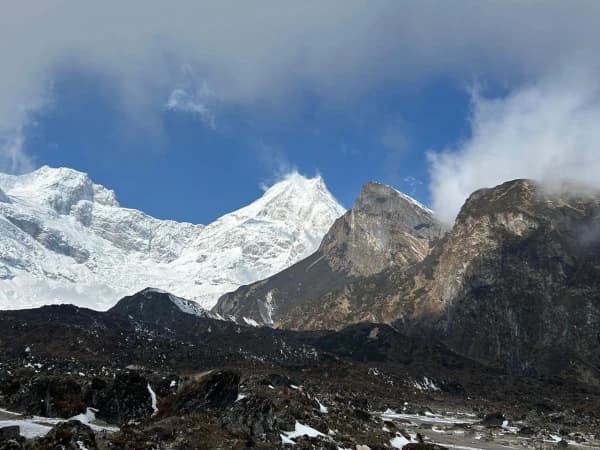
The prayer flags snap in the wind at 5,160 metres. You have been climbing since 3 AM, headlamp cutting through darkness, boots crunching on frozen scree, lungs burning in air that holds half the oxygen of sea level. Then the sun comes over the ridge and the snow turns gold. Himlung Himal, Cheo Himal and Kang Guru stand ahead, and the Larkya Glacier lies below. You are standing on Larkya La, one of the great high passes of the Himalayas, and it is much quieter than Thorong La. On the Annapurna Circuit, about 30,000 trekkers cross Thorong La every year. On the Manaslu Circuit, about 6,000 make this crossing. You are walking through a restricted area where you need a permit and a licensed guide, and the villages are small.
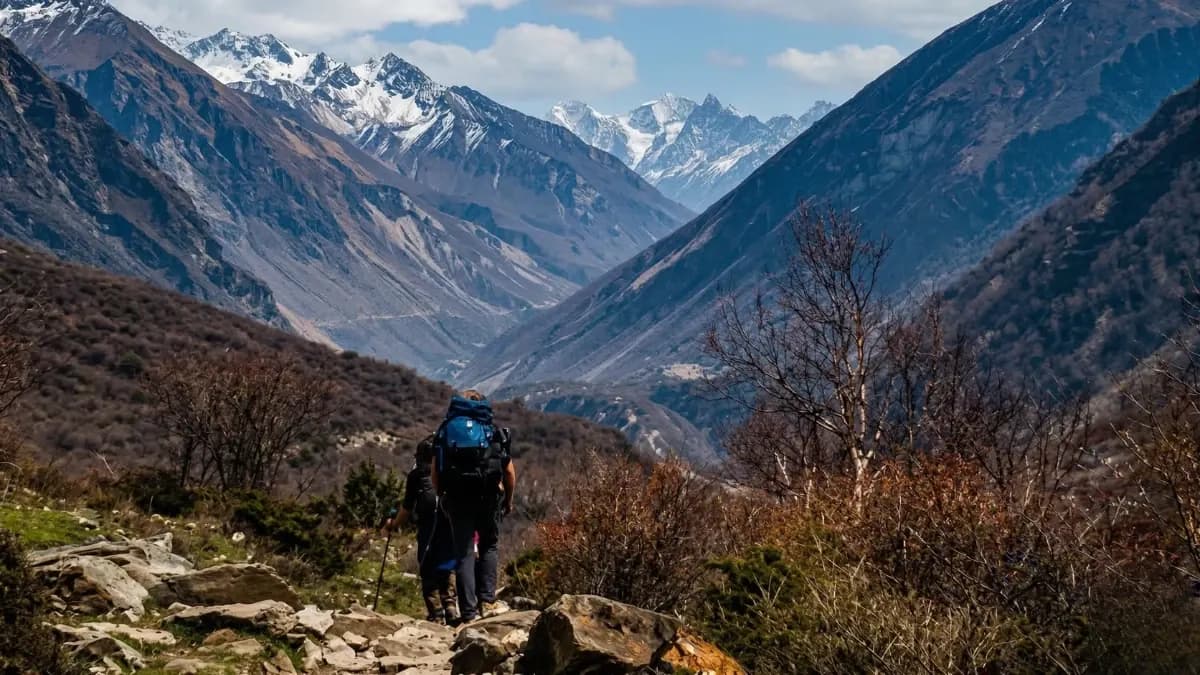
The 12-day Manaslu Circuit Trek follows the Budhi Gandaki river valley from Soti Khola through increasingly remote villages, past carved mani walls and Tibetan Buddhist monasteries, into the Nubri Valley where the culture is more Tibetan than Nepali, and over Larkya La Pass (5,160m / 16,929ft) before descending through Bhimtang to Dharapani on the Annapurna Circuit road. It suits those who want the grandeur of a high pass crossing without the crowds, designed by Shreejan Simkhada, whose family has been guiding people through these mountains across three generations.
What Makes This Trek Special
- Cross Larkya La (5,160m / 16,929ft), one of the highest trekking passes in Nepal, with panoramic views of Manaslu, Himlung Himal and the Annapurna range stretching south
- Walk through a restricted area where around 6,000 trekkers a year go, compared with about 30,000 on the neighbouring Annapurna Circuit
- Stay in Samdo and Shyala, Nubri Valley settlements where Tibetan Buddhist monks still perform morning pujas and villagers speak a Tibetan dialect
- Follow the Budhi Gandaki river from subtropical lowlands at 870 metres through temperate forests, alpine meadows, and glacial moraines to the foot of the world's eighth highest mountain
- Pass through Namrung, Jagat, and Lokpa, stone-walled villages where mani walls carved with Om Mani Padme Hum line every trail and prayer wheels spin in the river current
- Trek beneath the flanks of Manaslu (8,163m), close enough at Sama Gaon that you may hear avalanches from the hanging glaciers
- Complete the circuit in 12 days, including the Larkya La crossing
12-Day Manaslu Circuit Trek Overview
Twelve days, one restricted area and one glacial pass above 5,000 metres. The Manaslu Circuit goes right around the world's eighth highest peak, through villages that still feel traditional. While the Annapurna Circuit has been changed by road building and busy trails, while the Manaslu region sees far fewer trekkers. It needs a restricted-area permit and a licensed guide, and most of the route is on foot.
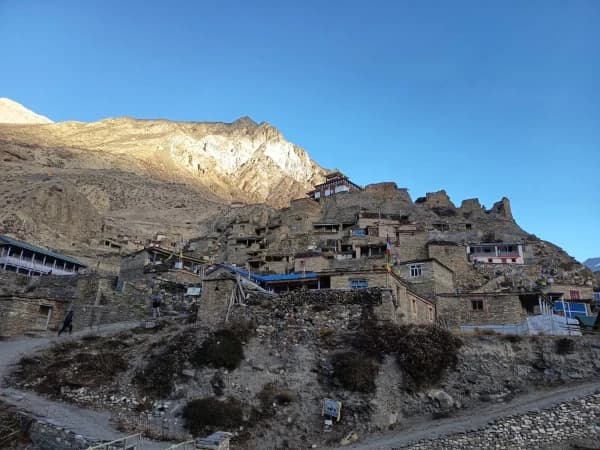
The route begins with a drive from Kathmandu to Machha Khola (870 m), or Soti Khola (700 m) when the road above it is closed, where the Budhi Gandaki river cuts through a subtropical gorge thick with banana trees and rice paddies. Over the first three days, you climb through Jagat and into the restricted area, watching the landscape shift from lowland jungle to pine and rhododendron forest. By Namrung (2,630m), you have crossed into the Nubri cultural zone, where flat-roofed stone houses, fluttering prayer flags and Tibetan Buddhist gompas replace the Hindu villages of the lower valley. The architecture, the food, the language, the religion, everything changes.
From Shyala and Sama Gaon, you spend time acclimatising beneath Manaslu's slopes before pushing to Samdo (3,875m), the last settlement before the pass. The Larkya La crossing day starts before dawn, a long push up frozen moraine and snow to the 5,160-metre col, then a steep descent through Bhimtang's alpine meadows. From Bhimtang, the trail drops rapidly to Dharapani, where you meet the Annapurna Circuit road and drive back to Kathmandu.
Acclimatisation is built into the itinerary: a full rest day at Sama Gaon, where you can hike to Birendra Tal (a glacial lake at the foot of Manaslu) or towards Manaslu Base Camp, then short days to Samdo and Dharamsala before the pass. By the time you tackle Larkya La, your body has had the time it needs to adjust.
Arrive in Kathmandu by 4 PM the day before
Please arrive in Kathmandu by 4 PM the day before your trek. This gives you time for a final gear check, a briefing with your guide, and a proper night of sleep before the early morning drive to Machha Khola (Soti Khola if the road is closed). The drive takes 8 to 10 hours, so you will want to be rested.
Online Trip Briefing
After you book, we schedule a video call to walk you through everything: what to pack, what the teahouses are really like on the Manaslu trail, how the restricted-area permit works, what the Larkya La crossing day involves, and anything else on your mind. No question is too small. This is also when you share your accommodation preferences for Kathmandu so we can match the right hotel to your budget.
Note to Hikers
The Manaslu Circuit is a restricted-area trek. You must travel with a licensed guide and hold a special restricted-area permit, which we arrange as part of your package. Since 22 March 2026 there is no minimum group size, so solo trekkers are welcome. Solo trekkers can book with us and go with a licensed guide. Treks are private, your group only, and you can also join a fixed departure if you would like company. Manaslu needs care this autumn. The Manaslu Conservation Area Project issued a notice on 21 October 2026 asking trekkers to go with extreme caution, and the Tsum Valley side is still under repair. Ask us for the latest before you book.
Kathmandu Accommodation
Your hotel in Kathmandu is not included in the trek package, and that is intentional. Kathmandu has everything from USD 10 guesthouses in Thamel to five-star hotels with rooftop pools. During the online briefing, tell us what you prefer and we will arrange it for you. Your trek package begins the moment you leave Kathmandu for the mountains.
Manaslu Circuit at a glance
| Duration | 12 days, Kathmandu to Kathmandu |
|---|---|
| Highest point | Larkya La pass, 5,160 m |
| Region | Manaslu restricted area, Gorkha |
| Difficulty | Very strenuous |
| How quiet | About 6,000 trekkers a year, against 30,000 on the Annapurna Circuit |
| Permits | Restricted-area permit set, all arranged by us and included |
| Best months | September to November and March to May |
| Group size | 1 to 20 people. Solo is welcome. Treks are private, and you can also join a fixed departure |
| Starts and ends | Kathmandu to Machha Khola by road (8 to 10 hours), and Dharapani back to Kathmandu by road. No flights |
| Walking per day | 5 to 8 hours, and 8 to 10 hours on the Larkya La day |
| From price | USD 1,005 Budget, USD 1,599 Standard, USD 2,665 Luxury (1 to 4 people) |
Best time to trek the Manaslu Circuit
| Season | Months | What it is like | Verdict |
|---|---|---|---|
| Autumn | September to November | Clearest and most stable; the main season, with Larkya La normally open | Best overall |
| Spring | March to May | Warm, rhododendron lower down, a little more haze | Great, second season |
| Winter | December to February | Very cold; Larkya La can be snowed shut and fewer teahouses stay open | Only with care and a flexible plan |
| Monsoon | June to August | Rain, leeches and landslip risk along the Budhi Gandaki | Avoid |
Month by month: when to go
| Month | Rain at Pokhara (mm) | On the trail, from our guides | Our view |
|---|---|---|---|
| January | 21.6 | Dry but very cold, snow on the high trail, and the pass is not a safe plan | We do not recommend it |
| February | 35.1 | Cold, and snow lingers | We do not recommend it |
| March | 63.7 | Late winter above 3,000 m early in the month, clearer and quiet by the end | Late March only |
| April | 141.7 | Spring peak with rhododendron, and the pass is usually clear of heavy snow | Yes |
| May | 354.7 | Good early in the month, a gamble late, with cloud and leeches in the lower valley | Early May yes, late May no |
| June | 648.2 | Monsoon | No |
| July | 941.0 | Monsoon, the wettest month, with landslides on the approach | No |
| August | 839.4 | Monsoon | No |
| September | 635.0 | Rains easing, a wet trail, slides still possible, and views improving late in the month | Late September only |
| October | 159.2 | Best month for the pass. It dries out each week and it is the busiest month | Best |
| November | 17.2 | Clear and dry but cold, and fresh snow on the pass is more likely from mid-month | Yes, the first half is best |
| December | 11.5 | Clear and cold, and the pass is difficult | We do not recommend it |
There is no weather station on the Manaslu Circuit itself, so the rain column is the Pokhara record (1991 to 2020), the nearest long one, and shows which months are wet. What I say about the trail comes from our guides, not from a measured number. The pass is the one day of twelve that fresh snow or high wind can change, so the month matters more here than on most treks. More in Manaslu Circuit best time, month by month.
Permits
The Manaslu Circuit is a restricted-area trek, so it needs the special permit and a licensed guide; the two-person minimum was scrapped on 22 March 2026. We arrange every permit below and include them in your trek price.
| Permit | Cost per person |
|---|---|
| Manaslu Restricted Area Permit (September to November) | USD 100 per week, then USD 15 per day |
| Manaslu Restricted Area Permit (December to August) | USD 75 per week, then USD 10 per day |
| Manaslu Conservation Area Permit (MCAP) | NPR 3,000 (SAARC NPR 1,000) |
| Annapurna Conservation Area Permit (ACAP) | NPR 3,000 (SAARC NPR 1,000) |
| TIMS card | NPR 2,000 (SAARC NPR 1,000) |
What the price covers, and what it does not
Manaslu is a restricted area. The Manaslu Restricted Area Permit costs USD 100 for the first week plus USD 15 a day from September to November, and USD 75 a week plus USD 10 a day from December to August. You also need the Manaslu Conservation Area Permit (NPR 3,000), the Annapurna Conservation Area Permit (NPR 3,000, because the route ends at Dharapani) and a TIMS card (NPR 2,000). The restricted-area permit does not replace TIMS. We arrange every one and include them in your price, and the permit application needs 48 hours in government working days. Our Manaslu permits guide goes through them one by one.
Not in the price: your international flights, your Nepal visa (USD 50 for 30 days on arrival), travel insurance bought at home that covers trekking to 5,500 m and helicopter evacuation, your Kathmandu hotel, tips for your team, and on Budget your meals (about NPR 2,000 a meal, so up to about USD 40 a day). There are no ATMs on the circuit, so carry the Nepali rupees you need for snacks, showers and charging.
A 10% deposit (about USD 80 on Budget) confirms your dates. You pay it by card through Himalayan Bank's secure gateway, and you pay the balance when you arrive in Kathmandu, in US dollars or euros, in cash or by card (card payments carry a 3.5% bank charge). If your plans change we move your trip to any date within a year, free, with 7 days' notice. The deposit itself is not refunded if you cancel. If we cannot run the trip ourselves, we refund what you have paid, less taxes, bank and card charges and any money already spent for you on permits and flights.
Book your 2027 trek early: a free Kathmandu night
Pay the 10% deposit between 21 October and 31 December 2026 and I will add one night in a Kathmandu hotel to your trek, free. It is a twin room with breakfast, in a Thamel-area 3-star hotel that we choose. You pick which night: the night you arrive, or the night after the trek.
Two more things come with it:
- Your 2027 price is held. If the government changes a permit or park fee, we pass on only that change, at cost.
- Free rescheduling, as always: tell us at least 72 hours before (7 days for restricted areas) and move to any date within one year.
Airport pickup, a sleeping bag and a down jacket are already part of every trek, so there is nothing to add there.
Limited to the first 30 bookings, counted by deposit received. Treks only, new bookings only. Message me on WhatsApp +977 9810351300 and I will send your deposit link. (Shreejan)
Terms
- Applies to new treks booked for 2027 dates, once the 10% deposit is received between 21 October and 31 December 2026. Not Kailash or Tibet, and not tours (tours already include Kathmandu accommodation).
- Limited to the first 30 bookings, counted by deposit received, not by enquiry.
- One free Kathmandu hotel night per room (one twin room with breakfast, in a Thamel-area 3-star hotel that we choose), on the night before your trek or the night after it, your choice. Extra nights, meals and upgrades are charged separately.
- Not combinable with any other offer. Airport pickup, sleeping bag, down jacket and duffel are already included and are not extra gifts.
- Price hold: the 2027 website price stays. Government permit or park fee changes are passed on at cost.
- The 10% deposit is non-refundable. Free rescheduling at least 72 hours before departure (7 days for restricted areas), to any date within one year. If we cannot run the trip, we refund what you paid less taxes, bank or card charges and money already spent.
What a trek price often leaves out
Prices checked 25 Oct 2026, per person, 2-4 people: Budget 1,005 / Standard 1,599 / Luxury 2,665.
| Line | Often extra elsewhere | With us (tier) |
|---|---|---|
| 13% VAT + 10% service | Listed as extra on some listings (about +24%) | Included in every tier |
| Porter | Extra or optional, about USD 22 a day on one listing | Budget: none. Standard: 1 per 2 trekkers (10 kg each). Luxury: 1 each (up to 20 kg). Extra porter USD 25 a day + 13% VAT + 3.5% bank charge |
| Meals on the trek | Often not in the price; about NPR 2,000 (about USD 13) a meal with tea or coffee, so roughly USD 40 a day for three meals | Budget: not included, you pay in the teahouse. Standard and Luxury: all meals included |
| Permits and TIMS card | Usually included, so check the small print | Included, all tiers: Manaslu restricted-area permit, Manaslu and Annapurna conservation permits, TIMS |
| Airport pickup | Sometimes extra | Included, all tiers |
| Kathmandu hotel | Included in about half of packages, which then run 14-16 days | Not included in any tier. I quote it separately, to your hotel standard |
Manaslu is a restricted area, so a licensed guide is required and the permits add up. They are all inside our price, with the taxes and your guide. Standard and Luxury include all trail meals, and the Kathmandu hotel is quoted separately. You pay a 10% deposit, and if your plans change we reschedule free with 7 days' notice, to any date within a year.
We are a family company since 2016, with three generations of family guides. We are a four-time TripAdvisor Travellers' Choice winner (2019, 2020, 2023, 2024), rated 4.9 from 208 reviews (16 Oct 2026). Our guides are licensed, and we never use elephants for rides.
All taxes included: 13% VAT and our 10% service charge are already in the price you see. A 3.5% card charge applies only if you pay the balance by card; cash in Kathmandu has none.
Getting there
There are no flights on this trek. Day 1 is a long drive from Kathmandu to Machha Khola (870 m), usually 8 to 10 hours on a rough road, so arrive in Kathmandu by 4 pm the day before and rest. You finish at Dharapani and drive back via Besisahar to Kathmandu. Because the walk ends on the Annapurna side, keep a spare day or two before your flight home in case the road is slow. Read the Manaslu region guide for the villages in between.
Safety and altitude
Altitude is the main risk, above 4,000 m especially. The plan climbs from 870 m to Namrung (2,630 m), Shyala (3,500 m) and Samagaun (3,530 m), where you rest a full day, then Samdo (3,875 m) and Dharamsala (4,480 m) before the pass at 5,160 m. You then drop to Bhimtang (3,720 m). Your guide carries a pulse oximeter, checks you daily and knows when to slow down or add a stop. The Larkya La day is 8 to 10 hours and starts in the dark, and your guide decides on the morning whether it is safe, because snow or wind can change it. There is narrow trail cut into cliffs between Jagat and Deng. Your insurance must cover trekking to 5,500 m and helicopter evacuation. See how difficult the Manaslu Circuit is and the Larkya La guide.
Packing basics
Warm layers and a down jacket, a windproof and waterproof shell, gloves, a warm hat, boots you have already walked in, poles, sunglasses and a head torch for the pre-dawn pass. Lodges above Sama Gaon are basic and hot showers may not be available, so bring a liner or a warm sleeping bag; if you do not own one, tell us at your briefing and we will lend you a sleeping bag and down jacket. Carry your cash in Nepali rupees. The Manaslu packing list has the full list.
Budget, Standard or Luxury: what actually changes
| Budget | Standard | Luxury | |
|---|---|---|---|
| Porter | None. You carry your own bag | 1 porter for every 2 trekkers | 1 dedicated porter for every trekker |
| Meals on the trek | Not included, you pay at the teahouse | All meals | All meals, fruit and nuts, and unlimited soft drinks |
| Rooms | Shared | Private | Private deluxe with ensuite bathroom |
| Transport | Local vehicle to Machha Khola and back | Shared tourist vehicle | Private vehicle |
If you are going alone, Luxury still gives you your own dedicated porter. On Standard there is no porter, because porters are shared one between two trekkers, so your guide carries up to 10 kg of your bag instead. Budget never has a porter. You can add a porter of your own on any tier for USD 25 per day, plus 13% VAT and the 3.5% bank charge on top. Since 22 March 2026 a single trekker can hold the restricted-area permit, so you can book alone with a licensed guide. You cannot walk apart from your guide in the restricted area, because the guide is named on the permit.
Kathmandu hotel nights are not included in any trek tier, so tell us your budget at the online briefing and we will book them for you. We name your guide once you have booked.
Trekking as a group?
Bring your own group — friends, family, a club, a university society, your workplace, or a cause you are raising money for — and any of the three comfort levels can run as a private group on your own dates. Private or group, the price per person is the same; we never merge separate private bookings. The more of you there are, the less each person pays:
| Group size | Budget (per person) | Standard (per person) | Luxury (per person) |
|---|---|---|---|
| 1 person | US$1,595 | US$2,205 | US$4,015 |
| 2-4 people | US$1,005 | US$1,599 | US$2,665 |
| 5-8 people | US$935 | US$1,549 | US$2,565 |
| 9-12 people | US$885 | US$1,499 | US$2,350 |
| 13-20 people | US$845 | US$1,449 | US$2,240 |
The organiser treks free. Get fourteen or more paying trekkers together and whoever organised the group joins the trek free. The one thing the organiser still pays is their own flights and permits, since those are fixed costs we pay out for every person and cannot absorb, and we cover the rest. Your departure is guaranteed on your own dates — from a solo traveller up to a group of twenty, and we never merge separate private bookings.
Planning a group? Message me on WhatsApp with the trek, roughly when, and how many of you, and I will send you a price and a plan.
Compare Our Three Packages
| Feature | Budget | Standard | Luxury |
|---|---|---|---|
| Price from | USD $1,005 | USD $1,599 | USD $2,665 |
| Meals | Not included (order and pay at teahouses) | 3 meals daily + tea, fruits and 2L water | All meals + all drinks (except alcohol) |
| Room | Shared teahouse room | Private twin with attached bathroom | Private deluxe with bed heater |
| Porter | Not included | 1 porter per 2 trekkers | 1 porter per trekker (carry nothing) |
| Guide | 1 guide per group (assistant at 8+) | 1 guide per 6 trekkers (assistant at 7+) | 1 guide per 2 trekkers, plus an assistant guide for every 2 more |
| Transport | Local vehicle to Machha Khola | Shared tourist vehicle | Luxury private vehicle |
| SIM & Data | SIM card only | SIM with limited data | SIM with unlimited data |
| Best for | Experienced backpackers comfortable with basic lodges | Comfort trekkers who want full support | Premium experience seekers |
Himalayas for Every Budget. Same guides, same safety, three comfort levels. Every tier includes all permits (Manaslu Restricted Area Permit, Annapurna Conservation Area Permit, TIMS), a Nepal government well-trained guide, airport transfers and 24/7 emergency support. Note: teahouse accommodation on the Manaslu Circuit is more basic than Everest or Annapurna routes. At higher elevations, all tiers share the best available lodge, and hot showers may not be available above Sama Gaon.
Difficulty: Very Strenuous
The Manaslu Circuit is a serious mountain trek. You will walk 5 to 8 hours per day over 12 days, gaining altitude steadily from 870 metres at Machha Khola to 5,160 metres at Larkya La. The pass crossing day is the hardest: 8 to 10 hours of walking that starts in freezing darkness, climbs over snow and moraine, and descends steeply through loose rock to Bhimtang. The trail between Jagat and Deng includes narrow sections carved into cliff faces above the river. Altitude sickness is a genuine risk above 4,000 metres. Our guides carry pulse oximeters, monitor your condition daily, and know when to slow the pace or add an extra acclimatisation stop. Previous high-altitude trekking experience is recommended but not mandatory if you are fit, well-prepared and willing to listen to your guide. Travel insurance that covers trekking to 5,500 m and helicopter evacuation is mandatory.
The Larkya La crossing that builds a classroom
The Manaslu Circuit crosses the Larkya La at 5,160 metres, one of the highest non-technical passes in Nepal, on a restricted-area permit that requires a licensed guide. The minimum of two trekkers was scrapped on 22 March 2026. The pricing reflects all of that. A fixed share of every twelve-day Manaslu booking goes to the Nagarjun Learning Center, the village school we have run in Saldum since 2019. Around seventy children attend on free places, and the school provides two warm meals a day. It is a registered Nepalese charity and verified and listed on the UN Partner Portal.