

In short: the Mera Peak climb suits fit trekkers with some altitude experience who want a first 6,000 m summit and a quiet approach through the Hinku valley. It runs 14 days from Kathmandu, tops out at 6,476 m and is graded technically challenging. Prices start from USD 3,800 per person on Budget, USD 5,110 on Standard and USD 9,999 on Luxury, with permits, all technical gear, emergency oxygen and the USD 500 garbage fee included.
Mera Peak Trek Highlights
- Stand on the summit of Mera Peak at 6,476 metres (21,247ft), Nepal's highest trekking peak, with five of the world's fourteen 8,000-metre giants in view: Everest, Lhotse, Makalu, Cho Oyu and Kangchenjunga
- Approach via the Hinku Valley, the quieter route that bypasses the main Everest crowds and gives you fresh trail every day
- Full climbing skills training day at Khare base camp before the summit push: crampon technique, fixed-rope ascent, ice-axe arrest, harness work — taught one-to-one by your climbing guide
- All technical gear included in every tier: double mountaineering boots, crampons, harness, ice axe, jumar, descender and helmet
- Two acclimatisation days at Khare (5,045m) before high camp, with two summit push windows scheduled if weather closes the first
- 14-day schedule built around the slow-trekker rule: better odds of summit than 12-day expeditions that cut acclimatisation to save a day
Why I built this trek the way I did
I am Shreejan, the founder of The Everest Holiday. Mera Peak is the trek I send experienced trekkers to when they want their first real 6,000-metre summit. If you have done Everest Base Camp or Annapurna Base Camp and you are ready for the next step, this is it. If you have not done either, please tell me — I will recommend a different package first. The Mera summit reward is huge, but only if your body has been to altitude before.
The route matters. Most operators run Mera by flying into Lukla and crossing the Zatrwa La pass on day two. That gains 4,600 metres in 48 hours, which is the single biggest reason for failed summits on Mera. I built ours the other way: gradual gain through the Hinku Valley, arriving at Khare with a body that has already done the altitude work. You climb the summit from a position of strength, not from a position of catching up.
The training day at Khare is non-negotiable in our package. You spend a full day on the glacier with your climbing guide before summit night. Crampons, ice axe, rope work, descent technique. If you have not done this before, the first time you try should not be at 2am at 6,000 metres in the dark. We teach you in daylight, on terrain that lets you make mistakes safely. By the time summit night arrives, the technique is in your body, not in your head.
Every booking on this trip helps us pay the teacher's salary at our Nagarjun Learning Center in Saldum, where 70 children get free education. The salary is currently funded out of my own pocket. Your trek is what makes that sustainable.
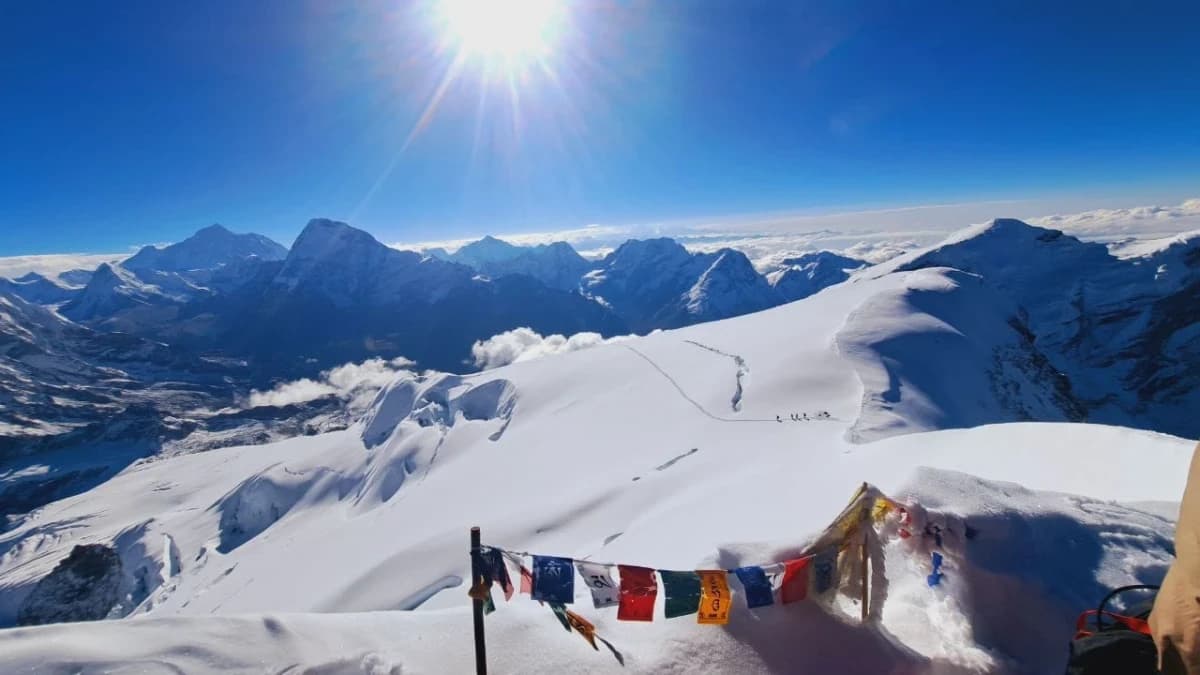
At 6,476 metres (21,247ft), the summit of Mera Peak is a world stripped to its essentials: ice, wind, sky, and silence. You arrive in darkness, having climbed since midnight through steep snow and narrow ridges, your crampons biting into frozen slopes while the headlamp picks out the rope ahead. Then the horizon opens. Five of the world's fourteen 8,000-metre peaks materialise out of the pre-dawn blue: Everest and Lhotse to the north, Makalu to the east, Cho Oyu to the northwest, and Kangchenjunga shimmering on the far horizon. The sun hits the summit ridge, and the snow turns gold. You are standing on Nepal's highest trekking peak, and the view from here is one of the finest on earth.
Fourteen days from Kathmandu to the summit and back. The route bypasses the main Everest trail entirely, flying into Lukla before turning south into the remote Hinku Valley, a wild, quiet corridor of rhododendron forest, glacial moraines, and high pastures where yaks graze beneath towering walls of rock and ice. You won't see the crowds of the classic Khumbu trail here. Instead, you'll walk through villages where Sherpa families dry cheese on stone rooftops, sleep in teahouses warmed by wood-burning stoves, eat dal bhat cooked by the families who run them, and cross high passes draped in prayer flags. All climbing gear is provided by The Everest Holiday. Your climbing guides hold mountaineering degrees and have stood on this summit dozens of times. No prior climbing experience is needed.
What Makes This Climb Special
- Summit Nepal's highest trekking peak at 6,476m (21,247ft), with panoramic views of Everest, Lhotse, Makalu, Cho Oyu, and Kangchenjunga from the top
- No prior climbing experience required. Your licensed climbing guide teaches you everything you need during a full training day at Khare before the summit push
- All climbing gear provided by The Everest Holiday: ropes, harness, ice axe, crampons, helmet, and all technical equipment. You do not need to buy or bring any climbing-specific gear
- Trek through the remote Hinku and Honku valleys, far from the crowded main Everest route, where the mountains feel truly wild
- Full acclimatisation day at Khare (5,045m) with technical climbing training, giving your body time and your mind confidence before summit day
- Climb with licensed mountaineering guides who hold university degrees in mountaineering. Our team includes our climbing Sherpa and our expedition-qualified guides, all with deep Mera Peak experience
- Three tiers from USD 3,800 to USD 9,999. Same summit, same climbing team, same gear, three comfort levels. Budget, Standard, or Luxury
- Every booking supports 70 children's education at the Nagarjun Learning Center, our family-founded charity in rural Nepal
- Small groups of 1 to 20 people. Your expedition is always private, never merged with strangers
- Fly into Lukla on one of the world's most dramatic mountain flights, then walk into a valley most trekkers never see
- Best climbing season: February to June and September to November, with autumn offering the clearest summit views
14-Day Mera Peak Climbing Overview
Fourteen days divides into three clear phases: the approach trek through the Hinku Valley, the acclimatisation and training at base camp, and the summit push. The first phase begins with the flight to Lukla (2,860m / 9,383ft), then heads south on foot through Paiya, Pangkoma, and Ramailo Danda. This is not the well-worn trail to Namche Bazaar. The Hinku Valley route is quieter, greener, and wilder, dropping through dense rhododendron forest before climbing gradually through high alpine terrain towards Chetrakhola and Kothe (3,600m / 11,811ft).
From Kothe, the scenery transforms. The valley narrows, the vegetation thins, and the glacial moraines begin. You trek through Thaknak (4,350m / 14,272ft) to Khare (5,045m / 16,552ft), which serves as Mera Peak Base Camp. Here you spend a full acclimatisation day, and your climbing guide runs a thorough training session: crampon technique, ice axe arrest, rope work, and movement on steep snow. By the time you leave Khare for High Camp (5,780m / 18,963ft), you'll know exactly what to expect on summit day.
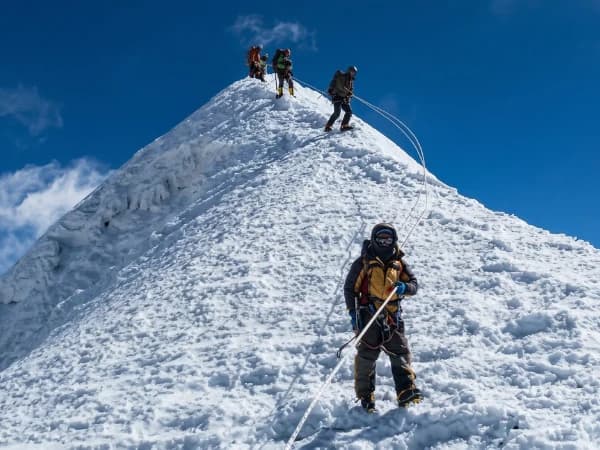
Summit day begins around midnight. You climb by headlamp through steep snow slopes and narrow ice ridges, roped to your climbing guide, using the skills you practiced at Khare. The ascent takes 10 to 12 hours round trip. At 6,476 metres, the summit offers what many mountaineers consider the single greatest panorama in the Himalayas: five 8,000-metre peaks visible in a single sweep. After the summit, you descend through Khare and Kothe and back to Lukla for the flight to Kathmandu. You return not as a trekker but as a mountaineer who stood on a Himalayan summit.
Before You Arrive
Please arrive in Kathmandu by 4 PM the day before your expedition begins. This gives you time for a final gear check, a climbing briefing with your guide, and a good night's rest before the early morning flight to Lukla.
Your Online Briefing
After you book, we schedule a video call where we walk you through every detail: what to pack for both trekking and climbing, what the summit day is really like, how to prepare physically, what fitness level you need, and anything else on your mind. No question is too small. This is also when we learn about you. Our expedition itinerary does not include your hotel in Kathmandu. During the briefing, share your preferences and budget, and we'll arrange accommodation that fits, whether you want a simple guesthouse in Thamel or a five-star hotel.
Lukla Flight — What You Need to Know
The flight to Lukla is one of the most dramatic in the world, a short ride between mountain peaks that ends on a runway carved into a hillside at 2,860m (9,383ft). It is weather-dependent, and flights can be delayed by fog, cloud, or wind, sometimes for a full day. This is normal in the Himalayas and nothing to worry about, but it is something to plan for. We strongly recommend keeping two buffer days at the end of your trip before your international flight home. Make sure your Nepal visa covers the extra days. During peak season (roughly 15 March to 15 May and 25 September to 30 November), flights may operate from Manthali Airport instead of Kathmandu. All ground transport is included in every package.
Your Climb, Your Way
Every expedition we run is private. Your group only, no strangers added. Whether you choose Budget, Standard, or Luxury, the mountain is yours and your companions' alone. This is not a conveyor belt. This is your personal Himalayan summit.
Your hotel in Kathmandu is not included in the expedition package, and that is intentional. Kathmandu has everything from USD 10 guesthouses in Thamel to five-star hotels with rooftop views. During the online briefing, tell us what you prefer, and we'll arrange it for you. Your expedition package begins the moment you leave Kathmandu for the mountains.
Luxury-tier clients fly by helicopter from Kathmandu to Lukla and back, skipping the weather-dependent fixed-wing flights entirely. Standard and Budget clients fly by fixed-wing aircraft, with Standard receiving shared tourist vehicle transfer to and from the airport and Budget using local or shared transport.
Climbing Gear and Team
All climbing gear is provided by The Everest Holiday: ropes, harness, ice axe, crampons, helmet, and all technical equipment needed for the summit push. You do not need to bring or buy any climbing-specific gear. You'll need your own trekking clothing and layers (available to buy or rent in Kathmandu), but the mountain-specific equipment is on us.
Your climbing guides are licensed mountaineering professionals with university degrees in mountaineering. Our team includes our climbing Sherpa and our expedition-qualified guides, all with extensive Mera Peak experience. They grew up in these mountains, they know the routes intimately, and they will teach you everything you need to know during the training day at Khare.
Difficulty: Technically Challenging
Mera Peak is classified as a trekking peak, but make no mistake: this is a genuine mountaineering expedition. The trekking portion involves 5 to 7 hours of walking per day over mountain trails, through forest, across moraines, and up steep valley sides. The climbing portion adds technical mountaineering: crampon and ice axe work on steep snow slopes, roped travel on glaciated terrain, and an exposed summit ridge at 6,476m. There is no technical rock climbing. The challenge is altitude, endurance, cold, and the sustained physical effort of a midnight summit push lasting 10 to 12 hours. You should be in excellent cardiovascular fitness and comfortable with long days of sustained effort. Previous trekking experience is strongly recommended. Previous climbing experience is helpful but not essential.
Mera Peak at a glance
| Duration | 14 days, Kathmandu to Kathmandu |
|---|---|
| Summit | Mera Peak, 6,476 m, Nepal's highest trekking peak |
| Region | The Hinku valley, Makalu-Barun National Park, south of Lukla and away from the Base Camp crowds |
| Difficulty | Technically challenging; a real mountaineering climb at serious high altitude |
| Fly in and out | Lukla, 2,860 m |
| Guides and gear | our IFMGA/NNMGA-certified lead guides; all climbing gear provided free |
| Permits | NMA climbing permit and Makalu-Barun National Park |
| Best months | April to May and October to November |
| Group size | 1 to 20 people. Solo is welcome, and every climb is private |
| Starts and ends | Kathmandu, with the flight to Lukla and back |
| Summit day | 10 to 12 hours round trip from Mera High Camp (5,780 m), roped to your climbing guide |
| Royalty | NMA royalty USD 350 in spring and USD 175 in autumn, winter and summer, included in your price |
| From price | USD 3,800 Budget, USD 5,110 Standard, USD 9,999 Luxury (1 to 4 people) |
Best time to climb Mera Peak
| Season | Months | What it is like | Verdict |
|---|---|---|---|
| Spring | March to May | The main climbing season; warmer, stable snow on the summit slope, and the busy Base Camp window | Best overall |
| Autumn | October to November | Clear and cold, the second climbing season, and the NMA royalty is lower than spring | Great, second season |
| Winter | December to February | Very cold with high wind on the summit; only for experienced, well-equipped teams | Only with care |
| Monsoon | June to mid-September | Snow, cloud and avalanche risk on the approach | Avoid |
Month by month: when to go
| Month | On the climb | NMA royalty per climber | Our view |
|---|---|---|---|
| January | Very cold, with high wind on the summit. Only for experienced, well-equipped teams. | USD 175 | Only with care |
| February | Very cold, with high wind on the summit. | USD 175 | Only with care |
| March | The spring climbing season begins, with warmer days. Lukla rain 45.3 mm. | USD 350 | Yes |
| April | The main climbing season, warmer with stable snow on the summit slope. Lukla rain 58.7 mm. | USD 350 | Best |
| May | Still the main season, but rain is building at Lukla (127.6 mm). | USD 350 | Best, early May |
| June | Monsoon. Snow, cloud and avalanche risk on the approach. Lukla rain 324.8 mm. | USD 175 | Avoid |
| July | Monsoon. Lukla rain 529.8 mm. | USD 175 | Avoid |
| August | Monsoon, the wettest month. Lukla rain 641.8 mm. | USD 175 | Avoid |
| September | The monsoon is clearing, but Lukla still gets 419.0 mm and the approach is wet. | USD 175 | Avoid until late September |
| October | Clear and cold. The second climbing season, and the royalty is lower than in spring. Lukla rain 102.9 mm. | USD 175 | Best |
| November | Clear and cold, with almost no rain at Lukla (6.2 mm). Colder nights on the glacier. | USD 175 | Yes |
| December | Dry and cold. Winter climbing is for experienced, well-equipped teams. | USD 175 | Only with care |
The royalty is the Nepal Mountaineering Association's published rate (USD 350 spring, USD 175 for autumn, winter and summer), and we pay it for you. Lukla rain is the Department of Hydrology and Meteorology record, 1991 to 2020. The climbing notes are our own, from the Hinku valley. See Nepal peak climbing permit fees 2026: NMA rates and Mera Peak cost, permits and gear.
Permits
We arrange the NMA climbing permit, all park fees and your TIMS card, and include them in your climb price.
| Permit | Cost per climber |
|---|---|
| NMA climbing permit (Group B trekking peak) | US$350 in spring, US$175 in autumn, US$175 in winter |
| Makalu-Barun National Park entry | NPR 3,000 (NPR 1,500 for SAARC) |
| Local rural-municipality fee | Small, varies, collected on the trail |
| TIMS card | NPR 2,000 (NPR 1,000 for SAARC) |
What the price covers, and what it does not
You need the NMA climbing permit (royalty USD 350 in spring, USD 175 in autumn, winter and summer), park entry fees, local rural-municipality fees and a TIMS card (NPR 2,000). The USD 500 garbage fee for the climb is included in your price on every tier, as are emergency oxygen and all technical gear. We arrange everything, and permits need 48 hours in government working days.
Not in the price: your international flights, your Nepal visa (USD 50 for 30 days on arrival), climbing insurance bought at home, your Kathmandu hotel, tips for your team (the climbing Sherpa deserves a proper one), and on Budget your meals on the trek. Meals on the climbing days above base camp are included on every tier.
A 10% deposit (about USD 350 on Budget) confirms your dates. You pay it by card through Himalayan Bank's secure gateway, and you pay the balance when you arrive in Kathmandu, in US dollars or euros, in cash or by card (card payments carry a 3.5% bank charge). If your plans change we move your trip to any date within a year, free, with 72 hours' notice. The deposit itself is not refunded if you cancel. If we cannot run the trip ourselves, we refund what you have paid, less taxes, bank and card charges and any money already spent for you on permits and flights.
Getting there
You fly from Kathmandu to Lukla (2,860 m), about 40 minutes, then walk south into the Hinku valley, away from the Everest crowds. In the busy seasons, roughly 15 March to 15 May and 25 September to 30 November, flights may leave from Manthali (Ramechhap) instead, with a midnight pickup and a 4 to 5 hour drive. The flight depends on weather, so keep two spare days before your flight home and make sure your visa covers them. On Luxury you fly by helicopter between Kathmandu and Lukla both ways. See the Manthali airport guide.
Safety and altitude
Altitude and cold are the real risks. The route climbs gradually from Lukla through Paiya (2,730 m), Kothe (3,600 m) and Thaknak (4,350 m) to Khare (5,045 m), where you take a full day to adjust and to train. Then Mera High Camp (5,780 m), and a midnight summit push to 6,476 m that takes 10 to 12 hours round trip, back to Khare. Your guide goes with you to base camp, and a climbing Sherpa climbs with you to the summit. We carry a pulse oximeter, first aid and emergency oxygen. The climbing guide's decision on summit night is final. Your insurance must cover helicopter evacuation to 6,476 m with mountaineering and climbing included, and you should buy it at home. See can a beginner climb Mera Peak and Khare, the gateway to Mera Peak.
Packing basics
All technical gear is ours and included on every tier: double mountaineering boots, crampons, harness, ice axe, jumar, descender and helmet. You bring your own warm layers, a down jacket, a good sleeping bag, gloves and liner gloves, a warm hat, goggles and sunglasses, a head torch with spare batteries, and boots for the trek. If you do not own a sleeping bag or down jacket, tell us at your online briefing and we will lend you ones. We send the full list when you book.
Budget, Standard or Luxury: what actually changes
| Budget | Standard | Luxury | |
|---|---|---|---|
| Porter | None. You carry your own bag | 1 porter for every 2 trekkers | 1 dedicated porter for every trekker |
| Meals on the trek | Not included on the trek, but meals on the climbing days above base camp are included | All meals | All meals, fruit and nuts, and unlimited soft drinks |
| Rooms | Shared | Private | Private deluxe with ensuite bathroom |
| Transport | Local transfers and the flight to Lukla | Shared tourist vehicle and the flight to Lukla | Private vehicle and a round-trip helicopter to Lukla |
If you are going alone, Luxury still gives you your own dedicated porter. On Standard there is no porter, because porters are shared one between two trekkers, so your guide carries up to 10 kg of your bag instead. Budget never has a porter. You can add a porter of your own on any tier for USD 25 per day, plus 13% VAT and the 3.5% bank charge on top. On a climb your guide goes to base camp and a climbing Sherpa goes from base camp to the summit; you never climb alone.
Kathmandu hotel nights are not included in any trek tier, so tell us your budget at the online briefing and we will book them for you. We name your guide once you have booked.
Climbing as a group?
Bring your own group — friends, family, a club, a university society, your workplace, or a cause you are raising money for — and any of the three comfort levels can run as a private group on your own dates. Private or group, the price per person is the same; we never put strangers in your group. The more of you there are, the less each person pays:
| Group size | Budget (per person) | Standard (per person) | Luxury (per person) |
|---|---|---|---|
| 1-4 people | US$3,499 | US$4,999 | US$9,999 |
| 5-8 people | US$3,299 | US$4,799 | US$9,499 |
| 9-12 people | US$3,199 | US$4,499 | US$8,999 |
| 13-20 people | US$2,999 | US$3,999 | US$8,599 |
The organiser travels free. Get fourteen or more paying people together and whoever organised the group joins the trip free. The one thing the organiser still pays is their own flights and permits, since those are fixed costs we pay out for every person and cannot absorb, and we cover the rest. Your departure is guaranteed on your own dates — from a solo traveller up to a group of twenty, and we never merge you into another trip.
Planning a group? Message me on WhatsApp with the trip, roughly when, and how many of you, and I will send you a price and a plan.
Compare Our Three Packages
| Budget | Standard | Luxury | |
|---|---|---|---|
| Price from | USD 3,499 | USD 4,999 | USD 9,999 |
| Meals | Choose your own (approx. USD 15-25/day) | 3 meals + tea + fruits + 2L water daily | All meals + all drinks anytime (except alcohol) |
| Room | Shared teahouse | Private twin w/ bathroom | Private deluxe w/ bed heater |
| Porter | Not included | 1 per 2 trekkers | 1 per trekker (carry nothing) |
| Guide | 1 guide, assistant at 8+ | 1 guide per 6; assistant at 7+ | 1 guide per 2 trekkers, plus an assistant guide for every 2 more |
| Climbing guide | Included—licensed, with a mountaineering degree | Included—licensed, with a mountaineering degree | Included—licensed, with a mountaineering degree |
| Climbing gear | All provided by TEH | All provided by TEH | All provided by TEH (premium quality) |
| High Camp | Mountaineering tent | Mountaineering tent | Mountaineering tent |
| Transport | Local/shared vehicle + flight to Lukla | Shared tourist vehicle + flight to Lukla | Helicopter Kathmandu–Lukla both ways |
| SIM data | SIM only | Limited data | Unlimited data |
| Best for | Ambitious climbers on a budget | First-time summiteers want comfort | Premium climbing experience |
Himalayas for Every Budget—same climbing guides, same gear, same summit, three comfort levels.
Your Climb, Our Family
Our family brings three generations of guiding in the Himalayas. Shreejan's grandfather, Hari Lal Simkhada, helped international travellers experience the Himalayas for the first time, arranging logistics, finding routes, and building trust with people who had come halfway around the world on a dream. His son Ganesh went on to hold senior positions in Nepal's tourism and mountaineering institutions. And now, Shreejan, the third generation, designs every itinerary you see on this website.
This is not a company that someone started in a boardroom. It was started on a mountain trail three generations ago.
Shreejan hand-picks the guide and climbing team for your group from our roster of licensed mountaineering professionals, people who grew up in these mountains, who have stood on Himalayan summits dozens of times, and who know exactly how to guide you safely to the top of Mera Peak and back. He briefs your team personally before your expedition begins, because your safety and experience are not something we delegate to a system.
Have a question right now? WhatsApp Shreejan directly: +977 9810351300. No sales team. No chatbot. The person who designed your climb answers personally.
Why Climbers Trust Us
- Over 300 reviews on TripAdvisor, Google and Trustpilot — 4.9 out of 5 on TripAdvisor
- Google reviews — 4.9 out of 5 stars
- TAAN Member — #1586, Government Reg: 147653/072/073
- Secure 10% Deposit — pay just USD 350 to reserve your Mera Peak expedition, via Himalayan Bank
- Himalayas for Every Budget—from USD 3,800 including all climbing gear, guides, and permits
- Three Generations—three generations of family guides in the Himalayas
- Mountaineering-Degree Guides—your climbing team holds university qualifications in mountaineering, not just trekking certifications
Solo Climbers Welcome
You do not need a climbing partner. Many of our Mera Peak clients book alone, solo climbers looking for their first summit above 6,000 metres. Your climbing guide and trekking guide are with you every step, and if you want company on the expedition, tell us, and we'll list your dates as a fixed departure so others can join. Nepal's mandatory guide rule is already covered by our package, so there's nothing extra to arrange.
Our groups are small, 1 to 20 people, because the Himalayas deserve more than a crowd. You book your expedition, and it's yours. We will never add strangers to your group without your permission. Whether you're a solo climber or bringing a group, choosing the right company matters more at 6,476m than anywhere else. Bring Nepali rupees for personal spending along the trail, and budget for tipping your guide and porters at the end.
Difficulty: What Mera Peak Is Really Like
Mera Peak sits at 6,476 metres, making it Nepal's highest trekking peak. The classification "trekking peak" refers to the permit category, not the difficulty. This is a real mountaineering expedition that demands respect.
The approach trek through the Hinku Valley involves 5 to 7 hours of walking per day over mountain trails, through forest, across river crossings, and up steep hillsides. The terrain is rougher and less developed than the classic Everest trail. Teahouses in this region are simpler, the trails quieter, and the sense of remoteness real.
Summit day is the crux. You leave High Camp (5,780m) around midnight, climbing by headlamp through steep snow slopes and narrow ice ridges. The round trip takes 10 to 12 hours. You'll use crampons and an ice axe and be roped to your climbing guide throughout. There is no technical rock climbing, but the combination of altitude, cold, darkness, and sustained effort on steep snow and ice makes this a serious undertaking. Altitude sickness is a real concern at this elevation, and our guides carry pulse oximeters and altitude medication throughout.
You need excellent cardiovascular fitness. We recommend at least three months of targeted training before your expedition, and our eight-week Mera Peak training plan sets out week by week what that actually looks like: running, hiking with a loaded pack, stair climbing, and core strength work. The full acclimatisation day at Khare, combined with the gradual altitude gain through the Hinku Valley, gives your body the best possible preparation. Your climbing guide teaches crampon and ice axe technique during the training session at Khare, so you don't need prior experience with this equipment.
Travel insurance with helicopter evacuation cover to the summit altitude of Mera Peak (6,476 m), with mountaineering and climbing included, is mandatory for this expedition. We require confirmation before departure.
The climb that funds a school year
Mera Peak is the highest trekking peak in Nepal at 6,476 metres. It is also the most physically demanding expedition we sell on this site. A larger price means a larger contribution to the Nagarjun Learning Center, the school my mother helps run in the village of Saldum, central Nepal. About seventy children study there for free, and the school provides two daily meals. It is registered as a Nepalese charity and is listed on the UN Partner Portal. A single Mera Peak booking covers more than a full year of one child’s education.