

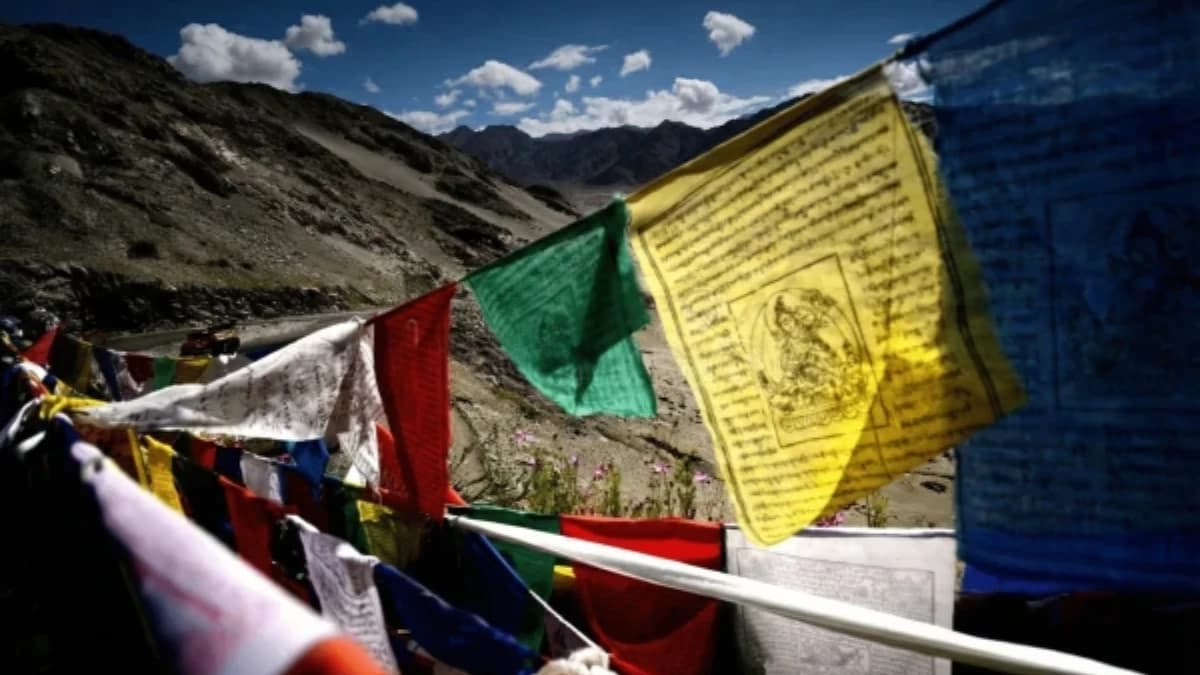
Short answer: Prayer flags carry printed mantras that the wind is said to spread, mani walls are lines of carved prayer stones that you pass with your right shoulder to them, and gompas are Buddhist monasteries that are still in daily use. All three are part of everyday religious life on the trails, not decoration. You will pass many on our Langtang Valley trek.
Before you see the mountains, you see the flags. Strung between trees, draped across bridges, stretched from rooftop to rooftop in every village on every trail in Nepal, rectangles of cotton in five colours, faded and frayed by the wind that is their purpose, printed with text in a script you cannot read, carrying prayers you cannot hear to deities you may not believe in. They are the first thing the trail teaches you and the last thing you remember when you leave. And if you walk the trails of Nepal without understanding what they are, you walk through a sacred landscape seeing only decoration.
Prayer flags are not decoration. Mani walls are not fences. Gompas are not museums. They are the infrastructure of a spiritual practise that is as real and as functional to the communities through which you trek as the trail itself. They exist because the people who built them believe that mantras carried by wind bring benefit to all beings, that carved stones accumulate merit for the carver and the community, and that monasteries are the anchors that hold a village to its hillside not just physically but spiritually. Understanding these objects, even in the most basic terms, transforms the trek itself from a walk through scenery into a walk through meaning.
What do Nepal prayer flag colours and lung ta mean?
The Tibetan name for prayer flags is "lung ta", wind horse. The name captures both the mechanism and the mythology: the wind is the horse that carries the prayers printed on the flags to all beings. Each time the wind moves the flag, the prayer is activated, released into the air and distributed across the landscape by the same force that shapes the mountains and fills the valleys.
The five colours represent the five elements in Tibetan Buddhist philosophy, and they are always arranged in a specific order: blue (sky/space), white (air/wind), red (fire), green (water), yellow (earth). The order is not arbitrary, it follows the Buddhist understanding of creation, from the emptiness of space through the elements that compose the physical world. When you see prayer flags strung from a bridge or a tree, the colour sequence, blue, white, red, green, yellow, is always the same.
The text printed on the flags is most commonly the mantra "Om Mani Padme Hum", the mantra of Avalokiteshvara, the bodhisattva of compassion. The mantra is the most widely used in Tibetan Buddhism, and its six syllables carry layers of meaning that Buddhist scholars have written volumes about. The approximate translation, "the jewel is in the lotus", gestures toward the teaching that enlightenment (the jewel) exists within the ordinary world (the lotus), but the mantra's function is not intellectual understanding. It is repetition. The mantra is chanted, printed, carved, spun, and carried by wind because its power lies in its presence, in the continuous, distributed, wind-borne repetition that saturates the landscape with compassionate intention.
Prayer flags are placed at significant locations: mountain passes (where the wind is strongest), bridges (which connect the mundane to the sacred), monastery rooftops (which are closest to the sky), and anywhere that a spiritual event occurred or a blessing is desired. New flags are added on auspicious days, Losar (Tibetan New Year), full moons, and important Buddhist anniversaries. Old flags are not removed, they are left to deteriorate naturally, their disintegration representing the Buddhist teaching of impermanence. The faded, shredded flags that you see on trail alongside bright new ones are not neglected. They are completing their function.
What are mani walls and which side do you pass?
The stone walls that line every trail in the Buddhist regions of Nepal, sometimes stretching for hundreds of metres, sometimes just a few stones stacked beside a chorten, are mani walls. Each stone in the wall is carved with a mantra, most commonly "Om Mani Padme Hum" but sometimes other prayers or devotional texts. The carving is done by hand, using a hammer and chisel, by craftsmen whose skill is inherited and whose work is simultaneously artistic and devotional.
The practise of carving mani stones is itself a form of meditation. The carver concentrates on the mantra while carving it, each chisel stroke is accompanied by mental recitation, so the physical act of carving accumulates the same merit as verbal recitation. A mani wall of a thousand stones represents not just a thousand carved mantras but a thousand sessions of concentrated devotion.
Always pass mani walls on the left, keeping the wall to your right. This is not a suggestion. It is a cultural and religious requirement that your guide will enforce from the first day. The reason is cosmological: the clockwise direction (keeping sacred objects to your right) follows the direction of the Buddhist cosmos, the direction of the sun across the sky, the direction of circumambulation around a stupa, and the direction in which merit flows. Walking on the wrong side of a mani wall is not a sin, you are not a Buddhist, and the community understands this, but it is disrespectful in the same way that wearing shoes in a mosque is disrespectful. It costs nothing to walk on the correct side. It costs goodwill to walk on the wrong one.
How do you spin a Buddhist prayer wheel correctly?
The cylindrical metal drums mounted on spindles at monastery entrances, along trails, and beside mani walls are prayer wheels. Inside each wheel is a scroll printed with mantras, sometimes thousands of repetitions of Om Mani Padme Hum on a single scroll. Spinning the wheel activates the mantras, each revolution is equivalent to reciting every mantra on the scroll.
Spin prayer wheels clockwise, the same direction as passing mani walls. The handle or the rim is designed for spinning with the right hand as you walk past. Some prayer wheels are large, the height of a person, requiring effort to spin. Some are small, handheld, carried by elderly devotees who spin continuously as they walk. And some are powered by water, small water mills built into streams that spin the prayer wheel continuously, day and night, releasing mantras into the water and the air without human effort.
The water-powered prayer wheels are among the most beautiful and most ingenious devotional devices in the Himalaya. You will see them on the trail, a small wooden housing beside a stream, with water channelled to turn a wheel that spins inside, releasing prayers with every rotation. The technology is medieval. The intention is timeless. And the sound, a soft, rhythmic clicking as the wheel turns, is one of the trail's most distinctive and most peaceful sounds.
What are the etiquette rules for visiting a Nepal gompa?
Every significant village on the trekking trails of Nepal has a gompa, a Buddhist monastery that is the community's spiritual centre. The gompas range from grand (Tengboche, with its large prayer hall and resident community of monks) to modest (a single room in a village house, maintained by a lay practitioner who opens it for prayer on auspicious days). But every gompa, regardless of size, serves the same function: it is the place where the community's relationship with the sacred is maintained, expressed, and renewed.
Visiting a gompa: Most gompas welcome visitors during specific hours, typically morning and late afternoon, when the monks are not conducting services. Remove your shoes before entering. Walk clockwise inside the prayer hall. Do not touch the statues, butter lamps, or sacred objects without permission. Do not photograph during prayer services. A small donation (two hundred to five hundred rupees) is customary and supports the monastery's maintenance.
The interior of a Himalayan gompa is designed for sensory immersion. The walls are covered in murals depicting Buddhist deities, historical events, and teaching stories. The central altar holds statues, usually the Buddha, flanked by specific deities depending on the monastery's tradition. Butter lamps burn continuously, their flickering light creating movement in the murals. Incense, typically juniper, fills the air with a scent that becomes, over the course of a trek, the smell of the sacred. And the sound, if monks are chanting, the deep, drone-like resonance of Tibetan prayer, accompanied by drums and cymbals and the occasional blast of a dungchen (long horn), is a sound that vibrates through the stone floor and through the chest of anyone sitting in the hall.
Chortens and Stupas
The dome-shaped structures found at village entrances, trail junctions, and monastery courtyards are chortens (Tibetan) or stupas (Sanskrit), Buddhist reliquaries that contain sacred objects (texts, relics, blessed substances) and that serve as focal points for devotion and circumambulation. The distinctive "Buddha eyes" painted on the four sides of the dome, looking in the four cardinal directions, are one of Nepal's most recognisable symbols.
Chortens mark significant locations: the entrance to a village, the crest of a pass, the site of a teacher's meditation, or the boundary between the mundane world and the sacred. Walking past a chorten, you should walk clockwise, keeping it to your right. This is the same principle as mani walls and prayer wheels: clockwise movement aligns with the direction of the Buddhist cosmos.
What is a kani gateway on Nepal trekking trails?
The stone archways at village entrances, painted with Buddhist imagery on the interior ceiling, are kani. They mark the boundary between the trail and the village, between the outside world and the community. Walking through a kani is walking through a threshold, not just architectural but spiritual. The paintings on the kani's ceiling, typically mandalas, protective deities, or images of the Buddha, bless everyone who passes beneath them.
Walk through the kani, not around it. This is the correct approach to a village, passing through the blessed gateway rather than bypassing it. Some trekkers, unaware of the kani's significance, walk around the outside. The community notices. The guide corrects.
On the Trail
Walking a Nepal trekking trail is walking through a landscape saturated with sacred intention. The prayer flags above. The mani walls beside. The prayer wheels at the water mills. The chortens at the passes. The gompas on the hillsides. The kani at the village entrances. Each of these objects is a node in a network of devotion that covers the Himalaya like a web, connecting villages to monasteries to mountains to sky in a system of spiritual infrastructure that has been built, maintained, and renewed for centuries.
You do not need to be Buddhist to respect this infrastructure. You do not need to believe in the mantras to spin the prayer wheels. You do not need to understand the cosmology to walk on the correct side of the mani wall. What you need is attention, the willingness to see the prayer flags as more than colourful rectangles, the mani stones as more than carved rocks, and the gompas as more than photogenic buildings. Because when you see them as what they are, the living, functioning, wind-powered, water-powered, hand-carved, butter-lamp-lit infrastructure of a faith that has been practised in these mountains for longer than most nations have existed, the trail transforms. From scenery to meaning. From walking to pilgrimage. From a trek through mountains to a trek through something sacred that the mountains hold and that the wind carries and that the flags, faded and fraying and snapping in the thin Himalayan air, release into the world with every gust.
You will see prayer flags, mani walls, and gompas on every trek in Nepal. They are especially prominent on the Manaslu Circuit, the Langtang Trek, and the Kailash Mansarovar Tour.
Prayer flags are not decoration. They are prayers being spoken by the wind. Every time the flag moves, the prayer goes out into the world. The faded, shredded flags on a high pass are not neglected: they have done their job. New ones will replace them and the cycle continues. Understanding this changes how you see every bridge, every pass, every monastery in Nepal.
Our guides explain the meaning behind what you see on the trail. It turns a trek into an education.
WhatsApp:+977 9810351300
Email:[email protected]
Written by Shreejan Simkhada, CEO of The Everest Holiday and third-generation Himalayan guide. TAAN Member #1586.
Mani walls + prayer flags on our Kathmandu tour. Our Kathmandu & Pokhara Tour (7 Days) is private (your group only, no strangers), 2027 dates open, From USD $749. WhatsApp us for tailored 2027 dates and current departures.

 Chat with Shreejan