

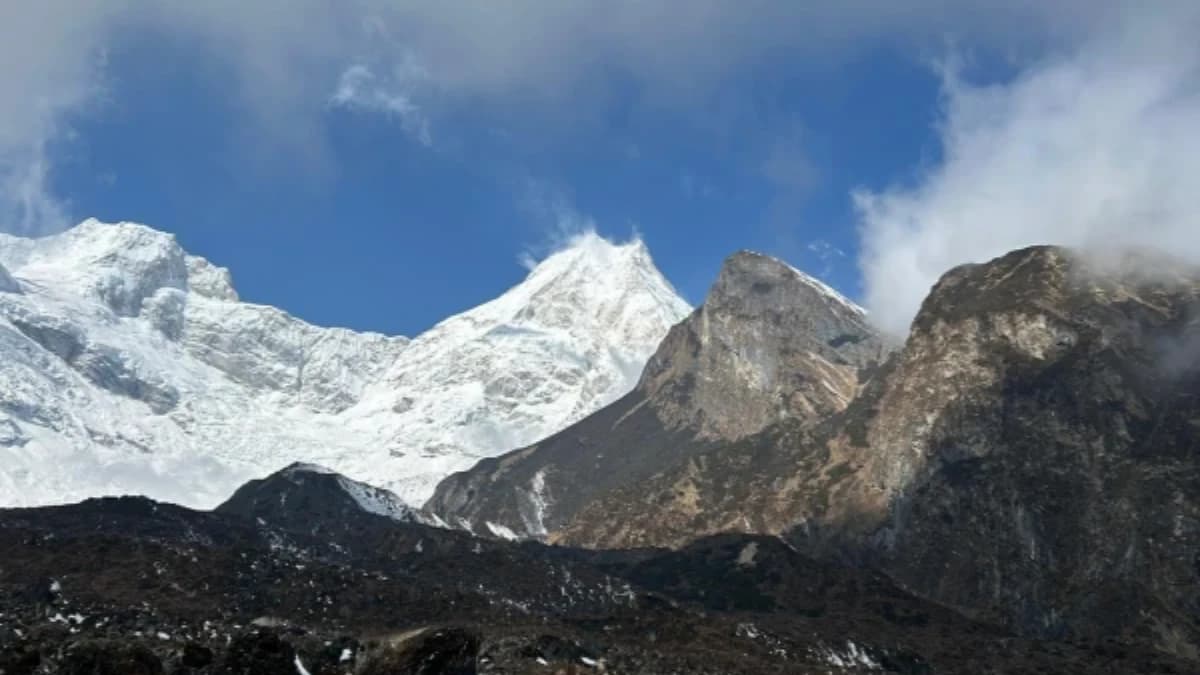
Trek Highlights
- 16-day private trek through Tsum Valley, the sacred Buddhist valley closed to outsiders until 2008. Mu Gompa monastery, Rachen Gompa nunnery, Chumling, Chhokangparo.
- Tsum Valley is one of the most physically and culturally Tibetan parts of Nepal. The valley sits against the Tibetan border at the head of the Budhi Gandaki gorge. The dialect is Tsumke, distinct from Nepali and Tibetan.
- Restricted area permit required. Licensed guide required, no minimum group size since 22 March 2026. We handle paperwork. No Larkya La crossing on this version (choose our 19-day Tsum Valley and Manaslu Circuit Trek if you want Tsum plus the Larkya La crossing).
- Private guide and porter ratio that does not change based on group size. No shared-group surcharge gimmicks.
- 10% deposit to lock dates, balance paid in person in Kathmandu. No full prepayment required to a foreign trekker you have never met.
- Every booking helps fund our Nagarjun Learning Center work at Saldum, where 70 children are taught by one dedicated teacher.
Why I built this trek the way I did
I am Shreejan, the founder of The Everest Holiday. My family is from Gorkha, the district that the Manaslu Circuit and Tsum Valley both walk through. The 16-day Tsum-only version is for trekkers who want the deep cultural immersion of the sacred valley without the Larkya La pass crossing of the longer combined Manaslu Circuit plus Tsum route.
Tsum Valley was closed to outsiders until 2008. Five working monasteries remain active in the valley today: Mu Gompa (the head monastery), Rachen Gompa (a nunnery), Gompa Lungdang, and two smaller village monasteries at Chhokangparo and Chumling. You can sleep at the monasteries, attend morning prayer if you wake before dawn, and meet nuns and monks who have spent their whole adult lives in retreat.
The 16-day shape gives you 5 days inside the Tsum Valley itself: enough to reach Mu Gompa at the head of the valley, spend time at Rachen Gompa nunnery, and walk back out through Chhokangparo and Chumling. The walking days are 4 to 6 hours each, which is what makes the trek accessible to fit trekkers who do not want a high pass crossing but want serious cultural depth.
We run this as a private trek only. The Restricted Area Permit requires a licensed guide, and until March 2026 it also required a minimum of two trekkers. The Department of Immigration scrapped that requirement on 22 March 2026, so you can now book this route as a solo traveller, with a licensed guide included. If you would rather not walk alone, tell us and we will hold dates until we can pair you with one other client.
Every booking on this trip helps us pay the teacher’s salary at our Nagarjun Learning Center in Saldum, where 70 children get free education. The salary is currently funded out of my own pocket. Your trek is what makes that sustainable.
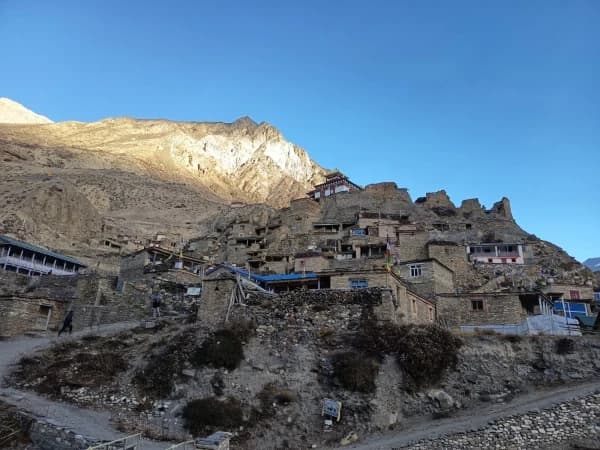
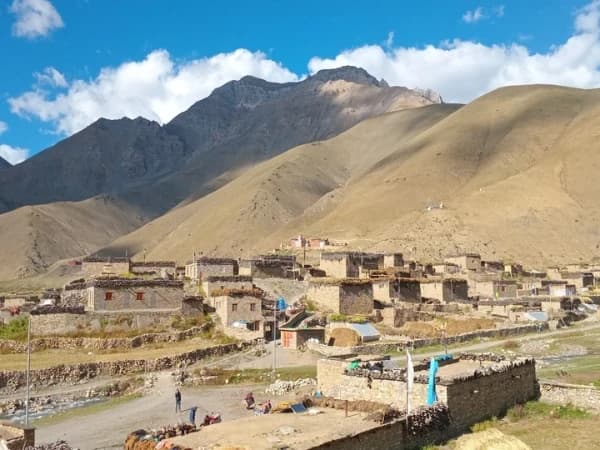
The valley reveals itself slowly. You have walked for three days through gorges and forests, past waterfalls and across bamboo bridges, and then the canyon opens, and there it is: a wide, golden valley cradled between snow peaks, with flat-roofed stone houses clustered around a gompa whose prayer flags stretch across the entire river. Chhokang Paro sits at the center of the Tsum Valley, a place so sacred that no animal has been killed within its boundaries for over 500 years. Monks chant in the early morning cold. Children run barefoot between many walls that stretch for hundreds of metres, every stone carved with prayers. A woman spinning wool on her doorstep smiles and invites you in for butter tea. This is not a Himalayan adventure. This is a pilgrimage into one of the last truly hidden places in Nepal, a valley that the government did not open to trekkers until 2008 and that still receives fewer than 1,500 visitors per year.
The 16-day Tsum Valley Trek follows the Budhi Gandaki river from Soti Khola through the lower Manaslu corridor, then branches east into the sacred Tsum Valley, a hidden Buddhist beyul described in ancient Tibetan texts as Kyimolung, a paradise valley. You walk through Lokpa, Nile, and Chhokang Paro to reach Mu Gompa (3,700m), one of Nepal's highest and most remote monasteries, and then visit Rachen Gompa before retracing your steps. There is no high pass. No extreme altitude. No crampons or ice axes. The maximum elevation is 3,700 metres. This trek is about culture, not conquest, designed by Shreejan Simkhada for travellers who want to see the Nepal that most trekkers never reach.
What Makes This Trek Special
- Walk through the Tsum Valley, a sacred Buddhist beyul (hidden paradise valley) that was closed to foreigners until 2008 and still receives fewer than 1,500 visitors per year
- Visit Mu Gompa (3,700m), one of the highest nunneries in Nepal, where Buddhist nuns have lived in meditation for centuries beneath peaks that mark the Tibetan border
- Experience the Shyagya non-violence tradition, a centuries-old practice that prohibits the killing of any living creature within the valley. The food is vegetarian. The silence is earned.
- Walk through Chhokang Paro, the largest settlement in Tsum, where mani walls carved with Om Mani Padme Hum stretch for hundreds of metres along the trail, and the architecture has not changed in centuries
- Explore Rachen Gompa, a monastery perched on a hillside above the valley floor, where the murals and manuscripts date back generations, and the monks welcome curious visitors
- Trek through a landscape that changes from subtropical gorge to alpine meadow without ever exceeding 3,700 metres, making this accessible to a far wider range of fitness levels than the Manaslu Circuit
- Enter a restricted area where permits are limited, and infrastructure is minimal, giving you the authentic Himalayan experience that the Annapurna and Manaslu regions lost years ago
16-Day Tsum Valley Trek Overview
Sixteen days. Zero high passes. One sacred valley. The Tsum Valley Trek is the opposite of every "how high can you go" trek in Nepal. It is not about altitude records or pass crossings or standing on top of something. It is about walking into a valley where the outside world has barely arrived, where Buddhism is not a cultural attraction but the fabric of daily life, and where the pace of walking matches the pace of the people who live there.
The route begins with a drive from Kathmandu to Soti Khola (700m), then follows the Budhi Gandaki river through increasingly dramatic gorge scenery. The lower section of the trail passes through Jagat and into the restricted area. At Lokpa, the trail splits: the Manaslu Circuit continues north, while the Tsum Valley route turns east up a side valley. Within hours, the scenery transforms. The gorge opens into a broad, sun-filled valley. Prayer flags appear everywhere. Mani walls line the trail. Stone houses with flat roofs and stacked firewood replace the pitched-roof lodges of the lower valley.
Over several days, you walk through Nile and Chhokang Paro to Mu Gompa (3,700m), the highest point of the trek. Mu Gompa is a working nunnery beneath the glaciated peaks of the Tibetan border, a place of extraordinary quiet and beauty. You also visit Rachen Gompa, where monks maintain one of the oldest libraries in the region. The return follows the same trail back to Soti Khola, but you will see it differently going down. The river is louder. The birds are more visible. The children remember your name.
Because the maximum altitude is only 3,700 metres, altitude sickness is far less of a concern than on the Manaslu Circuit or Everest treks. This makes the Tsum Valley Trek accessible to people who love mountains but worry about extreme altitude, older travellers, families with teenagers, and anyone who has always wanted to walk through the Himalayas but felt intimidated by the 5,000-metre pass crossings.
Arrive by 4:00 PM on Day One
Please arrive in Kathmandu by 4 PM the day before your trek. This gives you time for a final gear check and a briefing with your guide. The drive to Soti Khola the following morning takes 7-8 hours, so a good night's rest matters.
Online Trip Briefing
After you book, we schedule a video call to walk you through everything: what to pack for the Tsum Valley; what the accommodation is really like (basic, but warm and welcoming); the Shyagya non-violence tradition and how to respect it; what Mu Gompa looks like in reality versus photographs; and anything else on your mind. The call is also when you tell us your Kathmandu hotel preferences so we can match the right accommodation to your budget.
Note to Hikers
The Tsum Valley is a restricted area. You must travel with a licensed guide and hold a special restricted-area permit, which we arrange as part of your package. Since 22 March 2026 there is no minimum group size, so solo trekkers are welcome. The Shyagya non-violence tradition means that no animals are killed within the valley. Meals in Tsum are vegetarian. Please respect this tradition. Photography is welcomed in most places, but you should ask for permission before photographing monks, nuns, or religious ceremonies. All treks are private, your group only.
Kathmandu Accommodation
Your hotel in Kathmandu is not included in the trek package. During the online briefing, share your preferences and budget, and we will arrange accommodation that fits. Your trek package begins the moment you leave Kathmandu for the mountains.
Tsum Valley Trek at a glance
| Duration | 16 days, Kathmandu to Kathmandu |
|---|---|
| Highest point | The Mu Gompa area, around 3,700 m |
| Region | The sacred, restricted Tsum Valley, Manaslu Conservation Area |
| Difficulty | Moderate; a culture-first trek at gentle altitude |
| Permits | Tsum Valley Restricted Area Permit, MCAP and TIMS |
| Best months | September to November and March to May |
Best time to trek Tsum Valley Trek
| Season | Months | What it is like | Verdict |
|---|---|---|---|
| Autumn | October to November | Clearest and most reliable; the main season | Best overall |
| Spring | March to May | Warm, rhododendron in the forest, a quiet trail | Great, second season |
| Winter | December to February | Cold and clear, high villages very quiet | Cold but often clear |
| Monsoon | June to mid-September | Rain, cloud and leeches on the approach | Avoid |
Permits
Tsum Valley is a restricted area, so it needs a special permit issued only for a group with a licensed guide. We arrange all three below and include them in your trek price.
| Permit | Cost per person |
|---|---|
| Tsum Valley Restricted Area Permit | USD 40/week (Sep–Nov), USD 30/week (Dec–Aug), +USD 7/day beyond |
| Manaslu Conservation Area (MCAP) | NPR 3,000 (NPR 1,000 for SAARC) |
| TIMS card | NPR 2,000 (NPR 1,000 for SAARC) |
Trekking as a group?
Bring your own group — friends, family, a club, a university society, your workplace, or a cause you are raising money for — and any of the three comfort levels can run as a private group on your own dates. Private or group, the price per person is the same; we never put strangers in your group. The more of you there are, the less each person pays:
| Group size | Budget (per person) | Standard (per person) | Luxury (per person) |
|---|---|---|---|
| 1 person | US$1,850 | US$2,660 | US$5,070 |
| 2-4 people | US$999 | US$1,899 | US$3,310 |
| 5-8 people | US$949 | US$1,849 | US$3,205 |
| 9-12 people | US$899 | US$1,799 | US$3,030 |
| 13-20 people | US$849 | US$1,749 | US$2,349 |
The organiser travels free. Get fourteen or more paying people together and whoever organised the group joins the trip free. The one thing the organiser still pays is their own flights and permits, since those are fixed costs we pay out for every person and cannot absorb, and we cover the rest. Your departure is guaranteed on your own dates — from a solo traveller up to a group of twenty, and we never merge you into another trip.
Planning a group? Message me on WhatsApp with the trip, roughly when, and how many of you, and I will send you a price and a plan.
Compare Our Three Packages
| Feature | Budget | Standard | Luxury |
|---|---|---|---|
| Price from | USD $999 | USD $1,899 | USD $3,310 |
| Meals | Not included (order and pay at teahouses) | 3 meals daily, tea, fruits, and 2L water | All meals + all drinks (except alcohol) |
| Room | Shared teahouse room | Private twin with attached bathroom | Private deluxe with a bed heater |
| Porter | Not included | 1 porter per 2 trekkers | 1 porter per trekker (carry nothing) |
| Guide | 1 guide per group (assistant at 8+) | 1 guide per 6 trekkers (assistant at 7+) | 1 guide per 2 trekkers, plus an assistant guide for every 2 more |
| Transport | Local vehicle to Soti Khola | Shared tourist vehicle | Luxury private vehicle |
| SIM & Data | SIM card only | SIM with limited data | SIM with unlimited data |
| Best for | Budget travellers and cultural explorers | Comfort trekkers, couples, older travellers | Premium experience seekers wanting full support |
Himalayas for Every Budget. You will receive the same guides and the same safety, but with three different comfort levels. Every tier includes all permits (Tsum Valley Restricted Area Permit, ACAP, and TIMS); a well-trained Nepal government guide; airport transfers; and 24/7 emergency support. Note: Accommodation in the Tsum Valley is the most basic you will find on any trek in Nepal. Lodges are family homes that take in guests. Rooms are simple, showers may not be available for several consecutive days, and electricity is limited. The discomfort is part of the experience. Standard and Luxury tiers get the best available room at each stop, but "best available" in Tsum is still basic by Annapurna or Everest standards.
Why Trekkers Trust Us
- Over 300 reviews on TripAdvisor (4.9/5, Travellers' Choice 2024), Google and Trustpilot
- TAAN Member (#1586), Government Registration: 147653/072/073
- Three generations of family guiding across three generations
- MATKA 2026 exhibitor, representing Nepal at Northern Europe's largest travel trade fair in Helsinki
- Secure 10% deposit processed through Himalayan Bank Limited
- No strangers added to your group, ever. Every trek is private.
Difficulty: Moderate
This is one of the most accessible restricted-area treks in Nepal. The maximum altitude is 3,700 metres at Mu Gompa, well below the threshold where serious altitude sickness typically occurs. There are no high passes, no glacial crossings, no technical sections. Daily walking ranges from 4 to 6 hours on well-established trails. The terrain is varied (gorge sections, river crossings on suspension bridges, and stone-stepped ascents through villages) but never extreme.
The main challenge is duration. Sixteen consecutive days of walking requires stamina and mental endurance, even if individual days are manageable. The trail in the lower Budhi Gandaki gorge between Soti Khola and Jagat includes narrow sections and steep climbs. Accommodation in the Tsum Valley is very basic, which some trekkers find more challenging than the walking itself. If you can walk 5-6 hours per day on hilly terrain and are comfortable with simple lodging, you can do this trek. No previous high-altitude experience is required, though general trekking fitness is essential.
Sacred valley, sacred contribution
The Tsum Valley is a hidden Buddhist enclave on the Tibetan border, a restricted area, and sixteen days end to end. Booking this trek puts a fixed share into the Nagarjun Learning Center—the rural primary school my mother runs in Saldum village. About seventy children study there for free and eat two hot meals a day. The center is verified and listed on the UN Partner Portal. Walking the sacred trail through Tsum monasteries also pays for a different set of children to learn to read in their own village.