

Update, 26 August 2026: a large flood came down the Bhote Koshi river on 26 August and damaged the Rasuwagadhi border crossing, the customs post and the road through Timure and Syabrubesi. This itinerary crosses into Tibet at Rasuwagadhi, so it is not running for the rest of the 2026 season. The western route to Kailash, which flies Kathmandu to Nepalgunj to Simikot and then crosses by helicopter to Hilsa, is in a different part of the country and its trail is undamaged. It is not departing at present either, because every helicopter in Nepal is committed to the rescue operation and the Hilsa leg is flown by helicopter. I have written the full account of what happened here. Please speak to me before making any plan around this trip for 2026. We are working to get Kailash running again, and that work is going on now. I am not going to put a date on it while the situation is what it is, because I would only have to take it back. When there is something definite to say, it will be said here first.
2027 dates and prices are confirmed once the Tibet season opens. Join our 2027 priority list on WhatsApp, +977 9810351300.
Booking lead time: 30-45 days minimum for Tibet Group Visa processing.
Trek Highlights
- 14-day overland Kailash Mansarovar Yatra via Kerung border. Fixed-departure groups of 6 to 15 pilgrims; 2027 dates are confirmed once the Tibet season opens.
- 3-day kora around Mount Kailash (52km, max altitude Dolma La 5,630m). Emergency oxygen carried. Gamow bag access at supplier teahouses.
- Chinese group-visa application handled. Solo travel is not legal on this route; minimum 5 pilgrims per visa group is the legal requirement we work within.
- Family-run since 2016, three generations of guides. Our partner team has run this exact overland route for hundreds of groups since 2010.
- Standard tier, all-inclusive, pricing on request. 25% deposit to lock dates. Balance due 60 days before departure.
- Every booking helps fund our Nagarjun Learning Center work at Saldum, where 70 children are taught by one dedicated teacher.
Why I built this trek the way I did
I am Shreejan, the founder of The Everest Holiday. The Kailash Mansarovar Overland Yatra is the longest international pilgrimage we operate. It is also the most logistically complex trek in our catalogue because the route crosses an international border into Tibet, China, and every piece of it requires permits we coordinate with our long-term Tibet ground partner.
The Chinese government grants Kailash group visas only. Solo travel is not legal on this route. We run fixed-departure groups of 6 to 15 pilgrims so the cost stays reasonable and the group visa application is straightforward. If your family is fewer than 5 you can join an existing group; if your family is 5 or more we can pair you with one other family or run you as a private group at higher cost.
I run this as a 14-day overland route because the 11-day helicopter version is faster but more expensive and weather-dependent, and the 20-day Simikot trek version is for fit pilgrims who want to walk the Indian-pilgrimage approach. The 14-day overland is the standard yatra route most Hindu and Buddhist pilgrims take: drive in via Kerung, climb gradually to Manasarovar, then walk the 3-day kora at altitude.
The kora is 52 kilometres around Mount Kailash at altitudes between 4,600m and 5,630m (Dolma La pass). It is not a casual walk. We carry emergency oxygen and we slot Gamow bag access at supplier teahouses. Our partner has run this exact route for hundreds of groups since 2010.
Every booking on this trip helps us pay the teacher’s salary at our Nagarjun Learning Center in Saldum, where 70 children get free education. The salary is currently funded out of my own pocket. Your trek is what makes that sustainable.
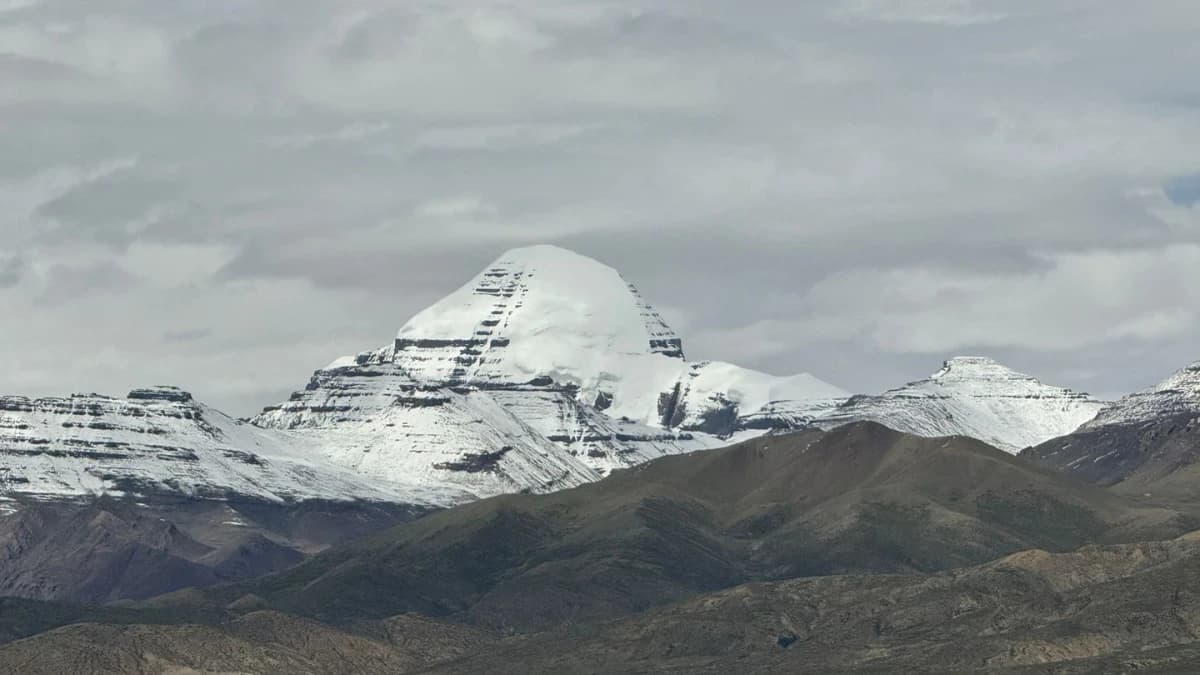
The Kailash Mansarovar Overland Yatra is a 14-day pilgrimage from Kathmandu to the foot of the sacred Mount Kailash (6,638m / 21,778ft) and the holy waters of Lake Manasarovar (4,558m / 14,954ft). This route follows the traditional Nepal-border overland path through Kerung or Kodari, climbing gradually onto the Tibetan plateau via Nyalam, Saga, and Hore before reaching Darchen for the three-day kora around Mount Kailash.
For Hindus, Buddhists, Jains, and Bon followers, the Kailash kora completes one of the most sacred pilgrimages on earth. The full circumambulation crosses the Dolma La pass at 5,630m (18,471ft) - the highest point of the journey and a moment many pilgrims describe as the most physically and spiritually demanding hours of their lives.
This is a fixed-departure group tour operated in partnership with our Tibet-side ground partner. Departures run in the Tibet pilgrimage season, with extra full-moon-aligned dates often booked early; the 2027 dates are confirmed once the season opens. Each departure includes 3 nights in Kathmandu, 1 night at the border, 9 nights inside Tibet, all meals throughout, all permits and ground transport by private bus.
The route is suitable for fit travellers comfortable with high altitude. We provide acclimatisation rest days at Kerung/Nyalam and emergency oxygen on the bus for the duration of the Tibet portion. The Kora itself requires three days of trekking with a porter or horse available for personal use at extra cost.


