
The brochure says "small group trek" and you picture four like-minded friends walking through the Himalayas in companionable silence. The reality might be fourteen strangers with fourteen different walking speeds, fourteen different ideas about when to stop for tea, and fourteen different opinions about the optimal temperature for the teahouse dining room stove.
Or it might genuinely be four like-minded friends walking through the Himalayas in companionable silence. The experience depends entirely on the company you book with, the size they define as "small," and whether the group dynamic works, which is something nobody can guarantee in advance.
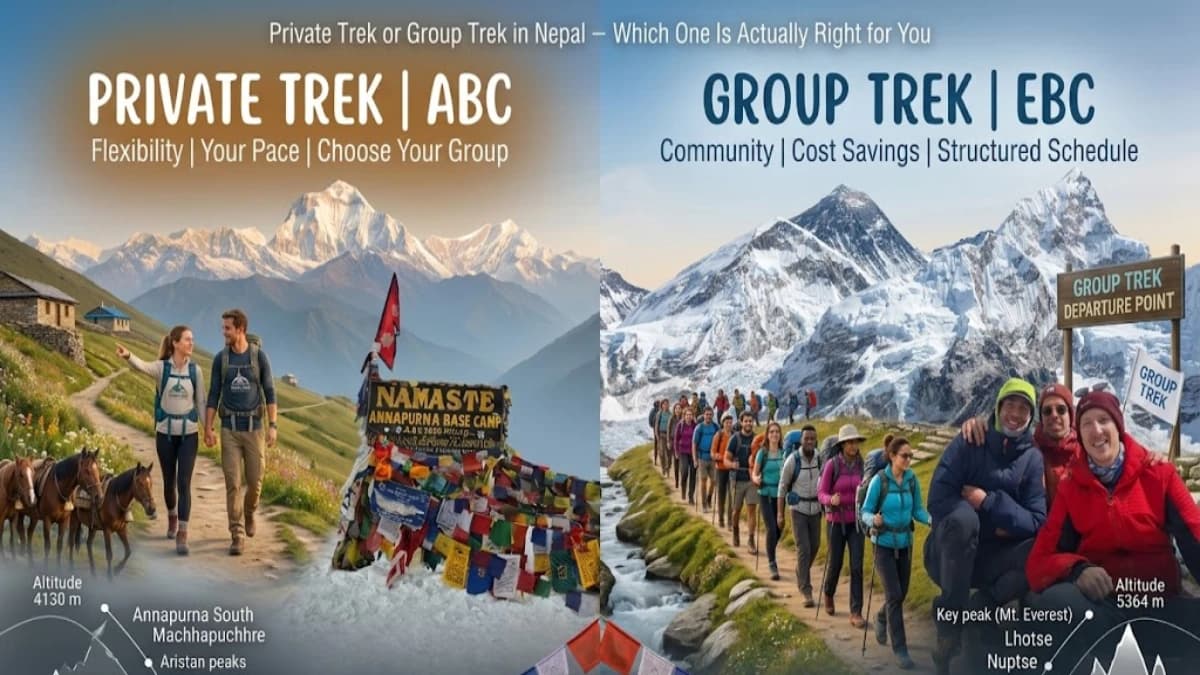
The other option is a private trek. Just you, or you and your chosen companions, with your own guide and porter, walking at your own pace, stopping when you want, starting when you want, and eating dinner without negotiating the restaurant choice with people you met forty-eight hours ago.
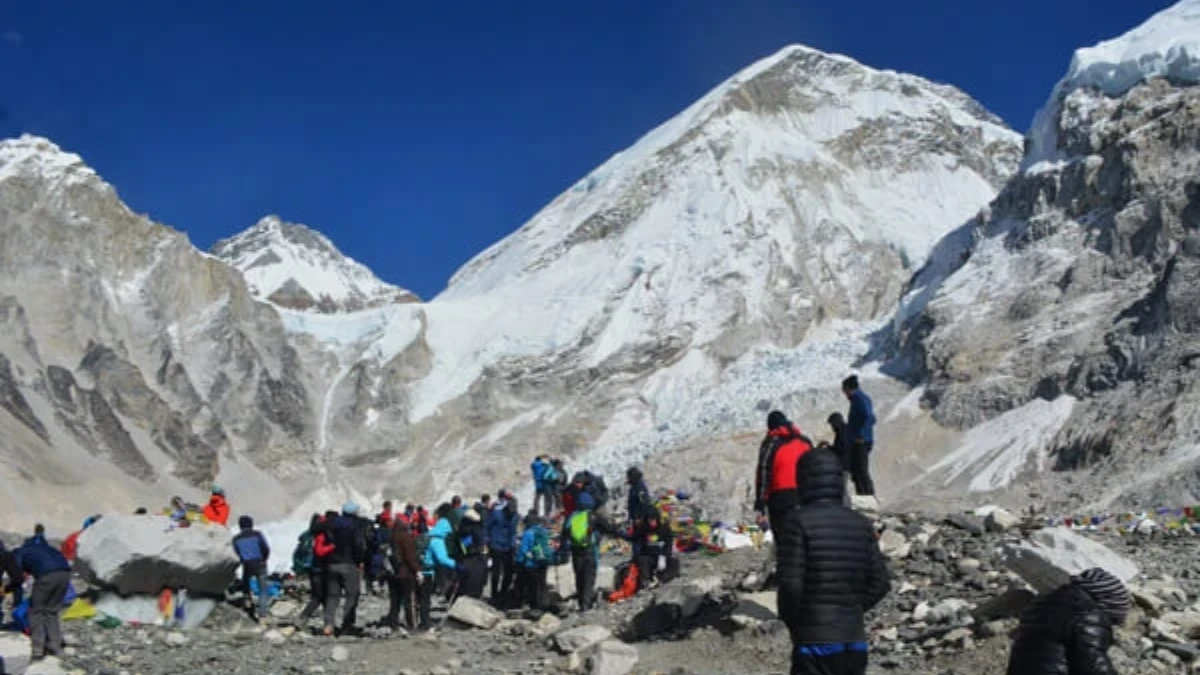
Both models work. Both get you to the same mountain. The question is which one matches how you travel.
| Private trek | Group / fixed-departure | |
|---|---|---|
| Who you walk with | Just you, or your own people | Strangers the operator puts together |
| Pace & schedule | Entirely yours | Set by the group |
| Start dates | Any date you choose | Fixed, published in advance |
| Itinerary changes | Add rest days or side trips freely | Fixed route |
| Cost | Lower per head as your own group grows | Lowest per head, but meals or a single supplement are often extra |
| Best for | Couples, friends, specific needs, flexibility | Solo travellers wanting company on a budget |
What "Group Trek" Actually Means in Nepal
Group treks in Nepal come in two forms that function very differently.
The fixed-departure group is a pre-scheduled trek that departs on a specific date regardless of how many people have booked. International companies like G Adventures, Intrepid, and Exodus operate this model, they publish dates months in advance and fill spots as bookings arrive. Group sizes range from six to sixteen depending on the company. You do not choose your companions. They arrive from different countries, with different fitness levels, different expectations, and different ideas about what "six in the morning" means.
The matched group is common among Nepal-based companies. You book as a solo traveller or a pair, and the company matches you with other solo trekkers heading to the same destination on similar dates. Groups are typically smaller, two to eight people, and the matching is more deliberate. Some companies ask about your walking pace, your age range, and your interests before placing you. This produces better group dynamics but is not guaranteed.
What "Private Trek" Actually Means
A private trek is exactly what it sounds like. Your guide. Your porter. Your schedule. If you book as a solo trekker, you walk with your guide alone. If you book with a partner or friends, you walk as your own self-contained group.
The itinerary can be standard, the same twelve-day EBC route that groups follow, or customised. Want an extra rest day in Namche? Add it. Want to skip Kala Patthar and sleep in? Your call. Want to take a side trip to a monastery that is not on the standard itinerary? Your guide knows the trail. Private trekking is flexible in a way that group trekking cannot be, because there is nobody else's schedule to accommodate.
How much does a private vs group trek in Nepal cost?
This is where the decision becomes concrete. Group treks are cheaper per person because the cost of the guide and logistics is divided among multiple participants. A budget EBC group trek costs roughly one thousand to twelve hundred dollars per person. A private EBC trek for one person costs the same base rate, the difference is that you are not splitting the guide cost with anyone.
At most Nepal-based companies, the per-person price decreases as private group size increases. A couple pays less per person than a solo trekker. A group of four pays less than a couple. The economics are straightforward, more people sharing the same guide and logistics equals lower individual cost.
International fixed-departure groups often appear cheaper per person but frequently exclude meals, adding three hundred to five hundred dollars to the true cost, or charge a "single supplement" for solo travellers who do not want to share a room.
When is a group trek in Nepal the better choice?
If you are a solo traveller who wants company. Not everyone wants to walk in silence for twelve days. The social dimension of a group trek, the shared meals, the trail conversations, the collective suffering at altitude and the collective joy at base camp, is genuinely one of the best parts of trekking. Friendships formed above four thousand metres have an intensity that few other experiences produce.
If your budget is tight and you want the lowest possible per-person cost. Group treks distribute fixed costs across more people. For budget-conscious trekkers, the savings matter.
If you prefer structure and certainty. Fixed-departure groups operate on set dates with established itineraries. There is no ambiguity about when you start, where you go, and what is included.
When is a private trek in Nepal worth it?
If you have specific physical needs. Walking slower than average. Needing extra rest stops. Having a medical condition that requires attention. In a group, you walk at the group's pace or you hold everyone up. On a private trek, the pace is yours.
If you value flexibility. Want to add a day? Remove a side trip? Start an hour later because the sunrise view from the teahouse roof is too beautiful to leave? Private treks bend to your preferences. Group treks do not.
If you are an introvert. Walking eight hours in the company of strangers who want to chat about their gap year is exhausting for people who recharge in solitude. A private trek with a guide who understands when to talk and when to be quiet is a fundamentally different emotional experience.
If you are travelling with a partner or friends. You already have your group. Adding strangers to it does not make it better. A private trek for two to four people who chose each other is almost always better than a group of ten who did not.
If you have specific dates that do not align with fixed departures. Private treks start when you want them to start. Group treks start on Tuesday the 14th whether that works for you or not.
Can I join a small group trek as a solo booker?
Many Nepal-based companies, including most family-run operators, offer a middle path. You book a private trek but the company lets you know if other solo trekkers want to join on similar dates. If you agree, you become a small, informally matched group of two to four. You get the lower per-person cost of a group with the intimacy and flexibility closer to a private experience.
This hybrid model works particularly well for solo trekkers who want companionship but not a crowd. The groups are small enough that everyone walks at a compatible pace. The dynamics are manageable. And if the group does not gel, which is rare but possible, the guide adjusts by letting faster walkers go ahead and meeting everyone at the teahouse.
Should I choose a private or group trek in Nepal?
If you want the cheapest option and enjoy meeting strangers: group. If you want control over your experience and value flexibility: private. If you want something in between: a small matched group through a company that takes care with the matching.
The mountain at the end is the same mountain. The prayer flags at base camp flutter the same way for groups of two and groups of twelve. The sunrise from Kala Patthar does not check how many people are watching. What changes is how the days feel, whether you spent them negotiating with strangers or walking at your own rhythm through a landscape that asks nothing of you except that you keep putting one foot in front of the other.
Compare both options on our trip pages. Private treks are available on every route, from the EBC Trek to the Upper Mustang Trek. Our treks page shows group and private pricing for all packages.
Private if you want flexibility: your pace, your schedule, your detours. Group if you want company and a lower price. Both get the same guide, the same safety standards, and the same mountains. The question is whether you want to choose when to stop for tea or are happy letting the group decide. Most of our guests choose private. The ones who choose group are usually solo travellers looking for friends on the trail.
We run both private and group departures. Ask us for pricing on both and decide which suits you.
WhatsApp:+977 9810351300
Email:[email protected]
Written by Shreejan Simkhada, CEO of The Everest Holiday and third-generation Himalayan guide. TAAN Member #1586.
Private or group? We only do private. Our Everest Base Camp Trek (12 Days) is private (your group only, no strangers), 2026 dates open, From USD $1399. WhatsApp us for tailored 2026 dates and current departures.
 Chat with Shreejan