
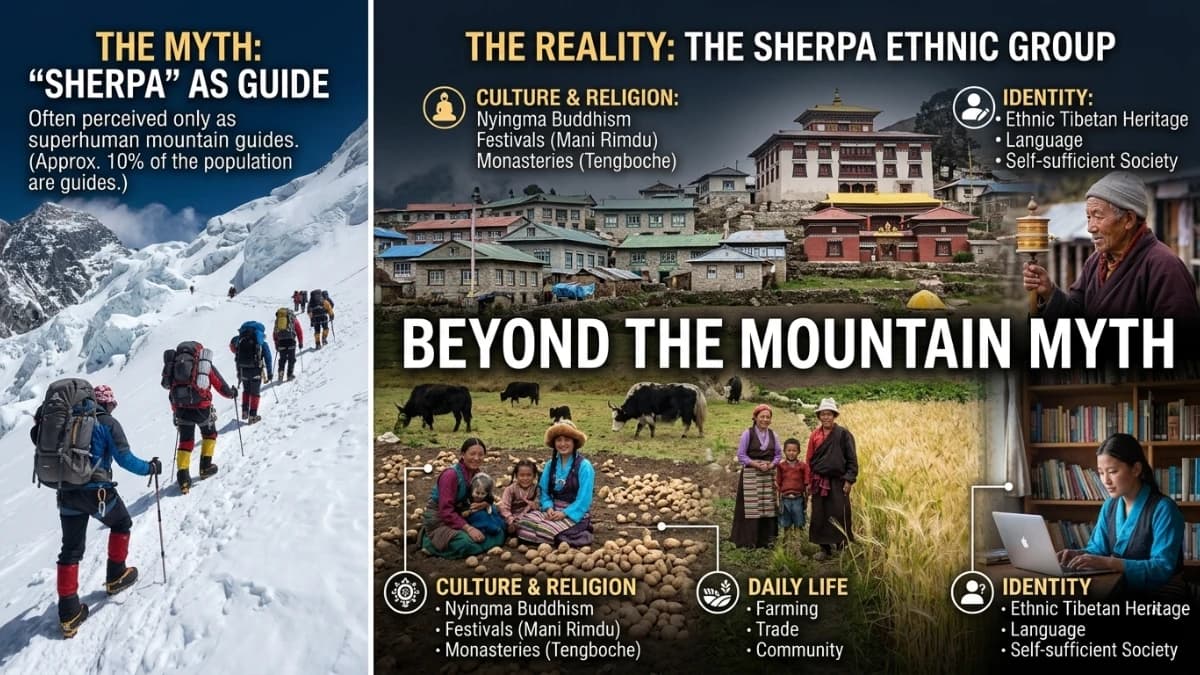
Short answer: The Sherpa are a Tibetan Buddhist people of about 150,000 who moved from eastern Tibet to the Solukhumbu region of Nepal around five hundred years ago. Sherpa is an ethnic name, not a job title. They farm, trade, run teahouses and guide, and their monasteries, such as Tengboche, are the heart of the Everest region. Meet them on our 12-day Everest Base Camp trek.
The word "sherpa" has become a verb. In boardrooms from London to Silicon Valley, people talk about needing "a sherpa" to navigate complex projects, meaning a guide, an expert, someone who carries the weight of knowledge through difficult terrain. The word has been borrowed, flattened, commercialised, and stripped of everything it actually means.
The Sherpa people are not a job description. They are an ethnic group, a Tibetan-Buddhist community of approximately one hundred and fifty thousand people who migrated from eastern Tibet to the Solu-Khumbu region of Nepal roughly five hundred years ago. They carry a culture, a language, a spiritual tradition, and a relationship with the Himalayas that predates mountaineering by centuries. Long before the first Western climber arrived in Nepal, the Sherpas were living at altitudes that most humans cannot sustain: farming barley and potatoes at 3,800 metres, trading across the Nangpa La pass to Tibet, building monasteries on cliff faces, and developing a physiology uniquely adapted to thin air through generations of natural selection.
That they became the world's most celebrated mountain workers is an accident of geography and colonial ambition. The British-led expeditions of the early twentieth century needed people who could function at extreme altitude. The Sherpas, already there, already adapted, already possessing the skills and the knowledge, became the workforce. The partnership was profound for both sides, but the mythology that grew around it has obscured the people behind the legend.
Where do Sherpa people live in Nepal?
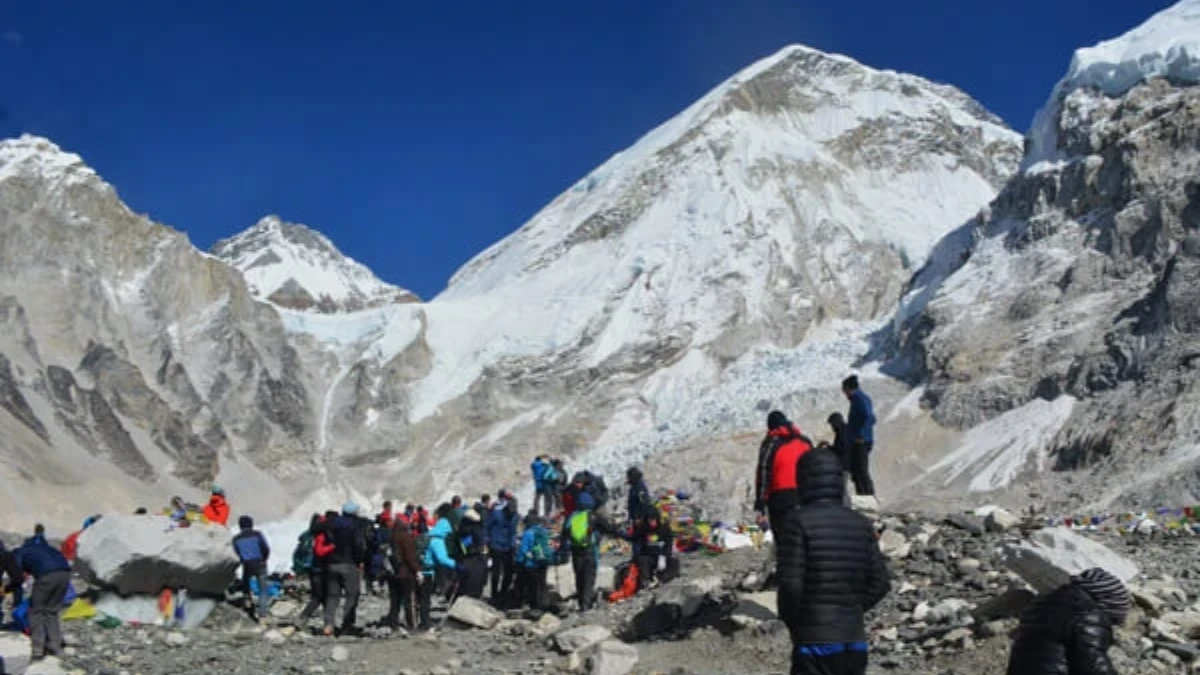
The Sherpa homeland is the Khumbu region of northeastern Nepal, the same valleys that today form the Everest Base Camp trekking corridor. Namche Bazaar, the busy market town where every EBC trekker stops for acclimatisation, is a Sherpa settlement. Tengboche, home to the famous monastery where the Mani Rimdu festival is celebrated each autumn, is Sherpa. Khumjung, Thame, Pangboche, Phortse, the villages that dot the trail to Everest, are Sherpa communities that have existed for centuries.
Beyond Khumbu, Sherpa communities are found in the Solu district (lower altitude, more agricultural), in the Rolwaling valley, and in Darjeeling and Sikkim in India where Sherpas migrated for trade and work. Kathmandu now has a significant Sherpa population, many families who made money in mountaineering and tourism have moved to the capital while maintaining strong connections to their ancestral villages.
What are the cultural and religious traditions of Sherpa people?
Sherpa culture is deeply Tibetan Buddhist. The monasteries that trekkers visit along the EBC route, Tengboche, Pangboche, Thame, are not tourist attractions. They are living centres of spiritual practise where monks study, meditate, and perform rituals that have continued without interruption for hundreds of years.
The Mani Rimdu festival at Tengboche Monastery, held in October or November, often coinciding with peak trekking season, is a three-day ceremony of masked dances, chanting, and blessing that celebrates the triumph of Buddhism over the older Bon religion. Trekkers who happen to be on the trail during Mani Rimdu witness one of the most visually spectacular and spiritually significant events in the Himalayan calendar.
Prayer flags, the colourful rectangles strung on every ridge, bridge, and pass in the Khumbu, are not decorations. Each flag carries printed prayers that the wind disperses across the landscape, spreading compassion and wisdom with every gust. The five colours represent the five elements, blue for sky, white for air, red for fire, green for water, yellow for earth. The flags are replaced annually; faded, tattered flags are not removed but allowed to decompose naturally, returning their prayers to the elements.
Mani stones, flat rocks carved with the Buddhist mantra "Om Mani Padme Hum", line the trails for kilometres. Trekkers pass them on the left, keeping the sacred inscription on their right side. Mani walls, long walls of these carved stones, some stretching for hundreds of metres, are found at the entrance to every Sherpa village, marking the boundary between the secular trail and the sacred community.
What is the history of Sherpa involvement in Himalayan mountaineering?
Tenzing Norgay Sherpa, who with Edmund Hillary became one of the first two people to reach the summit of Everest in 1953, is the most famous Sherpa in history. But he is far from the only one. The list of Sherpa mountaineering achievements is staggering: Apa Sherpa summited Everest twenty-one times. Kami Rita Sherpa holds the current record at thirty-two summits, the most recent on 17 May 2026. Pasang Lhamu Sherpa was the first Nepali woman to summit Everest, dying during the descent in 1993.
The modern Everest industry relies heavily on Sherpa climbers. They fix ropes on the Khumbu Icefall. They carry oxygen, tents, and food to high camps. They guide paying clients through the death zone above eight thousand metres. The risks they accept are enormous, the death rate among climbing Sherpas is significantly higher than among Western clients, and the compensation, while good by Nepali standards, is modest by the standards of the risk involved.
The 2014 avalanche on the Khumbu Icefall, which killed sixteen Sherpa climbers, the deadliest single disaster in Everest's history, brought worldwide attention to the imbalance between risk and reward in the mountaineering industry. The Sherpa community's grief, anger, and demands for better safety standards and compensation forced a reckoning that continues to shape how Everest expeditions are conducted.
What Trekkers See
On the EBC trail, the Sherpa world is visible in every village, every monastery, every prayer flag. The teahouse owners who cook your dal bhat and make your bed are often Sherpa. The guides who walk beside you and monitor your health may be Sherpa (though many guides come from other ethnic groups, Tamang, Rai, Gurung). The porters who carry your bag may or may not be Sherpa, the porterage economy draws from multiple ethnic communities.
The best way to understand Sherpa culture is not to read about it but to observe it with respect. Visit the monasteries, Tengboche, Pangboche, the small gompa in Khumjung, and sit quietly while monks chant. Walk the mani walls and notice how local people always pass on the left. Ask your guide about the prayer flags, what the colours mean, why they are placed where they are, how the wind carries the prayers. Listen when a Sherpa teahouse owner tells you about the 2015 earthquake and how the community rebuilt. These conversations, quiet, unforced, genuine, are where cultural understanding actually lives.
Is Sherpa an ethnic group or a job title?
Not every person who works in Himalayan tourism is Sherpa. Using "sherpa" as a generic term for any Nepali mountain worker is inaccurate and reductive. Guides from Tamang, Rai, Gurung, Magar, and other ethnic groups are equally skilled, equally experienced, and equally deserving of recognition by their actual identity.
Sherpa culture is a living culture, not a museum exhibit. The monasteries are places of worship, not photo opportunities. The prayer wheels are sacred objects, not toys. The mani stones are carved with prayers, not hashtags. Engaging with these elements respectfully, walking clockwise, spinning wheels clockwise, passing mani walls on the left, is the minimum courtesy that any visitor owes to the community that hosts them.
And the mountains that Sherpas call home, Sagarmatha (Everest), Lhotse, Cho Oyu, Makalu, are not just peaks to be summited or base camps to be reached. In Sherpa cosmology, mountains are the dwelling places of deities. Climbing them is not conquest. It is negotiation, an act that requires spiritual preparation, ritual offerings, and the permission of the mountain itself. The puja ceremony performed at Everest Base Camp before every climbing season, where a lama blesses the expedition, the juniper incense burns, and the climbers receive rice and sacred thread, is not theatre. It is faith. And the Sherpas who participate in it are not performing for an audience. They are praying for their lives.
The Sherpa people gave the world access to the highest mountains on earth. They did not ask to be reduced to a metaphor. They are a community, lively, complex, spiritual, resilient, that deserves to be seen as fully as the peaks they call home.
Meet Sherpa guides and communities on the Everest Base Camp Trek and the Gokyo Lakes Trek.
Sherpas are not porters. This is the single most common misunderstanding about Nepal. Sherpa is an ethnic group, a Tibetan Buddhist community from the Khumbu region, not a job title. Many Sherpas work as high-altitude guides because they grew up at altitude and their bodies are genetically adapted to thin air. But calling every porter or guide a "Sherpa" is like calling every French person a chef.
Our team includes Sherpa, Tamang, Gurung, Rai, and Magar guides. Every one of them is experienced and licensed.
WhatsApp:+977 9810351300
Email:[email protected]
Written by Shreejan Simkhada, CEO of The Everest Holiday and third-generation Himalayan guide. TAAN Member #1586.
Sherpa beyond the myth: book with Sherpa guides. Our Everest Base Camp Trek (12 Days) is private (your group only, no strangers), 2027 dates open, From USD $1399. WhatsApp us for tailored 2027 dates and current departures.


 Chat with Shreejan