

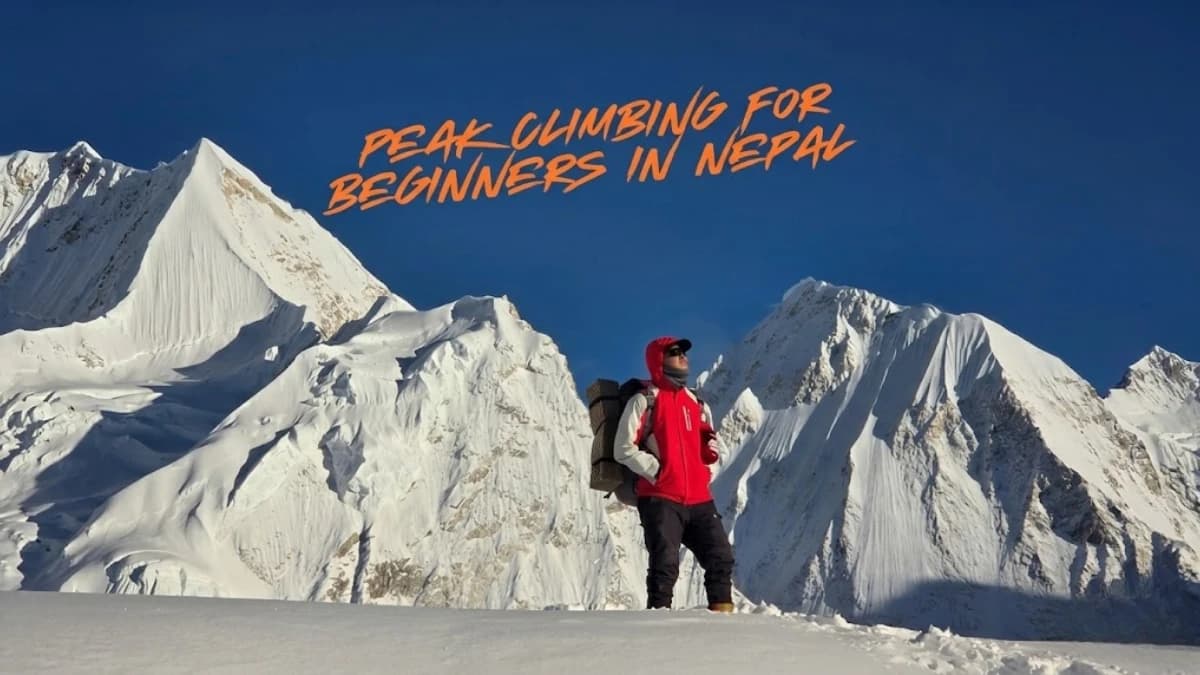
You have done the treks. You have walked to Everest Base Camp, or around the Annapurna Circuit, or up the Langtang Valley. You have stood at 5,545 metres on Kala Patthar and watched the sunrise, or at 5,416 metres on Thorong La and felt the wind try to knock you sideways. And now, standing on a pass or a viewpoint, looking at the peaks that rise above you, the real peaks, the ones with ice on their faces and prayer flags on their summits, the thought arrives: I want to climb one.
This thought is the beginning of mountaineering. Not the mountaineering of Everest expeditions and oxygen bottles and eight-thousand-metre death zones. The mountaineering of Nepal's trekking peaks, mountains between 5,500 and 6,500 metres that the Nepal Mountaineering Association has designated as climbable by experienced trekkers with basic training. Mountains that require crampons and ice axes and ropes, but not years of technical climbing experience. Mountains that offer genuine summits, the full feel of standing on a peak, above everything around you, with the Himalaya spread at your feet, to people whose climbing career starts here.
What "Beginner" Means in Peak Climbing
A beginner in peak climbing is not a beginner in trekking. The two are different activities with different demands. A beginner peak climber has: completed at least one multi-day high-altitude trek (above 4,500 metres), demonstrated good physical fitness and altitude tolerance, basic familiarity with cold-weather hiking, and the willingness to learn new technical skills (crampons, ice axe, rope work) in a mountain environment.
If you have never trekked at altitude, a trekking peak is not the place to start. Start with a trek. Learn how your body responds to altitude. Discover the teahouse life, the daily rhythm of walking, eating, and sleeping at altitude, the physical and mental demands of multi-day mountain travel. Then, with that foundation, consider a peak.
The progression is important because the peak adds layers of difficulty that a trek does not: higher altitude (above 6,000 metres for most trekking peaks), technical terrain (glacier, steep snow, fixed ropes), longer and more intense summit days (twelve to sixteen hours), and exposure to conditions that are more severe than anything on a standard trek. Each of these layers is manageable for a well-prepared trekker. Combined, without prior altitude experience, they can overwhelm.
Which are the best peaks for beginners to climb in Nepal?
1. Island Peak (Imja Tse), 6,165m
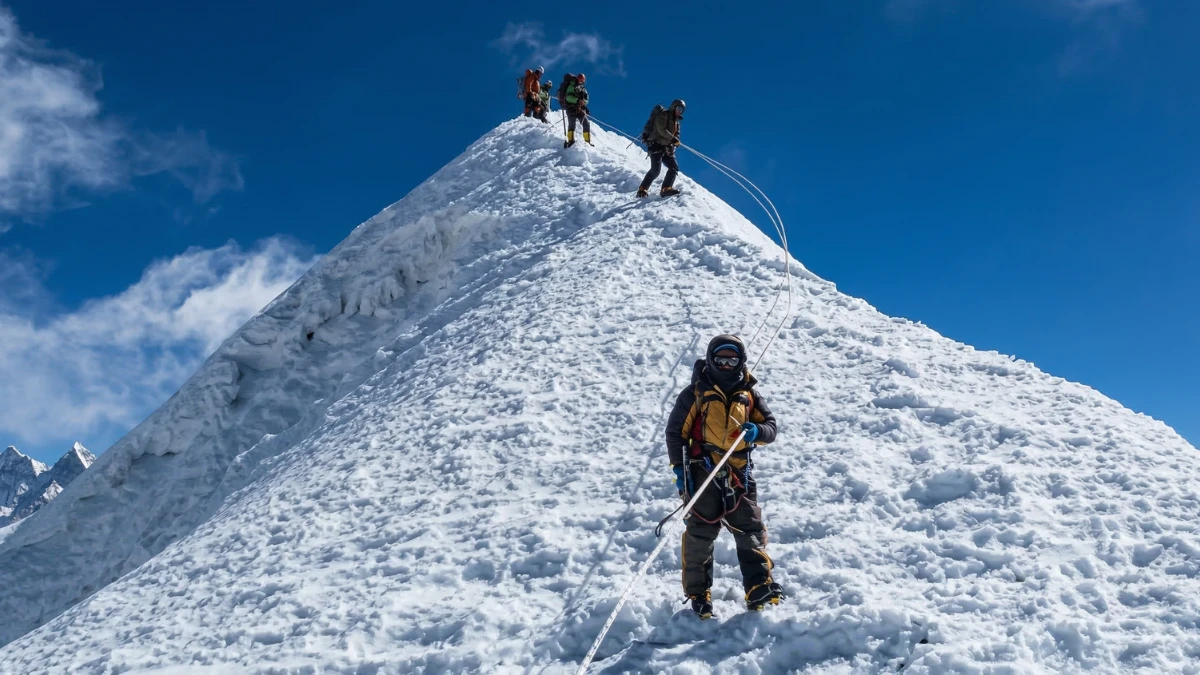
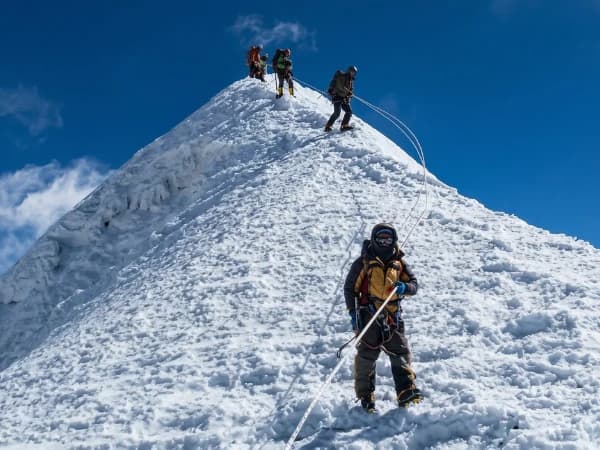
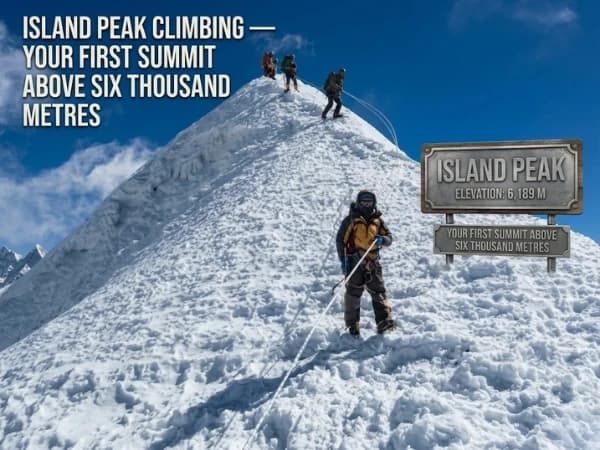
The most popular trekking peak in Nepal, and the most popular for good reason. Island Peak combines with the Everest Base Camp trek, you walk the EBC trail to Dingboche, then divert south to Chukhung and Island Peak base camp. The climbing route involves glacier travel and a headwall of steep ice (forty-five to fifty degrees) that requires fixed ropes and jumar technique. The summit ridge is narrow and exposed but short.
Why it suits beginners: the approach is the well-trodden EBC trail, providing excellent acclimatisation over ten days before the climb. The technical section (the headwall) is one discrete challenge rather than hours of sustained technical terrain. The fixed ropes are set by climbing Sherpas before your attempt. And the support infrastructure, guides, porters, equipment, is the most developed of any trekking peak.
What makes it challenging: the headwall is genuinely steep and intimidating. At 5,800 metres, you are clipping a jumar onto a fixed rope and climbing a wall of ice with crampons while breathing air that provides about half the oxygen your body wants. The summit ridge is narrow with drops on both sides. And the summit day is twelve to fourteen hours of sustained effort from base camp and back.
Duration: 14-17 days (combined with EBC trek). Summit success depends on acclimatisation, weather and preparation. Cost: from approximately $2,000-3,500 depending on service level.
2. Mera Peak, 6,476m
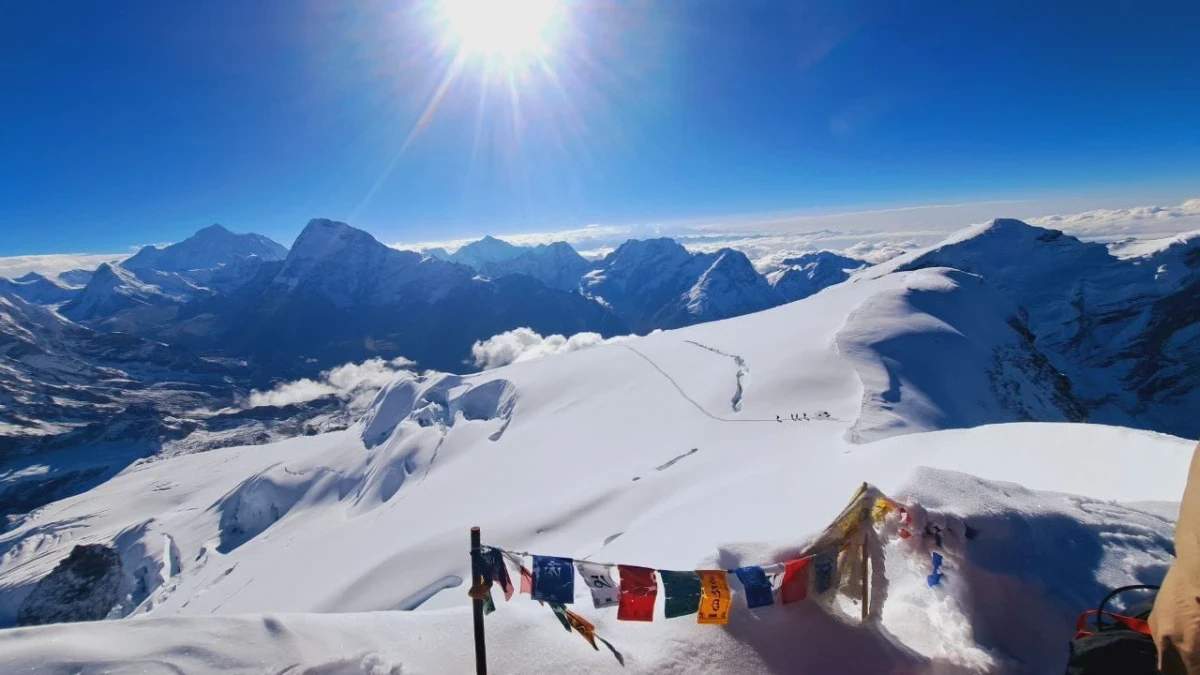
The highest trekking peak in Nepal and, paradoxically, one of the least technically demanding. Mera's standard route involves glacier walking and moderate snow slopes but no vertical ice climbing. The challenge is altitude (6,476 metres is significantly higher than Island Peak) and endurance (the summit day is long and exhausting).
Why it suits beginners: no technical crux, the climbing is sustained glacier walking rather than a single intimidating wall. The gradient rarely exceeds thirty-five degrees. The approach through the remote Hinku Valley provides excellent acclimatisation. And the summit view, five eight-thousanders visible, is the best from any trekking peak.
What makes it challenging: the altitude. At 6,476 metres, you are in the zone where altitude sickness becomes a serious risk even for well-acclimatised climbers. The cold at high camp (5,800 metres) is extreme. The summit day starts at midnight and lasts twelve to sixteen hours. And the remoteness of the Hinku Valley approach means that evacuation, if needed, takes longer than from the EBC region.
Duration: 18-21 days. The higher altitude makes summit success harder than on Island Peak. Cost: from approximately $2,500-4,000.
3. Yala Peak, 5,520m
The gentlest introduction to peak climbing in Nepal. Yala Peak sits above the Langtang Valley and can be climbed without fixed ropes in good conditions. The route involves glacier walking and a rocky scramble, no sustained steep ice, no jumar technique, no headwall. The altitude is the lowest of the commonly climbed trekking peaks.
Why it suits beginners: the technical demands are minimal, if you can walk in crampons and use an ice axe for balance, you have the skills needed. The Langtang Valley approach is short (seven to eight days) and provides good acclimatisation. The lower altitude (5,520 metres) means less exposure to extreme altitude effects. And the cost is lower because the NMA permit fee is less and the duration shorter.
What makes it challenging: the summit day is still a serious physical effort at high altitude. The glacier requires route-finding skills (your guide provides these). And the rocky scramble near the summit involves some exposure that beginners may find intimidating.
Duration: 10-12 days. Success depends on acclimatisation, weather and how well you have prepared. Cost: from approximately $1,500-2,500.
How do you train and prepare for climbing a 6000m peak in Nepal?
Physical preparation: Start training three to four months before departure. Focus on cardiovascular fitness (running, cycling, swimming, sustained effort for two to three hours), leg strength (squats, lunges, step-ups with a loaded pack), and core stability (planks, dead bugs, mountain climbers). Stair climbing with a weighted pack (ten to fifteen kilograms) is the single most specific training for peak climbing, it builds the leg endurance and cardiovascular capacity that the summit day demands.
The summit day is the benchmark. You need to be capable of sustained physical effort for twelve to sixteen hours in cold conditions at extreme altitude. This is not a sprint, it is an ultra-endurance event. Train accordingly. Long hikes (six to eight hours) on weekends, with altitude gain where possible, are better preparation than short, intense gym sessions.
Technical preparation: The climbing skills needed for trekking peaks, crampon walking, ice axe self-arrest, jumar technique, basic rope skills, are taught by your guide at base camp before the summit attempt. No previous technical training is required. However, trekkers who have taken a weekend mountaineering course (available through mountaineering clubs and outdoor education providers worldwide) feel significantly more comfortable on the mountain. The skills themselves are simple. Practising them at sea level, without altitude stress, allows your brain to automate the movements before it has to perform them at 5,800 metres with fifty percent oxygen.
Mental preparation: The summit day will test your mental resilience more than your physical fitness. At two in the morning, in minus-fifteen-degree cold, with twelve hours of climbing ahead of you and your body screaming for oxygen, the decision to continue is not physical. It is psychological. The trekkers who summit are the ones who can break the effort into small, manageable pieces, one step, one breath, one minute, and repeat the cycle without looking at the summit, without calculating the distance remaining, without engaging with the voice in their head that says stop.
Meditation, visualisation, and endurance sports (ultra-running, long-distance cycling) all build the mental framework that peak climbing requires. But the most effective mental preparation is simple: accept in advance that the summit day will be the hardest single day of physical effort you have ever experienced, and decide in advance that you will continue unless your guide tells you to turn back. The decision made beforehand is stronger than the decision made in the moment.
What is included in a Nepal peak climbing package?
A reputable trekking peak company provides: NMA climbing permit application and fees, a lead climbing guide (certified, experienced, English-speaking), a climbing Sherpa (who sets fixed ropes and manages the technical route), all camping and climbing equipment (tents, ropes, fixed lines, anchors), climbing hardware for your use (crampons, ice axe, harness, helmet, jumar, unless you bring your own), base camp and high camp management (cooking, camp setup, route preparation), and emergency equipment (satellite phone, first aid, oxygen if appropriate).
What you typically need to provide: your own sleeping bag (rated to minus fifteen to minus twenty), your own trekking and climbing clothing (layered system as for high-altitude trekking, plus a summit-weight down jacket), and your own trekking boots (which must be compatible with crampons, stiff-soled, B1 or B2 rated).
Check with your company exactly what is included and what you need to bring. Equipment lists vary between operators, and showing up at base camp without a critical piece of personal gear is a problem that cannot be solved at 5,300 metres.
The Summit Day
Every peak's summit day follows the same basic structure, and knowing the structure helps you prepare mentally for what is coming.
Midnight to 1 AM: Wake up. The alarm or the guide's knock. The cold hits immediately. Every layer goes on. Hot tea and biscuits, nothing heavy, because your stomach at altitude does not want food, but your body needs fuel.
1 AM to 5 AM: Walking in the dark. Headlamp. Crampons on glacier. Rope attached to your guide. The world shrinks to the circle of your headlamp, the crunch of crampons, and the rhythm of your breathing. This is the long, grinding phase, hours of steady upward movement in cold and dark. The mental challenge is sustained monotony in harsh conditions.
5 AM to 6 AM: Sunrise. The peaks emerge from darkness. The light changes from headlamp white to dawn gold. This is the morale inflection point, the darkness that was oppressive becomes a landscape that is spectacular. Energy returns. Motivation surges.
6 AM to 8 AM: The technical section (if applicable, Island Peak's headwall, Chulu West's steep snow slopes). This is the crux, the section that requires specific climbing technique rather than walking. Fixed ropes, jumar, ice axe. Focus, precision, and trust in your equipment and your guide.
8 AM to 10 AM: Summit. The moment. The view. The photographs. The prayer flags. The specific, irreducible, non-transferable knowledge that you climbed here. You are above six thousand metres. You earned this.
10 AM to 4 PM: Descent. Down the technical section (rapping or downclimbing). Back across the glacier. To high camp, then to base camp. The descent is faster but requires attention, fatigue, dehydration, and the psychological release of post-summit relaxation create a vulnerability that your guide manages by maintaining pace and vigilance.
After the Summit
The summit is not the end. It is the beginning of a memory that appreciates over time. The certificate from the NMA goes on a wall. The photograph goes on a shelf. But the knowledge, the specific, personal, unchallengeable knowledge that you stood on a Himalayan summit under your own power, goes into the architecture of your identity. It sits alongside everything else you know about yourself, your profession, your relationships, your history, and it says: I did something that most people only imagine. I climbed a mountain. I stood above six thousand metres. I looked at the Himalaya from inside the Himalaya. And I walked back down to tell the story.
The story is worth telling. The peak is worth climbing. And the first one, the first summit, the first time crampons bite into ice, the first time you look down from a ridge and see the world arranged below you in a way that only climbers see, is the one that changes everything. Not because it is the hardest. Not because it is the highest. But because it is the first. And firsts, in mountains as in everything, carry a significance that repetition can equal but never replace.
Start with Mera Peak or Island Peak. Both are 14-day expeditions designed for trekkers taking their first step into mountaineering.
Peak climbing in Nepal sounds intimidating until you learn that thousands of first-timers summit trekking peaks every year with nothing more than basic fitness and a willingness to learn. You do not need prior climbing experience. You do need a good guide, proper equipment, and enough acclimatisation days. We provide all three.
Check our peak climbing packages or ask us which peak suits your fitness and experience level.
WhatsApp:+977 9810351300
Email:[email protected]
Written by Shreejan Simkhada, CEO of The Everest Holiday and third-generation Himalayan guide. TAAN Member #1586.
First peak? Mera is the right intro. Our Mera Peak Climbing (14 Days) is private (your group only, no strangers), 2027 dates open, From USD $3499. WhatsApp us for tailored 2027 dates and current departures.
 Chat with Shreejan