
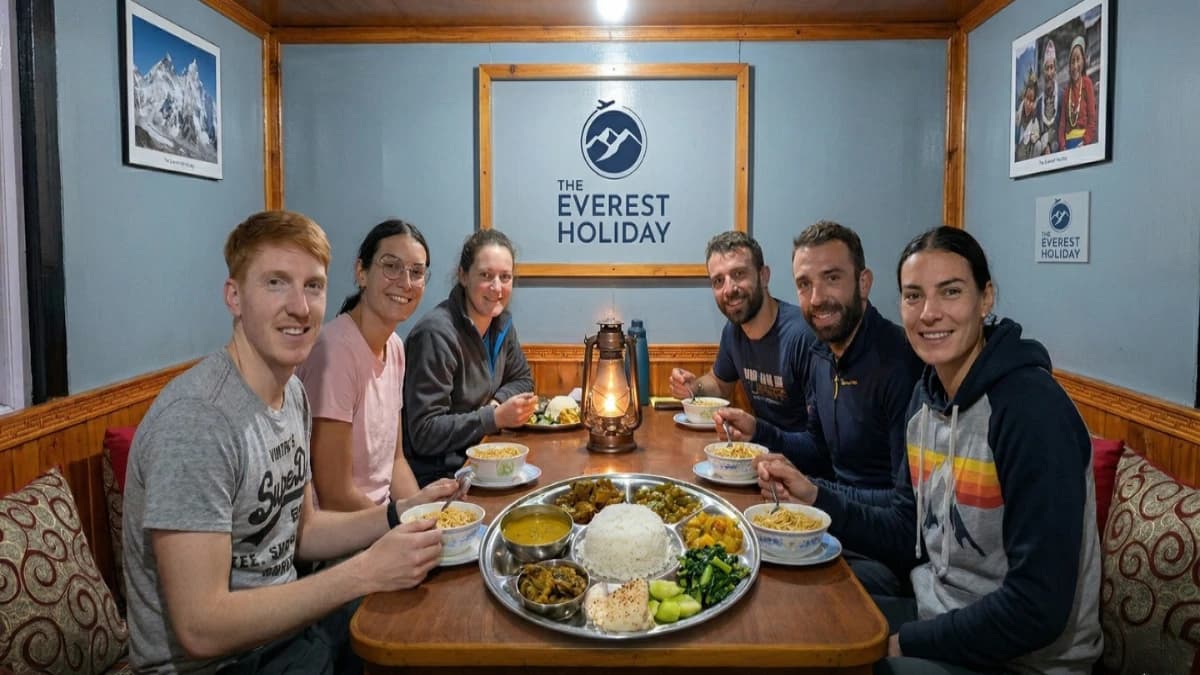
Short answer: On a Nepal trek you eat in teahouses, and the staple is dal bhat: rice, lentil soup, vegetable curry and pickle, usually with free refills. Menus also offer noodles, soups, pasta, eggs, Tibetan bread and momos, and prices rise the higher you go. Meals on the trail are included on our Standard and Luxury tiers, and not on Budget. Eat your way up on our 12-day Everest Base Camp trek.
It is four thousand metres above sea level, the temperature outside is minus six, and the kitchen of the teahouse in Lobuche is the warmest room within a day's walk. A woman in a fleece jacket and woolly hat is stirring a pot the size of a car wheel over a gas burner. Inside the pot: lentils. Yellow, thick, bubbling. The smell fills the room: earthy and warm and deeply, unreasonably comforting after seven hours of walking through cold thin air.
She ladles the lentils onto a metal plate alongside a mound of rice, a scoop of vegetable curry, a smear of pickle, and a piece of papad that cracks when you touch it. She sets it down in front of you without ceremony. This is dal bhat. Rice and lentils. The national dish of Nepal. The fuel that has powered Himalayan lives for centuries and that will power yours for the next twelve days.
It does not look like much. It tastes like everything.
What is dal bhat and why do trekkers eat it?
Every guide in Nepal will tell you the same thing, usually with a grin: "Dal bhat power, twenty-four hour." It is a joke that is also the truth. Dal bhat (rice with lentil soup, vegetable curry, pickles, and papad) is what ninety percent of trekkers eat for lunch and dinner throughout their trek. Not because there are no other options on the menu, but because experienced trekkers and guides quickly learn that nothing else works as well.
The science supports the folklore. Rice provides complex carbohydrates for sustained energy. Lentils deliver protein and iron. The vegetable curry adds vitamins and fibre. The pickle (achaar, in Nepali) provides salt, which your body desperately needs at altitude where you are losing fluids faster than you realise. Together, it is a nutritionally complete meal designed by generations of people who work at altitude for a living.
And it comes with unlimited refills. You eat your plate. The kitchen brings more. You eat that. More appears. Until you physically cannot eat another grain of rice, the dal bhat keeps coming. All for four to eight dollars depending on altitude.
The porters who carry your bag eat dal bhat twice a day. The guides eat it. The teahouse owners eat it. The Sherpas who climb Everest eat it at base camp. It is not exotic. It is not Instagram-worthy. It is the most effective trekking fuel in the Himalayas, and after a few days on the trail, the sight of that metal plate arriving at your table will produce a Pavlovian rush of anticipation that no restaurant meal has ever triggered.
What food is on a Nepal teahouse trekking menu?
Teahouse menus are surprisingly diverse, especially at lower altitudes. The handwritten laminated cards that appear at every meal typically offer fifteen to twenty-five items, though in practise two or three dishes dominate because they use the same base ingredients and can be prepared quickly in a kitchen running on limited fuel.
Breakfast
Porridge, oats or rice, sometimes with apple or cinnamon. Tibetan bread, which is fried flatbread that arrives golden and crispy and is best eaten with honey while it is still hot. Pancakes, plain, apple, or drowned in local honey. Eggs in every form: fried, scrambled, omelette, boiled. Toast with peanut butter or jam. And chapati, the thin flatbread that works as a scoop for anything else on your plate.
Tea and coffee appear at every meal. Nepali milk tea, sweet, strong, brewed with ginger and cardamom, becomes the addiction that outlasts the trek. Black tea for those who take it plain. Coffee that ranges from excellent at lower altitudes to something best described as "brown and hot" above four thousand metres.
Lunch and Dinner
Dal bhat reigns supreme, but the alternatives include fried rice with vegetables or egg. Fried noodles, chow mein, the Nepali version, with cabbage and carrot and soy sauce. Momos, steamed dumplings filled with vegetables or chicken, served with a fiery red chilli sauce that clears sinuses at any altitude. Pizza, which sounds improbable at three thousand metres but is surprisingly good at lodges that have wood-fired ovens. Pasta with tomato sauce. Spring rolls. Soup, garlic, tomato, mushroom, or mixed vegetable.
Garlic soup deserves its own mention. Locals and guides swear by its altitude-sickness-fighting properties. The scientific evidence for this is thin, but the soup itself is thick, warming, and hydrating, three things your body needs desperately above four thousand metres. Whether garlic specifically helps acclimatisation or whether hot liquid with calories and salt helps acclimatisation is a debate best settled over a bowl of the stuff at a teahouse in Dingboche. Related: 10 Things I Wish I Knew Before Trekking in Nepal.
How does trek food change with altitude in Nepal?
Between Lukla and Namche Bazaar, the food is genuinely good. Fresh vegetables arrive from lower valleys. Bakeries in Namche produce croissants and cinnamon rolls. A coffee shop near the central square serves espresso that would not be out of place in Melbourne or Portland. You can eat pizza and drink beer and momentarily forget you are at three thousand four hundred metres in the Himalayas.
Above Namche, the quality remains solid through Tengboche and Dingboche. The menus narrow slightly. Vegetables become less fresh. Meat appears less frequently, and above four thousand metres, it is wise to avoid meat entirely. There is no refrigeration at altitude. The chicken or yak on the menu was butchered at an unknown time and stored at an unknown temperature. Food poisoning at four thousand metres, a day's walk from the nearest road, is a genuinely serious situation.
At Lobuche and Gorak Shep, the final settlements before base camp, the menus shrink to essentials. Dal bhat. Noodle soup. Fried rice. Porridge. The kitchen is running on limited fuel, limited water, and limited ingredients, all of which were carried up on the backs of porters or yaks. Do not expect culinary artistry. Expect energy, warmth, and gratitude that someone is cooking for you at five thousand metres.
How much does food cost on a Nepal trek?
Everything on a Nepal trek gets more expensive as you climb higher. This is not price gouging, it is the direct result of transportation costs. At Namche Bazaar, a dal bhat costs roughly five hundred to six hundred Nepali rupees, about four to five US dollars. At Gorak Shep, the same meal costs eight hundred to a thousand rupees, six to eight dollars. A bottle of water that costs a dollar fifty in Phakding costs three to four dollars at Lobuche.
Every item on that menu was carried to its current altitude on someone's back or on a yak. The porter who hauls thirty kilograms up a three-day trail to Gorak Shep earns a fraction of what you pay for dinner. The prices reflect not just the food but the extraordinary human effort of getting it there.
Are there vegetarian and vegan options on Nepal treks?
Vegetarians will find Nepal one of the easiest trekking destinations on earth. The majority of teahouse menus are vegetable-based. Dal bhat is vegetarian by default. Fried rice, noodles, soup, momos, pancakes, porridge, all available without meat at every stop.
Vegans need slightly more planning. Dal bhat without ghee, vegetable curry without dairy, fried rice with oil instead of butter, all possible but requiring communication with the kitchen. Tell your guide in advance and they will brief each teahouse owner before your meal is prepared.
Gluten-free trekkers face the most challenges. Rice-based meals are safe. Potatoes and eggs are reliable. But bread, noodles, momos, and chapati are ubiquitous and avoiding them above Namche where options narrow becomes an exercise in repetitive eating. It is doable, but bring supplementary snacks from Kathmandu.
If you have serious allergies, nuts, shellfish, dairy, inform your guide before the trek begins. Teahouse kitchens are small and shared. Cross-contamination is possible. Your guide will communicate directly with each kitchen in Nepali to ensure your requirements are understood and respected. Related: Vegan and Vegetarian Trekking in Nepal: What You Can Actually Eat.
How much water should you drink on a Nepal trek?
At altitude, your body loses water faster than at sea level, through increased breathing, reduced humidity, and the diuretic effect of acclimatisation. Dehydration at four thousand metres mimics and worsens altitude sickness symptoms. The headache you attribute to thin air may actually be your body screaming for water.
Three to four litres per day. Every day. Whether you feel thirsty or not.
Options: boiled water from the teahouse kitchen, ask them to fill your water bottle for a hundred to two hundred rupees. Purification tablets, cheap, lightweight, brought from home. A SteriPen UV purifier, fast, no chemical taste, reliable. Bottled water, available but expensive at altitude, creates plastic waste, and goes against the leave-no-trace ethic that keeps these trails beautiful.
The Meals You Will Remember
Trekkers rarely remember the best meal they ate on the trail. They remember the meal that mattered most, the dal bhat at Dingboche after the hardest day so far, eaten in a room warmed by a yak-dung stove while wind howled outside. The garlic soup at Gorak Shep that was the only thing they could stomach at five thousand metres. The pancakes with honey at Namche on the descent, when appetite returned like a lost friend and everything tasted extraordinary because their body finally had enough oxygen to process flavour again.
Food on a Nepal trek is not about cuisine. It is about fuel, warmth, community, and the remarkable reality that in the most remote mountains on earth, someone is cooking for you. That metal plate of dal bhat, carried to your table by a woman whose kitchen is higher than any mountain in Europe, is an act of hospitality that deserves to be received with something approaching reverence.
All meals on the trail are included in every package. See our EBC Trek or ABC Trek pages for the full meal inclusions by tier.
Teahouse food in Nepal is better than it has any right to be at 4,000 metres. Dal bhat with refills, garlic soup that cures headaches (or at least feels like it does), and apple pie baked in a wood oven with no electricity. The menus are the same on every route, the portions get smaller as you go higher, and the prices go up with the altitude. None of this matters. You will eat more dal bhat in two weeks than you thought possible, and you will miss it when you get home.
Food is included on all our treks. Your guide knows which teahouses cook the best dal bhat on every route.
WhatsApp:+977 9810351300
Email:[email protected]
Written by Shreejan Simkhada, CEO of The Everest Holiday and third-generation Himalayan guide. TAAN Member #1586.
Picked your trek? Our Everest Base Camp Trek (12 Days) is private (your group only, no strangers), 2027 dates open, From USD $1399. WhatsApp us for tailored 2027 dates and current departures.


 Chat with Shreejan