

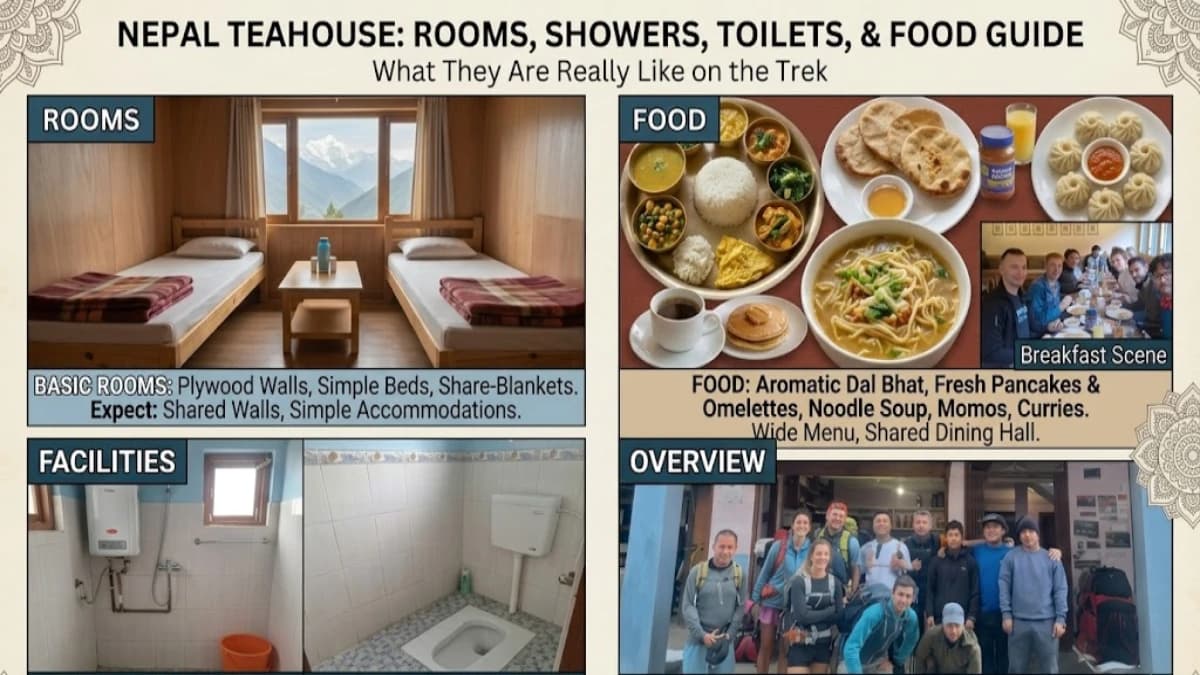
Short answer: A teahouse is a simple family lodge on the trail. You sleep in a basic twin room with a bed, a mattress and blankets, and eat in a shared dining room warmed by a stove. Lower down, rooms may have an attached bathroom; higher up, toilets are shared and hot showers and charging cost extra. Budget has shared rooms, while Standard and Luxury have private rooms. Stay in them on our 12-day Everest Base Camp trek.
The first teahouse surprises everyone. You have been walking for five hours through forest and farmland, your pack is heavy, your feet are speaking to you in a language you have not heard before, and then the trail rounds a corner and there it is, a two-storey stone building with a tin roof and a hand-painted sign that reads "Welcome Lodge and Restaurant" in slightly uneven English. Prayer flags flutter from the rooftop. Smoke drifts from a kitchen window. A dog of uncertain heritage sleeps across the doorstep.
You step inside and the warmth hits you, a wood-burning stove in the dining room, a row of bench seats along the walls, a menu handwritten on a laminated card, and the smell of dal cooking that triggers something primal in a body that has been burning calories for five hours straight. A woman in a fleece jacket appears from the kitchen, smiles, and says "Namaste. Tea?"
This is a teahouse. Not a hotel. Not a hostel. Not a guesthouse in any Western sense. It is something unique to the Himalayas, a family-run shelter along the trekking trails that provides a bed, a meal, and a roof to anyone who walks through the door. They are the infrastructure that makes Nepal trekking possible. Without them, the only option would be camping, which would transform a twelve-day trek into an expedition requiring tents, cooking equipment, and a support team.
Understanding what teahouses are, and what they are not, is the difference between arriving with expectations that match reality and arriving disappointed by something that was never trying to be what you imagined.
What are Nepal teahouse rooms really like?
A standard teahouse room contains two single beds separated by a thin plywood partition from the room next door. Each bed has a mattress, ranging from adequate to thin depending on altitude and establishment, a pillow, and one or two blankets. There may be a small table, a hook on the wall for your jacket, and a window that either opens or does not. The walls are wood or stone. They are not insulated. They are not soundproof. Your neighbour's alarm clock is your alarm clock.
At lower altitudes, Lukla to Namche on the Everest route, or the first few days of the Annapurna Circuit, the rooms are comfortable by mountain standards. Some have attached bathrooms. Some have electrical outlets. A few have been recently renovated with plaster walls, curtains, and something approaching cosiness.
At higher altitudes, above four thousand metres, the rooms become simpler. Bare wood walls. No electricity in the room. Shared bathroom down a cold corridor or in a separate building outside. The mattress is thinner. The blankets are fewer. The temperature inside the room at night is only marginally warmer than the temperature outside. Your sleeping bag is not a luxury at this altitude, it is the difference between sleep and a miserable night of shivering under inadequate blankets.
The rooms are clean. Not hospital clean. Not hotel clean. Trekker clean, swept, the sheets changed between guests, the mattress wiped down. You are sleeping at altitude in a building constructed from local materials by local hands in one of the most remote inhabited places on earth. Adjust your cleanliness threshold accordingly and you will be fine.
Do Nepal teahouses have hot showers and Western toilets?
Below three thousand metres, many teahouses offer Western-style flush toilets and sometimes hot showers, solar-heated or gas-heated depending on the establishment. These are functional. They are not spa facilities. The hot water may last four minutes or fourteen depending on how many trekkers showered before you and how much sunlight the solar panel received that day.
Above four thousand metres, the standard changes. Squat toilets become the norm, a porcelain or concrete basin set into the floor, flushed with a bucket of water scooped from a barrel. This is the bathroom technology used by the majority of the world's population. It is hygienic when used correctly. It requires thigh muscles you did not know you had. And it requires a head torch at three in the morning when the path from your room to the toilet block is dark, uneven, and possibly icy.
Showers above four thousand metres are cold unless the teahouse has a gas-heated system, which some do and some do not. Many trekkers above Dingboche simply stop showering for the final four or five days of an EBC trek. Wet wipes become the daily hygiene routine. Nobody judges. Nobody smells any better than you do.
What Food Can You Get at Nepal Teahouses?
Teahouse food is the surprise of Nepal trekking. Most first-timers expect basic sustenance and find instead a diverse menu that, at lower altitudes at least, offers genuine choice and flavour.
The menus are handwritten on laminated cards and appear identical from one teahouse to the next because they are: dal bhat, fried rice, fried noodles, momos, soup, pizza, pasta, pancakes, porridge, eggs, toast. The variation is in the execution, some teahouse kitchens produce remarkable food from basic ingredients and a two-burner gas stove, while others produce the same dishes with considerably less care.
Dal bhat dominates. Rice, lentil soup, vegetable curry, pickle, and papad, with unlimited refills. It is the most nutritionally complete and cost-effective meal on the menu. It is what every guide eats. It is what every porter eats. It is what your body needs at altitude: complex carbohydrates, plant protein, salt, and warmth. Eating dal bhat twice a day is not a limitation. It is a strategy that has fuelled Himalayan workers for centuries.
At Namche Bazaar, the food reaches unexpected heights. Bakeries produce croissants and cinnamon rolls. Coffee shops serve espresso. Pizza comes from wood-fired ovens. Namche exists in a strange altitude-defying culinary bubble that disappears the moment you walk north towards Tengboche.
Above Dingboche, the menus narrow and the quality simplifies. Fresh vegetables become rare. Meat should be avoided, there is no refrigeration, and the chicken on the menu was butchered at an unknown time under unknown conditions. Dal bhat, noodle soup, fried rice, and garlic soup become the four-item reality of high-altitude dining. Eat for fuel, not flavour. Your taste buds are suppressed by altitude anyway.
The Dining Room
The social heart of every teahouse is the dining room. A room lined with bench seats around a central stove, wood-burning at lower altitudes, yak-dung at higher ones, where every trekker in the building congregates from late afternoon until bedtime. This is where you eat, drink tea, play cards, charge phones, and have conversations with people from countries you have never visited about experiences you cannot yet imagine.
The stove is the axis around which mountain evenings revolve. When it is lit, usually around four in the afternoon as the temperature drops, the dining room transforms from a cold, empty space into the warmest room within hours of walking. Trekkers huddle closer as the evening deepens. Books appear. Card games start. The teahouse owner moves between tables refilling tea. Your guide sits with the other guides in a corner, speaking Nepali and laughing at jokes you wish you could understand.
The dining room is the reason many trekkers remember teahouses with genuine fondness long after the trail details have faded. The cold rooms, the basic toilets, the limited menu, these are forgettable inconveniences. The warmth of the stove and the company of strangers becoming friends at seven thousand feet, that stays.
How Does Your Package Tier Affect Teahouse Quality?
Budget packages use standard teahouse rooms, whatever is available when your guide books. Standard packages prioritise better rooms where available, larger, with an attached bathroom at lower altitudes, with a better mattress. Luxury packages secure the best rooms in each teahouse, private, attached bathroom, sometimes heated.
The difference between tiers is not the food, which comes from the same kitchen regardless of what you paid, or the trail, which is the same trail. The difference is the room you sleep in. After a ten-hour day at four thousand metres, the quality of your sleep determines the quality of your next day. A better room is not a luxury at altitude. It is a performance investment.
The Etiquette
Remove your boots at the door. Do not charge your phone in the dining room socket without asking. Do not spread your drying laundry across the communal benches. Order your food from the teahouse where you are sleeping, not from the one next door. The room cost is subsidised by the food revenue. If you sleep in one teahouse and eat at another, you are undermining the economic model that keeps the roof over your head.
Be patient with the kitchen. One or two people are cooking for thirty trekkers on gas burners that were carried up the mountain on someone's back. Meals take time. The wait is part of the experience. Use it to write in your journal, study the map, or watch the light change on the peaks through the window.
And leave the teahouse as you found it. Or better. The Himalayas are not indestructible. The communities that host you along the trail are maintaining a delicate balance between livelihood and environment. Your respect for their space is the rent you pay for the privilege of sleeping in the most extraordinary guesthouses on earth.
Experience teahouse trekking on the Everest Base Camp Trek, the Annapurna Base Camp Trek, or the Langtang Trek. All accommodation is included in our packages.
Nepal teahouses are not hotels. The rooms are small, the walls are thin, the showers are sometimes warm and sometimes not, and the toilets range from Western-style to a hole in the floor. They are also the most welcoming accommodation you will ever stay in. The owner's family cooks your dinner, the common room has a wood stove, and the conversation with other trekkers over tea is half the experience. Manage your expectations and you will love them.
Teahouse accommodation is included on all our treks. Your guide books the best available rooms at every stop.
WhatsApp:+977 9810351300
Email:[email protected]
Written by Shreejan Simkhada, CEO of The Everest Holiday and third-generation Himalayan guide. TAAN Member #1586.
Nepal teahouses on EBC: what the rooms really look like. Our Everest Base Camp Trek (12 Days) is private (your group only, no strangers), 2027 dates open, From USD $1399. WhatsApp us for tailored 2027 dates and current departures.

 Chat with Shreejan