

Written by Shreejan Simkhada, CEO of The Everest Holiday and third-generation Himalayan guide. TAAN Member #1586.
Khumbu Glacier, Walking Across a River of Ice
There's a moment on every Everest Base Camp trek that catches people off guard. You've been walking through valleys and villages for days, climbing steadily, adjusting to the thin air. Then somewhere between Lobuche and Gorak Shep, the ground beneath your boots changes. It's no longer dirt and rock. It's ice, covered in rubble, cracked and groaning, stretching out in every direction like a frozen wasteland. You're standing on the Khumbu Glacier, and it's unlike anything you've seen before.
Khumbu Glacier at a glance
| Length | About 17 km, one of the longest glaciers in Nepal |
| Source | The Western Cwm and the Khumbu Icefall, below Everest and Lhotse |
| Where you meet it | Between Lobuche and Gorak Shep, on the Everest Base Camp trek |
| Everest Base Camp | Sits on the glacier's lateral moraine at about 5,364 m |
| Best viewpoint | Kala Patthar (5,545 m), above Gorak Shep |
| Protected area | Sagarmatha National Park (a UNESCO World Heritage Site) |
| Trek it on | Everest Base Camp Trek, Everest Three Passes Trek |
The glacier lies within Sagarmatha National Park, managed by Nepal's Department of National Parks and Wildlife Conservation.
This is Nepal's most famous glacier, and for good reason. It sits at the foot of the world's highest mountain, feeds the rivers that run through the Khumbu valley, and forms the final stretch of terrain between you and Everest Base Camp itself. Every trekker who reaches EBC walks across it. Every climber who attempts Everest's south side starts from its surface. It's one of the most extraordinary natural features in the Himalayas, and understanding it before you arrive makes the experience far richer.
What Exactly Is the Khumbu Glacier?
The Khumbu Glacier is a massive body of ice that flows down from the Western Cwm of Mount Everest, between the peaks of Everest, Lhotse, and Nuptse. It stretches roughly 12 kilometres in length, making it one of the longest glaciers in the Nepal Himalaya. At its widest points, it spans nearly a kilometre across.
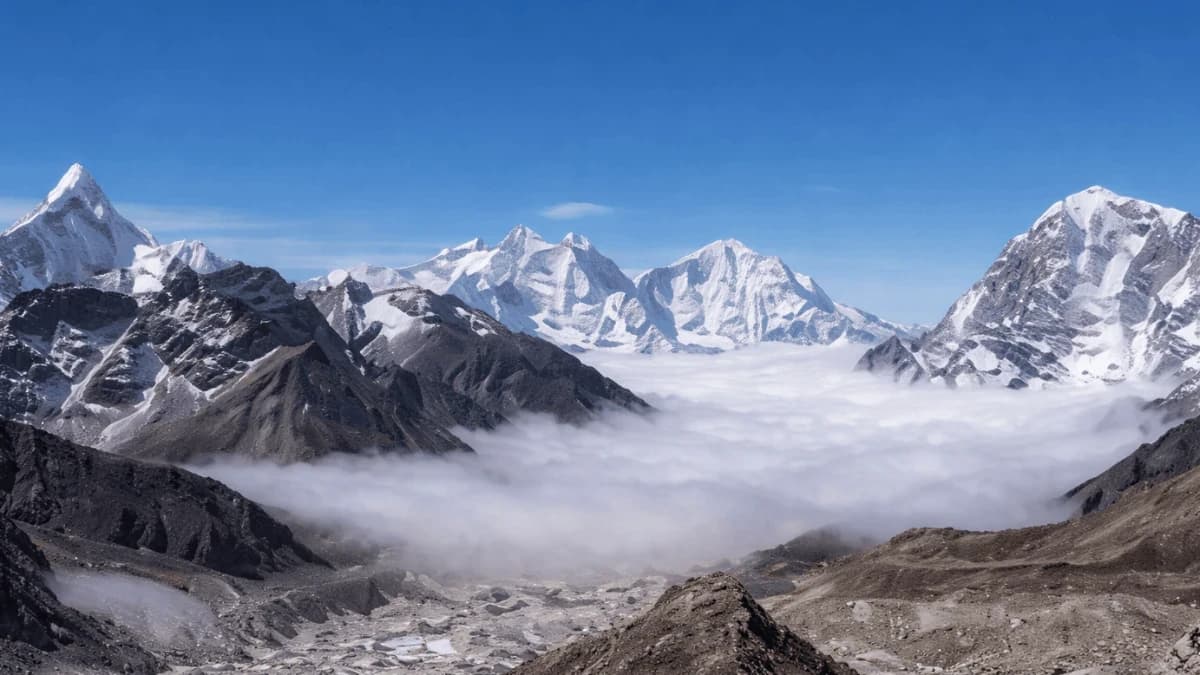
The glacier begins high up at around 7,600 metres, where snowfall compresses into ice year after year. It flows slowly downhill, and we mean slowly, a few centimetres per day in most sections, until it reaches its terminus at around 4,900 metres near Gorak Shep. Along the way, it picks up enormous amounts of rock and debris, which is why large sections of it don't look like ice at all. From above, it resembles a rocky moonscape more than a glacier. But dig beneath that thin layer of rubble and you'll find solid blue ice, sometimes tens of metres thick.
The glacier is fed by avalanches and snowfall from the surrounding peaks. It's a living, moving thing, always shifting, always cracking, always reshaping itself. You'll hear it. That's what surprises most trekkers. The glacier groans and pops and cracks beneath you, especially in the afternoons when the sun warms the surface. It sounds unsettling at first, but it's completely normal. Our guides will tell you, the glacier talks. You just have to listen.
What Is It Like to Walk on the Khumbu Glacier?
If you're trekking to Everest Base Camp, you'll walk across the Khumbu Glacier on Day 9 of our 15-day itinerary (or the equivalent day on other routes). The crossing happens between Gorak Shep and Everest Base Camp itself, a stretch of roughly two to three hours each way.
Here's what to expect. The trail from Gorak Shep heads south across the glacier's lateral moraine, the ridges of debris pushed to the sides by the moving ice. The path is rough and uneven. You're stepping over loose rocks, navigating around small meltwater pools, and occasionally crossing patches of exposed ice. It's not technical climbing by any means, but it does require concentration. A twisted ankle here would be a serious problem, so we always tell trekkers: watch your feet, take your time, use your trekking poles.
The trail is marked with small cairns, piles of stones left by guides and porters. These shift from season to season as the glacier surface changes, so the exact route is never quite the same twice. This is one of the reasons we insist on experienced, licensed guides for every trek. They know this terrain intimately and they walk it multiple times each season.
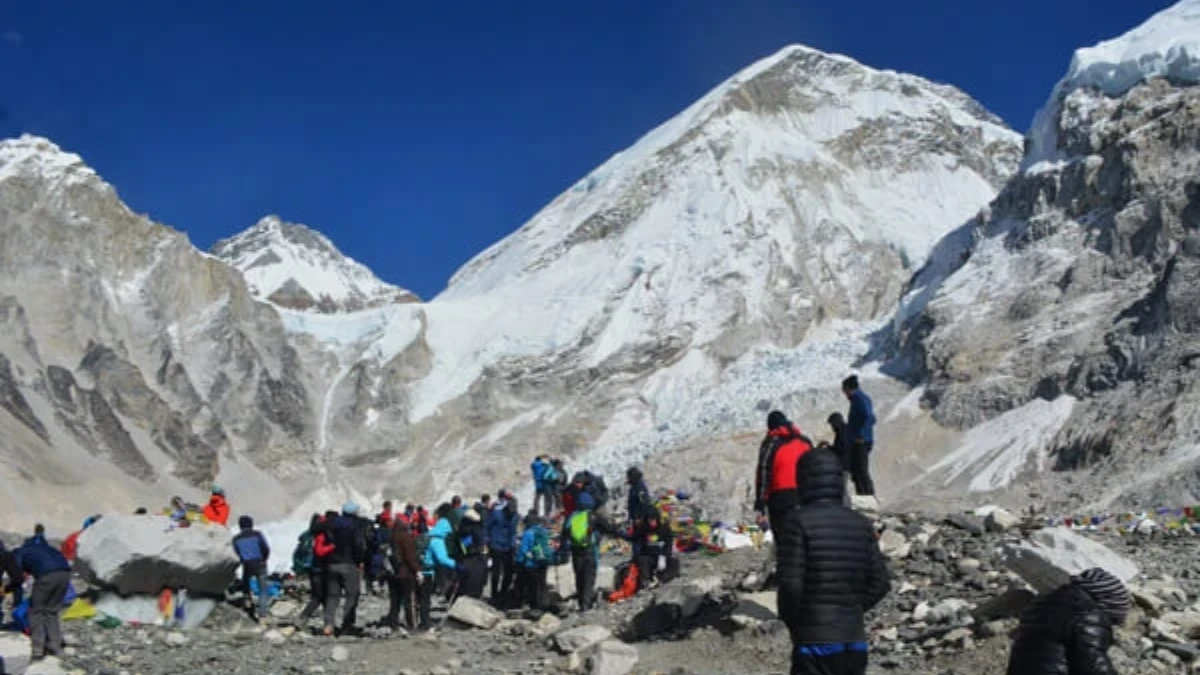
Everest Base Camp sits directly on the glacier at 5,364 metres. When you arrive, you're standing on ice. The colourful tents of climbing expeditions (during spring and autumn seasons) are pitched on flattened sections of the glacier surface. It's a surreal sight, a small temporary city on a moving river of ice, with the Khumbu Icefall towering above.
The Khumbu Icefall, Everest's Most Dangerous Section
You won't climb through the Khumbu Icefall on a standard EBC trek, that's the domain of summit climbers. But you'll see it clearly from Base Camp, and understanding what it is adds real weight to the experience.
The Khumbu Icefall is the section of glacier between Base Camp (5,364m) and Camp 1 (6,065m) in the Western Cwm. It drops roughly 700 metres over a distance of just two kilometres, which means the ice is under enormous stress. It cracks, splits, and collapses constantly, creating a maze of crevasses, seracs (towering ice pillars), and unstable ice blocks, some the size of houses.
Every spring, a team of highly skilled Sherpa climbers known as the "Icefall Doctors" fixes ropes and aluminium ladders across the worst sections. Even so, the icefall remains the single most dangerous part of the south side Everest route. It moves roughly a metre per day, which means the ladders and ropes need constant adjustment.
From Everest Base Camp, you can see the lower sections of the icefall, a chaotic jumble of blue-white ice towers catching the light. On quiet mornings, you might hear the crack and rumble of ice collapsing somewhere above. It's a humbling reminder of the forces at work here, and it gives you enormous respect for the Sherpa climbers who cross it dozens of times each season.
How Is Climate Change Affecting the Khumbu Glacier?
We need to talk about this honestly, because it's something we see with our own eyes every season.
The Khumbu Glacier is shrinking. Studies from the International Centre for Integrated Mountain Development (ICIMOD) and other research bodies confirm what local guides have known for years, the glacier is thinner than it was a generation ago, and its terminus is retreating uphill.
Glacial lakes are forming where solid ice used to be. The surface is increasingly covered in debris as the ice beneath melts and drops its rocky load. Meltwater streams that used to appear only in late spring now run earlier and longer. The older Sherpa guides in Namche and Pangboche will tell you the same thing, the ice isn't what it was when they were young.
This matters beyond the trek itself. The Khumbu Glacier feeds the Dudh Koshi river system, which provides water to hundreds of thousands of people downstream. As the glacier shrinks, water flow patterns change, more flooding in the short term as ice melts faster, less water in the long term as the ice reserve diminishes.
For trekkers, the practical impact is that the glacier surface is rougher and more unstable than it was decades ago. Routes across it change more frequently. Meltwater pools appear in unexpected places. None of this makes the trek dangerous, our guides navigate it safely every season, but it does mean the landscape you'll see is actively changing, year on year.
Walking across the Khumbu Glacier today is, in a real sense, witnessing one of the most visible effects of climate change on the planet. It's worth pausing to take that in.
What You'll See on the Glacier
Despite its reputation as a barren wasteland, the glacier has more to offer visually than most trekkers expect.
- Ice pinnacles (penitentes), Small, blade-like formations of ice that catch the light beautifully in early morning and late afternoon. They form through a process called sublimation and can reach a metre or more in height.
- Glacial pools, Bright turquoise meltwater pools that appear on the glacier surface, particularly in spring. They're striking to photograph but not safe to approach too closely, the edges can be undercut.
- Crevasses, Deep cracks in the ice, sometimes hidden beneath thin snow bridges. You'll see them from a safe distance on the marked trail. They're a vivid reminder that the glacier is moving.
- Moraine ridges, The great walls of rubble pushed up along the glacier's edges. Walking along these gives you elevated views across the glacier surface.
- The Khumbu Icefall, Visible from Base Camp, the chaotic, broken section of glacier climbing toward the Western Cwm. Best viewed in morning light.
- Prayer flags, At Everest Base Camp itself, colourful prayer flags strung between rocks flutter in the wind. It's the traditional marker that you've arrived.
Safety on the Glacier
Let's be straightforward, crossing the Khumbu Glacier on the standard EBC trekking route is safe when you're with an experienced guide. You're walking on the lower, slower-moving section of the glacier where the ice is relatively stable. You're not crossing crevasses on ladders. You're not roped up. It's a rough walk, not a mountaineering exercise.
That said, there are sensible precautions we always take.
- Proper footwear is essential. You need sturdy trekking boots with good ankle support and grippy soles. The terrain is loose rock over ice, slippery when wet.
- Trekking poles make a real difference. They give you stability on the uneven surface and take pressure off your knees on the return.
- Stay on the marked trail. The cairns are there for a reason. Wandering off-route risks stepping on thin ice or unstable rubble.
- Watch for meltwater. In the afternoons, small streams appear on the glacier surface. They're not dangerous but they can make rocks slippery.
- Listen to your guide. If they say stop, you stop. If they change the route, you follow. They've crossed this glacier dozens of times and they know its moods.
Our guides carry a pulse oximeter and first aid kit at all times. We monitor every trekker's oxygen saturation daily from Namche onwards. At 5,364 metres, altitude is a bigger concern than the glacier itself, which is precisely why we build two acclimatisation days into every itinerary.
Preparing for the Glacier Crossing
You don't need any special equipment or technical skills to cross the Khumbu Glacier. If you've made it to Gorak Shep, you've already proven you can handle the terrain and the altitude. The glacier crossing is the final push, physically demanding because of the altitude and the rough ground, but not technical.
What helps most is being well-rested the night before (as much as anyone sleeps well at 5,140 metres), eating a good breakfast, carrying enough water, and starting early. We always aim to reach Base Camp in the morning when the glacier is at its most stable and the air is calm. Afternoons bring wind, cloud, and more meltwater on the surface.
Bring your camera fully charged with a spare battery, cold kills batteries fast at this altitude. Bring sunscreen and good sunglasses too. The reflection off ice and snow at this altitude can cause snow blindness in minutes without protection.
Why It Matters
The Khumbu Glacier isn't just an obstacle between you and Everest Base Camp. It's one of the most remarkable natural features on the planet, a 12-kilometre river of ancient ice that has shaped the Khumbu valley, sustained its communities, and challenged its climbers for generations. Walking across it connects you to something much bigger than a trek. It connects you to the mountain itself.
When you stand at Base Camp and look up at the icefall, with the glacier stretching away behind you and the summit of Everest hidden somewhere above the clouds, you'll understand why people come back to this place again and again. It's not about conquering anything. It's about being present in a landscape so vast and so powerful that it puts everything else in perspective.
We've been guiding trekkers across this glacier for years, and it still takes our breath away, though at 5,364 metres, that might just be the altitude.
Plan Your Khumbu Glacier Trek
The Khumbu Glacier is the final stretch of every walking route to Everest Base Camp. If this guide has convinced you to walk it yourself, here are the treks that cross the glacier and the trail-stop guides for the villages right above it.
- Everest Base Camp Trek - 12 Days : the headline route, crossing the Khumbu Glacier on the way to base camp.
- Everest Base Camp with Gokyo Lakes and Cho La Pass - 15 Days : the longer route adding the Gokyo lakes and the Ngozumpa Glacier crossing.
- Everest Three Passes Trek - 17 Days : the ultimate Khumbu loop, crossing every major glacier in the region.
- Gorak Shep Guide : the highest village on the trail, sitting right beside the Khumbu Glacier.
- Cho La Pass Guide : the high pass that links the Khumbu and Gokyo glacier systems.
You cross the Khumbu Glacier on the final approach to Everest Base Camp on the EBC Trek. The EBC with Gokyo Lakes Trek also crosses glacier terrain at Cho La Pass.
The Khumbu Glacier is the highest glacier most trekkers will ever walk on. The ice towers, the crevasses, and the sound of the glacier creaking under your feet are things that photographs cannot capture. You have to be there. And when you are there, standing on ice that has been flowing down from Everest for thousands of years, you feel very small and very alive at the same time.
You walk on the Khumbu Glacier on our Everest Base Camp Trek. Base Camp itself sits on the glacier's moraine.
WhatsApp:+977 9810351300
Email:[email protected]
Want to stand on the Khumbu Glacier? Our Everest Base Camp Trek (12 Days) is private (your group only, no strangers), 2027 dates open, From USD $1399. WhatsApp us for tailored 2027 dates and current departures.
 Chat with Shreejan