
Island Peak is a lie. The mountain was named by Eric Shipton's 1953 expedition, who looked at its triangular summit rising from the surrounding glaciers and thought it resembled an island in a sea of ice. The name suggests something gentle. The reality, 6,165 metres of rock, snow, and a final headwall that requires fixed ropes, crampons, and the willingness to trust your life to an ice axe planted in a frozen wall at an altitude where your body has about forty percent of the oxygen it needs, is anything but gentle.
And yet. Island Peak is the most popular trekking peak in Nepal. It is climbed by hundreds of people every year, teachers, accountants and software engineers, who arrived in Kathmandu two weeks earlier with no mountaineering experience. They trained. They acclimatised. They walked to Everest Base Camp and then, instead of going home, they turned south toward a mountain that offers something the base camp trail cannot: a summit.
Not Everest's summit. Not a seven-thousander's summit. A summit that is achievable by non-climbers with proper preparation, professional guidance, and the physical and mental fitness to push through a twelve-hour summit day that begins in the dark at two in the morning and ends, if everything goes well, with you standing on a narrow ridge of snow at 6,165 metres, looking at Lhotse and Makalu and Ama Dablam at eye level, breathing air so thin it tastes like metal, and understanding, viscerally, in your muscles and your lungs and the part of your brain that processes accomplishment, that you have just climbed higher than any mountain in North America, South America, Europe, or Africa.
What the Climb Involves
The trek to Island Peak base camp follows the standard EBC route to Dingboche, then diverges south to Chukhung at 4,730 metres. From Chukhung, a day's walk brings you to Island Peak base camp at approximately 5,100 metres.
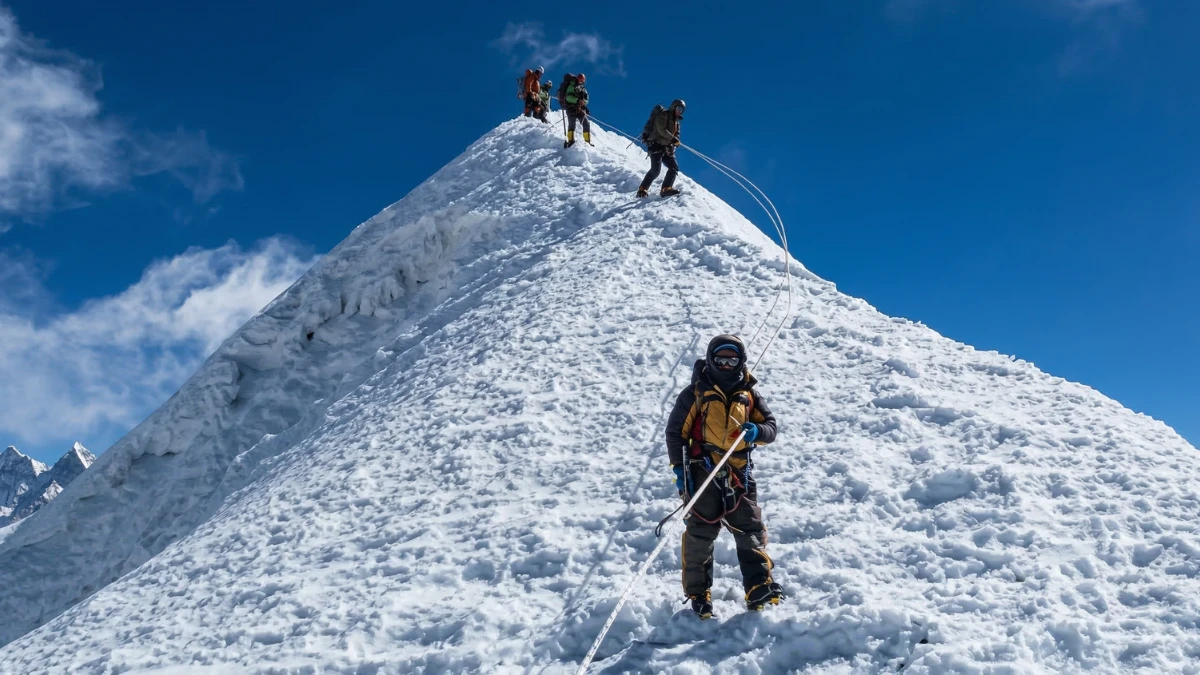
Summit day starts at one or two in the morning. You climb in the dark through rocky terrain to the glacier, headlamp, crampons, ice axe, and a rope that connects you to your climbing guide. The glacier crossing is moderate, relatively flat, with occasional crevasses that your guide navigates. Then the headwall.
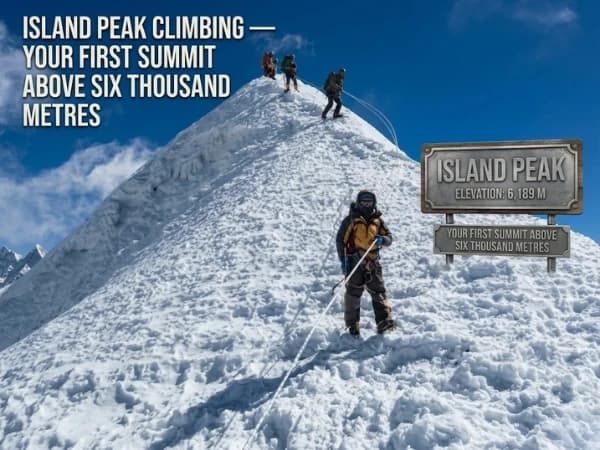
The headwall is the crux. A steep wall of ice and snow, roughly forty-five to fifty degrees, that rises three hundred metres to the summit ridge. Fixed ropes are set by the climbing Sherpas before your attempt. You clip in with a jumar (ascender) and climb, one step, one slide of the jumar, one step, one slide, for approximately two hours of sustained vertical effort at an altitude where each step requires conscious will.
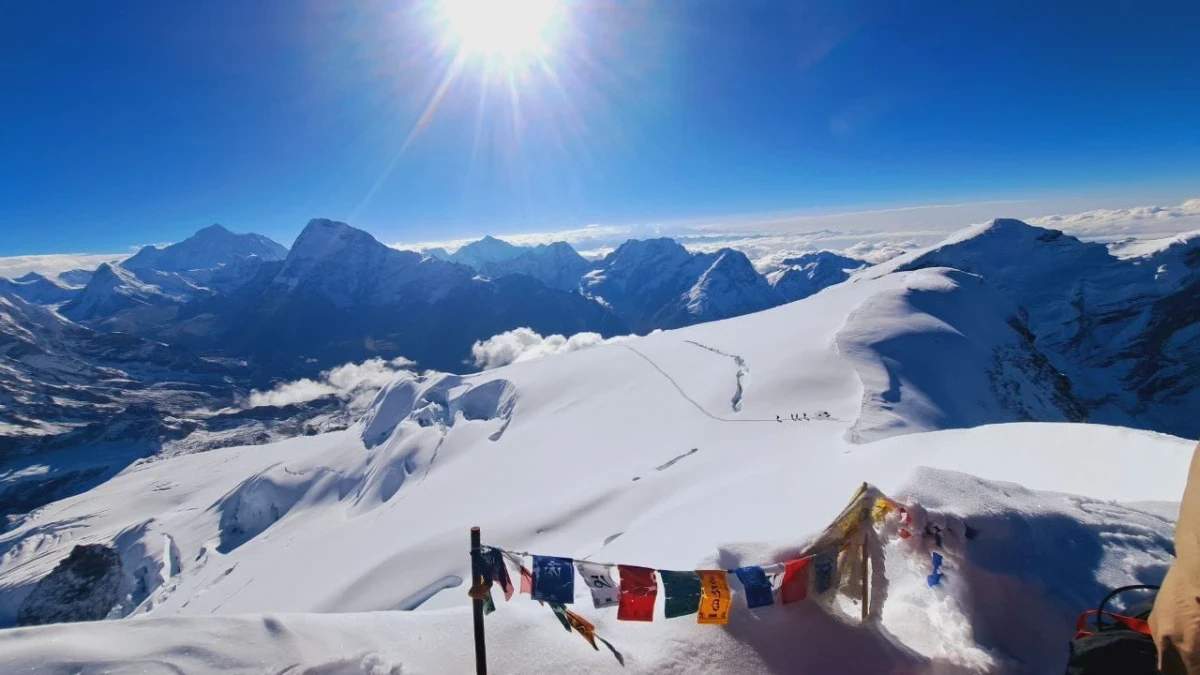
The summit ridge is narrow. Exposed on both sides. The views are, and this word is inadequate but accurate, indescribable. Lhotse's south face dominates the north. Makalu rises to the east. Ama Dablam's perfect pyramid sits to the south. You are surrounded by the highest mountains on earth, and you are standing above six thousand metres among them.
The descent reverses the route. Down the headwall on fixed ropes. Back across the glacier. To base camp by mid-afternoon. To Chukhung by evening. Every step of the descent feels like flying, the oxygen thickening with each hundred metres lost, the body recovering as altitude releases its grip.
Who Can Do This
The answer is broader than most people expect. Island Peak does not require previous mountaineering experience. It requires fitness, good cardiovascular endurance and strong legs trained through weeks of stair climbing and hiking. It requires mental toughness, the summit day is twelve to fourteen hours of sustained effort in cold, thin air, and the headwall is intimidating in a way that walking never is. And it requires basic crampon and rope skills, which are taught by your guide on a training day before the summit attempt.
The typical Island Peak client has completed a multi-day trek before, EBC, Annapurna Circuit, or similar, and wants to take the next step. They are not mountaineers. They are trekkers who want a summit. And Island Peak, designed by geography and geology to offer exactly that combination of challenge and accessibility, is where trekkers become climbers.
What Is the Island Peak Climbing Route?
Fourteen days total. Maximum altitude 6,165 metres. Budget from two thousand nine hundred and ninety-nine dollars. Includes EBC trek to Dingboche, diversion to Chukhung and Island Peak base camp, summit attempt, and return to Lukla. Requires all EBC permits plus NMA climbing permit. Difficulty: five out of five, the most demanding trek in our standard portfolio.
What the Peak Teaches You
At some point on the headwall, usually about two-thirds up, when your arms are shaking and your lungs are screaming and the summit ridge is visible above but feels impossibly far, a negotiation happens inside your head. Part of you says stop. Part of you says continue. The negotiation is not about fitness. It is about identity. Are you the person who turns back, or the person who keeps going?
Both answers are valid. Turning back from a mountain is not failure. It is the decision that keeps you alive to climb again. But for those who continue, who plant the ice axe one more time, slide the jumar one more time, take one more step, the summit is not just a place. It is proof. Proof that you can do things your normal life does not require and that the limits you assumed were fixed are, in fact, negotiable.
This is what Island Peak teaches. Not mountaineering technique, though you learn some. Not altitude physiology, though you see it. But the specific, personal, non-transferable knowledge that you are capable of more than you thought. And that knowledge, carried down from 6,165 metres and back into the life you left at sea level, changes the way you approach everything that comes after.
See our Island Peak Climbing (14 days) page for the full itinerary and pricing.
Island Peak is a lie. The name makes it sound tropical. The reality is a 6,165-metre summit in the Khumbu with a glacier approach, a headwall, and a ridge that drops away on both sides. It is not a trekking peak in any meaningful sense. It is a real mountain that happens to be climbable by fit, determined people with no prior climbing experience and a very good guide.
See our peak climbing packages or ask us if Island Peak is right for your fitness level.
WhatsApp:+977 9810351300
Email:[email protected]
Written by Shreejan Simkhada, CEO of The Everest Holiday and third-generation Himalayan guide. TAAN Member #1586.
Island Peak: your first 6,000m+ summit. Our Island Peak Climbing (14 Days) is private (your group only, no strangers), 2027 dates open, from USD 3,499 per person. WhatsApp us for tailored 2027 dates and current departures.
 Chat with Shreejan