

Gokyo Lakes and Renjo La Pass Trek, 12 Days is a 12-day trek over a high pass to the Gokyo lakes for fit trekkers who want the Gokyo lakes and a high pass without the Base Camp crowds. It reaches 5,360 m (Renjo La) and is graded Strenuous: a rest day at Thame, a pass day of about 8 hours at over 5,000 m and cold, basic lodges at Lungden and Gokyo. It costs from USD 1,970 per person (Budget, couple). The price per person is the same for a private trip and a group of the same size, and it falls as the group grows.
Gokyo Lakes and Renjo La at a glance
| Duration | 12 days, Lukla to Lukla (11 days on the trail, plus the flight back to Kathmandu on day 12) |
|---|---|
| Maximum altitude | 5,360 m / 17,585 ft (Renjo La). Gokyo Ri 5,357 m. You sleep no higher than 4,790 m at Gokyo |
| Grade | Strenuous. A pass day of about 8 hours and several days above 4,500 m. No technical skill needed |
| Best months | Mid October to mid November, then April |
| Group size | 1 to 20, always private |
| Starts and ends | Kathmandu. Fly to Lukla (Manthali in the busy weeks), fly back |
| Permits | Sagarmatha National Park, Khumbu Pasang Lhamu Rural Municipality and TIMS. All included |
| Start dates | You choose. See the windows for 2027 below |
| Hotels | Kathmandu nights are not included |
| From price | USD 1,970 per person, Budget, couple. Standard USD 2,760, Luxury USD 5,170 |
Why I built it this way
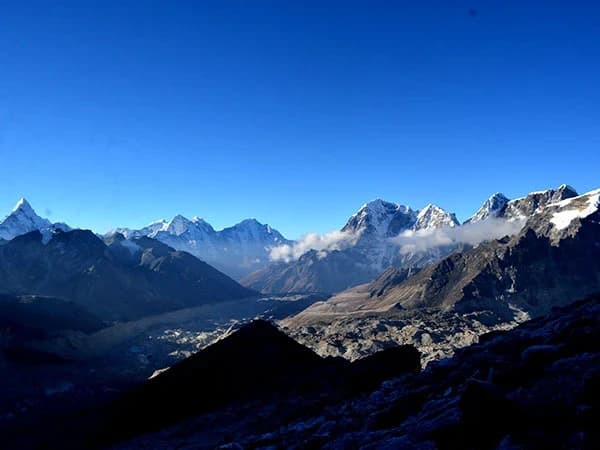
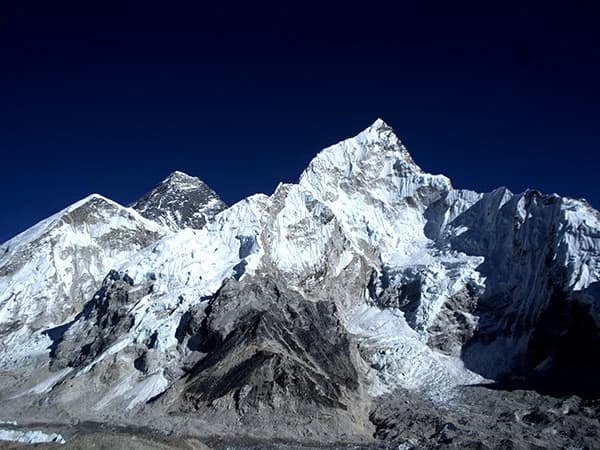
Gokyo is the Everest trek I send people on when they want the mountains without the Base Camp crowds. You walk beside the longest glacier in Nepal to a chain of turquoise lakes, then climb Gokyo Ri for a view of four of the six highest mountains in the world. This version adds Renjo La. Instead of walking in and out of the valley the same way, you cross a 5,360 m pass from the quiet Thame valley and arrive at the lakes from above. It is a loop, and you see more of the Khumbu.
I built in two changes to the usual plan. A full rest day at Thame, because the next sleep, at Lungden, is 680 m higher than the last. And a day at Gokyo after the pass, so you have a second chance at a clear sunrise from Gokyo Ri. Read Renjo La Pass Trek: One of the Most Scenic High Passes in the Everest Region and Gokyo Ri vs Kala Patthar: which view is better? before you choose, and Everest Base Camp vs Gokyo Lakes: Two Treks in the Same Mountains That Feel Like Different Worlds if you cannot decide between the two.
This is a hard trip. The pass day is about eight hours, mostly at 5,000 m or more, and the lodges at Lungden and Gokyo are cold and basic. You need to be fit, and you need to be happy with early starts in the dark. If you would rather not cross a pass, our 10-day Gokyo Lakes trek walks in and out of the valley the same way.
Hotel nights in Kathmandu are not included, so you choose your own (our family homestay is USD 15 per person per night). Every booking helps pay the teacher's salary at our Nagarjun Learning Center in Saldum. The Everest Holiday is a family company founded in 2016, from three generations of guiding in the Himalayas.
Best time to go, month by month
Rain and temperatures on the trail are published station averages from our Gokyo month-by-month guide. There is no weather station at Gokyo, which is colder than every station here, and the Dingboche figures are modelled. None of it is a forecast.
| Month | What it is like | My verdict |
|---|---|---|
| January | Coldest. Lukla 15.3 mm of rain. Namche 6.9 C by day and -8.5 C at night, Dingboche (modelled) 1.0 / -15.3 C. Gokyo is colder still. The lakes partly freeze and the trail can be icy above Machhermo. | Only with winter experience |
| February | Lukla 17.2 mm. Namche 6.4 / -6.5 C, Dingboche (modelled) 1.5 / -14.2 C. Very cold, dry. | Only with winter experience |
| March | Lukla 45.3 mm. Namche 9.6 / -3.0 C, Dingboche (modelled) 4.7 / -10.5 C. Spring begins. Flights leave from Manthali from about 15 March. | Possible, cold on the pass |
| April | Lukla 58.7 mm. Namche 12.8 / 0.8 C, Dingboche (modelled) 8.5 / -7.0 C. Warmer, more afternoon cloud, busier. | Good |
| May | Lukla 127.6 mm as the monsoon builds. Namche 14.3 / 3.7 C. Warmer but hazier and wetter. | Early May only |
| June | Monsoon. Lukla gets 324.8 mm and flights are held up often. | No |
| July | Monsoon. Lukla gets 529.8 mm. | No |
| August | Wettest month. Lukla gets 641.8 mm. | No |
| September | Lukla still gets 419.0 mm. The monsoon is clearing. | Late September only, with spare days |
| October | Lukla 102.9 mm. Namche 12.5 / 1.2 C, Dingboche (modelled) 8.9 / -5.3 C. Clear, the busiest weeks. | Best, from mid month |
| November | Almost dry: Lukla 6.2 mm. Namche 9.1 / -3.8 C, Dingboche (modelled) 5.3 / -11.0 C. The clearest views, colder every week. | Best, the first half |
| December | Lukla 0.5 mm. Namche 7.6 / -7.1 C, Dingboche (modelled) 3.2 / -13.4 C. Dry and very cold. | Only with care |
October and November give the clearest views, with the first half of November the pick if you can choose. March and April are the second window, warmer by day but with more afternoon cloud. The morning is the good part of the day, so we climb Gokyo Ri before dawn. Renjo La has occasional snow, and your guide decides on the morning of the pass. See also Everest Base Camp Weather Month by Month: What the Temperature Actually Feels Like at Five Thousand Metres.
Starting dates for 2027
You choose your start date, because every trip is private. These are the windows I would pick for 2027. Festival dates for 2027 are the expected ones from public calendars, and the government confirms them each year.
| Window in 2027 | What to expect | My advice |
|---|---|---|
| Early March 2027 (Gyalpo Lhosar, Sherpa New Year, expected 5 or 9 March) | Cold nights and quiet lodges. Namche is lively for the festival. Flights may leave from Manthali from about 15 March. | Only if you want cold and quiet |
| Late March to April 2027 | Warmer days and spring light, with more cloud as the weeks go on. Manthali flights, so keep spare days. | Good |
| Late September to early October 2027 (Dashain expected 6 to 10 October, not yet announced) | Clearing monsoon, still wet trails and flight holds. Dashain closes some teahouses and fills the buses. | Avoid the Dashain days |
| Mid October to mid November 2027 (Tihar expected 29 to 31 October) | The best weeks for clear lakes and a clear Gokyo Ri, and the busiest. Flights leave from Manthali, so keep two spare days at the end. | Best |
| Late November to February 2027 | Dry and very cold. The lakes partly freeze and the passes can be icy. | Only with winter experience |
The Manthali windows are about 15 March to 15 May and 25 September to 30 November, and they can shift from year to year. Keep at least two spare days before your international flight in the busy weeks. Tell me your dates and I will tell you what I know for that week.
Permits and costs
We apply for every permit and pay for all of them. You send us your passport details early.
| Permit or fee | Cost | Notes |
|---|---|---|
| Sagarmatha National Park entry | NPR 3,000 (NPR 1,500 SAARC) | Included |
| Khumbu Pasang Lhamu Rural Municipality | NPR 3,000 | Included |
| TIMS card | NPR 2,000 (NPR 1,000 SAARC) | Included, we issue it through our agency |
The price per person falls as the group grows, and a child pays the same as an adult. Private or group, the price per person is the same. Here is the full table. These prices hold for 2027.
| Group size | Budget | Standard | Luxury |
|---|---|---|---|
| 1 guest (solo) | USD 2,985 | USD 3,655 | USD 7,705 |
| 2 to 4 guests | USD 1,970 | USD 2,760 | USD 5,170 |
| 5 to 8 guests | USD 1,615 | USD 2,700 | USD 5,155 |
| 9 to 12 guests | USD 1,605 | USD 2,640 | USD 5,090 |
| 13 to 20 guests | USD 1,535 | USD 2,580 | USD 5,065 |
Not included: international flights, your Nepal visa (USD 30 for 15 days or USD 50 for 30 days, paid in cash on arrival), Kathmandu hotel nights, travel insurance, tips, personal spending and any extra porter (USD 25 per day plus 13% VAT and the 3.5% bank charge). You pay a 10% deposit to book and the balance in Kathmandu. We take US dollars or euros, in cash or by card, and card payments carry a 3.5% bank charge.
Getting there and getting back
You fly from Kathmandu to Lukla, a flight of about 40 minutes. Between roughly 15 March and 15 May and 25 September and 30 November the flights may leave from Manthali (Ramechhap) instead, and we include the road transfer. Luxury flies to Lukla and back by helicopter, on a shared seat. A helicopter does not remove weather, but it avoids the Manthali drive. Read our Is the Lukla Flight Safe? An Honest Answer from Someone Who Flies It and Manthali (Ramechhap) Airport: Where Your Lukla Flight Leaves From in Peak Season before you choose your dates.
Visa on arrival is USD 30 for 15 days or USD 50 for 30 days, and your passport must be valid for at least six months. Keep at least one spare day before your international flight, two in the busy weeks.
Safety and altitude
You cross Renjo La at 5,360 m and sleep at 4,500 m at Lungden and 4,790 m at Gokyo. Our own guideline is not to raise your sleeping height by more than 300 to 500 m a day above 3,000 m. The step from Thame (3,820 m) to Lungden (4,500 m) is 680 m, which is above that guideline, and that is why we add the rest day at Thame and walk slowly. Drink three to four litres of water a day. Your guide checks everyone's oxygen level every day with a pulse oximeter. If a reading is low or symptoms appear, we do not go higher, and if they worsen we go down.
The pass is steep and can have snow. There is no easy way round it once you have left Lungden. Your guide decides on the morning of the pass, and if it is not safe we do not push on. Lungden and Gokyo are cold at night. Buy travel insurance at home that covers trekking to 6,000 m and helicopter evacuation.
What to pack
- Broken-in trekking boots, with spare laces, and sandals for the lodge
- A warm sleeping bag rated to about -15 C, or ask us to lend one
- A down jacket, a fleece, thermal base layers and a windproof shell
- Warm gloves plus a thin pair, a warm hat, a buff and sunglasses with side shields
- Sun cream SPF 50 and lip balm
- A head torch and spare batteries (cold drains them)
- Trekking poles for the steep descents
- Microspikes for icy sections in late autumn and spring, if you have them
- A daypack of about 30 litres. Your duffel goes with the porter
- Personal medicines, blister care and rehydration salts
- Our full list is in What to Pack for Everest Base Camp: The Only List You Actually Need
Budget, Standard or Luxury
All three tiers walk the same route on the same days. What changes is how you sleep, what you eat, who carries your bag and how you get to Lukla.
| Budget | Standard | Luxury | |
|---|---|---|---|
| Rooms | Shared rooms in simple teahouses | Private twin rooms, attached bathroom where the lodge has one | Private deluxe rooms, ensuite where the lodge has one |
| Porter | None. You carry your own pack. An extra porter is USD 25 per day plus 13% VAT and the 3.5% bank charge | One porter for every two trekkers, 20 kg each in total. A solo guest has no porter: the guide carries up to 10 kg | One dedicated porter for every trekker |
| Meals | Not included on the trail | Breakfast, lunch and dinner every day, tea or coffee and seasonal fruit once a day | All meals, fruit and nuts, tea, coffee, soft drinks, juice and water whenever you want |
| Lukla flight | Fixed-wing, Kathmandu or Manthali to Lukla and back | Fixed-wing, Kathmandu or Manthali to Lukla and back | Round-trip helicopter, Kathmandu to Lukla and back, shared seat |
| Guide | 1 guide, an assistant at 8 or more | 1 guide for up to 6 trekkers, an assistant at 7 or more | 1 guide for every 2 trekkers |
Read before you book
- Gokyo Trek Best Time: Month by Month, With the Lakes, Passes and Flights
- Renjo La Pass Trek: One of the Most Scenic High Passes in the Everest Region
- Gokyo Ri vs Kala Patthar: which view is better?
- Lungden: The High Camp Gateway to Renjo La Pass on the Everest Three Passes Trek
- Thame: The Ancient Sherpa Village Where Tenzing Norgay Grew Up
- How Much Does the Gokyo Lakes Trek Cost in 2026/2027?
The Everest Holiday is a family company founded in 2016, from three generations of guiding in the Himalayas.