

There is a moment on every Everest Base Camp trek, usually somewhere between Namche Bazaar and Tengboche, when you see it happen. A trekker stumbles into the teahouse after a long day, drops their daypack on the floor, and starts pulling out things they have been carrying for three days and never once used. A hardcover book. A second pair of jeans. A hair dryer. True story.
Then there is the other trekker. The one who packed a 6kg daypack and glides through the door looking annoyingly fresh. Their secret is not fitness or youth or some expensive piece of gear. Their secret is that they packed less.
After watching this play out hundreds of times (we have been guiding trekkers to 5,364 metres for over a decade), here is the honest, no-nonsense packing list. Not the generic one copied from a travel magazine. The one that actually works when you are six days from the nearest road, breathing half the oxygen you are used to, and everything you own has to fit in a single duffel bag.
What Is the Most Important Packing Rule for EBC?
Your porter carries a maximum of 20 kilograms split between two trekkers, so your own share is 10 kilograms. You carry a daypack of 5 to 7 kilograms. That is it. Everything you bring for 12 days in the Himalayas must fit within those numbers.
Our guides repeat the same advice to every new group on Day 1. Pack your bag at home. Then take out a third. You still have too much. Take out one more thing. Now you are getting close.
They are not joking. The trekkers who enjoy Everest Base Camp the most are invariably the ones carrying the least.
What Head and Face Protection Do You Need for EBC?
At 5,000 metres, you lose most of your body heat through your head. And the ultraviolet radiation at altitude will burn exposed skin in twenty minutes flat: the air is thinner, the UV is brutal, and most people do not realise until their nose is peeling for three weeks after.
Bring a warm beanie or wool hat. You will sleep in it some nights above Dingboche when the temperature in your room drops to minus ten. Bring a sun hat with a brim for the lower elevations where the sun beats down and the air is warm and humid. Bring a buff or neck gaiter, arguably the most versatile item in your entire pack. It works as a face cover in wind, a neck warmer, a headband, a dust mask on the trail, and an emergency blindfold for sleeping in bright teahouses. Bring two.
Sunglasses with UV400 protection are not optional. Snow blindness at altitude is real, painful, and preventable. A trekker from Melbourne once told us she forgot her sunglasses at the teahouse in Gorak Shep and tried to summit Kala Patthar without them. She spent the next two days with her eyes bandaged in a dark room. Do not be that person.
Why Does the Layering System Matter More Than One Big Jacket?
The temperature on an Everest Base Camp trek swings from a comfortable twenty-five degrees Celsius in the lower valleys to minus twenty at Gorak Shep before dawn. If you pack one massive puffy jacket, you will be either sweating or freezing for twelve days straight. Neither is fun.
Instead, think in layers. Three layers that you can add and remove as the day changes, because it will change, sometimes hourly.
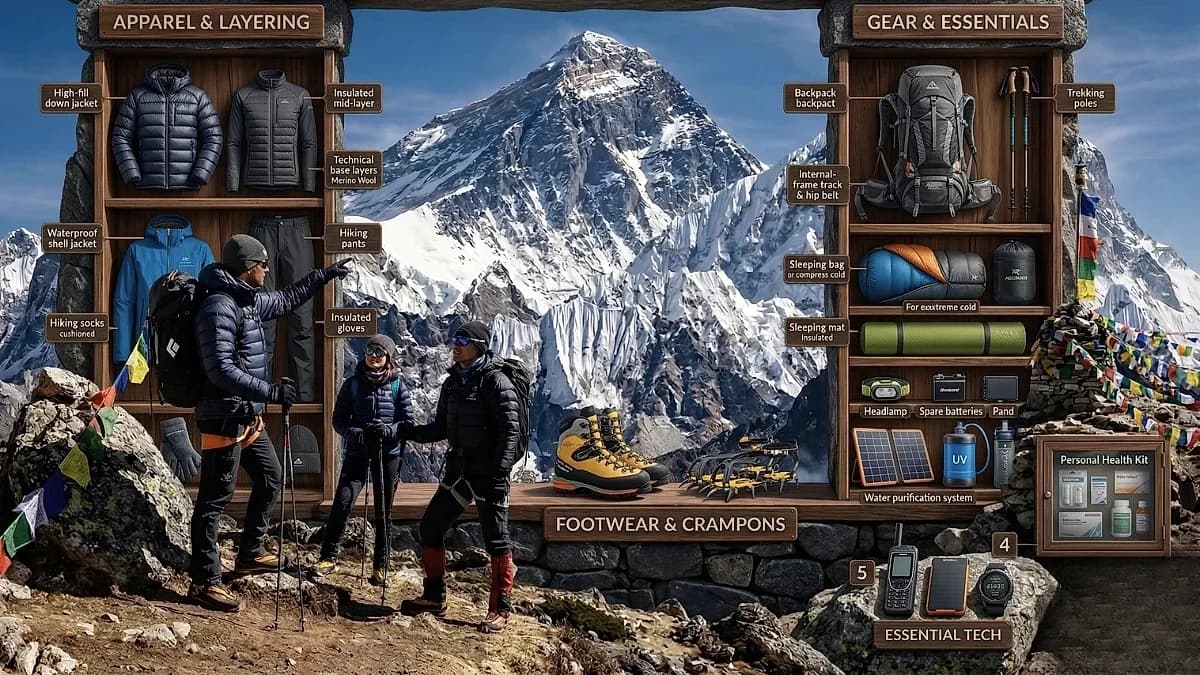
Against your skin: Two or three moisture-wicking thermal tops. Merino wool is the gold standard, it breathes, it regulates temperature, and it does not smell even after days of continuous wear. Synthetic fabrics work too. Cotton does not. This is the single most important packing rule for the Himalayas. Cotton absorbs sweat, stays wet against your skin, and makes you cold. Cold at altitude is not just uncomfortable, it is dangerous.
The warm layer: A fleece jacket for everyday walking warmth, and a lightweight down jacket for teahouse evenings and those freezing mornings above four thousand metres when you step outside and the air hits your lungs like ice water. The down jacket becomes your best friend from Dingboche onwards. You will put it on at four in the afternoon when the sun drops behind the ridge, and you will not take it off until you crawl into your sleeping bag.
The shell: One waterproof and windproof jacket with a hood. Gore-Tex or its equivalent. It does not need to be expensive, it needs to stop rain and wind from reaching your warm layers underneath. You will use this less than you expect. Most days on the EBC trail are dry and calm. But when a sudden snowstorm rolls in above Lobuche, and it can happen even in October, you will be grateful for every penny you spent on it.
You do not need to buy one. We provide a down jacket and a sleeping bag rated to minus fifteen on every one of our treks and on every tier, Budget included, and there is no charge for either. Related: How to Stay Warm at Night in Nepal Teahouses: A Guide That Actually Works.
What Trousers and Legwear Do You Need for EBC?
Two or three pairs of trekking trousers with zip-off legs are the universal choice. The zip-off feature sounds gimmicky until you are walking uphill in warm sunshine at 2,800 metres and need shorts, then arriving at a windy 3,800 metre ridge two hours later and need full-length trousers. One zip and you have both.
A pair of thermal base layer leggings for sleeping and for layering under your trousers above four thousand metres on the coldest mornings. Waterproof overtrousers for rain or snow days, lightweight packable ones that stuff into a side pocket are fine. And enough underwear for four or five days. You can hand-wash on rest days in Namche Bazaar and Dingboche where there is time and (sometimes) warm water.
What Boots and Socks Do You Need for Everest Base Camp?
We cannot stress this enough: your boots are the single most important item you will bring to Nepal. Everything else can be borrowed, rented, or improvised. Bad boots cannot.
Trekking boots need to be waterproof, ankle-high for support on uneven ground, and most critically, broken in before you arrive. We have seen people start the trek in brand-new boots purchased at Kathmandu airport. By Phakding on Day 1 they have blisters. By Namche on Day 3 they are in agony. By Tengboche on Day 5 they are considering turning back. All because they did not wear their boots for fifty kilometres of walking before getting on the plane.
Four or five pairs of wool or merino trekking socks. Not cotton, cotton socks absorb moisture, bunch up, and cause blisters. Good socks are the difference between happy feet and destroyed feet over twelve days. A trekker from Toronto once told us, with absolute seriousness: "The most important thing I packed was expensive socks. It sounds ridiculous. It is not ridiculous."
A pair of camp shoes or sandals for teahouse evenings. Crocs work surprisingly well. Your feet need to breathe after six hours in boots, and walking to the dining room in your trekking boots is unnecessarily heavy when flip-flops will do.
Do You Need a Sleeping Bag for EBC?
A sleeping bag rated to minus fifteen Celsius. Teahouse blankets are not enough above four thousand metres, they are thin, they have been used by thousands of trekkers before you, and they do not keep out the cold that seeps through wooden walls and stone floors at altitude. We provide one free on every tier, Budget included, so this is not something you need to buy or rent for a single trip. Bring your own if you would rather sleep in a bag you know, but you do not have to.
A silk or thermal sleeping bag liner adds five to ten degrees of warmth and keeps the inside of your sleeping bag clean. Worth every gram of the two hundred grams it weighs.
How Should You Organise Your Bags for EBC?
A sixty-five to seventy-five litre duffel bag for the porter. Soft-sided, not a hard-shell suitcase, porters carry duffels on their backs using a headstrap, and rigid cases are impossible to balance. Your main luggage stays in the duffel at the teahouse each day while you walk.
A thirty to thirty-five litre daypack that you carry yourself every day. Inside it: water, snacks, camera, rain jacket, a warm layer, sunscreen, and whatever personal items you need during the day. A good hip belt transfers weight from your shoulders to your hips, your shoulders will thank you by Day 8.
Dry bags or large bin liners inside your duffel. Everything, everything, goes inside waterproof bags. Rain happens. River crossings happen. Porters sometimes have to wade through knee-deep water. If your sleeping bag gets wet at four thousand metres, you have a very cold and very miserable night ahead of you.
What Electronics Should You Bring to Everest Base Camp?
Your phone, a charging cable, and a power bank of at least twenty thousand milliamp-hours. This is non-negotiable. Above Namche Bazaar, teahouses charge two hundred to five hundred Nepali rupees to charge your phone, that is one and a half to four dollars per charge, and the outlets are often occupied. Your power bank is your lifeline. Charge it fully on the rest day in Namche.
A head torch with spare batteries. Teahouse power cuts are common, and you will need light for the four-thirty in the morning start to Kala Patthar on summit day. The path in the dark is steep, rocky, and unforgiving without a torch.
A universal power adapter. Nepal uses type C, D, and M sockets, bring one adapter that covers all three. A camera is optional. Your phone camera is genuinely good enough for everything except professional photography, and carrying a camera plus lenses plus spare batteries adds weight you will regret by Day 9.
How Do You Stay Clean on the EBC Trek?
Sunscreen SPF fifty or higher. Reapply every two hours. One trekker from Hamburg told us his nose peeled for three weeks after the trek because he forgot to reapply above Lobuche. The altitude strips away the atmosphere's UV protection, your skin burns faster and more severely than at sea level.
Lip balm with SPF. Your lips will crack painfully without this. Hand sanitiser for before every meal, stomach bugs are the silent enemy of the Himalayas. Wet wipes for the days between showers, which above Namche Bazaar means most days. Basic toiletries decanted into small travel containers. And whatever personal medication you take regularly, with three extra days of supply in case of delays.
What Documents Do You Need for the EBC Trek?
Your passport, the original, not a copy. It is needed for permits and checked at multiple points on the trail. Travel insurance documentation proving you are covered for helicopter emergency evacuation to six thousand metres. We check this before departure. Without valid insurance, you cannot trek with us.
Cash in United States dollars or Nepali rupees. ATMs exist in Namche Bazaar but they are unreliable, sometimes out of cash, sometimes offline, sometimes both. Budget fifteen to twenty dollars per day for extras and carry it from Kathmandu. Four passport-size photos for permit processing, we handle the paperwork but spare photos save time.
What Should You NOT Bring to Everest Base Camp?
Cotton anything. Jeans. Heavy books, download them to your phone instead. A laptop, unnecessary weight for checking emails that can wait twelve days. Full-size toiletry bottles, decant into thirty-millilitre containers. And the biggest trap of all: the "just in case" items. If you find yourself debating whether to bring something, the answer is almost always no. You can buy or rent nearly anything in Namche Bazaar if you discover a genuine need on the trail.
What Gear Can You Rent in Kathmandu for EBC?
Thamel, the traveller district in central Kathmandu, has dozens of gear shops selling and renting trekking equipment at a fraction of what you would pay in London, Sydney, or New York. Down jackets rent for one to two dollars per day. Sleeping bags for the same. Trekking poles for a dollar. A duffel bag costs five to ten dollars to buy outright.
The quality varies. Check zips and stitching before committing. Much of what is sold as branded gear is locally manufactured, it works perfectly well for a single trek but will not last years of use. For a one-time EBC trip, renting makes more financial sense than buying at home.
How Do You Know Your EBC Pack Is Ready?
Lay everything out on your bed. Weigh it. If your duffel is over thirteen kilograms, you are bringing too much. Open it again. Remove the thing you are least sure about. Then remove one more thing. Leave the extras at your Kathmandu hotel, they will store your bag for free until you return.
Your job on this trek is to walk and look at mountains. Everything else, the route, the teahouses, the permits, the logistics, we take care of. The less you carry, the more you see.
We provide a sleeping bag rated to minus fifteen and a down jacket free on every tier of our Everest Base Camp Trek, Budget included, and a duffel bag as well on the Standard and Luxury packages, so those are fewer items to pack. For the full itinerary, gear list, and what is included in every tier, see our EBC Trek page. If you want the trek without the Lukla flight, the EBC by Road option saves money and adds hill-country scenery.
Packing for Everest Base Camp is an exercise in discipline. Everything you bring, your porter carries. Every extra kilogram is weight on someone's back for twelve days. Pack light, pack smart, and remember that you can buy or rent almost anything in Thamel if you forget it.
We provide a free sleeping bag and down jacket on every tier of our Everest Base Camp treks, and a duffel bag as well on the Standard and Luxury packages. That saves you the most expensive items on the list.
WhatsApp:+977 9810351300
Email:[email protected]
Written by Shreejan Simkhada, CEO of The Everest Holiday and third-generation Himalayan guide. TAAN Member #1586.
Our 2026 EBC packing list. Our Everest Base Camp Trek (12 Days) is private (your group only, no strangers), 2026 dates open, From USD $1399. WhatsApp us for tailored 2026 dates and current departures.
Ready to start? See our full Everest Base Camp Trek: 12-day guided itinerary, cost from $1,399, daily departures.
 Chat with Shreejan