
Is the Lukla Flight Safe? An Honest Answer from Someone Who Flies It

Update, 7 October 2026: The Everest region is open and unaffected by the floods, as at our 29 September update. We check 48 hours before departure; if the road is not open we move your dates free.
Quick answer: the Lukla flight's reputation is built on incidents from an earlier era. There has been no fatal accident involving a passenger flight at Lukla since April 2019, and the things that make the airport look frightening (the short runway, the slope, the strict weather rules, the cancellations) are the safety system, not evidence of the danger. I have flown this route many times with my groups, and I put my own family on it. But if you would rather not fly at all, that is a rational choice too, and we built a trek for exactly that.
I am Shreejan Simkhada, founder of The Everest Holiday. Every season, at least one traveller writes to me some version of the same message: "I want to do Everest Base Camp, but I've seen the videos of Lukla and I'm scared of the flight. Be honest with me." This post is that honest answer, written once, properly, so I can point people to it. If you would rather talk it through with a human, message me on WhatsApp and I will give you the same straight answer personally.
First, let me say the thing most trekking companies will not: your fear is not silly. You have seen a 527-metre runway tilted at nearly 12 per cent, ending at a mountain wall, at 2,860 metres altitude, and your brain has correctly concluded that this is not a normal airport. It is not. What the videos do not show you is why it is built that way and how the system around it works. Once you understand that, most of my nervous flyers relax. The rest choose the road, and I respect that completely.
Is the Lukla flight actually dangerous, or just famous for being dangerous?
Mostly the second. Lukla earned the title "world's most dangerous airport" from a television programme in 2010, and the label has been repeated so often that it now floats free of the facts. Here is the record, stated plainly: the last fatal accident at Lukla was on 14 April 2019, when a Summit Air aircraft veered off the runway during take-off and struck two parked helicopters, killing three people. That was more than seven years ago. In the years since, thousands of flights have carried tens of thousands of trekkers in and out of the Khumbu without a single fatality on this route.
I will not pretend the history before that is clean. It is not, and you deserve to know it. The worst accident in the airport's history was in October 2008, when Yeti Airlines Flight 103 crashed on final approach in sudden fog, killing eighteen people. In 2017, a cargo flight struck terrain just below the runway in poor visibility, killing two crew. These crashes were real, they were investigated, and each one changed how the airport operates. Which brings me to the important part.
What changed after the last crashes?
Three things, and they explain why the recent record looks so different from the old one.
1. Helicopters were separated from the runway. The 2019 accident happened because helicopters were parked close to the strip. After the investigation, a separate helipad area was established away from the runway, removing the specific hazard that caused the collision.
2. Weather minimums are enforced, not negotiated. Lukla has no instrument approach. Every flight operates under visual flight rules, which means the pilot must be able to see the terrain and the runway with their own eyes. If visibility drops below the published minimum, nothing flies. Full stop. The 2008 crash happened in suddenly deteriorating fog; today's operations are far more conservative about marginal conditions, which is exactly why so many flights get delayed or cancelled. More on that below, because the cancellations are the part travellers misread most.
3. Only the most experienced pilots fly here. Under Nepal's civil aviation rules, a captain cannot simply be rostered onto Lukla. The published requirements include a hundred short-take-off-and-landing missions, a year of STOL experience in Nepal, and training landings at Lukla itself with an instructor before commanding a flight there. The person at the controls of your Twin Otter has flown into this strip more times than most pilots land at their home airport in a year.
The airlines on the route today (Tara Air, Summit Air and Sita Air) fly aircraft designed for precisely this job: the de Havilland Twin Otter, the Dornier 228 and the Let L-410. These are not old planes pressed into unsuitable work. They are short-field specialists, doing the thing they were built for.
Why is the Lukla runway built like that?
Because the slope is doing a job. This is the piece that transforms the airport from terrifying to logical once you see it.
Lukla sits on a mountainside at 2,860 metres. There is no flat ground in the Khumbu to build a conventional runway, so the strip works with the terrain instead of against it. Aircraft always land uphill: the 11.7 per cent gradient acts as a natural brake, slowing the plane far faster than flat tarmac would, which is why 527 metres is enough. Departures always go downhill: the same slope works as an accelerator, helping the aircraft reach flying speed quickly in the thin high-altitude air. One direction in, the other direction out, every time.
The "wall at the end of the runway" that looks so alarming in videos is simply the uphill side of the mountain the strip is carved into. You are not aimed at it by accident; the whole geometry of the approach is designed around it, flown by pilots who know it intimately, in aircraft that can land in a few hundred metres. When I sit on that flight, the landing feels firm and short, like a very decisive full stop at the end of a sentence. Then everyone claps, the door opens, and you are breathing Khumbu air fifteen minutes after leaving Manthali.
If you want the full story of the airfield, its history and what the flight is like as an experience, I have written a separate guide to Tenzing-Hillary Airport. This post stays on the question you actually came here with.
Why do so many Lukla flights get cancelled? Isn't that a bad sign?
It is the opposite. Cancellations are the safety system doing its job in public.
Because there is no instrument approach, Lukla flights only operate when pilots can see the route. Mountain weather is a morning creature: valleys are typically clearest at dawn, cloud builds through late morning, and afternoon wind makes the approach unreliable. So the entire schedule is compressed into a morning window, flights go in quick rotations while the air is clean, and when the window closes, everything stops.
This is worth reframing in your mind. Every cancelled flight is a flight that somebody declined to operate in conditions below the standard. The airline loses money, the schedule tangles, a hundred trekkers groan in the departure hall, and the system accepts all of that cost rather than push a plane into cloud. When my guests are stuck waiting, I tell them honestly: the frustration you are feeling right now is what safety looks like from the inside.
Practically, it means two things for your booking. First, fly as early in the morning as you can get manifested, and we book our groups accordingly. Second, build slack into your itinerary, which I cover two sections down.
Do Lukla flights really leave from Ramechhap instead of Kathmandu?
In peak season, yes, and I would rather you hear the unvarnished version from me than discover it in the middle of the night on the day.
During the two high seasons (roughly mid-March to mid-May in spring, and late September to the end of November in autumn), Lukla flights operate from Manthali Airport in Ramechhap district, not from Kathmandu. That means a road transfer of four to five hours from Kathmandu, leaving in the small hours, usually between 1 and 2.30 a.m., to make the morning flight window. It is a genuinely tiring start to a trek, and any operator who glosses over it is doing you a disservice.
Why does it exist? Because it makes the flying more reliable, not less. Manthali sits at about 474 metres, far below the cloud that builds over the Kathmandu valley, and it is a fifteen-to-twenty-minute hop from Lukla instead of thirty-five. The cleaner, longer visual window means airlines complete far more rotations per morning with fewer weather holds. The pre-dawn drive is the price of a flight that actually departs.
How we handle it: our EBC packages include the Ramechhap transfer both ways, we use drivers who do this exact road all season, we time departure so you are at the airstrip before your rotation rather than watching it leave, and we tell you at booking, not at the briefing, that this is what the first morning looks like. In the off-season months, flights go from Kathmandu domestic terminal as normal. I have written a full comparison of the two starting points, with current logistics, in our Ramechhap vs Kathmandu guide, so I will not repeat the detail here.
How many buffer days do I need for the Lukla flight?
One at minimum, two if your international connections are unforgiving. This is the single most useful practical decision you will make.
Weather delays at Lukla are not rare events to be feared; they are a normal operating condition to be planned for. A buffer day between your scheduled return to Kathmandu and your international flight home means a one-day weather hold is a bonus rest day in Kathmandu rather than a missed flight and a rebooking fee. Two buffer days means even a rough patch of weather leaves you calm. Our 12-day Everest Base Camp itinerary is built with acclimatisation and contingency in mind, and when we confirm your booking we look at your international tickets and tell you plainly whether your buffer is adequate.
And if the weather closes for longer? That is where the helicopter comes in.
Should I take a helicopter instead of the plane?
Sometimes, and we will tell you when it is the right call rather than upselling it by default.
Helicopters serve the Lukla route alongside the fixed-wing flights, and they have one real advantage: they can operate in narrower weather windows and route through gaps that a Twin Otter approach cannot use, so on marginal days helicopters sometimes fly when planes are grounded. They carry four to five passengers, and a seat costs meaningfully more than a plane ticket, with the exact price depending on season and demand, so we quote it live rather than print a number that will be stale by the time you read this.
When do I actually recommend it? Three situations. First, when a multi-day weather backlog threatens your international connection and buying back a day is worth real money to you. Second, for travellers whose anxiety about the fixed-wing flight is strong enough to shadow the whole trip; a helicopter feels very different, flies lower through the valley, and for some people that reframes the journey completely. Third, on the return leg for trekkers who are simply done and want the fastest way to a hot shower. If a stuck group asks us to arrange a helicopter, we do it the same morning where seats exist. One warning from experience: book helicopters only through your operator or a licensed agent, never from a stranger in a departure hall.
Can I do Everest Base Camp without flying at all?
Yes, and this is the option almost nobody tells nervous flyers about, which baffles me, because it is a genuinely better trek in several ways.
Our Everest Base Camp Trek by Road replaces the flight entirely. You drive from Kathmandu deep into the Solu region (a long day on mountain roads, ten hours or more, I will not pretend otherwise), then walk for around two days through Rai and Sherpa villages to join the classic trail near Phakding. From there it is the same route, the same Namche, the same base camp.
What you give up is speed. What you gain is worth listing: zero flight anxiety and zero cancellation risk; a gentler altitude profile, because you gain height on foot over extra days instead of stepping off a plane at 2,860 metres; a quieter first stretch of trail that most trekkers never see; and usually a lower cost, since road transport is cheaper than airfare. Several of my guests who chose it for the "no flight" reason came back saying the walk-in was their favourite part. If Lukla is the one thing standing between you and this trek, this package removes it. For a fuller side-by-side, see our flight vs road comparison.
So what would I tell a nervous friend?
Exactly what I tell my own guests over tea in our Kathmandu office. The Lukla flight in 2026 is a short, tightly regulated hop flown by Nepal's most experienced short-field pilots, in purpose-built aircraft, under weather rules so conservative that the schedule visibly bends around them. Its frightening reputation rests mainly on accidents from an earlier era, and the record since 2019 reflects the changes made after them. I keep flying it, season after season, with people I am responsible for.
But safety statistics do not argue anyone out of a fear, and they should not have to. What actually gives you back control is knowing your choices: fly with the morning window and proper buffer days; upgrade to a helicopter when the situation calls for it; or take the road and never leave the ground. All three end at Everest Base Camp.
Tell me which one sounds like you, and I will build the trip around it. Message me directly on WhatsApp, or start with the classic 12-day EBC trek or the EBC by Road. Either way, you will get a straight answer, because that is the whole point of this post.
Planning a trip to Nepal?
Drop us your details and tell us what you have in mind. We will put together a personalised plan and get back to you.
Not sure which Nepal trek is right for you?
Take our free 2-minute quiz and get personalised recommendations based on your fitness, experience, and travel style.
Find Your Perfect Trek →
Bungee Jumping in Pokhara: 80 m Jump, Cost, Safety and Best Time (2027)
How the Pokhara bungee jump works: the 80-metre jump at Hemja, the morning step by step, who can jump, what the price includes and the best months.
Read More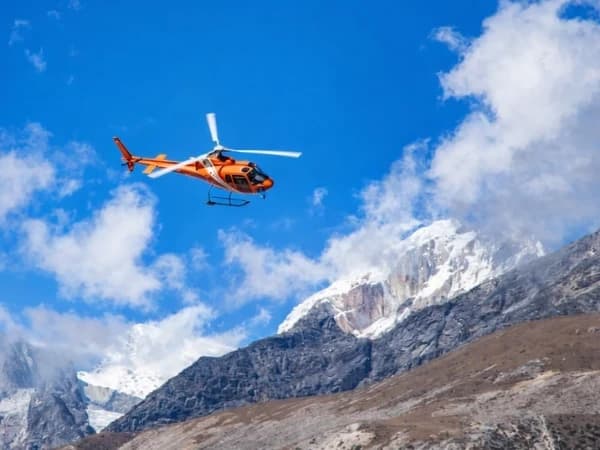
Short Trek to Namche with an Everest Base Camp Helicopter in 5 Days: Route, Cost and Who It Suits (2027)
The 5-day trip that combines two days of Khumbu trekking to Namche with a private helicopter to Everest Base Camp: the day-by-day plan, tiers, permits, best months and the cost.
Read More
Kathmandu Yoga Tour in 2 Days: How It Runs and What It Costs (2027)
Two days of asana, breathwork, meditation and yoga philosophy in Kathmandu with a certified instructor: how it runs, what each tier includes and 2027 prices.
Read More Chat with Shreejan