

Update, 7 October 2026: The Everest region is open and unaffected by the floods, as at our 29 September update. We check 48 hours before departure; if the road is not open we move your dates free.
Between midnight and 2 am, in the pitch dark, a line of jeeps pulls out of Kathmandu heading east. Inside each one, trekkers clutch thermoses of tea and try to sleep against rattling windows. They are driving to Manthali airport for the roughly twenty-minute flight that will deposit them at the foot of the Himalayas, Lukla, altitude 2,860 metres, one of the most famous airstrips in aviation.
At the same hour, in a different part of the city, another jeep pulls out heading in the same general direction. But this one is not going to the airport. It is driving all the way to the trailhead. Eight or nine hours through Nepal's middle hills, through terraced rice paddies and sleepy Tamang villages and river gorges that catch the first pink light of dawn. No flight. No cancellation risk. And two hundred to three hundred dollars still in the passenger's pocket.
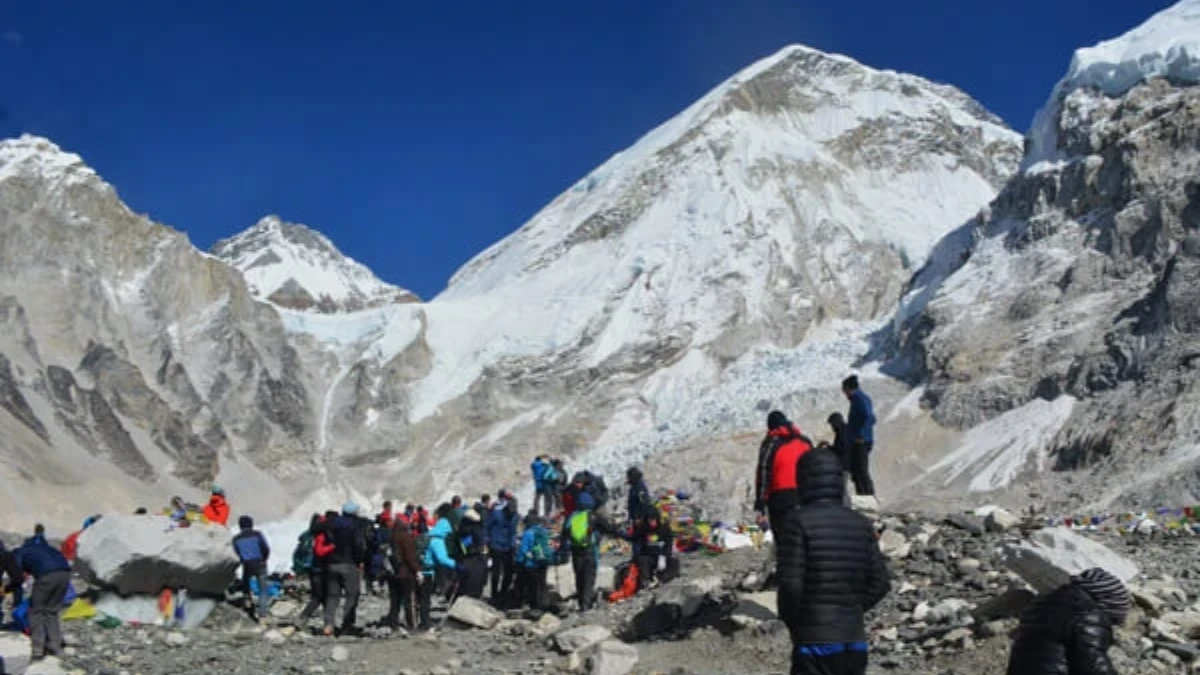
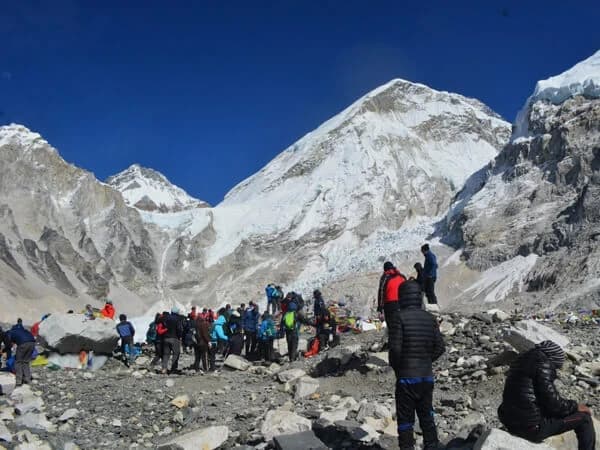
Two ways to reach the same mountain. Both end at Everest Base Camp, 5,364 metres. The question is which journey you want to take getting there.
How does the Lukla flight route to Everest Base Camp work?
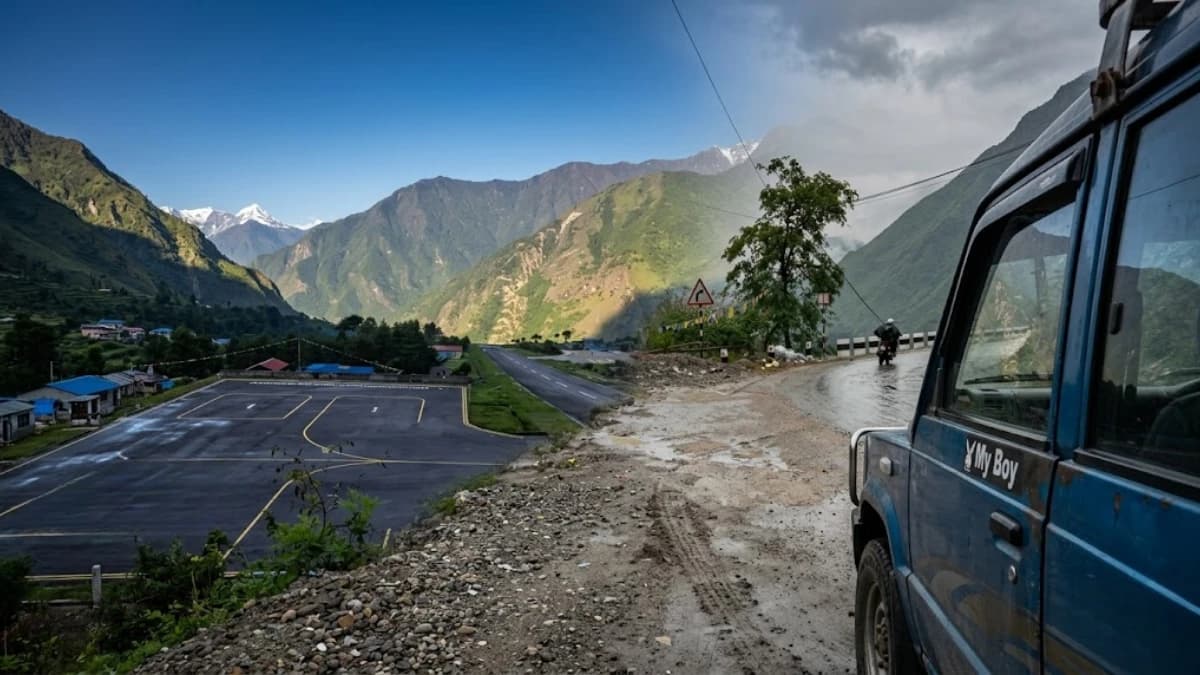
The traditional EBC route involves flying to Tenzing-Hillary Airport at Lukla. The airport sits on a ledge carved into the side of a valley at 2,860 metres. The runway is 527 metres long, roughly a quarter of a typical commercial runway, with a twelve percent uphill gradient and a sheer mountain wall at one end. There is no instrument landing system. Pilots navigate by sight alone, threading between cloud and cliff face in small twin-otter aircraft that seat fifteen to twenty people.
The flight itself is extraordinary. Twenty minutes of aerial spectacle, Everest and its satellites sliding past the window, glaciers catching light, the Khumbu valley opening below. Landing at Lukla is something that belongs on any adventurer's list. The approach through the narrow valley, the sudden drop, the wheels touching down on the tilted runway, it quickens the pulse in a way that twelve hours of international flying cannot.
But the Lukla flight has another reputation. Cancellations.
When cloud fills the valley below the runway minimums, or fog settles over Manthali, or wind gusts exceed safe parameters, the flights stop. All of them. And they do not restart until conditions improve, which might be in an hour, or a day, or three days. Peak season, October and November, when trekker numbers are highest, is also when cancellation backlogs hit hardest. Five hundred trekkers waiting at a small mountain airport with limited accommodation is not a crisis, but it is not pleasant either.
Since a decision by the Civil Aviation Authority of Nepal in 2022, most Lukla flights in the busy windows, roughly 15 March to 15 May and 25 September to 30 November, leave from Manthali instead of Kathmandu's Tribhuvan International Airport. Manthali is a smaller airport roughly four to five hours by road east of the capital. Some flights still leave from Kathmandu outside those windows. In the busy windows, every trekker on a fixed-wing flight faces a pre-dawn drive before the flight even begins.
What does the road route to Everest Base Camp involve?
You leave Kathmandu in a private jeep as the sun comes up. The drive takes eight to nine hours through Nepal's Hill District, a landscape of stacked terraces, suspension bridges, and small towns where children wave from school courtyards and women carry baskets of oranges along the roadside.
The road climbs gradually from the Kathmandu Valley into the middle hills, following river valleys that grow narrower and greener as the altitude increases. Lunch is dal bhat at a roadside stop where the owner's grandmother might come out to look at the foreigners, an event that still happens in villages off the main tourist circuit.
By late afternoon, you reach Salleri or Phaplu. The next morning, you start walking. The trail joins the classic EBC route at Phakding, and from there the two paths are identical.
A couple from Berlin chose the road and described it like this: "We stopped at a village where the grandmother held my wife's hands and blessed us for the journey ahead. She did not speak English and we did not speak Nepali, but the warmth was unmistakable. That moment was worth more than any view from an aeroplane window." Related: Phaplu and Salleri: The Road Start to Everest in Solukhumbu.
Is the Everest Base Camp road route cheaper than the Lukla flight?
No. The two packages cost exactly the same at every group size. The flight you do not buy is spent instead on three more days of guide, porter, food and lodging, so the price comes out level. What the road route buys you is not money, it is certainty: the Lukla flight is the single most common reason an Everest itinerary loses days, and driving to the trailhead removes that risk completely. If you are trekking independently rather than on a package the arithmetic is different, because the return airfare alone is roughly five hundred dollars, although the extra days on the trail take back part of that.
How many extra days does the Everest Base Camp road route take?
The road adds three days. Fifteen days total instead of twelve. For trekkers with tight schedules and limited annual leave, those three days are a dealbreaker, and the twelve-day Lukla route is the right choice.
For trekkers who have the time, those extra days are not a cost but a gift. You see the Nepal that exists between the capital and the high mountains. The Nepal that ninety percent of Everest trekkers fly over without ever knowing it was there.
Does the road route to Everest Base Camp help with altitude acclimatisation?
When you fly to Lukla, you jump from Kathmandu at 1,400 metres to Lukla at 2,860 metres in under an hour. Your body has zero time to register the altitude change. The next day you walk to Phakding at 2,610 metres and the day after to Namche Bazaar at 3,440 metres, gaining significant altitude from an already elevated starting point.
When you drive, the ascent is gradual. You spend hours moving through progressively higher terrain. By the time you start walking, your body has had an extra day to begin adjusting to moderate altitude. The science on this is anecdotal rather than clinical, but the pattern observed by guides over years of experience is consistent: road-route trekkers tend to acclimatise more smoothly and report fewer headaches in the critical first days above three thousand metres.
Should I fly to Lukla or take the road to Everest Base Camp?
Over the past two years, roughly thirty-five percent of Everest Base Camp trekkers with our company chose the road route. The percentage grows every year as word spreads. The satisfaction rate is identical across both groups, five stars regardless of how they got to the trailhead.
The trekkers who choose Lukla tend to be time-constrained professionals who need the shortest possible trip, bucket-list travellers for whom the Lukla landing is part of the dream, and repeat visitors who have done the road before and want the aerial experience.
The trekkers who choose the road tend to be couples and families who value the savings, nervous flyers who prefer eliminating the cancellation variable, photographers who want the hill-country landscapes, and anyone who defines "the journey" as beginning the moment they leave Kathmandu rather than the moment they step off a plane.
There is no wrong choice. The mountain at the end is the same mountain. The base camp is the same base camp. The sunrise from Kala Patthar is the same sunrise. How you arrive is a matter of preference, not quality.
Compare both options on our trip pages: EBC Trek (Lukla flight) and EBC by Road Trip. Both cost exactly the same. The road route is not the cheaper option, because the flight you do not buy is spent instead on three more days of guide, porter, food and lodging. What it buys you is certainty rather than savings.
Fly if you value time. Drive if you value the journey. The Lukla flight takes about 20 minutes from Manthali and lands you at the start of the trail. The road takes two days through the Nepali middle hills and shows you a Nepal that most EBC trekkers never see. Both get you to the same trailhead. The road is harder and slower and gives you better acclimatisation. The flight is fast and exciting and saves two days.
We offer both options on our Everest Base Camp Trek. Ask us which suits your schedule.
WhatsApp:+977 9810351300
Email:[email protected]
Written by Shreejan Simkhada, CEO of The Everest Holiday and third-generation Himalayan guide. TAAN Member #1586.
Lukla flight or road? From late September the flights switch to Ramechhap by road. Our Everest Base Camp Trek (12 Days) is private (your group only, no strangers), 2026 dates open, From USD $1399. WhatsApp us for tailored 2026 dates and current departures.
 Chat with Shreejan