

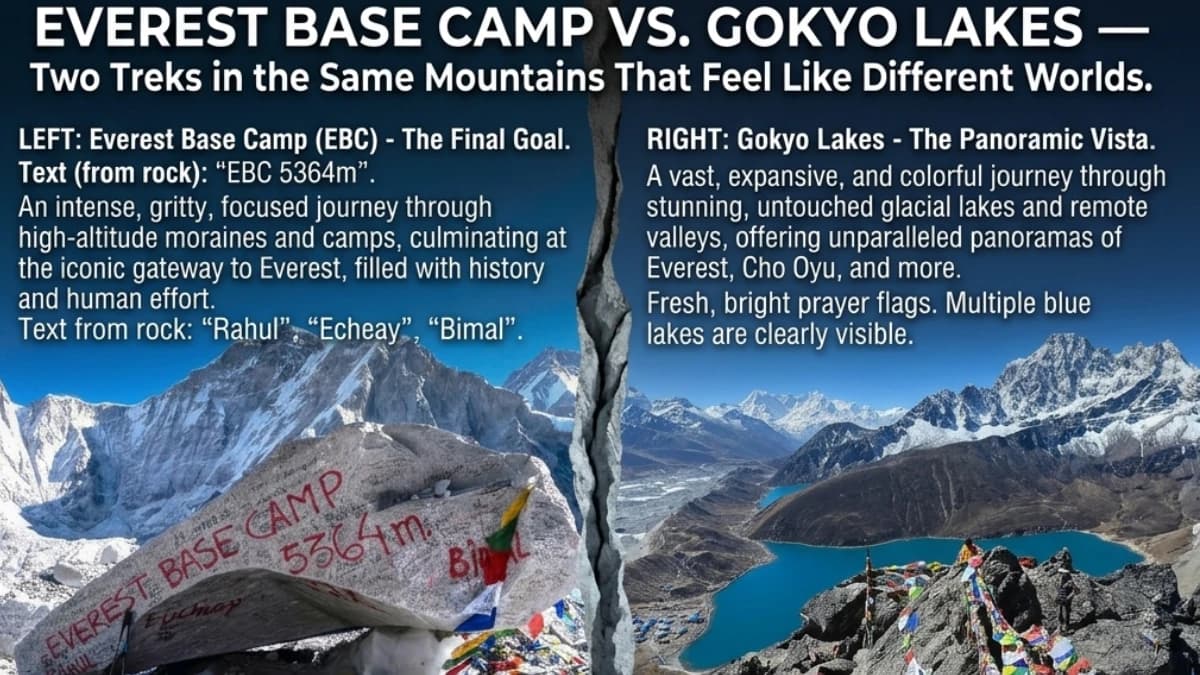
They share the same starting point: Lukla. The same first three days: Phakding, the suspension bridges, the steep climb to Namche Bazaar. The same acclimatisation rest day in Namche, the same Sherpa villages, the same prayer flags snapping in the same wind. And then, on Day 4, the trail forks. Right toward Tengboche, Dingboche, and Everest Base Camp. Left toward Dole, Machhermo, and the turquoise lakes of Gokyo.
The right path takes you to the most famous mountain destination on earth. The left path takes you to what many experienced trekkers quietly call the most beautiful one.
What Makes Everest Base Camp Special?
EBC is the name that needs no explanation. Twelve days to 5,364 metres at the foot of the highest mountain on earth. The Khumbu Icefall towering above. Prayer flags marking the spot where expeditions begin their assault on the summit. Kala Patthar at sunrise: 5,545 metres, gold light spreading across the summit of Everest in the most famous mountain view in the world.
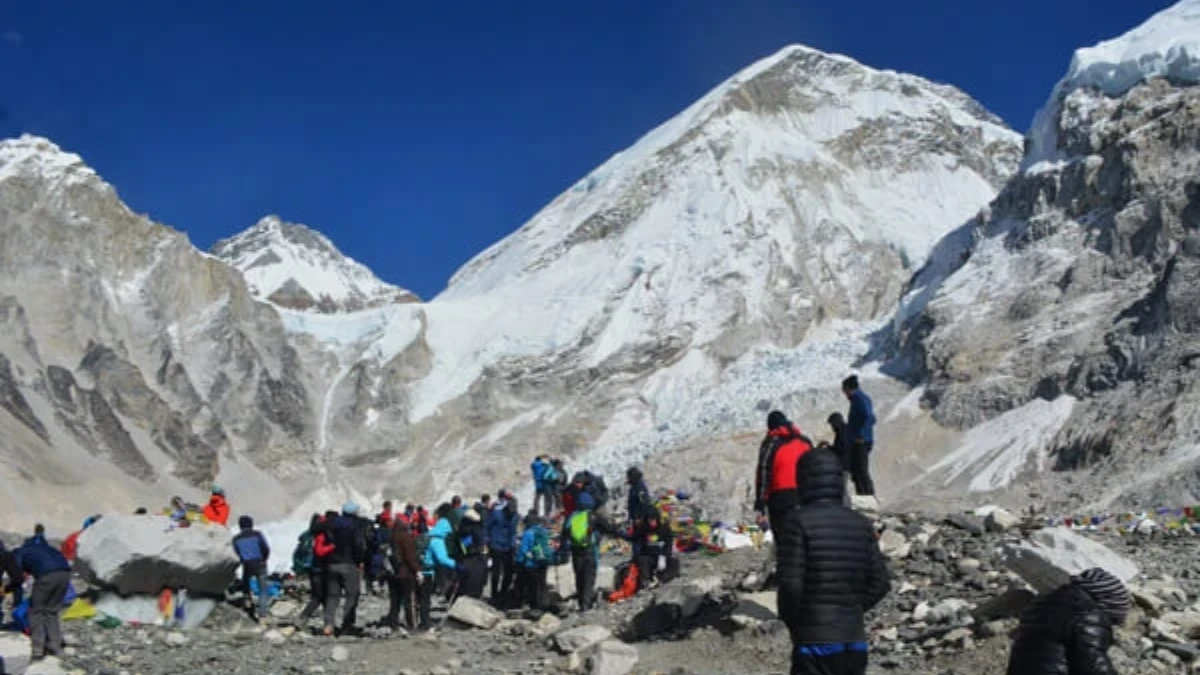
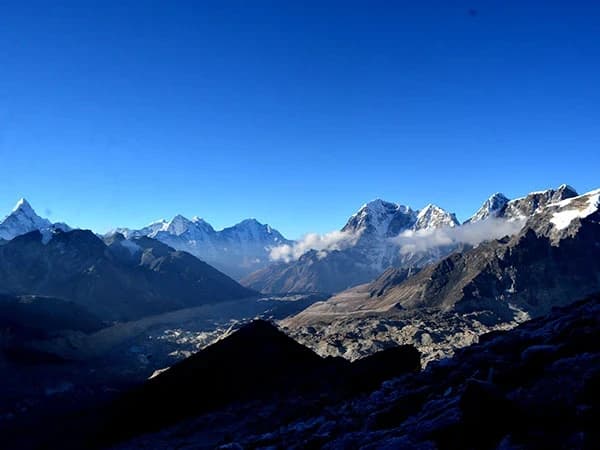
The trail above Namche follows the Imja Khola valley through progressively more austere terrain. Tengboche Monastery. The alpine meadows of Dingboche. The memorial cairns above Lobuche for climbers who never came down. And then the grey, rubble-strewn moraine of Gorak Shep, where the air is thin enough to make you question every decision that brought you here, until you see the icefall, and every question answers itself.
The trip is monumental. The scale of Everest, not just the peak but the entire ecosystem of ice, rock, and ambition that surrounds it, is something that photographs cannot prepare you for. Standing at base camp, watching a helicopter descend toward the medical tent while a line of climbers in down suits moves up the icefall above, you are standing inside one of the great human narratives of the past century.
What Makes Gokyo Lakes the Better-Kept Secret?
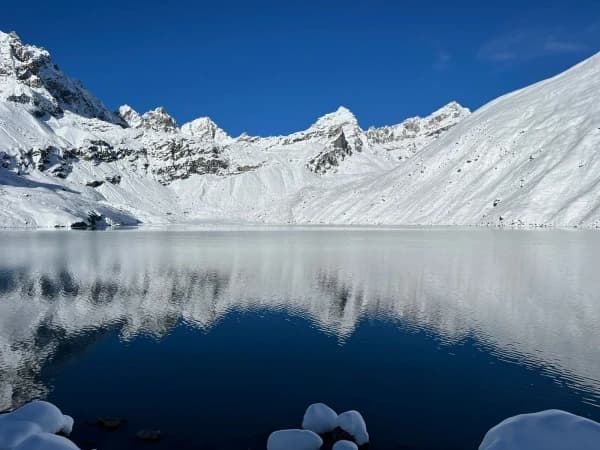
Gokyo is the path less taken. The trail diverges from EBC at Namche and follows the Dudh Koshi northwest into a valley that narrows between glacial walls. The Ngozumpa Glacier, the longest in Nepal, fills the valley floor with rubble and ice. And along its eastern edge, strung like beads on a necklace, five lakes sit at altitudes between 4,700 and 5,000 metres.
The colour is the first thing. Turquoise. Not blue-green. Not teal. A specific, vivid, almost artificial turquoise that comes from glacial meltwater carrying suspended rock particles too fine to settle. The lakes catch sunlight in a way that changes with every hour, pale and ethereal at dawn, deep and saturated at noon, silver and grey at dusk.
The second thing is the silence. Gokyo receives a fraction of EBC's trekkers. On the shore of the third lake, Dudh Pokhari, you may stand with nobody else visible in any direction. The glacier creaks. A raven calls from somewhere above. The wind, which is constant, pushes small waves across water so clear you can see the bottom five metres down.
And then there is Gokyo Ri. A steep ninety-minute climb from the lake shore to 5,357 metres, where four mountains above eight thousand metres are visible simultaneously, Everest, Lhotse, Makalu, and Cho Oyu, with the turquoise lake directly below and the glacier stretching to the horizon. Many trekkers who have done both EBC and Gokyo say this viewpoint is the better one. Not because the mountains are closer, they are not, but because the composition is more complete. Lake, glacier, four of the six highest peaks on earth, all in a single panorama that no camera can capture in its entirety.
The Comparison
| Everest Base Camp | Gokyo Lakes | |
|---|---|---|
| Duration | 12 days | 10 days |
| Highest point | Kala Patthar, 5,545 m | Gokyo Ri, 5,357 m |
| Difficulty | Extreme altitude, multi-day | Extreme altitude, multi-day |
| Crowds | The busiest trail in Nepal above Namche | One of the quietest in the Khumbu |
| Signature scenery | Glacier and moraine, austere and monumental | Turquoise lakes among rock and ice |
| Our price, per person from | $1,399 | $1,285 |
Both treks carry the same paperwork, the Sagarmatha National Park entry fee, the Khumbu Pasang Lhamu Rural Municipality fee and a TIMS card, with no restricted-area permit on either. Those fees are set by the Nepal Tourism Board, and our full trek-by-trek breakdown is in our guide to Nepal trekking permits.
Duration: EBC twelve days, Gokyo ten days. Altitude: similar, Kala Patthar 5,545m versus Gokyo Ri 5,357m. Difficulty: similar, both require proper acclimatisation and multi-day walking at extreme altitude. Cost: similar at the budget level, though Gokyo is slightly less because of shorter duration.
Crowds: dramatically different. EBC's trail above Namche is the busiest in Nepal. Gokyo's trail above Namche is one of the quietest in the Khumbu. In peak season, the contrast is stark, queues at suspension bridges on the EBC side, empty trail on the Gokyo side.
Scenery: different in character rather than quality. EBC's landscape is dominated by glacier and moraine, austere, monumental, grey and white. Gokyo's landscape is dominated by the lakes, colour, reflection, water in a landscape of rock and ice. Both are extraordinary. Neither is objectively superior. They appeal to different aesthetic sensibilities.
Cultural experience: similar. Both trails pass through Sherpa villages with monasteries, mani walls, and prayer flags. The communities above Namche on both routes are culturally identical, the fork in the trail does not create a cultural divide.
Achievement: different in narrative weight. "I went to Everest Base Camp" carries a significance in any conversation that "I went to Gokyo" does not. If the story matters, if part of the motivation is the thing you will tell people for the rest of your life, EBC wins unambiguously.
The Combined Option
For trekkers with fifteen days, the two routes can be connected via the Cho La pass at 5,420 metres. This creates a loop that visits Everest Base Camp first, crosses Cho La, a dramatic pass involving a glacier crossing, and arrives at Gokyo and the lakes.
The combined trek is physically demanding, three high points above 5,300 metres in fifteen days, but delivers the complete Khumbu experience. You see everything the region has to offer in a single continuous journey. For fit, experienced trekkers, it is arguably the optimal way to spend two weeks in the Everest region.
The Choice
If Everest is the dream that brought you to Nepal, if standing at base camp and watching the icefall is the image you have carried in your mind for years, go to EBC. The experience lives up to the dream.
If you have done EBC and want to return to the Khumbu for something different, go to Gokyo. The lakes and the viewpoint from Gokyo Ri provide a perspective on the Everest region that the EBC trail cannot.
If you value solitude over fame, choose Gokyo. The empty trail and the silent lakes offer an intimacy with the landscape that EBC's busier corridor does not.
If you have fifteen days and want everything, combine them via Cho La. Both experiences. One trip. The complete Khumbu.
And if you have time for only one and cannot decide, choose the one that responds to something deeper than the guidebook. The mountains will be there for the other one next year. What matters is which direction the trail pulls you, toward the name that defines mountaineering or toward the colour that defies explanation. Both are the right choice. Both end with you standing above five thousand metres, breathing thin air, looking at the same peaks from different angles, and understanding that the Himalayas are vast enough to contain both fame and silence without either diminishing the other.
Compare both treks on our trip pages: EBC Trek and Gokyo Lakes Trek, or combine them on the EBC with Gokyo via Cho La.
EBC gives you the name and the glacier. Gokyo gives you the lakes and the view. If you have to choose one, ask yourself: do I want to say I stood at Everest Base Camp, or do I want the better view of Everest? Gokyo Ri at sunrise gives you four of the six highest mountains on earth in one panorama. Base Camp gives you a rocky glacier and a sign. Both are extraordinary. Gokyo is more beautiful. Base Camp is more famous.
We run both treks and can combine them on the Three Passes Trek.
WhatsApp:+977 9810351300
Email:[email protected]
Written by Shreejan Simkhada, CEO of The Everest Holiday and third-generation Himalayan guide. TAAN Member #1586.
EBC vs Gokyo Lakes? Pair them on our Three Passes. Our Everest Base Camp Trek (12 Days) is private (your group only, no strangers), 2026 dates open, From USD $1399. WhatsApp us for tailored 2026 dates and current departures.
 Chat with Shreejan