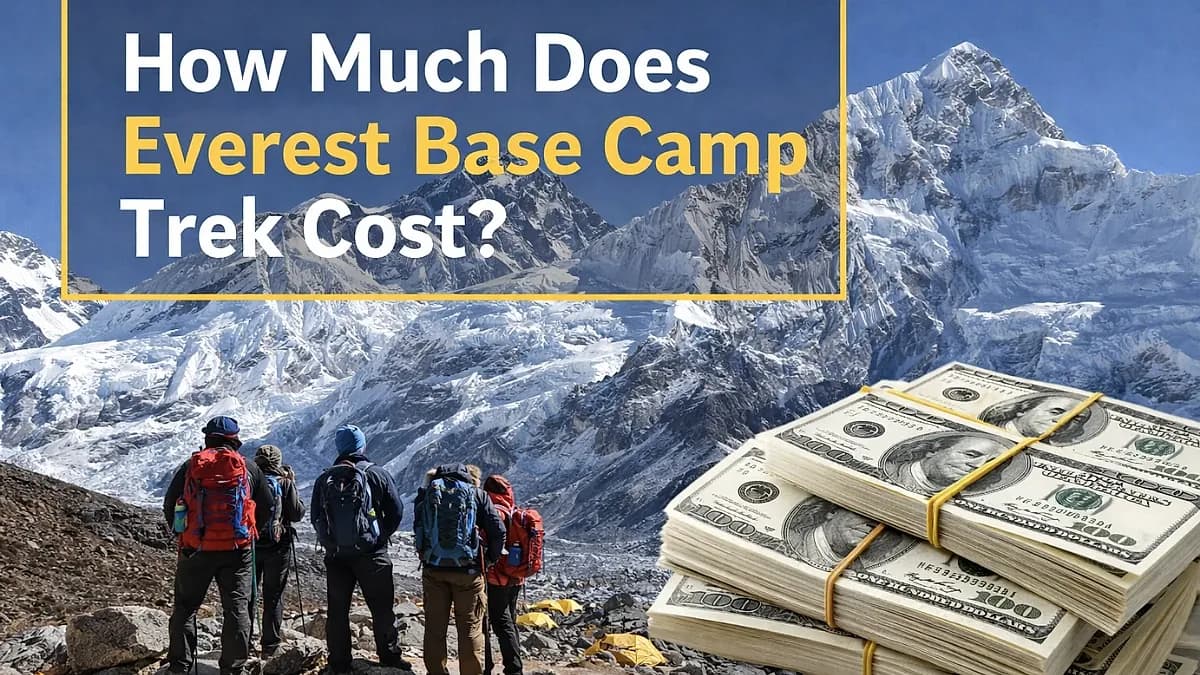
"How much does it actually cost to trek to Everest Base Camp?"
It's the first question nearly everyone asks me. And honestly, the answer you'll find online ranges from "$500" to "$5,000+", which isn't very helpful.
I'm Shreejan Simkhada, founder of The Everest Holiday and a third-generation Himalayan guide. I've been sending trekkers to Base Camp for over a decade. Here's what it really costs in 2027, broken down so you can plan properly. Our prices are held for 2027 departures: the price you see is the price you pay, this year or next.
Updated 18 October 2026. Every price on this page was read from our booking system on that date and applies to 2027 departures.
The short answer
For a fully guided Everest Base Camp trek with a reputable company, expect to spend:
- Budget: $1,399 per person
- Standard: $2,785 per person
- Luxury: $4,999 per person
These are the costs of the trek package itself. Your total trip budget (including flights to Nepal, visa, insurance, and spending money) will be higher. I'll break that down below.
What does the price per person drop to for a couple or a group?
Our price is the same whether you travel privately or as a group, because every trip is private anyway. We never add strangers to your trek. What changes the price per person is simply how many of you there are. This is the exact ladder from our booking system for the 12-day trek.
| Your group | Budget | Standard | Luxury |
|---|---|---|---|
| Solo (1 person) | $2,275 | $3,345 | $5,640 |
| 2 to 4 people | $1,399 | $2,785 | $4,999 |
| 5 to 8 people | $1,299 | $2,520 | $4,949 |
| 9 to 12 people | $1,199 | $2,470 | $4,899 |
| 13 to 20 people | $999 | $2,450 | $4,849 |
Prices are per person in US dollars. A solo trekker pays the solo row ($2,275 on Budget, $3,345 on Standard and $5,640 on Luxury), because one person carries the whole cost of the guide and the logistics. A single room in a Kathmandu hotel is quoted separately. Most of the people who trek with us are a couple or a pair of friends, so if that is you, the second row is your price.
Message me on WhatsApp with your dates and how many of you there are, and I will send back an exact figure the same day, not a range.
What's included in a trek package
Here is what sits inside our price on every tier, Budget included:
- Airport pickup and drop-off in Kathmandu
- An experienced, licensed trekking guide
- Return transport to Lukla: the flight from Kathmandu or Manthali on Budget and Standard, a direct helicopter on Luxury
- All three Everest permits, including the municipality fee most quotes leave out
- Teahouse or lodge accommodation for every night on the trail
- A sleeping bag rated to minus fifteen and a down jacket, provided free on request
- First aid kit and pulse oximeter
- Farewell dinner
Two things sit outside our trek prices, and I would rather say so here than let you discover it later. Hotel nights in Kathmandu are quoted separately on every tier, and meals on the trek are included from Standard upward, not on Budget. On the Budget package you order and pay at the teahouses yourself, and that is a large part of why it is $1,399 rather than $2,499. It is a deliberate trade, not a hidden cost.
So the thing to watch for is not a short inclusions list. It is a vague one. Ask any company three specific questions before you pay: how many porters for how many trekkers, which meals are covered and on which days, and which permits are in the price by name. A company that answers those plainly, in writing, is being straight with you.
What's not included
These costs are on you, regardless of which company you choose:
- International flights to Kathmandu
- Nepal visa ($30 for 15 days, $50 for 30 days; paid on arrival, at the rates published by Nepal's Department of Immigration)
- Travel insurance (mandatory, must cover altitude up to 6,000m)
- Lukla flight or road transport to the trailhead
- Personal spending, drinks, and snacks
- Tips for your guide and porters
- Gear you don't already own
How much does the Lukla flight cost, and is the road route cheaper?
Most EBC treks start with a flight from Kathmandu to Lukla. In 2026 that flight costs about $254 each way for foreign nationals out of Kathmandu, or about $209 out of Manthali in Ramechhap. That second airstrip is worth understanding before you book. In the busiest windows, roughly mid-March to mid-May and late September to the end of November, fixed-wing flights are moved from Kathmandu to Manthali, which means a pickup from your hotel between midnight and 2 am and a four to five hour drive before you board. Nobody enjoys learning that in October. Helicopters are exempt and fly Kathmandu to Lukla directly all year, which is why our Luxury tier uses one in both directions. It's a short, dramatic flight, but it's also frequently delayed by weather, which can throw off your entire schedule. Lukla operates under the Civil Aviation Authority of Nepal, and in practice it is the weather rather than the airline that decides whether you fly that morning.
We offer an alternative: the EBC Road Trip. Instead of flying, you drive through Nepal's hill country to reach the trailhead. It adds three days (15 days against 12), but you see the hill country that flying trekkers never do, and you remove the one thing that spoils more Everest itineraries than altitude does: a cancelled Lukla flight that leaves you sitting in an airport for two days. It is not a way to save money. Budget costs the same as the flying trek, so choose it for the calmer trip, not the price.
Our 15-day Everest Base Camp by Road trip starts at $1,399 per person for the budget package.
What permits do you need for Everest Base Camp, and what do they cost?
You'll need three permits for the Everest region, not two. The municipality fee is the one that gets left off quotes:
- Sagarmatha National Park entry permit: NPR 3,000 for foreign nationals, NPR 1,500 for SAARC nationals
- Khumbu Pasang Lhamu Rural Municipality fee: NPR 3,000
- TIMS card, the Trekkers' Information Management System: NPR 2,000 for foreign nationals, NPR 1,000 for SAARC nationals
All three are included on all three of our tiers. National park permits are issued under the Department of National Parks and Wildlife Conservation, and the TIMS card is administered by the Trekking Agencies' Association of Nepal. That second site is useful to you for another reason: you can check there whether a company you are considering is genuinely a member. We are number 1586.
Total trip budget by country
Here's a realistic total budget, including everything, flights, trek, visa, insurance, gear, and spending money:
From the UK:
- Return flights to Kathmandu: $500–$900
- Trek package (standard): $2,785
- Visa, insurance, Kathmandu nights, tips, extras: $600–$900
- Total: roughly $3,900–$4,600
I wrote a full sterling breakdown, flights to tips, in Everest Base Camp trek cost from the UK.
From the US:
- Return flights to Kathmandu: $700–$1,200
- Trek package (standard): $2,785
- Visa, insurance, Kathmandu nights, tips, extras: $600–$900
- Total: roughly $4,100–$4,900
The dollar version, coast by coast, is in Everest Base Camp trek cost from the USA.
From Australia:
- Return flights to Kathmandu: $600–$1,000
- Trek package (standard): $2,785
- Visa, insurance, Kathmandu nights, tips, extras: $600–$900
- Total: roughly $4,000–$4,700
The Australian dollar breakdown, Sydney to Perth, is in Everest Base Camp trek cost from Australia.
From Germany:
- Return flights to Kathmandu: $800–$1,150
- Trek package (standard): $2,785
- Visa, insurance, Kathmandu nights, tips, extras: $600–$900
- Total: roughly $4,200–$4,850
The euro version, with the DAV insurance note, is in Everest Base Camp trek cost from Germany.
From Canada:
- Return flights to Kathmandu: $1,250–$1,800
- Trek package (standard): $2,785
- Visa, insurance, Kathmandu nights, tips, extras: $600–$900
- Total: roughly $4,650–$5,500
The Canadian-dollar version, with flight costs from Toronto and Vancouver, is in Everest Base Camp trek cost from Canada.
The Singapore-dollar version, with Singapore Airlines nonstop flight costs, is in Everest Base Camp trek cost from Singapore.
The Japanese-yen version, with Tokyo flight costs, is in Everest Base Camp trek cost from Japan.
The euro version, with Amsterdam flight costs, is in Everest Base Camp trek cost from the Netherlands.
The euro version, with Paris flight costs, is in Everest Base Camp trek cost from France.
The Swiss-franc version, with Zurich flight costs and the KVG and Rega insurance note, is in Everest Base Camp trek cost from Switzerland.
The New Zealand dollar version, with Auckland flight costs and the ACC note, is in Everest Base Camp trek cost from New Zealand.
The ringgit version, with Kuala Lumpur flight costs, is in Everest Base Camp trek cost from Malaysia.
The dirham version, with Dubai flight costs and the dollar peg, is in Everest Base Camp trek cost from the UAE.
The riyal version, with the Dammam nonstop and the Riyadh and Jeddah routing problem, is in Everest Base Camp trek cost from Saudi Arabia.
The Qatari riyal version, with the Doha nonstops and the training problem in a country with no hills, is in Everest Base Camp trek cost from Qatar.
The dinar version, with the Kuwait City nonstops and a currency pegged to a basket rather than to the dollar, is in Everest Base Camp trek cost from Kuwait.
The Omani rial version, with the Muscat connection problem and a rial pegged hard to the dollar since 1986, is in Everest Base Camp trek cost from Oman.
The Bahraini dinar version, with no nonstop flight at all because Gulf Air ended the Kathmandu route, and a dinar pegged hard to the dollar, is in Everest Base Camp trek cost from Bahrain.
The Philippine peso version, with no nonstop flight from Manila, a peso that has moved nearly nine per cent this year, and an October that is both the best month to trek and the dearest month to fly, is in Everest Base Camp trek cost from the Philippines.
The Korean won version, with the seasonal Korean Air nonstop from Incheon and six different treks priced in won rather than Everest alone, is in Nepal trekking from South Korea. The euro version for Irish and euro-zone walkers, with the Dublin routing and six treks priced in euro, is in Nepal trekking from Ireland. And the rupiah version, with halal food notes for Indonesian trekkers, is in Nepal trekking from Indonesia. And the euro version written for Italian walkers, with the Italian research station at 5,050 metres on the flanks of Everest and the three one-stop routings out of Rome and Milan, is in Nepal trekking from Italy. And the euro version for German walkers, with the Zugspitze comparison and the Frankfurt and Munich routings, is in Nepal trekking from Germany.
These are mid-range estimates. You can do it cheaper on a tight budget, or spend more for private rooms and the best lodges.
Budget vs standard vs premium, what's the difference?
Budget ($1,399):
You'll stay in shared teahouse rooms and walk with a licensed guide. There is no porter on this tier, so you carry your own bag, and you buy your own meals along the trail. Dal bhat, the Nepali plate of rice, lentils and vegetables, is delicious, endlessly refilled and costs a few dollars. Everything you actually need, nothing more.
Want to push the total even lower? The levers that work are the season you go in, the Budget tier and the savings tips further down this page. The things never to skimp on are your guide, your insurance and your boots.
Standard ($2,785):
Private rooms where available, a wider menu at teahouses, better lodges in popular stops like Namche Bazaar. This is what most of our trekkers choose.
Luxury ($4,999):
The best available lodges at every stop, private rooms guaranteed, extra acclimatisation days, and sometimes helicopter options for the return. Good for trekkers who want more comfort at altitude.
Which Everest trek should you actually book?
Here is something our own booking records taught me. The classic 12-day trek is the one nearly everyone asks about, but most of the people who end up going with us choose one of its variations once they understand the differences. Prices below are the Budget and Standard tier for two to four people.
| Trek | Days | Budget | Standard | Best for |
|---|---|---|---|---|
| Everest Base Camp classic | 12 | $1,399 | $2,785 | Your first Himalayan trek, limited holiday time |
| Everest Base Camp by road | 15 | $1,399 | $2,499 | No Lukla flight at all: you drive in and walk up from the road head, with gentler acclimatisation |
| Base Camp with Gokyo Lakes via Cho La | 15 | $1,699 | $3,240 | Base Camp plus the turquoise lakes and Gokyo Ri, on a trail with a fraction of the traffic |
| Everest Three Passes | 17 | $1,855 | $3,540 | Fit trekkers who want Kongma La, Cho La and Renjo La in one loop |
| Gokyo Valley Lakes | 10 | $1,225 | $2,485 | Everest views from Gokyo Ri without the crowds at Base Camp |
If you have the days, the Gokyo and Cho La route is the one I recommend most often to couples. You still stand at Base Camp and on Kala Patthar, but you spend half the trek away from the main corridor.
How does the 10% deposit work?
At The Everest Holiday, we ask for just 10% to secure your booking. Your deposit goes through Himalayan Bank Limited (HBL), one of Nepal's largest banks. Nepal's central bank requires international payments to go through a licensed bank gateway, so you'll be briefly redirected to HBL's secure payment page. It's the same system Nepal's airlines use.
You pay the remaining 90% when you arrive in Kathmandu, in US dollars or euros, in cash or by card (card payments carry a 3.5% bank charge). We cannot take Nepali rupees from foreign clients.
If your plans change, we move your booking to dates that suit you. The 10% deposit itself is not refunded if you cancel. The full terms are on our terms and conditions page.
Do you need to book ahead, or can you just arrange it in Kathmandu?
You will read on forums that you can land in Kathmandu and arrange an Everest trek in two days. In April or in late November that is often true, and I would not argue with it. In October it is a gamble, and here is exactly why.
- From late September to the end of November the Lukla flights leave from Manthali, four to five hours by road from Kathmandu, and seats on the morning flights sell out well ahead. Walk-in trekkers get the later, more cancellation-prone slots or wait a day.
- The good lodges in Namche, Dingboche and Lobuche fill in October. We book rooms ahead for our trekkers; a walk-in group takes what is left.
- Guides who speak your language, or who have the temperament for an older or nervous trekker, are assigned weeks ahead. The best ones are not sitting in an office in October.
- Our free gear, the down jacket and the minus fifteen sleeping bag, needs to be set aside for you in your size.
Booking ahead with us costs a 10% deposit and nothing else. Plans change? We move your booking rather than keep your money. The deposit itself is not refunded if you cancel. The permits themselves are not the reason to book early; we obtain those in a day. The flights, the rooms and the right guide are.
How to avoid overpaying
A few tips from years of watching trekkers get burned:
- Don't book through a middleman. Big international booking platforms take 20–30% commission. That money comes from somewhere, usually your guide's wages or your food quality.
- Ask what's included. A $900 trek that doesn't include meals, permits, or a Lukla flight will cost you $1,500+ by the end.
- Check the company's TAAN membership. TAAN is the Trekking Agencies' Association of Nepal. If they're not a member, they may not be properly licensed. We're TAAN Member #1586.
- Talk to the owner. If you can't get a real person on the phone before you book, that's not a good sign. I reply personally to every WhatsApp message.
What do the cheapest Everest Base Camp quotes leave out?
Every week someone sends me three quotes for what looks like the same Everest Base Camp trek, one at around a thousand dollars and another at three times that. The difference is rarely profit. It is things that sit inside one quote and are missing from the other, and the missing things land back on you, usually on the trail, where you pay for them without adding them up.
These are the cuts I see most often when a trekker shows me a suspiciously cheap quote:
- Fewer days. The easy cut is the acclimatisation days at Namche Bazaar and Dingboche. They are not rest days, they are the safety margin of the whole itinerary. Ask how many nights the quote spends above 3,400 metres before the push to Base Camp.
- The Lukla flight. "Domestic flight not included" in the small print, so you buy it at the airport at the airport's price.
- Meals. Breakfast only, or "meals as per plan" with no plan attached. On our own Budget tier meals are also yours to pay for, and I say so on the page and in this guide, because Budget is cheaper for exactly that reason.
- Crew pay and welfare. One porter sharing the load between three or four trekkers, no insurance, a guide paid so little that he has to hurry you. You cannot see this on a quote. You see it on the trail.
- Permits "at cost" on arrival, and service charges that appear at the final payment.
- Solo travellers quoted the group rate and then surcharged once it turns out no group exists.
Add the missing flights, meals and permits back onto the cheap quote and the gap usually shrinks to a few hundred dollars. What is left is the difference between a fairly paid, insured crew with proper acclimatisation and a compressed dash run on squeezed wages.
How do you compare two Everest Base Camp quotes line by line?
Put the quotes side by side and make each one answer the same nine questions. Where a quote is silent, email the company and ask for the answer in writing. How quickly and clearly they reply is useful information too.
- How many days in total, and how many nights above 3,400 metres before Base Camp?
- Are both Lukla flights included, and from which airport in the busy months?
- Is the guide government-licensed, and how often has he led this exact route?
- What is the porter ratio and the weight limit, and is the porter insured?
- Are all three permits included in the price shown?
- How many meals a day, and are there caps on what you can order?
- What is the largest group on my departure date?
- What is the written procedure if I get sick at altitude, and who pays for what?
- What exactly is excluded? Every honest company has a list.
Be wary of an itinerary of eleven days or fewer that still claims to reach Base Camp safely, a quote with no day-by-day plan, vague inclusions, no licence numbers and no stated evacuation procedure. Two or more of those together and I would walk away. Ours are listed in the section above about checking us before you pay, and I would rather you checked.
A word on why some overseas brands charge far more for what looks like the same trek. Many of them sell a trek that a Kathmandu company runs on the ground, so the guide beside you holds the same Nepali licence either way. What the extra money buys is a booking process in your own time zone and consumer protection at home. That has value for some people. Just do not expect a better guide or a safer itinerary because of it.
Which hidden costs do most Everest budgets miss?
Lukla delays. Weather cancels flights on some days every season, and more often in winter. A cancelled flight means an extra night in Lukla or Kathmandu and meals you had not budgeted for. If the airline cancels or delays your flight, those extra nights and any helicopter seat are paid by you, because we cannot be liable for the weather or the airline. What we can do is move the value of your fixed-wing ticket across to a helicopter seat, less the airline cancellation charge, bank charges and tax. Ask me for the current seat price on WhatsApp, because helicopter rates change with fuel. Keep a cushion of a few hundred dollars and keep every receipt, as the better insurers reimburse weather delays against receipts.
Altitude sickness. Mild symptoms usually cost you a rest day of food and lodging. Anything worse means going down, losing days and sometimes missing Base Camp itself. That is what the insurance in the earlier section is for, and why I never start a trek without seeing the policy.
After the trek. An extra Kathmandu night if the flight back slips, tips for your guide and porter, laundry, and the souvenirs you did not plan to buy. None of them is large, but they are the ones people forget.
Is the Budget tier a safe way to do Everest Base Camp?
Yes, when it is run properly. On Budget you walk the same trail, with the same licensed guide, the same teahouses and the same itinerary, including both acclimatisation days. What changes is that your meals are not included, there is no porter so you carry your own bag, and rooms are shared. Standard includes every meal and one porter between two trekkers, with private rooms where available.
The sticker gap between Budget and Standard is $1,386 for a pair or group. Once you add the roughly $25 to $40 a day that meals cost on the trail, the real gap is nearer $900 to $1,100, and you are also giving up the porter and the private room. If you are happy to share a room, carry your own bag and order your own dinner, Budget is a real saving and I will not talk you out of it. If you would rather not think about money at every meal for twelve days, Standard is the one most people choose.
How can you lower the cost without lowering the safety?
- Eat dal bhat. It is the cheapest plate on every teahouse menu, it comes with refills, and it is what your guide eats.
- Carry a water bottle and purification tablets. Bottled water gets dearer with every hundred metres of height and adds plastic to the trail.
- Ask who actually runs the trek. Whoever you are talking to, ask whether they employ your guide or hand you to another company when you land. We run our own treks with our own guides.
- Go in the shoulder months. Flights and lodges are cheaper outside the busiest weeks of October and April. Winter is cheaper again, but it brings warmer gear, more flight delays and fewer lodges open, so read the honest winter guide before you choose it for the saving alone.
- Decide honestly whether you need a porter. Budget does not include one, and plenty of fit trekkers carry their own bag. If you want one, an extra porter is USD 25 a day, plus 13% VAT and the 3.5% bank charge on card payments, added to your booking. We never put you with strangers to split the cost.
More Everest reading before you pay
On the money: what a solo trekker pays, what the jump from Standard to Luxury actually buys, and the cost pages for the two variants, Gokyo Lakes and the Three Passes. On the honest questions: is the Lukla flight safe, can you actually see Everest from Base Camp, can you go without a guide, and the helicopter evacuation we refused, and why. On the trail itself: where we stay each night, why October rooms are booked ahead, and two quieter ways in, walking in from Jiri and Pikey Peak if the view matters more than Base Camp itself.
Getting ready: how fit you need to be, what an acclimatisation day is for, Diamox and altitude medication, sleeping at altitude, what happens if you get sick on the trail, whether a porter is worth it, the packing checklist, the layering system, whether you need your own sleeping bag, how much luggage a porter carries, drinking water on the trail, staying warm at night, where to stay in Kathmandu, and the ten mistakes first-timers make.
Check us before you pay a rupee
Trekking scams in Nepal are real and they are in the news, so do not take my word for any of this. Every claim below can be checked against a public register, and I would rather you checked than trusted.
- The Everest Holiday Pvt. Ltd., registered in Kathmandu on 8 April 2016, company registration number 147653/072/073.
- Trekking licence 2090/072 and travel licence 2838/072 from the Department of Tourism.
- Trekking Agencies' Association of Nepal member number 1586.
- PAN 604243078. Registered office: House 183, Gyanjoti Marga, Banasthali, Ward 16, Kathmandu.
- Before you send a deposit, ask me for a call. I am on WhatsApp around the clock and would rather talk with you than be trusted blind. If a company will not get on a call with you, walk away.
Two of the people who have trekked to Base Camp with us, in their own words:
"Going for this Everest Base Camp Trek was a dream come true for me. My wife and I are in our fifties. The guide D.B Rai was very helpful and experienced. Step by step, he helped us all the way to the top of Kala Patthar at 5,545 metres." Thomas Fang, TripAdvisor
"Really knowledgeable, attentive and accommodating. We were able to reach base camp successfully! The guides made sure we were safe and comfortable throughout the entire trek." Ross B, United Kingdom, TripAdvisor
You can read every review, including the ones that criticise us, on our TripAdvisor and Google pages. I reply to all of them personally.
What your money supports
When you book with The Everest Holiday, a portion of your trek fee goes directly to the Nagarjun Learning Center, a charity my wife Shamjhana and I founded in 2019. We provide free education and hot meals to 70 children across a learning centre in rural Nepal.
Your trek doesn't just take you to Everest. It helps a child go to school.
Ready to experience Nepal for yourself?
The Everest Holiday has guided trekkers through the Himalayas for over a decade with a near-perfect five-star TripAdvisor rating.
Browse our Nepal treks: www.theeverestholiday.com
Chat with Shreejan on WhatsApp: +977 9810351300
Related Treks & Guides
How much do food and drinks cost on the Everest Base Camp trail?
If you book with us on Standard or Luxury, every meal on the trek is included, three a day with seasonal fresh fruit. On Budget you order and pay at the teahouses yourself, and that is a large part of why Budget is cheaper. Here is what food actually costs on the trail, so you can budget properly either way:
| Item | Lukla-Namche | Namche-Dingboche | Above Dingboche |
|---|---|---|---|
| Dal bhat (rice and lentils) | NPR 500-600 ($4-5) | NPR 600-800 ($5-6) | NPR 800-1,000 ($6-8) |
| Pizza or pasta | NPR 600-700 ($5-6) | NPR 700-900 ($6-7) | NPR 900-1,200 ($7-10) |
| Fried rice or noodles | NPR 400-500 ($3-4) | NPR 500-700 ($4-6) | NPR 700-900 ($6-7) |
| Tea or coffee | NPR 80-100 ($0.60-0.80) | NPR 100-150 ($0.80-1.20) | NPR 150-250 ($1.20-2) |
| Bottled water (1L) | NPR 150-200 ($1.20-1.50) | NPR 200-300 ($1.50-2.50) | NPR 300-500 ($2.50-4) |
| Beer (bottle) | NPR 500-600 ($4-5) | NPR 600-800 ($5-6) | NPR 800-1,000+ ($6-8+) |
| Snickers/chocolate bar | NPR 150-200 ($1.20-1.50) | NPR 200-300 ($1.50-2.50) | NPR 300-400 ($2.50-3) |
Everything is carried up by porters and yaks, prices increase with altitude because transport costs increase. A Snickers bar at Gorak Shep costs three times what it costs in Kathmandu. This is not a rip-off, it is the real cost of carrying goods to 5,000 metres on someone's back.
What travel insurance do you need for Everest Base Camp, and what does it cost?
Travel insurance is mandatory for all EBC trekkers. We check your policy before departure. Without it, you cannot trek.
Minimum requirement: Coverage for helicopter emergency evacuation up to 6,000m and medical treatment at altitude.
Cost range:
- Basic trekking insurance (up to 6,000m): $50-100 for 2-3 weeks
- Full travel + trekking insurance: $100-180 for 2-3 weeks
- Premium with trip cancellation coverage: $150-250
Recommended providers used by our trekkers: World Nomads, Global Rescue, IMG (International Medical Group), and Allianz Travel. Always confirm your policy specifically covers "trekking up to 6,000m" and "helicopter evacuation", some standard travel policies exclude these.
A helicopter evacuation from EBC to Kathmandu costs $3,000-5,000. Without insurance, you pay this yourself. With insurance, it is covered. The $100 insurance premium is the best money you will spend.
How much does trekking gear cost to rent or buy in Kathmandu?
Before you spend anything here, check what your operator already gives you. On every one of our tiers, including Budget, we provide a down jacket and a sleeping bag rated to minus 15 at no cost, and a duffel bag on Standard and Luxury. Those are the two most expensive lines in the table below, already covered. Thamel in Kathmandu has dozens of shops for everything else, and prices are a fraction of what you would pay at home:
| Item | Rent (per day) | Buy in KTM | Buy at home |
|---|---|---|---|
| Down jacket | $1-2 | $30-80 | $150-400 |
| Sleeping bag (-15C) | $1-2 | $40-100 | $200-500 |
| Trekking poles (pair) | $1 | $10-25 | $50-150 |
| Duffel bag (65L) | $0.50-1 | $5-15 | $30-80 |
| Fleece jacket | $0.50-1 | $10-25 | $40-100 |
| Waterproof jacket | $1-2 | $25-60 | $100-300 |
Quality tip: check zips, stitching, and brand labels carefully. Much of what is sold as "North Face" or "Marmot" in Thamel is locally made. It works fine for one trek but will not last years. For a single EBC trip, there is little sense in buying kit you may never use again.
We provide a sleeping bag rated to minus fifteen and a down jacket free on every tier, Budget included, and a duffel bag as well from Standard upward. They are ours, made to our own specification for this altitude by a workshop here in Kathmandu we have used for years. Tell us at your briefing and they will be waiting for you. That is the two most expensive lines on the gear list gone, whichever package you choose.
How much should you tip on the Everest Base Camp trek?
Tipping is not mandatory in Nepal but is customary and deeply appreciated. Your guide and porter earn modest salaries, tips make a meaningful difference to their families.
| Person | Suggested tip per day | Total (12-day trek) |
|---|---|---|
| Lead guide | $15-20 | $180-240 |
| Porter | $10-15 | $120-180 |
| Total tips | $300-420 |
Tips are typically given at the end of the trek in Kathmandu, in a sealed envelope. If you are in a group, pool tips together. Cash in NPR is preferred but USD is also accepted.
Our guides have told us the same thing for years. Tips are what allow them to support their families between trekking seasons, and a generous tip from a happy client means more than any review. We encourage fair tipping but never pressure clients.
Facility Costs Along the Trail
| Facility | Lukla-Namche | Above Namche |
|---|---|---|
| WiFi (per device) | NPR 200-300 ($1.50-2.50) | NPR 300-500 ($2.50-4) |
| Phone charging | Free - NPR 200 | NPR 200-500 ($1.50-4) |
| Hot shower | NPR 200-300 ($1.50-2.50) | NPR 300-500+ ($2.50-4+) |
| Laundry (per kg) | NPR 300-500 ($2.50-4) | Not available above Namche |
Pro tip: Buy an Everest Link WiFi card in Namche for NPR 500-1,000. It works at most teahouses from Namche to Gorak Shep and is faster than teahouse WiFi.
Bring a 20,000mAh power bank, this alone saves you $20-30 in charging fees over the trek.
Questions people ask before they pay
How much cash should I carry on the trek? On Standard or Luxury, where meals are included, around NPR 20,000 to 30,000 covers hot showers, charging, WiFi, snacks and tips for twelve days. On Budget, add roughly $25 to $40 a day for meals. The only ATMs are in Namche and they are often empty, so bring the cash from Kathmandu.
Are there hidden costs? Not on our side. What sits outside every tier is your Kathmandu hotel, your international flight, the Nepal visa, insurance, tips, and anything you drink or charge on the trail. Everything else on the trek is inside the price.
I am travelling alone. What do I pay? On Standard and Luxury the same per-person price as a pair. On Budget it is $2,275 against $1,399, because nobody shares the guide and the logistics with you. A single room in a Kathmandu hotel also costs more than half a double, and we quote that separately and honestly. The full solo breakdown is in what a solo trekker pays for Everest Base Camp.
Can I pay by card? The 10% deposit goes by card through Himalayan Bank's secure gateway. Some overseas banks block a first payment to Nepal, so if it fails, a quick call to your bank usually clears it. The balance is paid in Kathmandu in US dollars or euros, in cash or by card (card payments carry a 3.5% bank charge).
What altitude must my insurance cover? At least 6,000 metres, with helicopter evacuation included. Kala Patthar is 5,545 metres and a policy capped at 5,000 metres is worthless where you need it. Check the wording, not the brochure.
What if the Lukla flight is cancelled? Weather cancels flights a few days each season. Our itinerary carries a spare day, and if that is used up we help arrange a helicopter seat, which costs extra and is shared between the passengers. We tell you this before you book, not at the airport.
Why is the flight from Manthali and not Kathmandu in autumn? Kathmandu airport congestion moves Lukla flights to Manthali from late September to late November and again in spring. It means a pickup between midnight and 2 am and a four to five hour drive. We say so up front because we would rather you knew now.
Is a cheaper company a bad company? Not always, but a trek far below $1,200 is paying its guide badly, skipping a permit, or leaving out the flight. Ask what is included, line by line, and ask for the licence numbers in writing.
The short answer: A realistic all-in budget for EBC from the UK is $3,900–$4,600 on our Standard tier, or about $2,500–$3,200 on Budget (plus your own meals on the trail), once international flights, visa, insurance and Kathmandu nights are counted. From the US it is $4,100–$4,900, and from Australia $4,000–$4,700. Our Budget package at $1,399 is the trek itself; add flights, visa, insurance, tips and extras for the true total.
Chat with Shreejan on WhatsApp: +977 9810351300 for a personalised cost estimate based on your specific plans.
EBC 2027 cost broken down honestly. Our Everest Base Camp Trek (12 Days) is private (your group only, no strangers), 2027 dates open, From USD $1399. WhatsApp us for tailored 2027 dates and current departures.
Ready to start? See our full Everest Base Camp Trek: 12-day guided itinerary, cost from $1,399, daily departures.


 Chat with Shreejan