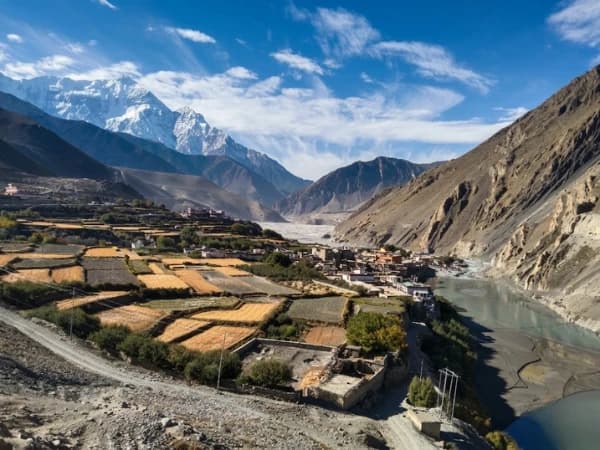
Why start from Pokhara instead of driving from Kathmandu?
Our standard 10-day trek drives from Kathmandu to Kagbeni, one very long day in each direction, 10 to 14 hours on rough road. This version flies Kathmandu to Pokhara and then drives to Jomsom over two days with a night in Tatopani, so you start fresh, and it adds the Chhoser caves day. The price is higher because of the flight and the jeep back.
Should we walk from Jomsom to Kagbeni or take a jeep?
We recommend walking. It is about two hours, gentle, and a good test of how you feel in the heat and the altitude before the real trek. If someone is tired after the drive, a jeep for this stretch is possible. Tell your guide.
What if the road is blocked?
We wait a day or change the order of the days. Extra hotel nights and meals caused by a landslide are yours to pay, because they are outside our control. We check the road 48 hours before each leg, and if we lose a day on the way in, the Chhoser day is the first thing to give way.
Can we go in July or August?
Yes, with open eyes. Upper Mustang sits in the rain shadow behind the Annapurna and Dhaulagiri ranges, so the trail itself stays fairly dry in the monsoon, and July is workable. Our best months are March to May and September to November. The weak spot is the road below Jomsom, which can have landslides. We plan around it.
What is the Chhoser day and is it included?
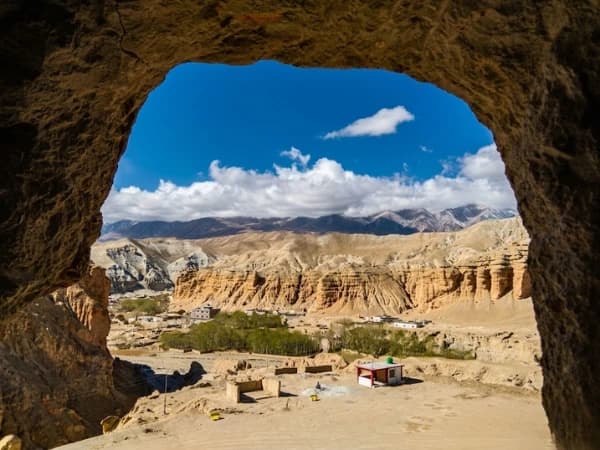
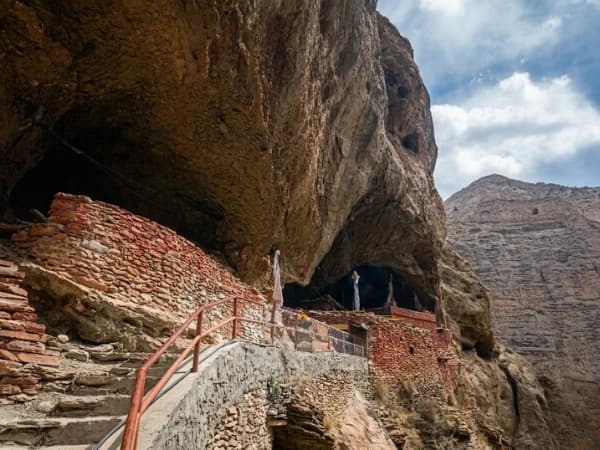
Chhoser is a village with cave monasteries and ancient cave dwellings north of Lo Manthang. This route includes a full day for it, with a third night in Lo Manthang, and the extra day of the restricted-area permit is already in the price. Your guide confirms the walking time on the day.
Can we return by jeep from Lo Manthang instead of walking back?
Yes. Instead of three days walking back to Kagbeni you can take a jeep from Lo Manthang to Pokhara. It costs more than the Jomsom jeep and skips the walking days, which also gives you spare days for weather or a slower pace. Ask us when you book and we will confirm the price for your group.
How hard is this trek?
You should be a fit person who enjoys long hiking days. There is no climbing gear or technical walking, but there are three days of 7 to 8 hours and you sleep above 3,000 m for most of the trek. The highest point is the Choku La at about 4,290 m, and you sleep highest at Lo Manthang, 3,840 m. Your guide carries a pulse oximeter and checks oxygen levels.
What does the restricted-area permit cost and is it included?
The Upper Mustang restricted-area permit is USD 50 per person per day, and this route has 9 days inside the area, so USD 450 per person. We pay it and it is in the price, together with the Annapurna Conservation Area permit and the TIMS card. You cannot walk here without it, and since 22 March 2026 even a solo trekker can be permitted through a registered agency with a licensed guide.
Can we trek Upper Mustang alone or as a family?
Yes to both. Almost all our departures are private, so it is your own group with your own guide. Children pay the adult price, because the permit, the flights and the lodge all cost us the same for a child. Standard solo guests have no porter, the guide carries up to 10 kg, and Luxury solo guests have their own porter.
Are Kathmandu and Pokhara hotels included?
No. Hotels in the cities are not in any of our trek prices. This route has two nights in Kathmandu and two in Pokhara. As a guide, a 3-star hotel in Pokhara is about USD 100 per room per night and a higher-category hotel about USD 150, and you can add them when you book. Our family homestay in Kathmandu is USD 15 per person per night and supports our learning centre.
How do I pay, and what is the deposit?
A 10% deposit confirms the trip and the balance is paid in Kathmandu. You can pay in US dollars or euros, cash or card. We cover the card fee on the deposit. Paying the balance by card carries a 3.5% bank charge, and cash in Kathmandu carries none. We cannot take Nepali rupees from foreign guests.
What if I need to cancel or change the dates?
If you need to change, rescheduling is free with at least 7 days' notice for restricted areas like Upper Mustang, to any date within one year. The deposit itself is not refunded if you cancel. If we cannot run the trip ourselves, we refund what you paid, less taxes, bank or card charges and any money already spent, such as permits and flights.
Who will guide us?
A licensed guide with experience in Upper Mustang. We confirm his name after you book, a little before departure, because we want him to be available, fit and well on the day rather than promise a name months ahead and change it at the last minute.
Are you a registered company?
Yes. The Everest Holiday is registered in Nepal, company registration 147653/072/073, trekking licence 2090/072, member of the Trekking Agencies' Association of Nepal, number 1586. These show we are a real, legal company. They do not prove quality, and even licensed companies have had problems, so please ask any agency for a phone call first. We are happy to speak any time.
How much does the 16 day Upper Mustang trek via Pokhara and Jomsom cost, and what is not in the price?
Prices start from USD 2,065 per person for 2 to 4 people on Budget, with Standard from USD 3,230 and Luxury from USD 4,480. The price covers the Kathmandu to Pokhara flights, the road from Pokhara to Jomsom, the jeep back from Jomsom to Pokhara (by tier), the Upper Mustang restricted-area permit and your guide. It does not cover international flights, your visa, the two Kathmandu and two Pokhara hotel nights (we can book them), insurance, tips, or about USD 10 to 15 per person per day for drinks, hot showers and charging. On your own it is USD 2,990 on Budget, USD 3,950 on Standard and USD 5,440 on Luxury, because the guide and the jeep are not shared.
How high do you sleep on the Upper Mustang trek and what insurance should I buy?
You sleep at Tatopani (about 1,190 m), Kagbeni (2,804 m), Chele (3,055 m), Syangboche (3,800 m), Dhakmar (3,820 m) and then three nights at Lo Manthang (3,840 m). The highest point is the Choku La at about 4,290 m on day 8, and your guide checks your oxygen level with a pulse oximeter every day. Buy cover at home that includes trekking and helicopter evacuation up to 4,500 m, which is the highest point rounded up to the next 500 m. Please do not buy insurance in Nepal.
What is the road like from Jomsom back to Pokhara, and is it open?
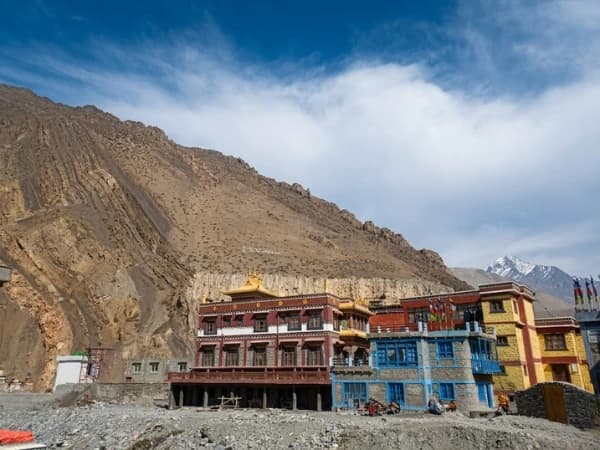
On day 14 a 4WD jeep (local shared on Budget, shared tourist on Standard, private luxury on Luxury) takes you from Kagbeni and Jomsom south through the Kali Gandaki gorge, past Marpha and Tukuche, to Pokhara. It is a long day on a rough mountain road, and your guide checks the road before you leave. As of 15 October 2026 the Beni to Jomsom road is repaired and open. We use the jeep both ways because it does not depend on the Jomsom flight.
Is there mobile signal or charging on the Upper Mustang trek, and how much cash should I carry?
Mobile data is not reliable north of Kagbeni, so tell your family to expect quiet days. A SIM card on arrival is included, and on Luxury hot showers and charging are covered where the lodge has them. On Budget and Standard, carry cash for hot showers, charging, snacks and tips, about USD 10 to 15 per person per day. Bring your cash with you from Kathmandu or Pokhara.
Which day is the hardest on the Upper Mustang trek from Kagbeni to Lo Manthang?
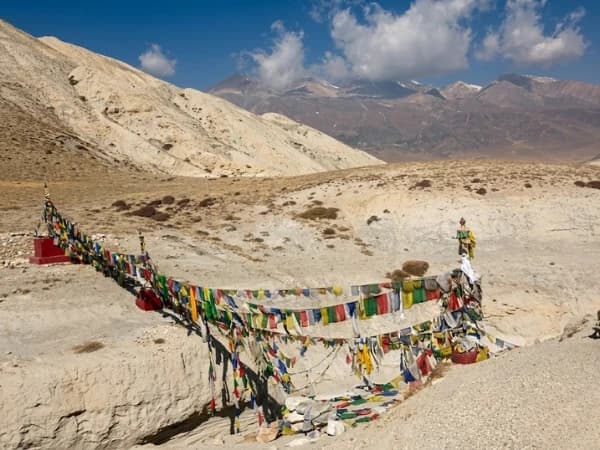
Day 6 from Chele to Syangboche is the one people remember, because you cross the Taklam La (3,624 m), the Dajori La (3,660 m), the Bhena La and the Yamda La at about 4,000 m before you reach the plateau at 3,800 m. Day 8 from Dhakmar over the Mui La (4,170 m) and the Choku La (about 4,290 m) into Lo Manthang is the high point. Three of the days are 7 to 8 hours of walking, and the trail has no technical sections. The free day in Lo Manthang and the Chhoser day give you rest at altitude before the walk back.
 Secure payment by Himalayan Bank.