Everest Base Camp Trek Cost From Qatar: The Real All-In Numbers in Riyals for 2027
Last updated 7 October 2026. Fares are for Doha (DOH), checked on 7 October 2026. The riyal is tied to the US dollar at QAR 3.64, so the riyal figures below will not drift. You pay us in US dollars or euros.
Doha is the easy end of this series. Qatar Airways flies nonstop to Kathmandu several times a day, so the flight is the cheap, short part of the trip, and almost all of the money is the trek itself. Many people reading this live in Qatar on a passport from somewhere else, which is why there is a section further down on entry rules passport by passport.
What does it cost? The trek: US$1,399 on Budget, US$2,499 on Standard, US$4,999 on Luxury for each person in a party of one to four, about QAR 5,090, QAR 9,100 and QAR 18,200, and the same in 2027. The whole trip from Doha, with flight, visa, insurance and tips, comes to about QAR 9,670 to QAR 12,950, QAR 13,060 to QAR 15,920 or QAR 22,590 to QAR 25,680 for one person, with Standard counted as solo. If your passport gets a free visa, take about QAR 180 off each.
Doha to Kathmandu on the day I searched
For the search I used economy, one adult, a cabin bag and a checked bag, with the outbound on Sunday 25 October 2026 and the return on Wednesday 11 November. Everything is on one ticket. I ran it with one change allowed, and again with nonstops only.
The first search allowed one change each way and returned 15 itineraries from QAR 2,467 to QAR 3,121. The cheapest, QAR 2,467, goes out with Air Arabia through Sharjah (Doha 10:10, Kathmandu 21:40, about 8 hours 45 minutes) and comes home with Air India through Delhi (Kathmandu 06:30, Doha 21:20, about 17 hours 35 minutes). Nonstop outbound flights also appeared in that list: Qatar Airways QR650 at 07:20 (in at 14:35, about 4 hours 30 minutes) with a Sri Lankan Airlines return through Colombo was QAR 2,959, and Nepal Airlines RA254 (02:45 to 10:10) with the same return was QAR 3,012.
The second search, nonstop only, returned 15 itineraries from QAR 2,979 to QAR 4,403. The lowest, QAR 2,979, is Qatar Airways both ways: QR650 out, QR649 home at 09:35 (in Doha at 11:50, about 5 hours). Qatar Airways has daytime outbounds at 07:20, 09:00 and 10:30 and several afternoon and evening returns. The price depends on the pairing more than the airline: the 07:20 outbound with an evening return (17:30 or 19:00) was QAR 3,852, and the dearest, QAR 4,403, pairs the 09:00 or 10:30 outbound with an evening return. Nepal Airlines out with Qatar Airways home was QAR 3,540. Every result included a cabin bag and a checked bag, though a few, on Hahn Air and Nepal Airlines, list no personal item. Himalaya Airlines did not appear.
The all-in table in riyals
The table is for a single traveller. The ticket column is the cheapest and the dearest of the results above. The extras column pairs a 30-day visa, insurance and tips with either meals (Budget) or pocket money (the other tiers). Kathmandu hotels are not included; our own family homestay is US$15 per person per night, about QAR 50.
| Per person | Trek, 12 days | Doha return | Visa, insurance, tips, extras | Total in riyals |
|---|---|---|---|---|
| Budget | QAR 5,090 | QAR 2,467 to QAR 4,403 | QAR 2,110 to QAR 3,460 | QAR 9,670 to QAR 12,950 |
| Standard, solo | QAR 9,100 | QAR 2,467 to QAR 4,403 | QAR 1,490 to QAR 2,420 | QAR 13,060 to QAR 15,920 |
| Luxury | QAR 18,200 | QAR 2,467 to QAR 4,403 | QAR 1,930 to QAR 3,080 | QAR 22,590 to QAR 25,680 |
Meals are an extra only on Budget, at US$25 to US$40 a day. The other two tiers include food, and you need 20,000 to 30,000 rupees (US$130 to US$195) for showers, charging and snacks. Take it out of a cash machine in Kathmandu. Allow US$15 to US$20 per day for your guide's tip and US$10 to US$15 per day for a porter's.
Entering Nepal: your passport decides, not your residence permit
Qatar is full of people on residence permits, and Nepal asks one question at the desk: which passport are you holding? Here is how it goes, from the immigration department's pages.
Indian passport. No visa and no fee, though the online arrival form is still filled in. The Nepal embassy in New Delhi says an Indian citizen over ten travelling between India and Nepal by air needs a valid Indian passport, a voter ID from the Government of India or an emergency certificate from the Indian embassy in Kathmandu. Flying from Doha you will have your passport anyway.
Bangladeshi, Pakistani, Sri Lankan, Bhutanese or Maldivian passport. Citizens of the SAARC countries other than India and Afghanistan get a free visa for up to 30 days, once in a calendar year. After 30 days the normal fees apply.
Nepali passport. No visa. If you hold a foreign passport and a Non-Resident Nepali card, the visa on arrival is free for you.
Every other passport, including Filipino, Egyptian, Arab and Western ones: visa on arrival at Tribhuvan airport, US$30 for 15 days, US$50 for 30 days (about QAR 180) or US$125 for 90 days. The immigration site lists no special rule for them. Chinese passports are listed there as free. Children under ten do not pay.
Twelve nationalities must apply before they travel: Nigeria, Ghana, Zimbabwe, Eswatini (the site writes Swaziland), Cameroon, Somalia, Liberia, Ethiopia, Iraq, Palestine, Afghanistan and Syria. The embassy in New Delhi lists Iran as well, so ask a Nepali embassy before you book. The passport should have at least six months left. Our visa on arrival guide and e-visa guide give the steps.
Nepal has an embassy in Doha, at [email protected] or +974 44675681. Before you fly, check that your own residence permit and passport are valid for coming back to Qatar, and ask your employer whether you need anything from them; I cannot advise on Qatari rules.
Do not count on a company health plan
Ask your insurer in writing whether it pays for treatment in Nepal, and assume the answer is no until it says yes. Buy a separate travel policy at home. It needs three things: trekking to 6,000 m in the wording, since Kala Patthar is 5,545 m; helicopter evacuation, which costs US$3,000 to US$5,000 (QAR 10,900 to QAR 18,200) if you pay; and illness as well as accident. Our helicopter cover to 6,000 m shows what to look for. If you send me the policy I will read it, free.
Leave and the calendar
Qatar's Labour Law (Law 14 of 2004, Article 79) gives at least three weeks of paid annual leave after a full year of service, and four weeks after five years. The trek, with the flights, needs 14 to 15 days, so it fits inside one leave. Under Article 80 the employer sets the dates and, with your consent, can split the leave into two parts. Nepal is 2 hours 45 minutes ahead of Qatar all year.
In October and November, Nepal's Dashain (17 to 23 October 2026) and Tihar (8 to 12 November) close government offices, and permits take 48 hours of government working days. When the Lukla flights are crowded they leave from Manthali, four to five hours from Kathmandu by road, with a pick-up between midnight and 2 am. A Luxury booking flies from Kathmandu by helicopter.
Which tier
On Budget, the pack on your back is yours and so is the menu: you share rooms, buy your meals and take the fixed-wing plane to Lukla. Standard feeds you, gives you a private room and shares a porter between two trekkers, which means a solo walker has no porter and hands up to 10 kg to the guide. Luxury is a porter of your own, a deluxe private room with its own bathroom, fruit, nuts, soft drinks without limit and the helicopter both ways. The three permits (NPR 3,000, 3,000 and 2,000), the licensed guide, the airport transfers and a borrowed down jacket and minus 15 sleeping bag are in the price at every level. No tier has a single supplement; Kathmandu hotels are separate. See the trek page.
Group prices in riyals
| Trekkers in the group | Budget | Standard | Luxury |
|---|---|---|---|
| 1 to 4 | QAR 5,090 | QAR 9,100 | QAR 18,200 |
| 5 to 8 | QAR 4,730 | QAR 8,910 | QAR 18,010 |
| 9 to 12 | QAR 4,360 | QAR 8,730 | QAR 17,830 |
| 13 to 20 | QAR 3,640 | QAR 8,550 | QAR 17,650 |
Whether the trek is private or in a group, the price per person is the same. Only the number of trekkers sets the band.
Flat ground and a 5,545 m viewpoint
Qatar is a flat country, barely a hundred metres above sea level at its highest, so nothing here prepares your body for altitude. The sleeping night is Gorak Shep at 5,164 m, and you walk five to seven hours a day for 12 days with two rest days to adjust. Train with stairs, a loaded pack and long, early walks in the cooler months, as in how fit you need to be.
Paying us
Pay 10 per cent to book. Pay the remaining 90 per cent in Kathmandu, in US dollars or euros, cash with no extra charge or card with 3.5 per cent added. We do not take Qatari riyals or rupees. You can move free to any date in the next year if we hear from you 72 hours ahead (seven days for Tibet, Kailash and restricted areas). If you cancel instead, the deposit is not returned and nothing else is refunded either. If we cancel, you receive what you paid minus taxes, bank and card charges, and permit and flight costs we have already paid.
Looking us up
The company was registered in Kathmandu in 2016, and the family behind it has guided for three generations. We belong to TAAN (member 1586), and over 300 people have reviewed us on TripAdvisor, Google and Trustpilot. The registrar, TAAN, the tourism licence and the forex certificate can each be checked. A licence is no guarantee: licensed firms have been caught in scams, so ask for a video call. Part of each booking supports the Nagarjun Learning Center. Other Gulf pages: the UAE, Saudi Arabia, Oman, Kuwait and Bahrain.
For a quote on your own dates and group, write to me on WhatsApp +977 9810351300 or [email protected].
Also on this topic: the day-by-day itinerary, permits and fees and travelling solo.
Shreejan Simkhada, CEO of The Everest Holiday. TAAN 1586.
Planning a trip to Nepal?
Drop us your details and tell us what you have in mind. We will put together a personalised plan and get back to you.
Not sure which Nepal trek is right for you?
Take our free 2-minute quiz and get personalised recommendations based on your fitness, experience, and travel style.
Find Your Perfect Trek →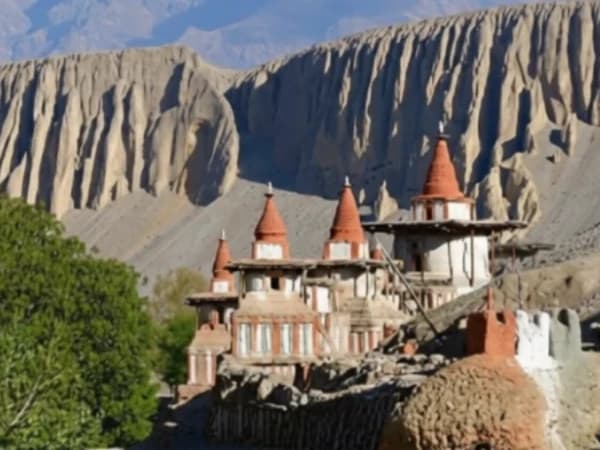
Upper Mustang Itinerary: 10, 12 or 14 Days? What Each Extra Day Adds for 2027
Our live 10-day Upper Mustang itinerary day by day, plus suggested 12 and 14 day outlines, with the USD 50 a day permit worked out for each length.
Read More
Nepal Weather Month by Month for 2027: Kathmandu, Pokhara and Namche
Average highs, lows and rainfall for Kathmandu, Pokhara and Namche Bazaar, the normal monsoon dates, and which of our treks suit each month in 2027.
Read More
Dunai Village Guide: Height, What Is There and the Trail North for 2027
Dunai is the district town of Dolpa where the Lower Dolpo walk starts. Its height, what is there, the 7 km walk from Juphal, the trail north, best months and 2027 prices.
Read More Chat with Shreejan