Nepal Travel Guide & Expert Trekking Tips
What I Wish I Knew Before Trekking to Everest Base Camp
Fourteen honest lessons from Shreejan Simkhada, third-generation Himalayan guide, on boots, Lukla weather, altitude, cold nights, trail costs, guides and porters, with real guest quotes.

Written by Shreejan Simkhada, CEO of The Everest Holiday and third-generation Himalayan guide. TAAN Member #1586.
The five things I tell every Everest Base Camp guest: break in your boots at home, keep one or two spare days before your flight home, go slowly because altitude is about pace and not fitness, bring a proper sleeping bag for the cold nights, and carry cash because costs rise as you climb. Our 12-day trek covers all of this: Everest Base Camp Trek 12 Days, from USD 1,255 per person. Questions? Message me on WhatsApp.
I have grown up around this trail. My family has guided in the Himalayas for three generations, and my company, founded in 2016, has taken guests to Everest Base Camp for years. Guests ask me the same questions again and again, and they make the same few mistakes. This page is what I would say to you over a cup of tea in Kathmandu the night before you fly.
Where I quote a guest, I use their own words from the reviews they left on Google or TripAdvisor. I have not changed a word.
1. Break in your boots before you fly
Never buy new boots for this trek and wear them for the first time on the trail. New boots cause blisters, and a blister on day two is a long walk to day twelve. Buy a decent pair at home, at least a month before, and walk in them until they feel like old friends.
If your boots are already good and broken in, use them. If you arrive in Kathmandu with nothing suitable, you can buy a decent pair in Thamel. In April 2026 we bought decent trekking shoes there for about NPR 6,500. But then you must walk in them before the trail, not on it. Either way, pack blister tape. I always tell guests to bring more than they think they need.
Trail-running shoes can work if you add something to keep snow out and carry crampons. In the colder months, a waterproof boot is better. I do not recommend rented shoes, because you cannot break in a pair that is not yours. My longer notes are in the trekking boots guide, and the Thamel gear guide shows what to buy and what to rent.
2. You will not see the summit of Everest from Base Camp
This surprises almost everyone. At 5,364 m you stand on the Khumbu Glacier, and Nuptse hides the summit. Base Camp is a place you reach, not a place with the big view. The view is from Kala Patthar at 5,645 m.
On our 12-day trek you sleep at Gorak Shep (about 5,164 m), visit Base Camp on day 8, then climb Kala Patthar for sunrise on day 9. A guest who made that climb wrote:
"On that Pinnacle was the Sunset Glory of Everest." (Thomas Fang, TripAdvisor, January 2021)
Full detail in my page on whether you can see Everest from Base Camp.
3. Lukla flights depend on weather, so keep spare days
Lukla's runway is short and on a slope, and the pilots fly by sight. If there is cloud, wind or fog at Kathmandu or Manthali, they wait. Most cancellations clear within a day. In the monsoon and on some winter days they can run longer.
My rule is simple. Keep at least one spare day, and two in the busy months or in winter, between the end of the trek and your flight home. When a guest's dates leave no gap before the international flight, I say so plainly and suggest moving the Lukla flights so that there is one.
If bad weather runs on, a shared helicopter seat from Lukla to Kathmandu is about USD 805 (USD 725 the other way), shared with four or five people. Extra nights and meals caused by weather are paid by you. Luxury avoids most of this because it flies by helicopter both ways. Read what happens when the Lukla flight is cancelled, the Kathmandu to Lukla flight guide and my honest answer on whether the flight is safe.
4. Altitude is about pace, not fitness, and rest days are not lazy days
Fit people get altitude sickness, and people in their fifties reach Kala Patthar. What decides it is how fast you go up, how much you drink and whether you listen to your body. Nobody can promise you will not feel it. What you can do is walk slowly, drink plenty of water, keep your daily gain in height sensible, follow your guide and tell him early if something feels wrong. If he says go down, you go down.
On our itinerary day 3 is a rest day at Namche Bazaar (3,440 m) and day 6 is a rest day at Dingboche (4,410 m). On a rest day we still walk higher for a few hours and come back to sleep lower. That is what lets your body catch up. Please do not skip these days to save a day. And I tell guests to leave alcohol and smoking until after the trek.
One guest wrote about the pace:
"The 14 days Trekking was Not easy for us as both of us are in our Fifties" (Thomas Fang, TripAdvisor, January 2021)
Our guides carry an oximeter in the first aid kit and check your oxygen levels at altitude. If you want to read more, start with the altitude of every stop on the route, where people struggle and why, altitude sickness prevention and what Diamox does and does not do. Speak to your own doctor about medication before you fly.
5. The nights are colder than the days
Teahouse rooms are not heated. Only the dining room has a stove, and everyone sits around it until bedtime. At 3,500 m in October it can drop to about minus 5 by midnight, and higher up it is colder. Walking in daytime is often comfortable. The night is the problem.
Bring a sleeping bag rated to minus 15 comfort, or tell us at the briefing that you need one. We have sleeping bags and down jackets made for our guests to use on the trek, and you give them back afterwards. Sleep in dry base layers and keep your next day's clothes and your phone battery inside the bag with you. One guest put it this way:
"we have a sleeping bag which is the most important thing we bring during our trek" (Candy See Lai Lai, TripAdvisor, January 2021)
More on this in my guide to staying warm in Nepal teahouses at night.
6. Pack less than you think, and check your gear early
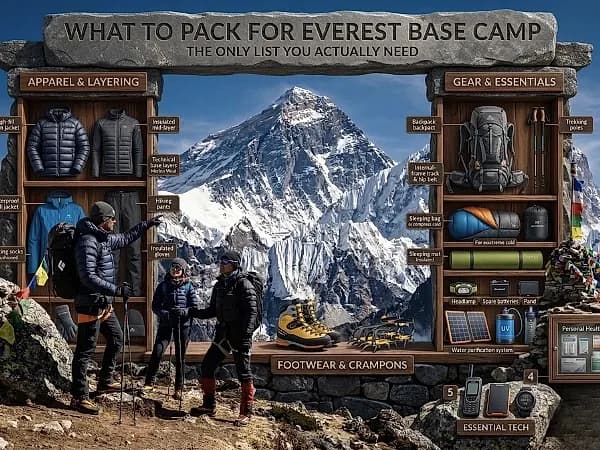
Keep the main bag light. Bring warm gloves and a hat, a headlamp, sun protection and a few spare pairs of socks. Walking poles help a lot on the downhill, and I recommend them if your knees complain.
Check your kit a few weeks before you fly, not the night before. A guest from an earlier season told us how we handled this:
"they checked if we had all equipment needed and good insurance and helped us renting some quality jackets and sleeping bags" (Milou, TripAdvisor, December 2017)
We still do that today. Use the EBC packing list and read the ten things not to bring.
7. Costs rise as you climb: cash, charging, Wi-Fi and showers
Everything on the upper trail arrives on the back of a porter or a yak, so prices go up with every day. A teahouse meal is about NPR 2,000 including tea or coffee at current prices, and it costs more as you climb. Charging your phone, Wi-Fi and hot showers are extra and the price rises with height.
Change your money into rupees in Kathmandu before you fly. The only trail ATMs we know of are two machines in Namche Bazaar, and they do not always work. Also bring US dollars in cash for your Nepal visa, because the card machine at immigration sometimes does not work. For trail cash I plan roughly USD 300 to 430 per person on Standard and USD 600 to 820 on Budget, because Budget does not include meals. More in Nepal money for trekkers, and the full price breakdown in Everest Base Camp trek cost.
Water costs more too. A litre of bottled water is around NPR 400 at Gorak Shep, so bring a bottle and a purification method and refill instead (see safe drinking water on treks). Plan to drink three to four litres a day. On Standard we include 2 litres of hot water a day. On Luxury you get all the hot water you can drink. On Budget, water is yours to buy.
Permits are the one cost you do not need to think about. The Sagarmatha National Park permit, the Khumbu local fee and the TIMS card are all in the price on every tier. A local SIM card is included too. Mobile signal fades at the highest points.
8. The food is better than you expect, and it is not cheap
Dal bhat, noodle soup, fried rice, eggs, pasta and potatoes. Menus are similar in every lodge, and the quality is good for such remote places. A guest from April 2026 said:
"The accommodation and food arrangements were excellent considering the remote locations." (Ankit Siwakoti, Google, April 2026)
Standard includes three meals a day, a cup of tea or coffee with each meal and fruit at breakfast. Luxury adds fruit, dry fruit and nuts, plus tea, coffee, juice and soft drinks that your porter carries for you. On Budget you buy your own meals. I like to buy fruit and dried fruit in Kathmandu and have a porter carry it up, because appetite drops at altitude and a snack you actually fancy is worth a lot.
Tell us about any allergy before you fly, so your guide can pass it on to each lodge. See the trek food guide and what teahouse rooms, showers and food are really like.
9. Your guide and porter: what each tier really gives you
Every tier has a licensed guide. The difference is the porter. Budget has no porter, so you carry your own bag. Standard has one porter for every two trekkers, with 10 kg each. If you travel alone on Standard, your guide carries up to 10 kg of your bag. Luxury gives you your own porter, with up to 20 kg.
That 20 kg is our own limit, not a rule from the government. We have seen porters on the trail carrying far more, which is why we keep to a lighter standard. Porters are the backbone of the Himalayas, and I want ours to walk home healthy. If you want extra help on Standard, a personal porter is USD 25 a day plus 13% VAT and the 3.5% bank charge, so about USD 29.24 a day.
Guests describe what the guide and porter gave them. The first quote is from a guest on our Three Passes trek:
"Having a porter (Umbier) was also well worthwhile as it made the long days less of a chore" (Gary C, TripAdvisor, October 2026, Three Passes trek)
"from accomodation locations to right viewing opportunities, they know everything inside out" (Connector542015, TripAdvisor, February 2020)
10. Buy insurance at home, and check what it covers
Your policy must cover trekking up to 6,000 m and helicopter evacuation. Buy it in your home country before you fly. Do not buy insurance in Nepal. We arrange the rescue if it is ever needed, and your insurer pays for it, so the cover has to be right before you leave. Send us your policy before the trek and we will check it with you. Details in my guide to EBC insurance and heli cover and the wider Nepal travel insurance page.
11. October and April are busy, so book early
Spring and autumn are the main seasons, and October and April are the busiest months. Flights, lodges and guides fill up early. The trail is also quieter in other months, with different weather. Read the month guides for November and March, and the weather month by month. Our deposit is 10%, and the deposit is non-refundable. If your plans change, you can reschedule free with at least 72 hours' notice, to any date within one year.
Kathmandu hotels are not included in the trek price, so fly in at least one day before day 1 and tell us if you want us to book a hotel.
12. Train your legs, and look after your knees on the way down
Start training at least a few months before you go. Long walks with a loaded pack, hills and stairs every day build the stamina and breathing you need. If you live in a flat, use the stairs. Short regular hikes beat one huge one. I wrote a 12-week training plan that builds the body and the mind slowly.
The downhill hurts more than people expect. Use walking poles, walk slowly on the descent and ask your guide to slow the pace if your knees are bothering you.
13. Tipping is expected, so plan for it
Tipping is not required by law, but it is part of what guides and porters earn. I suggest USD 15 to 20 a day for your guide and USD 10 to 15 a day for a porter, in cash, at the farewell dinner. On a 12-day trek that is about USD 180 to 240 for the guide. If you are on Standard, you share a porter with another trekker, so agree a split. Full detail in tipping in Nepal.
14. What guests remember most is the care, not the number
When I read our reviews, guests write a lot about people: the guide, the family, the food, the call from the office when the weather turned. One family wrote:
"When poor weather came in, we were personally contacted by the company from Kathmandu to check on our welfare and to offer advice." (W4821RHlizd, TripAdvisor, October 2021)
That is what I try to build: a guide you can trust, an office that picks up the phone, and plans that leave room for the weather. The mountain does the rest. For more, read my wider list of things I wish I knew before trekking in Nepal.
Frequently asked questions
How hard is the Everest Base Camp trek?
It is graded strenuous. There is no technical climbing, but you walk for several hours a day at altitude for 12 days. Training and a slow pace matter more than speed.
How many days do I need?
Our trek is 12 days from Kathmandu, with rest days at Namche Bazaar and Dingboche. I also suggest one or two spare days before your flight home in case of weather.
Can I see Everest from Base Camp?
Not the summit. Nuptse hides it. The best view is from Kala Patthar at 5,645 m, which we climb for sunrise on day 9.
How much does it cost?
For two to four people our prices start at USD 1,255 per person on Budget, USD 2,320 on Standard and USD 4,650 on Luxury. Solo travellers and bigger groups pay a different rate, shown on the package page. Kathmandu hotels, international flights, insurance, tips and extras on the trail are not included.
Do I need to buy all my gear?
No. Boots are the one thing to buy and break in at home. Sleeping bags and down jackets can be provided if you tell us before the trek, and you give them back afterwards.
What insurance do I need?
A policy bought at home that covers trekking up to 6,000 m and helicopter evacuation. Please send it to us before you travel.
If you want to talk any of this through, message me on WhatsApp and I will answer myself. Or see the trek: Everest Base Camp Trek 12 Days.
Updated 12 November 2026.
Planning a trip to Nepal?
Drop us your details and tell us what you have in mind. We will put together a personalised plan and get back to you.
Take our free 2-minute quiz and get personalised recommendations based on your fitness, experience, and travel style.
Find your trekMore from the travel blog
All stories and guides Nepal Travel Guide & Expert Trekking TipsAnnapurna Base Camp Altitude: How High Is ABC in Metres and Feet?Annapurna Base Camp is 4,130 m (13,550 ft). Here is the height of every night on our 9-day trek, how ABC compares with Everest Base Camp, and what to do about altitude.
 Nepal Travel Guide & Expert Trekking TipsEverest Base Camp Altitude: How High Is EBC in Metres and Feet?Everest Base Camp is 5,364 m (17,598 ft) high. Here is the height of every stop on the trek, what it feels like, and how we help you adjust.
 Nepal Travel Guide & Expert Trekking TipsWhere Is Mount Kailash? Location, Map Position and HeightMount Kailash is in Ngari Prefecture, Tibet, China, 6,638 m high, near Lake Manasarovar. Coordinates, map position, nearby rivers and how pilgrims reach it from Nepal.