

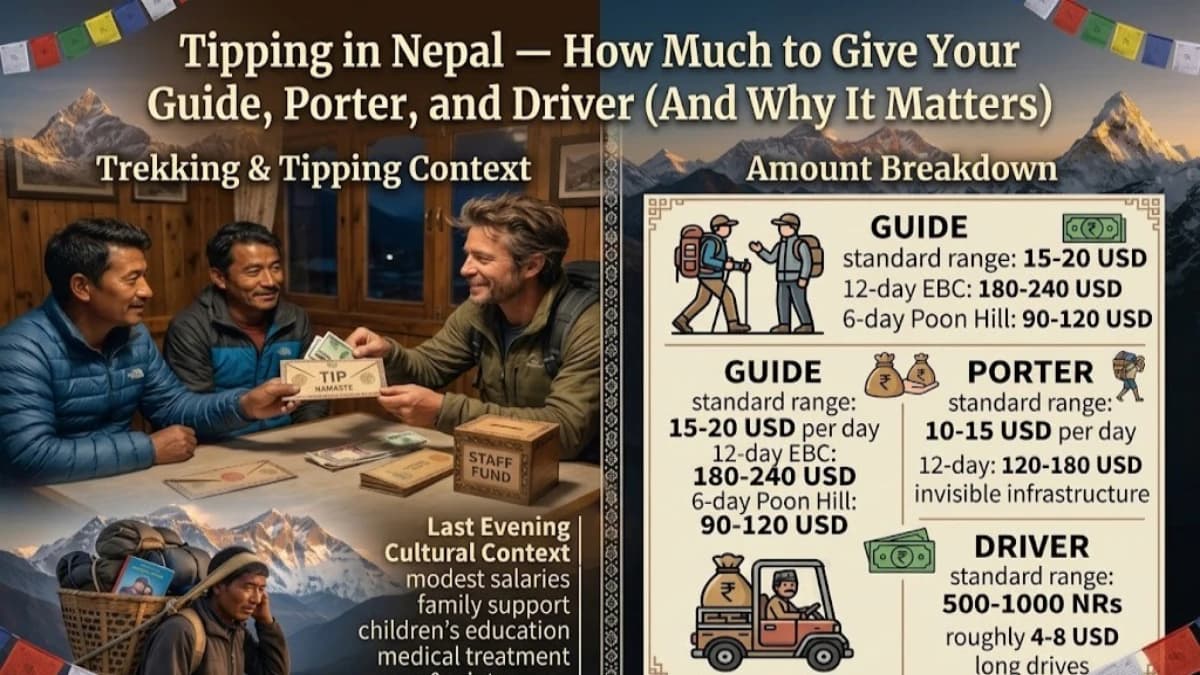
Short answer: Tip your guide USD 15 to 20 a day and your porter USD 10 to 15 a day, in cash, at the farewell dinner. On a 12-day Everest Base Camp trek that is about USD 180 to 240 for the guide and USD 120 to 180 for a porter. Tipping is not required by law, but it is expected, and it is a real part of what Nepali guides and porters earn.
On the last evening of every trek, usually in a restaurant in Thamel with the dust of the mountains still in your hair and the ache of twelve days still in your legs, there comes a quiet, slightly awkward moment. The meal is winding down. Your guide has been with you every day for nearly two weeks. Your porter has carried your bag through rain and altitude and river crossings without a single complaint. And now you need to say thank you in a way that words alone cannot express.
Tipping in Nepal is not legally required. It is not printed on any receipt or added to any bill. But it is culturally expected, deeply appreciated, and, for the people who make your trek possible, genuinely meaningful. The guides and porters who walk alongside you in the Himalayas earn modest base salaries. Tips represent a significant supplement that allows them to support their families between trekking seasons, fund their children's education, and survive the months when the mountains are closed to tourism.
This is the guide to doing it well, the amounts, the method, the etiquette, and the human reality behind the numbers.
| Who | Suggested tip | Notes |
|---|---|---|
| Trekking guide | USD 15–20 / day | ~USD 180–240 over a 12-day EBC trek |
| Porter | USD 10–15 / day | ~USD 120–180 over 12 days |
| Driver (long transfer) | NPR 500–1,000 (~USD 4–8) | One-time, not per day |
| Teahouse / kitchen staff | NPR 200–500 | Optional, a kind gesture |
| Kathmandu hotel / restaurant | Round up, or 10–15% | If service is not already included |
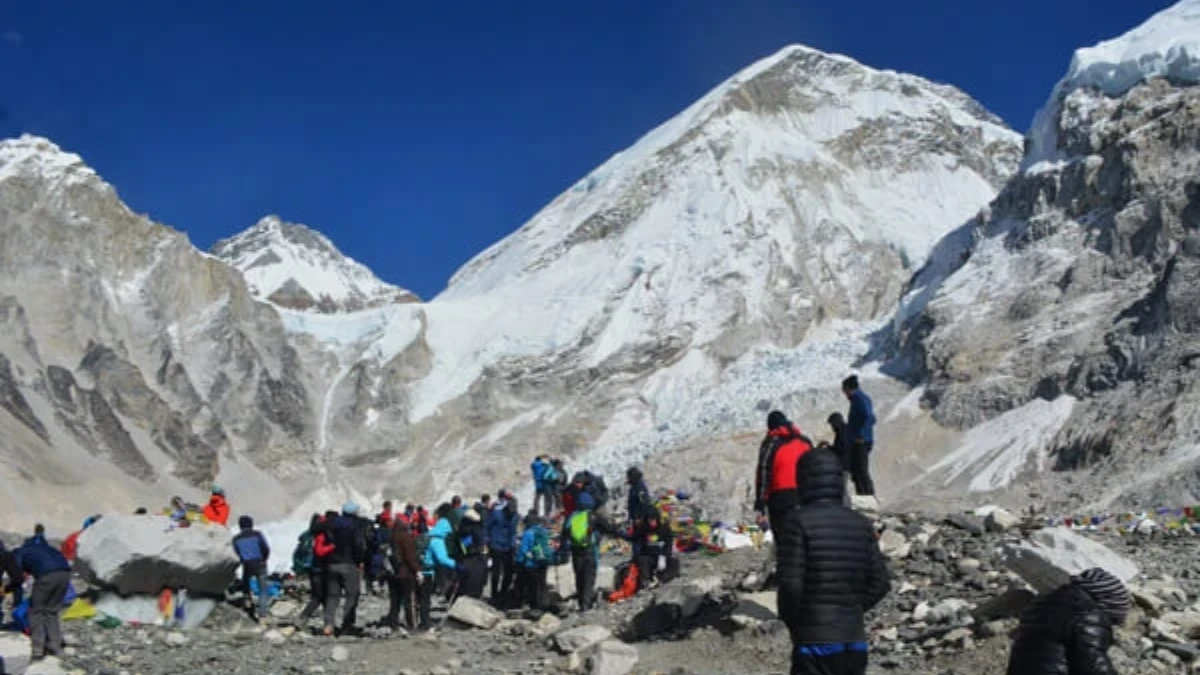
How Much Should You Tip on a Nepal Trek?
This is the same guidance as the table above, worked out per day and over two common trek lengths.
| Role | Per day | 6-day trek (Poon Hill) | 12-day trek (Everest Base Camp) |
|---|---|---|---|
| Trekking guide | USD 15-20 | USD 90-120 | USD 180-240 |
| Porter (your own porter, Luxury tier) | USD 10-15 | USD 60-90 | USD 120-180 |
| Shared porter (Standard tier, one porter per two trekkers), your half | USD 5-7.50 | USD 30-45 | USD 60-90 |
| Driver on a long transfer | One-time tip | NPR 500-1,000 (about USD 4-8) | NPR 500-1,000 (about USD 4-8) |
Budget treks have no porter, so there is no porter tip. If you pool a tip with your group, add up each person's share of the guide and porter lines.
How Much to Tip Your Trekking Guide
Fifteen to twenty US dollars per day is the standard range for a trekking guide. For a twelve-day Everest Base Camp trek, that translates to one hundred and eighty to two hundred and forty dollars total. For a six-day Poon Hill trek, ninety to one hundred and twenty dollars.
Guides who go above expectations, who anticipate problems before they arise, who adjust the pace to your body without being asked, who make the miserable cold evenings at Lobuche feel warm through sheer force of personality, deserve the upper end of that range or above it.
How Much to Tip Your Porter
Ten to fifteen dollars per day. Over twelve days: one hundred and twenty to one hundred and eighty dollars. Porters carry around twenty kilograms on their backs, your belongings, plus their own, over the same terrain you walk with a five-kilogram daypack. They are the invisible infrastructure of Himalayan trekking. Without them, the entire industry does not exist.
Your Driver
If your trek includes a long drive, Kathmandu to Salleri on the EBC road route, or Kathmandu to Chame for the Annapurna Circuit, a tip of five hundred to one thousand Nepali rupees (roughly four to eight dollars) for the driver is appropriate. This is a one-time tip, not per-day.
Other Staff
If you ate at the same teahouse multiple nights, a small tip for the kitchen staff, two hundred to five hundred rupees, is a kind gesture but not expected. Hotel staff in Kathmandu: round up the bill or leave a hundred rupees. Restaurant staff: ten to fifteen percent of the bill if service is not already included.
How do you give a tip to your guide or porter in Nepal?
In a sealed envelope. At the farewell dinner or on the final morning in Kathmandu. Hand it directly to your guide with a few words of thanks. If tipping the porter separately, hand it to them directly as well, do not ask the guide to pass it on.
If you are part of a group, pool your tips together. This means the guide and porter each receive a meaningful amount rather than multiple small envelopes. One person in the group typically volunteers to collect and present the combined tip.
Cash is preferred. Nepali rupees are ideal because the guide does not need to exchange them. US dollars are also widely accepted. Avoid tipping in currencies that are difficult to exchange in Nepal, Australian dollars, for example, are harder to convert than American ones.
Why does tipping your guide and porter in Nepal matter?
A guide earns roughly fifteen to twenty-five thousand Nepali rupees per month in base salary, about one hundred and twenty to two hundred US dollars. This is a decent income by Nepali standards, but it covers approximately seven to eight months of work. The monsoon season, June through August, and deep winter, January and February, produce little or no income because trekking stops.
Tips bridge the gap. A generous tip from a client who stayed for twelve days can represent a month of additional income. It funds school fees for the guide's children. It pays for medical treatment that Nepal's strained public health system cannot always provide. It allows the guide's family to eat well during the off-season months when no money is coming in.
This is not a guilt trip. It is context. The money you place in that envelope at the farewell dinner is not a transaction, it is a recognition that the person who kept you safe and comfortable in one of the most challenging environments on earth has earned something beyond their base pay.
Should you tip less if your Nepal guide gives poor service?
Two scenarios come up occasionally and both are worth addressing.
If the service was poor, if the guide was inattentive, uncommunicative, or negligent about safety, you are not obligated to tip generously. A reduced tip with honest, private feedback to the trekking company is more useful than a large tip that rewards poor performance. Honest feedback helps the company improve. Silence does not.
If the service was exceptional but your budget is genuinely tight, a smaller tip combined with a heartfelt thank-you and a detailed TripAdvisor or Google review is deeply valued. Guides know that reviews generate future bookings, which generate future income. A five-star review that mentions your guide by name has long-term financial value that exceeds the difference between a ten-dollar and a twenty-dollar daily tip.
Do reviews help Nepal guides and porters as much as cash tips?
When you arrive home and unpack your bag, write a review. Mention your guide's name. Mention your porter's name if you know it. Describe a specific moment, the morning they checked your oxygen level and decided you needed an extra rest, the evening they brought you ginger tea without asking, the time they carried your daypack for the last hour because they could see you were struggling.
This review is a tip that keeps giving. It builds the guide's reputation. It builds the company's visibility. It brings more clients, which brings more work, which brings more income to communities that depend on mountain tourism for survival.
The sealed envelope at the farewell dinner says thank you for this trek. The review says thank you for all the treks to come.
Tips are not included in the price of our packages, so bring them in cash. See our trek pages for what is included in each tier.
Tip your guide $15-20/day, your porter $10-15/day. It goes directly to them. It matters more than you think.
WhatsApp:+977 9810351300
Email:[email protected]
Related guides: Nepal currency guide | TIMS card guide | Trekking gear in Thamel
Written by Shreejan Simkhada, CEO of The Everest Holiday and third-generation Himalayan guide. TAAN Member #1586.
Booking the EBC trek? Our Everest Base Camp Trek (12 Days) is private (your group only, no strangers), 2027 dates open, From USD $1399. WhatsApp us for tailored 2027 dates and current departures.
 Chat with Shreejan