
Short answer: Rent the bulky items and buy the cheap small ones. A down jacket or a minus-15 sleeping bag rents for about USD 1 to 2 a day, so USD 12 to 24 over a 12-day trek, while buying one in Thamel costs USD 30 to 100. Bring your boots and base layers from home. On our own treks the sleeping bag and down jacket are provided free on every tier.
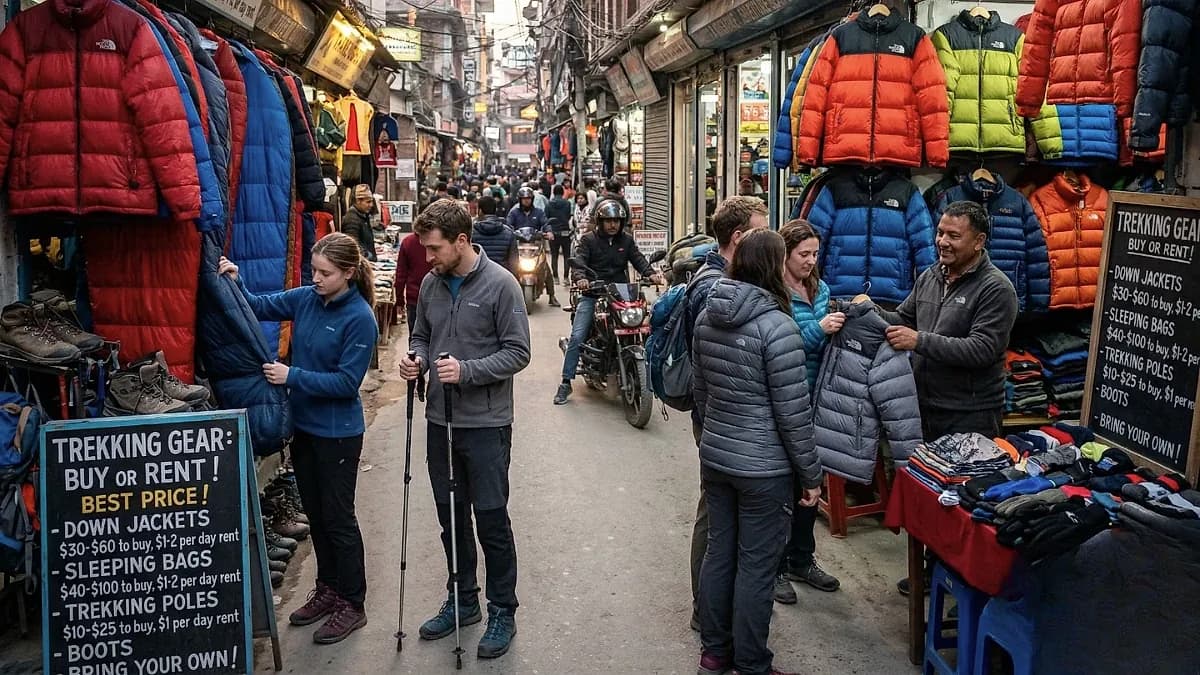
There is a particular chaos to Thamel's gear shops that first-time visitors find either exhilarating or terrifying. Narrow streets stacked with trekking jackets hanging from doorframes. Tables spilling onto pavements piled with fleece gloves, merino socks, and head torches. Shop owners calling from every doorway: "Looking for sleeping bag? Down jacket? Best quality, lowest price, come see."
Behind the noise, Thamel is one of the best places on earth to equip yourself for a Himalayan trek. The prices are a fraction of what you would pay in London, Sydney, or New York. The selection covers everything from budget basics to genuine branded gear. And the timing is perfect: you arrive in Kathmandu the day before your trek, walk into Thamel, and walk out an hour later with everything you need.
The trick is knowing what to buy, what to rent, what to avoid, and how to tell the difference between gear that will last twelve days at five thousand metres and gear that will fall apart at three thousand.
Is it cheaper to rent or buy trekking gear in Kathmandu?
The calculation is straightforward. Items you already own and trust, such as boots, base layers and your daypack, bring from home. Items you will use once and never again, such as a sleeping bag rated to minus fifteen, a bulky down jacket, rent in Kathmandu. Items that are cheap enough to buy and light enough to carry home, buffs, trekking poles, duffel bags, buy in Thamel.
Before you spend anything, check what your trekking company already gives you. On our own treks the sleeping bag and the down jacket are provided free on every tier, Budget included, and a duffel bag as well on the Standard and Luxury packages. That takes the two most expensive lines off the list below. Tell us at your pre-trek briefing if you need them and they will be waiting for you. Everything that follows is written for trekkers equipping themselves.
A down jacket rents for one to two US dollars per day. Over a twelve-day EBC trek, that is twelve to twenty-four dollars. The same jacket costs thirty to eighty dollars to buy in Thamel, or one hundred and fifty to four hundred at home. Unless you plan to trek multiple times, renting is the obvious choice.
A sleeping bag rated to minus fifteen rents for one to two dollars per day. Buying in Thamel costs forty to one hundred dollars. Buying at home costs two hundred to five hundred. Again, rental wins for single-trip trekkers.
Trekking poles rent for roughly a dollar per day. A decent pair costs ten to twenty-five dollars in Thamel. They are lightweight enough to carry home if you want them, but most trekkers leave them at the shop when they return their other rentals.
Here are the typical ranges in one place, in US dollars. They are ballpark figures from the Thamel shops, not a shop-by-shop price list, and they move with season and bargaining.
| Item | Rent per day | Rent over 12 days | Buy in Thamel | Buy at home |
|---|---|---|---|---|
| Down jacket | USD 1-2 | USD 12-24 | USD 30-80 (local-made); USD 150-300 (genuine branded) | USD 150-400 |
| Sleeping bag (rated minus 15) | USD 1-2 | USD 12-24 | USD 40-100 | USD 200-500 |
| Trekking poles | About USD 1 | About USD 12 | USD 10-25 | Bring your own if you have them |
| Duffel bag | Not worth renting | Not worth renting | USD 5-10 | Bring only if you already own one |
| Buff or neck gaiter | Buy | Buy | USD 2-3 each | Cheaper in Thamel |
| Fleece jacket | Not worth renting | Not worth renting | USD 10-25 | Bring if you own one |
| Waterproof jacket | Not worth renting | Not worth renting | USD 15-60 (the cheaper ones are water-resistant only) | Bring from home if possible |
Above 5,000 metres, shops also rent expedition-grade gear: roughly NPR 200 to 300 a day for a high-altitude sleeping bag and NPR 150 to 200 a day for a heavy down jacket. Check the rating on the label before you leave the shop.
What Trekking Gear Can You Buy in Thamel?
Thamel's gear shops fall into three categories.
The brand-name shops, North Face, Marmot, Columbia, Rab, sell genuine branded gear at prices lower than Western retail but still significant. A genuine North Face down jacket costs one hundred and fifty to three hundred dollars. These items are real, come with manufacturer tags and warranties, and will last years of use.
The local-manufacture shops sell gear that looks identical to branded equipment, same designs, same materials, often the same logos, but is produced locally rather than in the brand's authorised factories. A "North Face" down jacket from one of these shops costs thirty to sixty dollars. The quality varies enormously. Some are excellent, warm, well-stitched, functional for multiple treks. Some fall apart at the seams within a week.
The rental shops keep a rotating inventory of used and new items, sleeping bags, down jackets, trekking poles, duffel bags, gaiters, available by the day. The gear is functional but not new. Sleeping bags have been used by hundreds of trekkers before you. Down jackets carry the accumulated smell of altitude sweat. But they work. And at a dollar or two per day, the price cannot be argued with.
How can you tell if Thamel trekking gear is good quality?
Pull the zips. All of them. A zip that sticks, catches, or requires force to open will fail on the trail, usually at the worst possible moment, like when you are trying to get into your sleeping bag at minus ten in the dark. Smooth zips on a Thamel jacket are the single best indicator of overall build quality.
Check the stitching. Turn the garment inside out and look at the seams. Even, consistent stitching with no loose threads means the item was made with care. Uneven or skipped stitches mean it was rushed. At four thousand metres in a snowstorm is not when you want to discover that your jacket seam was rushed.
Feel the down. In a down jacket, squeeze the fabric between your fingers. You should feel the fill shifting and compressing evenly. If you feel hard lumps, thin spots, or the feathers poking through the shell, the jacket will not insulate evenly and will lose warmth quickly. Good down feels uniformly soft and springs back when compressed.
Try it on. Over your fleece. With your daypack. This is how you will wear it on the trail. If it restricts movement, rides up when you raise your arms, or does not zip comfortably over your layers, it is the wrong size regardless of what the label says. Thamel sizing varies wildly, a "large" in one shop is a "medium" in another.
Which trekking gear is worth buying versus renting in Kathmandu?
Down jacket: Rent unless you trek regularly. One to two dollars per day versus thirty to three hundred dollars to buy.
Sleeping bag: Rent unless you are particular about hygiene. The rental bags are functional but have been used by many people. A silk liner, which you should bring or buy regardless, creates a clean barrier between you and the bag. One to two dollars per day versus forty to five hundred dollars.
Trekking poles: Rent or buy cheap. A dollar per day to rent, ten to twenty-five dollars to buy. Collapsible poles from Thamel are adequate for a single trek. Serious trekkers with their own carbon poles should bring them from home.
Duffel bag: Buy. Five to ten dollars for a sturdy duffel that will last the trek and can be left behind or given away afterwards. Renting a duffel makes no financial sense when buying is this cheap.
Buff or neck gaiter: Buy. Two to three dollars each. Buy two. They weigh nothing and you will use them every day.
Fleece jacket: Buy if you do not have one. Ten to twenty-five dollars in Thamel for a warm, functional fleece. Not worth renting, the purchase price is barely more than a week's rental.
Waterproof jacket: Bring from home if possible. Thamel waterproofs range from fifteen to sixty dollars. The cheaper ones are water-resistant rather than waterproof, an important distinction when rain arrives at three thousand metres and you have six hours of walking ahead.
Boots: Absolutely bring from home. Broken-in, trusted, fitted to your feet. Buying boots in Kathmandu and starting a twelve-day trek in them the next morning is a recipe for blisters that no amount of savings justifies.
Where in Thamel should you buy trekking gear?
The densest concentration of gear shops runs along the main streets of Thamel between Thamel Chowk and the Kathmandu Guest House. The shops on the main drag tend to be slightly more expensive but offer wider selection. The shops on side streets, particularly the alleys running south towards Durbar Marg, often have the same inventory at lower prices because they pay less rent.
Bargaining is expected. The first price quoted is not the real price. Open at forty to fifty percent of the asking price and expect to settle at sixty to seventy percent. The shopkeeper will meet you somewhere in the middle. This is not adversarial, it is the normal commercial transaction in Nepal and both parties understand the game.
If you prefer fixed prices without negotiation, several shops in Thamel operate on a no-bargaining policy and mark their items with final prices. These are usually the branded-gear shops and tend to be slightly more expensive but save the time and energy of negotiating.
How do you spot fake trekking gear in Thamel?
Most "branded" gear in Thamel is locally manufactured under names that approximate the original. The North Face becomes Norfth Face on a hangtag if you look carefully. Mammut becomes Mamut. This is not necessarily bad, since many of the locally made pieces are functionally adequate for a single trek, but if you are paying genuine-branded prices, you have a right to genuine-branded gear.
Tell-tale signs that something is a copy:
- Stitching irregularity. Genuine outdoor brands stitch eight to ten passes per inch on stress seams. Counterfeits show five or six. Look at the inside of the chest seam on a down jacket.
- Zipper feel. YKK pulls are smooth and silent. Counterfeit zippers catch, stick, or sound metallic when you run them.
- Hangtags and labels. Real brands include batch codes, country-of-origin labels, and care instructions in multiple languages. A jacket labelled only in English with a single hangtag is local-made.
- Down feel. A genuine 700-fill down jacket compresses to the size of a grapefruit and re-lofts immediately. A polyester-fill or cheap down jacket stays flat or feels heavy for its volume.
- Stitching colour match. Counterfeit pieces often use one thread colour throughout. Genuine pieces match thread to fabric panel.
The two authorised outlets in Kathmandu that sell verified genuine gear are Sonam Gear on Tridevi Marg (verified Mountain Hardware, Black Diamond, Petzl) and Shona's Alpine off Thamel Chowk (verified Lowe Alpine, Sea to Summit, Therm-a-Rest). Prices at these are sixty to eighty percent of European retail, still a saving, with no counterfeit risk.
For a Khumbu or Annapurna trek, locally manufactured Sherpa-Made and Yak brand items are honest gear at honest prices. For a Kailash or Manaslu trek with longer high-altitude exposure, the difference between counterfeit fill and real 700-fill down is the difference between sleeping warm at 4,500 metres and shivering through the night.
Which trekking gear should you bring from home for Nepal?
Some items make sense to buy at home. Others are simply not worth the airline weight when you can find them on Tridevi Marg for a fraction of the price. The split, in practice, comes down to two questions: how personal-fit-dependent is this gear, and how often will you reuse it after Nepal?
Bring from home:
- Hiking boots: broken in, fitted to your feet, with the lace pattern you trust. New boots in Thamel paired with a fourteen-day trek is a recipe for blisters that ruin the journey.
- Performance base layers (merino): the genuine Icebreaker, Smartwool, or Devold pieces hold up over years. Thamel knockoffs are polyester pretending to be wool.
- Prescription glasses or sunglasses: bring your everyday pair, replace lost sunglasses in Pokhara if needed.
- Trekking poles: only if you already own carbon or aluminium pairs. Thamel rental poles are usually fine for a first-timer.
- Personal first-aid items, prescription medications, blister plasters, lip balm, sun cream higher than SPF 30.
- Headlamp from home if you have one. Thamel headlamps work but the batteries drain faster.
Buy or rent in Thamel:
- Down jacket, sleeping bag, duffel: bulky, expensive at home, easy and cheap here.
- Fleece mid-layer, trekking trousers, beanie, gloves: the local Sherpa-Made and Yak brands are honest gear at honest prices.
- Microfibre towel, water bottle, trekking socks: pennies.
- Down booties or camp socks, hand warmers: buy on the morning of departure, you will not regret it.
A useful rule of thumb: anything that touches your skin and travels with you for the rest of the year, bring. Anything that goes in a duffel and gets used once a year, buy here.
How do you bargain for trekking gear in Thamel?
Bargaining in Thamel is expected, and shopkeepers price the first quote anticipating you will negotiate. Walking away with the opening price is not respected. It suggests you do not value either side of the exchange. But there is a way to bargain that gets you a fair price while keeping the conversation warm, and a way that turns the shopkeeper cold for the rest of the morning.
The honest opening is to ask the price, then offer roughly forty to fifty percent of it. If the response is an immediate "okay, okay, take it," you should be suspicious. The first quote was high. If you hear "no, no, my final, I cannot," then you are closer to the real number. Move up in small increments. A genuine bargain usually settles around sixty to seventy percent of the first quote.
A few rules that change the outcome:
- Buy more than one item. Three pairs of socks, two beanies, a fleece: the bundle price drops sharply.
- Pay in cash, in rupees. Card payment adds three to five percent the shopkeeper has to absorb; rupees are king.
- Smile. The Nepali greeting namaste and a polite kati ho? ("how much?") shifts the entire exchange.
- Do not bargain over coffee or food. Restaurant pricing is fixed; haggling there is offensive.
- If you walk away and they call you back, you have hit the real price. If they let you leave, the price you offered was below their cost.
The trekking-gear bargaining range is wide. A name-brand down jacket that opens at NPR 8,000 might be available at NPR 4,500 by 9am, and at NPR 5,500 to a less patient buyer at noon. Sleeping bags and duffels are the most negotiable. Branded-store prices (the official outlets near Kathmandu Guest House) are fixed and the only place where bargaining is genuinely not done.
What gear do you need for trekking above 4,000m?
The gear list shifts in three discrete steps as you move higher.
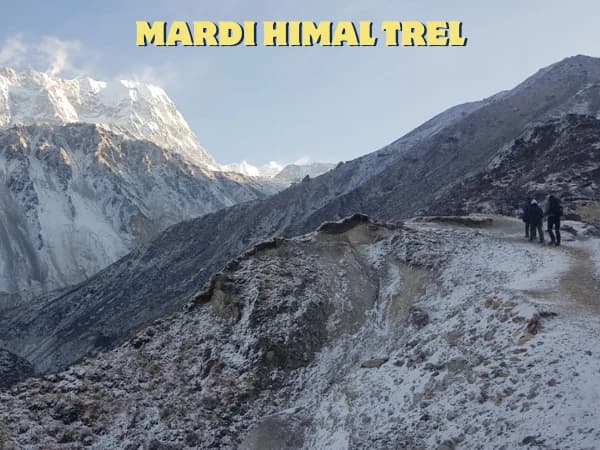
Below 4,000 metres (Poon Hill, Mardi Himal, lower Annapurna): a three-season sleeping bag, a single down jacket, fleece mid-layer, and standard trekking trousers will see you through. Rental gear from Thamel is more than adequate. You can comfortably trek in a single base layer most days.
Between 4,000 and 5,000 metres (Annapurna Base Camp, Langtang, lower EBC): night temperatures fall to minus ten and below. The sleeping bag should be rated to minus fifteen comfort, not extreme. The down jacket should be 600-fill minimum. Add a thermal hat, glove liners under the outer gloves, and an insulated water-bottle sleeve to prevent freezing. A balaclava becomes essential for the morning starts.
Above 5,000 metres (Everest Base Camp, Kala Patthar, Thorong La Pass, the Kailash kora): you are in a different gear category. A minus-twenty rated sleeping bag, an 800-fill down jacket, hard-shell layer over the down, mountaineering-grade gloves with inner liners, double-layer wool socks, and gaiters if there is snow on the route. Most rental shops in Thamel carry "expedition" rentals specifically for this: NPR 200-300 per day for a high-altitude sleeping bag and NPR 150-200 per day for a heavy down jacket. Confirm the rating in writing before you walk out with it; some shops will hand you a minus-five bag and call it "minus twenty" if you do not check the label.
For high-altitude treks like the Kailash kora at 5,630 metres, do not economise on the sleeping bag and down jacket. Everything else can be Thamel-quality without consequence. These two items decide whether you sleep or shiver. Related: Do I Need a Sleeping Bag for Nepal Trekking? The Honest Answer.
Can you buy trekking gear in Thamel last minute?
Most trekkers arrive in Kathmandu the evening before their pre-trek briefing and have the following morning to buy or rent whatever they need. This works, Thamel shops open by eight in the morning and most trekkers can equip themselves in an hour.
But if you arrive with an extra day in Kathmandu, which we recommend for jet lag recovery regardless, use the spare time to shop without pressure. Compare two or three shops. Try things on properly. Walk around the block in rental boots to check the fit. The difference between a rushed purchase and a considered one is the difference between twelve days of comfort and twelve days of regret.
Your trekking company can also help. Guides who have spent years outfitting clients know which shops offer the best quality at fair prices. A quick WhatsApp message asking where to go for a particular item gets you a trusted recommendation instead of a random doorway on a chaotic street. Ask us about the sleeping bag or the down jacket and the answer will be that you need neither, because both come with the trek.
Thamel is where most trekkers buy last-minute gear before heading to the mountains. Our EBC Trek and ABC Trek packages include a sleeping bag rated to minus fifteen and a down jacket free on every tier, and a duffel bag as well on the Standard and Luxury packages, so those come off your shopping list.
Thamel is a gear shopping experience that ranges from brilliant to disastrous depending on how you approach it. The real North Face store is on the main road. Everything else claiming to be North Face is fake. The fakes are fine for a two-week trek if you accept that they will not last a lifetime. The genuine gear shops are on the upper floors and side streets. Your best strategy: bring your boots and base layers from home, and check whether your trekking company provides the sleeping bag before you buy or rent one. Buy or rent everything else in Thamel.
We provide a sleeping bag rated to minus fifteen and a down jacket free on every tier of our trekking packages, Budget as well as Standard and Luxury, and a duffel bag on the Standard and Luxury tiers. They are our own gear, made to our specification, and you hand them back at the end of the trek. Tell us at the briefing if you need them.
WhatsApp:+977 9810351300
Email:[email protected]
Related guides: Choosing trekking boots | Nepal currency guide | TIMS card guide
Written by Shreejan Simkhada, CEO of The Everest Holiday and third-generation Himalayan guide. TAAN Member #1586.
Already packing for the trek? Our Everest Base Camp Trek (12 Days) is private (your group only, no strangers), 2026 dates open, From USD $1399. WhatsApp us for tailored 2026 dates and current departures.

 Chat with Shreejan