

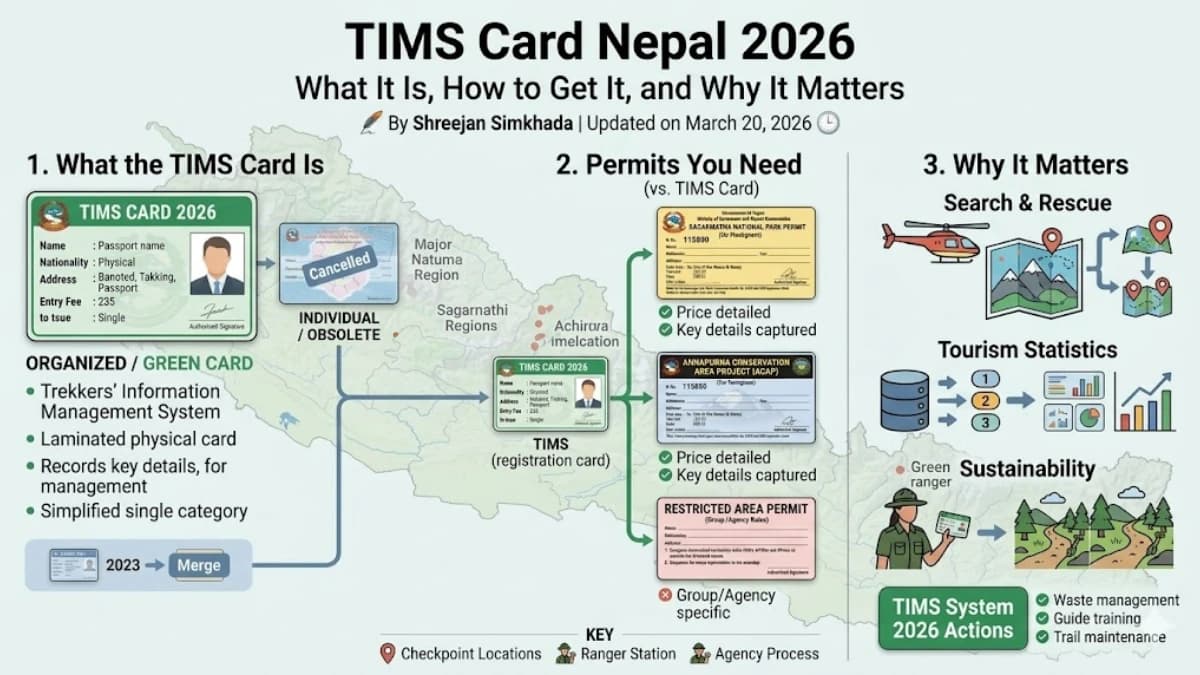
Somewhere in the bureaucratic architecture of Nepal's trekking industry, between the national park permits and the licensed-guide rule, there is a laminated card with your photograph on it that nobody will ask to see for the first three days of your trek and that everybody will ask to see for the rest of it. The TIMS card (Trekkers' Information Management System) is one of those administrative requirements that seems pointless until you understand why it exists, at which point it seems merely annoying rather than senseless.
Do I need a TIMS card for Everest Base Camp?
Yes. On the Everest Base Camp trek you carry three permits, and the TIMS card is one of them, alongside the Sagarmatha National Park entry permit and the Khumbu Pasang Lhamu Rural Municipality permit. On our treks we buy the TIMS card in Kathmandu before you fly to Lukla, and your guide buys the Khumbu permit on the trail at Lukla or Monjo, so all three are in order when the Monjo checkpoint asks for them.
- TIMS card: NPR 2,000 for foreign nationals, NPR 1,000 for SAARC nationals
- Sagarmatha National Park entry: NPR 3,000 for foreign nationals, NPR 1,500 for SAARC nationals
- Khumbu Pasang Lhamu Rural Municipality permit: NPR 3,000 for every nationality
Together that is NPR 8,000 for a foreign trekker, roughly USD 52. On every Everest package we sell, all three are included in every tier, so you pay nothing at the checkpoint.
TIMS is Nepal's trekker tracking system. It records who is trekking, where they are going, and when they entered a trekking area. The data feeds a database that serves two purposes: search and rescue coordination, and tourism statistics. If you go missing on the trail (and people do go missing, more often than the brochures suggest), TIMS is how the authorities know your planned route, your expected timeline, and where to start looking. If you complete your trek without incident, which the vast majority of trekkers do, your TIMS data becomes a statistic that informs permit pricing, trail maintenance budgets, and national tourism planning.
Neither purpose is glamorous. Both are genuine. The TIMS card is the unglamorous infrastructure that supports a trekking industry serving hundreds of thousands of visitors per year in some of the most remote terrain on earth.
What Is a TIMS Card and Do You Still Need One in 2027?
TIMS is a physical card, credit-card sized, laminated, with your passport photo, personal details, trekking route, entry and exit dates, and the name of your trekking company. It was introduced in 2008 by the Trekking Agencies' Association of Nepal (TAAN) in partnership with the Nepal Tourism Board to replace an earlier, less systematic registration process.
There are two types of TIMS cards, though the system has been simplified in recent years:
Group/Organised TIMS (Green Card): Issued to trekkers who are booked through a registered trekking agency. This is the standard card for anyone booking a package trek. Your trekking company arranges it as part of the booking process. Cost: NPR 2,000 for foreign nationals and NPR 1,000 for SAARC nationals.
Individual TIMS (Blue Card): Previously issued to independent trekkers walking without a guide. Some offices may still reference the individual card. On our treks every trekker is with a licensed guide and a registered company, so we arrange the TIMS registration for you.
The card is valid for the specific trek and dates listed on it. If you change your itinerary, extending your trek, adding a side trip, or switching routes, you technically need the card updated, though enforcement of this requirement varies. A TIMS card for EBC will be checked at Everest region checkpoints but would not be valid for the Annapurna region. Most trekkers do one route per card.
How Do You Get a TIMS Card or Nepal Trekking Card?
If you are booking through a trekking company, which is how every trek with us works, the company handles your TIMS card. You provide your passport details, two passport-sized photographs, and your trekking dates. The company submits the application, pays the fee, and collects the card. It is usually included in your trek package cost, though some budget packages list it as an additional fee, check your booking confirmation.
The TIMS card is issued from the Nepal Tourism Board office in Kathmandu (Pradarshani Marg, near Bhrikutimandap) or from TAAN offices. Processing takes a few hours on a normal day, longer during peak season when queues build. Your trekking company typically handles this on the day before your trek departure or on the first day while other logistics are being arranged.
You need to bring: your passport (original, not a copy), two passport-sized photographs (you can get these taken in Thamel for about one to two dollars), and cash for the fee if it is not included in your package. Related: Kailash Mansarovar Permit 2027: Requirements, Cost and Process.
Where is your TIMS card checked on Nepal trekking routes?
TIMS checkpoints are stationed at entry points to trekking areas and at intervals along major trails. The checks are simple, a trek official examines your card, records your details in a ledger, and waves you through. The process takes thirty seconds to two minutes.
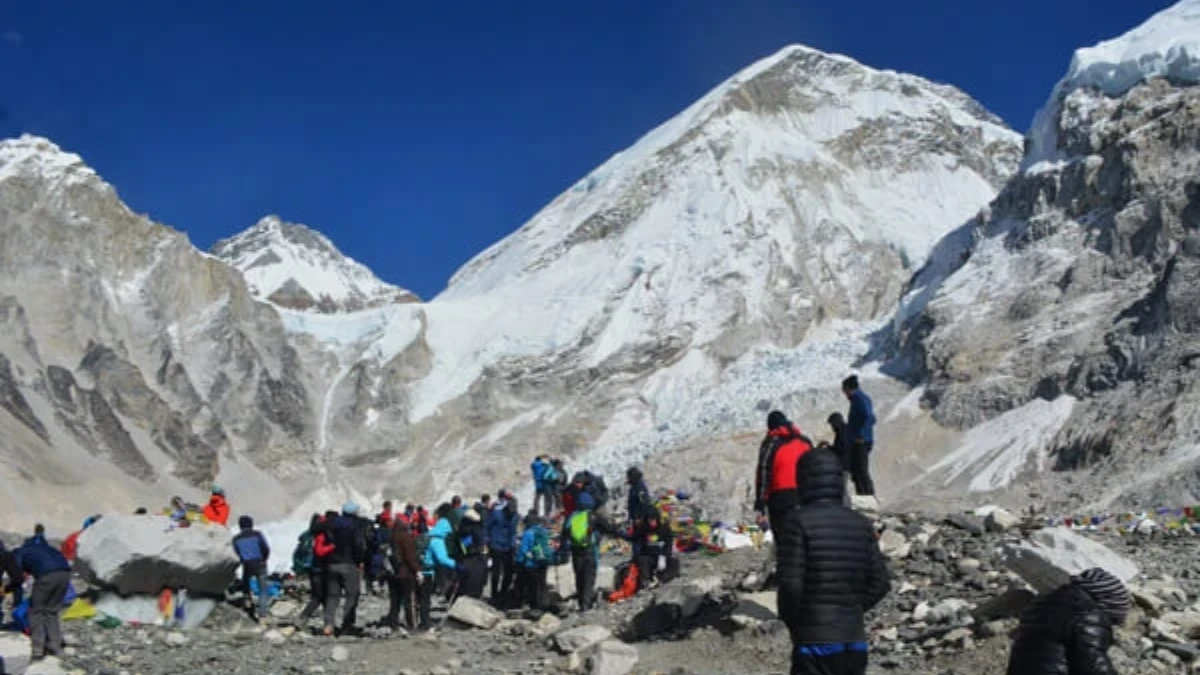
On the Everest Base Camp trail, expect TIMS checks at Monjo (the entrance to Sagarmatha National Park, where your park entry permit is also checked), and potentially at Jorsalle and Namche. On the Annapurna Circuit, checks occur at the ACAP checkpoint in Besisahar or Chamje, and at points along the trail. On the Langtang trail, the check is at the Langtang National Park entrance at Dhunche.
The consequences of not having a TIMS card vary by checkpoint and ranger. In the Everest region you need three documents: your TIMS card, the Sagarmatha National Park permit and the Khumbu Pasang Lhamu Rural Municipality permit. We buy the TIMS card in Kathmandu before the trek, and your guide buys the Khumbu permit on the trail at Lukla or Monjo. That way all three are in order by the time you reach the Monjo checkpoint. At less formal checkpoints, you may be turned back or asked to return to the nearest registration point. In practice, the system is designed to catch unregistered trekkers before they get deep into the mountains rather than to punish minor administrative oversights. Related: Can You Trek to Everest Base Camp Without a Guide? The 2027 Answer.
Is TIMS the only permit needed for trekking in Nepal?
The TIMS card is not a trekking permit. It is a registration card. The permits you need are separate and depend on where you are trekking:
Sagarmatha National Park entry permit (Everest region): NPR 3,000 for foreign nationals and NPR 1,500 for SAARC nationals, which is roughly twenty and ten US dollars at current rates. In the Everest region this permit is paired with the Khumbu Pasang Lhamu Rural Municipality permit, NPR 3,000 for every nationality (roughly twenty US dollars at the same rate), and with a TIMS card. The park and Khumbu permits are checked at Monjo.
ACAP permit (Annapurna Conservation Area): NPR 3,000 for foreign nationals and NPR 1,000 for SAARC nationals, roughly twenty and seven US dollars. Required for all Annapurna region treks including the Circuit, ABC, and Ghorepani-Poon Hill. In the Annapurna region a TIMS card is asked for alongside it, just as it is in the Khumbu.
Langtang National Park entry permit: similar to Sagarmatha pricing. Required for Langtang Valley and Helambu treks.
Restricted area permits (Manaslu, Upper Mustang, Kanchenjunga, Dolpo, etc.): these are separate, more expensive, and have additional requirements including minimum group sizes. Your trekking company arranges these in advance as they require more processing time.
Think of it this way: TIMS is your registration with the national trekking system. Permits are your entry tickets to specific protected areas. You need both, but they serve different functions and are issued by different authorities.
Common Questions
Can I get a TIMS card outside Kathmandu? TIMS cards can also be issued at the TAAN office in Pokhara (useful for Annapurna region treks starting from Pokhara) and at some regional tourism offices. However, the most reliable and fastest processing is in Kathmandu.
What if I lose my TIMS card on the trek? Report the loss to your guide immediately. Your guide will carry copies of your permits, and the checkpoints can usually verify your registration through their records or by contacting the TIMS office. Getting a replacement card on the trail is not possible, it would need to be arranged in Kathmandu. A photocopy or photo of the card on your phone is a sensible backup.
Do I need a TIMS card for day hikes near Kathmandu? No. TIMS is required for treks within national parks and conservation areas, not for day hikes or short walks outside these boundaries. Hikes to Nagarkot, Dhulikhel, Champadevi, and the Kathmandu Valley rim do not require TIMS.
Do children need a TIMS card? Yes, all trekkers regardless of age need a TIMS card if they are entering a trekking area that requires it. The process is the same as for adults.
Is TIMS the same as TIMS card? Yes. "TIMS" and "TIMS card" are used interchangeably. The official name is the Trekkers' Information Management System card.
Has the TIMS system changed recently? The system has been updated and modified several times since its introduction in 2008. The most significant change was the move to a single group card for trekkers booked through an agency. Some sources still reference the old two-category system, and on our treks we arrange the TIMS card for you.
Why is the TIMS card required for trekking in Nepal?
TIMS is easy to dismiss as bureaucracy. A form to fill, a photo to provide, a fee to pay, a card to carry. It adds nothing to the mountain adventure and subtracts twenty minutes of your pre-trek preparation.
But the system it supports matters. When a trekker goes missing on the Annapurna Circuit, and trekkers do go missing, swept away by avalanches, lost in storms, or simply failing to return from a day hike, the TIMS database tells rescue teams exactly which trail they were on, when they entered the area, and when they were expected to exit. This information narrows the search area and accelerates the response. In a country where mobile phone coverage is intermittent above 3,000 metres and satellite phones are carried by guides rather than trekkers, the low-tech paper trail of checkpoint registrations and TIMS data is sometimes the only record of where a person was last seen.
The tourism statistics that TIMS generates are equally consequential, even if less dramatic. The data determines how many rangers are stationed at checkpoints, how much budget is allocated to trail maintenance, and how permits are priced to balance access with conservation. Sagarmatha National Park's management plan, which determines everything from teahouse construction permits to waste management protocols, is built on visitor data that comes primarily from TIMS registrations.
Your TIMS card is boring. The system behind it is not. And the thirty seconds you spend at each checkpoint, showing your card to a ranger who records your name in a ledger, is the price of participation in a system that, imperfectly, slowly, and with the characteristic bureaucratic warmth of any government registration process, makes trekking in Nepal safer and more sustainable for everyone who follows you up the trail.
TIMS cards are included in all our trek packages. We handle the paperwork.
The TIMS card is a tracking system, not a permit. It tells the government where you are on the trail so rescue teams know where to look if something goes wrong. TIMS is still required in the Everest region and on the other main trekking routes, and we arrange it through our agency for every trekker. Your trekking company handles it for you: it is included in every package we run.
Questions about permits? We handle all of them: TIMS, national park fees, restricted area permits. Just ask.
WhatsApp:+977 9810351300
Email:[email protected]
Related guides: Nepal currency guide | Complete trek cost breakdown
Written by Shreejan Simkhada, CEO of The Everest Holiday and third-generation Himalayan guide. TAAN Member #1586.
Got your TIMS, now book your trek? Our Everest Base Camp Trek (12 Days) is private (your group only, no strangers), spring 2027 dates open, From USD $1399. WhatsApp us for tailored 2027 dates and current departures.
For 2027: no changes to TIMS fees or rules have been announced as of September 2026. Nepal changed the solo-trekking rules in 2023 and again in March 2026, both times with short notice, so we update this page the day anything official moves, and on our treks the card is arranged by us either way.
Reviewed and updated on 2 September 2026 by Shreejan Simkhada, CEO of The Everest Holiday and third-generation Himalayan guide. TAAN Member #1586.
 Chat with Shreejan