
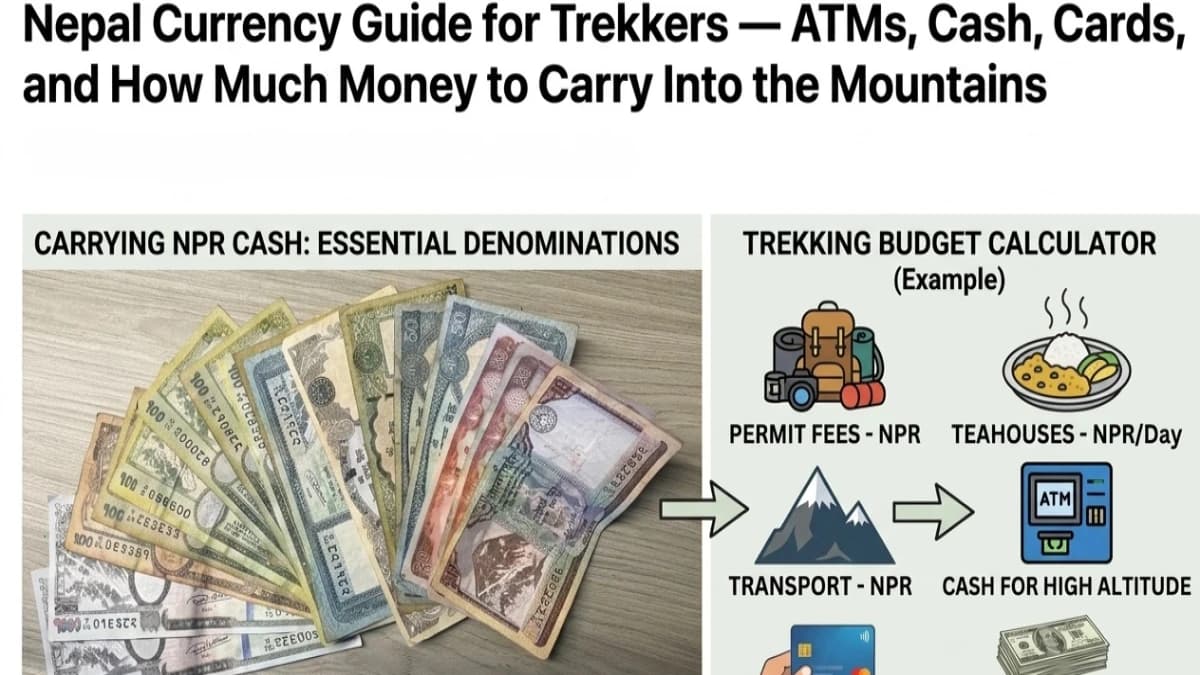
Carry rupees for the trail and dollars for us, and change your trek money in Kathmandu before you fly to the mountains. The reason is simple: the only trail ATMs we know of on our routes are two Nabil Bank machines in Namche Bazaar, our own Everest itinerary describes them as "two ATMs that sometimes function", and on the Rara Lake route our itinerary says there are none and that card payments do not exist. On a 12-day Everest Base Camp trek I would plan on roughly USD 300 to 430 of trail cash per person on Standard, about USD 600 to 820 on Budget (because Budget does not include your meals), and roughly USD 300 to 420 in tips plus whatever you spend on drinks and gifts on Luxury. The table below shows where those figures come from.
Written by Shreejan Simkhada, CEO of The Everest Holiday, from a family of three generations of family guides. TAAN Member #1586. Last updated 7 October 2026. The exchange rate was checked on that date.
How much cash should you carry on a Nepal trek?
It depends on your tier more than on the trek, because the tier decides who pays for your meals, your drinks and your porter. This table is for our 12-day Everest Base Camp trek, per person, in US dollars. The meal and extras figures are the ranges in our budget Everest Base Camp guide, which are our own guides' estimates and not an official price list. The tip ranges are the ones in our tipping guide: USD 15 to 20 a day for the guide and USD 10 to 15 a day for a porter, over 12 days. The totals are simple sums of those ranges.
| Cash item (12-day EBC, per person) | Budget | Standard | Luxury |
|---|---|---|---|
| Meals on the trek | Not included: about USD 360 to 480 | Included | Included |
| Drinks, charging, WiFi, hot showers | About USD 60 to 100 | About USD 60 to 100 (tea or coffee with each meal and 2 litres of warm water a day are included) | Showers, device charging and internet (where available) and soft drinks are listed as included; alcohol is not |
| Tip for your guide (12 days) | USD 180 to 240 | USD 180 to 240 | USD 180 to 240 |
| Tip for a porter | No porter on Budget | One porter per two trekkers, so your share is about USD 60 to 90 (a solo Standard trekker has no porter) | Your own porter: USD 120 to 180 |
| Trail cash, roughly | USD 600 to 820 | USD 300 to 430 | USD 300 to 420, plus alcohol and gifts |
Two things are not in that table. Kathmandu hotels are not included in any of our trek tiers, and our budget guide puts meals, taxis and souvenirs in Kathmandu at roughly USD 50 to 150. Your balance payment to us is separate too (see below). For treks other than Everest we don't publish a per-day figure, so ask us for your route and tier instead of relying on a guess.
What is the Nepali rupee exchange rate in 2026?
Roughly 154 rupees to the US dollar. On 7 October 2026 Nepal Rastra Bank's forex page showed the open-market rate for the US dollar as 153.98 buying and 154.58 selling. NRB notes that the open-market rates quoted by different banks may differ.
For mental arithmetic, divide the rupee price by about 154. At the buying rate, USD 100 is NPR 15,398 before any margin the changer takes, and NPR 1,000 is about USD 6.50. Check the same NRB page again before you fly, because the figure moves.
Where should you change money in Nepal?
In Kathmandu, at a licensed changer or bank, before you head for the trail. NRB's Foreign Exchange Management Department page lists licensed money changers and publishes a dated list called "Licensed Entities by NRB for FX Transactions" (the latest is as on 16 July 2026) on its FXM page. If you want to be sure a counter is licensed, check it against that list.
Beyond that, this is our guides' experience rather than a rule. Counters in Thamel, banks, hotels and the airport all change US dollars; the rates differ, so compare two before you hand over a large amount, and keep the airport for small sums. Bring crisp, undamaged dollar notes, because worn, torn or marked notes are sometimes refused. Don't count on finding a money changer on the trail itself, so treat the mountains as a place to spend rupees, not to buy them.
Can you bring foreign cash into Nepal?
Yes, up to a limit. NRB's Foreign Exchange Management Department notice on bringing foreign currency cash into and out of Nepal says Nepali or foreign citizens may bring cash foreign currency up to USD 5,000, or its equivalent in other currencies, without a customs declaration, and that any larger amount must be declared at customs and certified. The notice is in Nepali and was published in late July 2026 (2083/04/07 in the Bikram Sambat calendar).
Check the take-out rules before you fly. The NRB notice covers cash taken out of Nepal as well as brought in, but the figure that is clear is for bringing cash in, and the rule for Nepali rupees leaving the country is unclear, so ask us or the Department of Customs before you carry large sums out. For Indian travellers, a separate part of the same notice deals with Indian rupees (Indian citizens may carry Indian 200 and 500 rupee notes up to 25,000 rupees a person, and the old 500 and 1,000 notes from before 9 November 2016 cannot be traded). Since it is in Nepali, read it or ask us before you rely on it.
Are there ATMs on Nepal trekking routes?
Very few, and none you should plan around. Here is what we know.
| Route | What we know | Source |
|---|---|---|
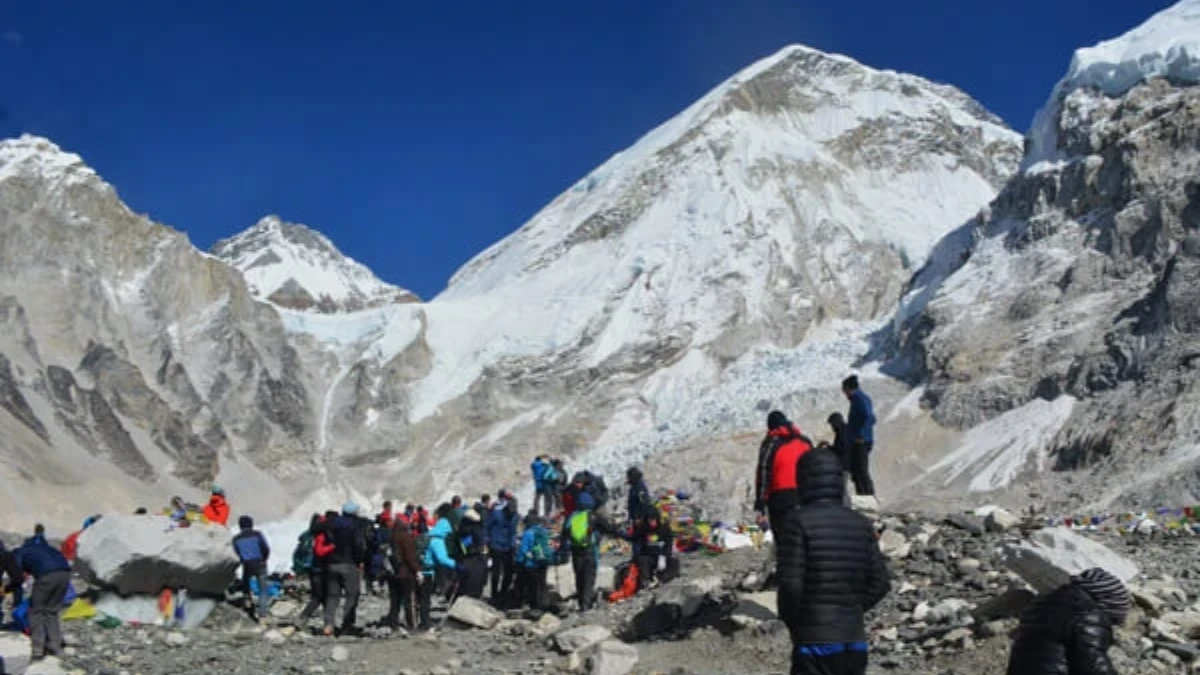
| Everest Base Camp | Two Nabil Bank ATMs in Namche Bazaar ("Nabil ATM Namche" and "Nabil ATM Namche - I"). Our itinerary calls them "two ATMs that sometimes function". Nothing confirmed above Namche. | Nabil Bank ATM page; our Everest itinerary |
| Rara Lake | Our itinerary tells you to get rupees in Kathmandu: "There are no ATMs between here and Rara Lake, and card payments don't exist on this route." | Our Rara itinerary |
| Annapurna, Langtang, Manaslu | We know of no trail ATM on these routes. The Nabil listing does not show Chame, Jomsom or Arughat. | Nabil Bank ATM page |
Nabil's list is one bank's ATMs, not every machine in Nepal, so other machines may exist. Don't bet your trek money on one. Nabil, Standard Chartered Nepal and NIC Asia publish no per-transaction limit or fee, so I do not quote one. Your own bank will charge its own foreign-withdrawal and currency fees, and its daily limit applies as well, so ask it before you travel.
Withdraw what you need in Kathmandu. Treat Namche as a backup that may be empty, offline or unable to read your card, and tell your bank you are travelling so it does not block the card.
Can you use a credit card on a Nepal trek?
Not on the trail. Our Rara itinerary says card payments do not exist on that route, and we know of no teahouse on our other routes that takes cards, so plan on rupees from the first night. In Kathmandu and Pokhara cards are taken at hotels and larger restaurants in our experience, but street food, taxis and small shops are cash. Ask about a surcharge before you pay by card.
How do you pay The Everest Holiday, and in which currency?
Our policy for foreign clients is simple. For Nepal treks the deposit is 10%, paid by card online when you book. The deposit is non-refundable, but you can reschedule free of charge to any date within one year with at least 72 hours' notice (7 days for restricted-area, Tibet and Kailash trips). The rest is paid in Kathmandu in US dollars or euros, in cash or by card. Cash in Kathmandu carries no extra charge; paying the balance by card carries 3.5%.
We do not take Nepali rupees from foreign clients, so you never need to change money to pay us. If you want to settle in a way not listed here, message us on WhatsApp before you travel.
The Nepal visa on arrival is a separate dollar cost. The Department of Immigration's visa page lists on-arrival fees of USD 30 for 15 days, USD 50 for 30 days and USD 125 for 90 days, and says multiple payment modes are accepted at the bank counter but that carrying some cash is advised. Our visa guide covers the online route.
What do you pay in dollars and what in rupees?
| What | Currency | Notes |
|---|---|---|
| Deposit and balance to us | USD cash or card | No rupees from foreign clients; balance by card carries 3.5% |
| Visa on arrival | USD | Fees from the Department of Immigration |
| Teahouse food and drinks (Budget trekkers; everyone for extras) | Rupees | Our EBC cost guide lists dal bhat at roughly NPR 500 to 600 below Namche and NPR 800 to 1,000 above Dingboche; these are our guides' figures, not an official price list |
| Charging, WiFi, hot showers (not Luxury) | Rupees | Not listed as included on Budget or Standard |
| Tips for guide and porter | Rupees or USD | Our tipping guide says rupees are ideal because the guide does not need to exchange them, and US dollars are also widely accepted |
Are charging and WiFi included in the trek price?
Not on Budget or Standard. Neither package lists hot showers, device charging or WiFi as included, so keep rupees for them. Our Luxury package lists hot showers, device charging, bed heaters and internet "whenever available" as included. I do not publish a fixed teahouse price for these here, because they change with altitude, season and the lodge; our WiFi and charging guide covers what works on the trail.
How do you keep your cash safe on the trail?
This is our guides' practice, not a regulation. Keep your trek cash in a waterproof bag inside your daypack, not in the duffel your porter carries. Split it between two places, for example the pack and a money belt, so losing one does not cost you everything. Bring small notes, because a large note may not be breakable at a small teahouse high up the trail. Keep valuables with you rather than unattended in a room and use a padlock on your duffel.
Cash is also not a substitute for insurance. Rescue operations are arranged by us and funded by your travel insurance, which you should buy before you leave home. Our pre-departure checklist has the rest of what to sort out before you fly.
Where these figures come from: Nepal Rastra Bank (forex page and Foreign Exchange Management Department), Nabil Bank's ATM page, the Department of Immigration visa pages, the Department of Customs, and our own live package pages and itineraries.
Our Everest Base Camp trek (12 days) is from USD 1,399 on Budget, USD 2,499 on Standard and USD 4,999 on Luxury, with a 10% deposit to secure it. Tell us your route and tier on WhatsApp and we will tell you what cash to bring.
WhatsApp: +977 9810351300
Email: [email protected]
We have over 300 reviews on TripAdvisor, Google and Trustpilot. Every booking helps fund our Nagarjun Learning Center.
Written by Shreejan Simkhada, CEO of The Everest Holiday, from a family of three generations of family guides. TAAN Member #1586.

 Chat with Shreejan