
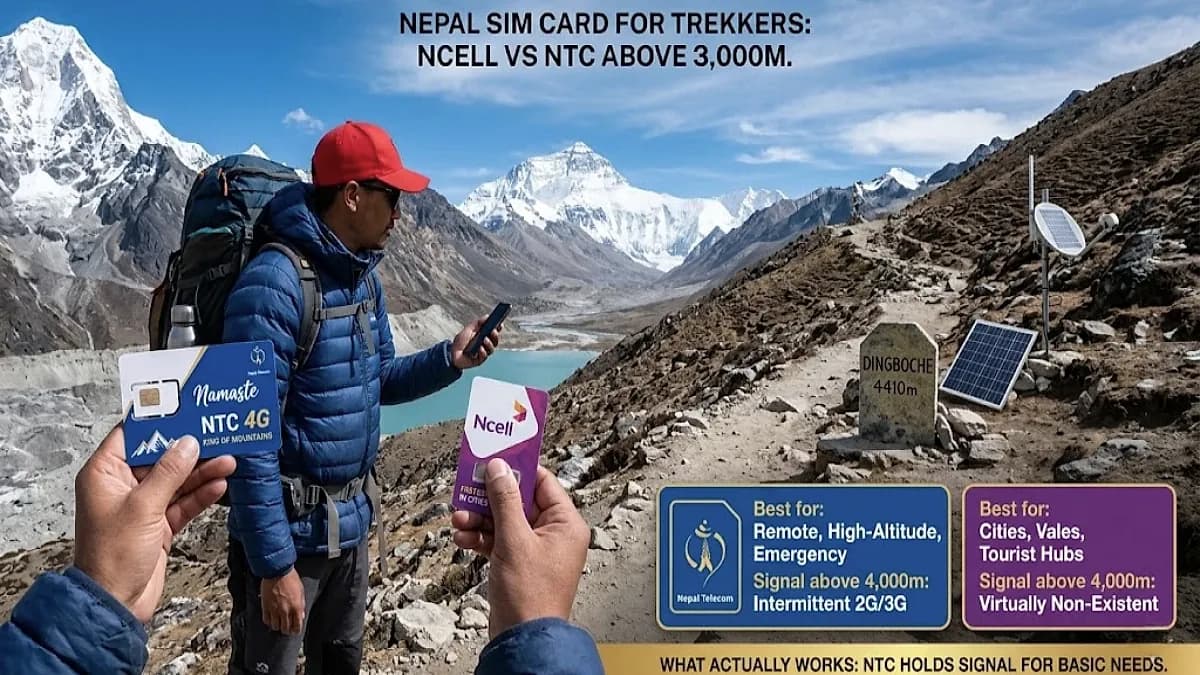
Short answer: Buy an Ncell tourist SIM at Kathmandu airport with your passport. Ncell lists three tourist plans with unlimited data (fair usage applies): NPR 595 for 7 days, NPR 995 for 14 days and NPR 1,995 for 28 days. Signal is good up to Namche on the Everest route and fades above it, so treat the phone as a way to message home, not as your rescue plan. If you trek with us, the SIM is arranged for you.
Last updated 7 October 2026. Ncell plan prices and data limits are from Ncell's own tourist SIM page on that date. Prices change, so check at the counter.
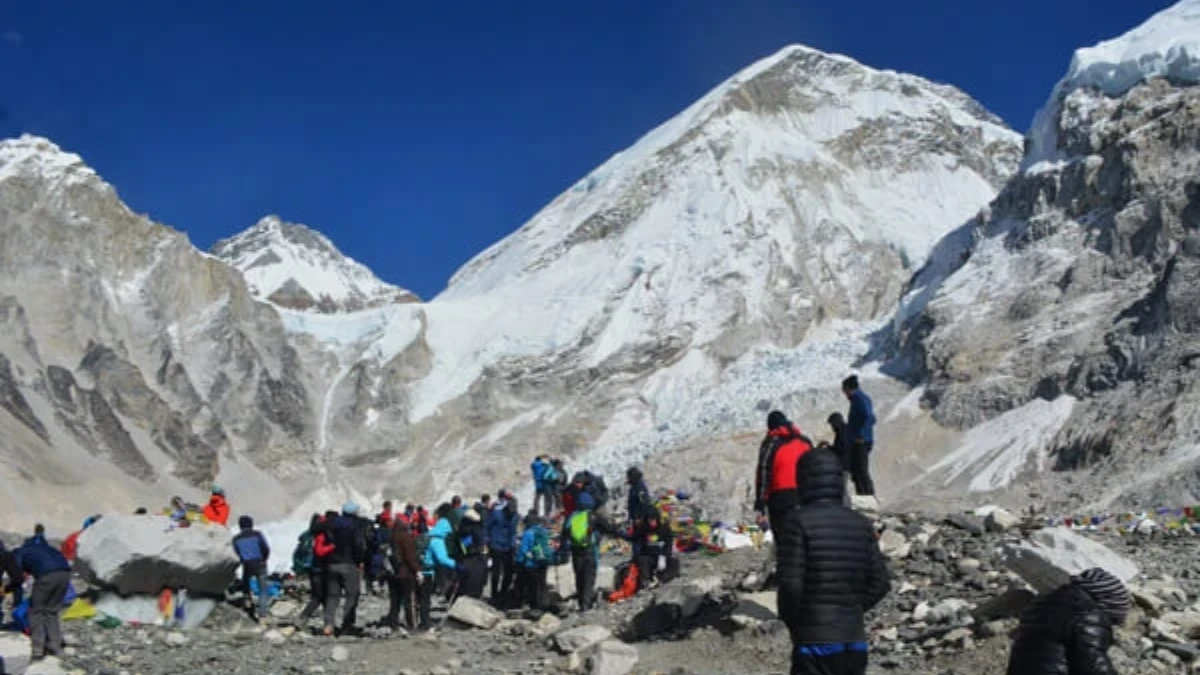
The first message arrives at base camp. A photograph: slightly blurry, compressed by a signal that has travelled from a phone at 5,164 metres through a tower on a distant ridge to a satellite and back down to a screen in someone's kitchen in Manchester. The photograph shows prayer flags against a sky so blue it looks fake. The caption reads: "I'm here." Two words. The distance they travel, not in kilometres but in meaning, is immeasurable.
Staying connected on a Nepal trek is not the necessity some people think it is. Many trekkers deliberately leave their phones in airplane mode for twelve days and describe the digital silence as one of the best parts of the experience. But for those who want to message home, post a photograph, check weather forecasts, or simply know that they can call for help in an emergency: a Nepali SIM card is cheap, easy to get, and works better than most people expect.
Which Nepal SIM Card Is Better: Ncell or NTC?
Nepal has two major mobile networks. Ncell is the larger commercial operator with the widest 4G coverage in tourist areas and trekking regions. NTC (Nepal Telecom) is the state-owned operator with broader geographic reach in very remote areas but sometimes slower data speeds in popular zones.
| Option | Best coverage | Tourist plans | Local number? | Best for |
|---|---|---|---|---|
| Ncell | 4G on all main routes (Everest to Namche, Annapurna to Manang, Langtang to Kyanjin) | TouristPro, unlimited data with fair usage: NPR 595 (7 days), NPR 995 (14 days), NPR 1,995 (28 days) | Yes | Most trekkers |
| NTC (Nepal Telecom) | Broader in very remote west (Dolpo, Humla); slower in busy zones | Ask at the counter, as packs change | Yes | Off-the-beaten-path routes, or a backup SIM |
| eSIM (Airalo, Holafly, Nomad) | Rides the local network; same coverage as above | Pricier per GB than a local SIM | No | Data only, skipping the airport queue |
For most trekkers, Ncell is the better choice. Its 4G coverage extends along the major trekking routes, Everest up to Namche Bazaar, Annapurna up to Manang, Langtang up to Kyanjin Gompa, and its tourist data plans are straightforward and cheap. NTC has an edge in a few very remote areas where Ncell's towers do not reach, but for the standard treks that ninety percent of visitors do, Ncell provides the better experience.
Some trekkers buy both, an Ncell SIM for primary use and an NTC SIM as backup. This is unnecessary for most routes but sensible for off-the-beaten-path treks in western Nepal or the restricted areas of Dolpo and Humla where Ncell coverage disappears.
Where can I buy a SIM card for trekking in Nepal?
If you are trekking with us, you do not buy one at all. A SIM card is arranged for you on arrival day in Kathmandu on most of the treks we run, and it is included in the price rather than sold as an extra. On our Everest Base Camp Trek the Budget tier includes the SIM and help setting up a data package, the Standard tier includes data with it, and the Luxury tier includes unlimited data. It does vary by package, so check the inclusions on the trek you are actually looking at. What follows is for independent trekkers, and for anyone who wants a second SIM.
Buy it at Kathmandu airport immediately after clearing immigration. Both Ncell and NTC have counters in the arrivals hall. The process takes five to ten minutes: hand over your passport, they photograph it, you choose a plan, you pay in cash (Nepali rupees or US dollars), and you walk out with a working SIM card and a Nepali phone number.
If you miss the airport counters, which happens if you arrive late at night when they are closed, Thamel has dozens of mobile shops that sell SIM cards. The process is the same: passport, photo, payment, activation.
Ncell's tourist page shows only the plan price and no separate charge for the SIM, so the plan is the number to plan around.
How much do Ncell tourist data plans cost for trekkers?
Ncell sells tourist-only plans called TouristPro, for non-Nepali passport holders. Each includes unlimited data, unlimited calls to all networks and 100 SMS. Fair usage applies, so these are not truly unlimited.
Sprinter is NPR 595 for 7 days, and Ncell says speed drops after 10 GB. Explorer is NPR 995 for 14 days, with speed cut to 256 kbps after 25 GB. Voyager is NPR 1,995 for 28 days, and Ncell's page gives no data limit for it. At roughly NPR 140 to the dollar those are about four, seven and fourteen US dollars. For a 12-day Everest trek, the 14-day Explorer plan is the one that fits. Take Voyager only if you will stay on longer or work remotely in Kathmandu or Pokhara. Either way, the data is plenty for messaging, WhatsApp calls, a few photos a day and weather checks. Streaming video eats it fast.
The plan runs from the time you activate it, not from midnight, so activate it when you land rather than a week before you walk.
You can buy another tourist pack in the Ncell app, at shops or by dialling *123#. Top-ups are also sold at many teahouses along the trail, though availability decreases with altitude. Load your plan in Kathmandu before you start trekking, do not rely on being able to top up at four thousand metres.
Does mobile signal work above Namche on the Everest trek?
Between Lukla and Namche Bazaar on the Everest route, 4G signal is strong. You can video-call, upload photos, check email, normal phone behaviour. At Namche itself, the signal is excellent. This is the last point of reliable high-speed data on the Everest route.
Above Namche, Tengboche, Dingboche, Lobuche, the signal degrades progressively. You may get intermittent 3G or 2G. Text messages and WhatsApp messages (without large attachments) usually get through. Photos take longer to send. Video calls become impractical. At Gorak Shep and Everest Base Camp, mobile signal is minimal and unreliable.
On the Annapurna Circuit, coverage extends reasonably well to Manang. Above Manang toward Thorong La, signal disappears. On the descent side, Muktinath and Jomsom have coverage again.
In the Langtang Valley, signal works up to around Langtang Village. At Kyanjin Gompa it becomes intermittent.
Is Everest Link WiFi worth it on the Everest Base Camp trek?
In the Everest region specifically, a private WiFi network called Everest Link provides internet access at teahouses from Lukla to Gorak Shep (along the Everest Base Camp trek route). You buy a prepaid card at shops in Namche Bazaar, a price that depends on the data package, and log into the network at participating teahouses.
Everest Link is generally faster and more reliable than mobile data above Namche. It works at most major teahouse stops on the EBC trail. The downside is that it only works at participating lodges, when you are walking between stops, you have no connection unless mobile signal is available.
Many trekkers use both: Ncell for the lower sections and messaging on the trail, Everest Link for faster WiFi at teahouses above Namche.
How much does charging your phone cost on the Everest trek?
Below Namche, charging is usually free or very cheap at teahouses. Above Namche, teahouses charge two hundred to five hundred Nepali rupees per device, a dollar and a half to three and a half dollars. Outlets are limited and shared. Queues form. Your phone might charge for an hour before someone else needs the socket.
A twenty-thousand-milliamp-hour power bank is the solution. Charge it fully at Namche on your rest day. It will keep your phone alive for four to five days of moderate use, which covers the high-altitude section of most treks where charging is expensive and unreliable.
Should I use an eSIM for trekking in Nepal?
If your phone supports eSIM, you can purchase a Nepal data plan before leaving home through providers like Airalo, Holafly, or Nomad. The advantage is that you arrive in Nepal with data already working, no queuing at the airport counter, no passport photos, no activation wait.
Ncell also sells its own Tourist eSIM online, on its own network, so that is worth a look before you pay a foreign provider. The disadvantage of foreign eSIM plans is that they tend to be more expensive per gigabyte than buying a physical Ncell SIM locally. And you do not get a Nepali phone number, which means you cannot make local calls or receive calls from your trekking company. For trekkers who only need data, WhatsApp messaging, maps, weather, an eSIM works fine. For those who want full phone functionality including voice calls, a local physical SIM is better.
The Case for Disconnecting
Not every moment needs to be shared in real time. The sunrise from Kala Patthar does not improve when viewed through a phone screen. The silence of the trail above Dingboche, the sound of nothing except wind and your own breathing, is a kind of luxury that modern life rarely offers.
Many trekkers who started their trek compulsively checking messages describe a shift around Day 4 or 5. The phone stays in the pocket longer. The need to document diminishes. The experience of being present, fully, physically, emotionally present in a place of extraordinary beauty, begins to feel more valuable than any photograph or status update.
Bring the SIM card. Set up the data. Know that you can reach home if you need to. And then consider putting the phone away and letting the mountains be the only thing competing for your attention.
One thing worth being clear about: your phone is not your emergency plan. Above Namche the signal is intermittent at best, and on a bad weather day it is nothing at all. What actually gets help to you is your guide, the lodge network and the radio and phone chain the lodges run between themselves. The SIM is for your family, not for your rescue. See our trek pages for full packing lists.
If you are buying your own, get Ncell rather than Nepal Telecom. Ncell has better 4G coverage on the trekking routes, and a 14-day tourist plan at NPR 995, roughly seven dollars, will last most people an entire trek. Coverage drops above 4,000 metres on most routes, but below that you will have signal at most teahouses. Both operators are licensed by the Nepal Telecommunications Authority, which publishes the coverage and quality-of-service data the operators are held to.
And if you are trekking with us, none of the buying is yours to do. The SIM is arranged on your arrival day, it is in the price, and on the Luxury tier of most of our treks the data on it is unlimited.
WhatsApp:+977 9810351300
Email:[email protected]
Related guides: Nepal currency and cash guide | Tipping your guide and porter | Trekking gear in Thamel
Written by Shreejan Simkhada, CEO of The Everest Holiday and third-generation Himalayan guide. TAAN Member #1586.
Ready to actually trek to base camp? Our Everest Base Camp Trek (12 Days) is private (your group only, no strangers), 2027 dates open, From USD $1399. WhatsApp us for tailored 2027 dates and current departures.
 Chat with Shreejan