Everything about trekking to Everest Base Camp in March. Weather by week, spring rhododendrons, gear advice, and why March light is a photographer favourite.
Govt Regd. No.: 147653/072/073
Travel Agency Licence: 2838/072
EBC Trek in March: Spring Snow, Rhododendrons, and Quiet Trails

Last updated 2 October 2026. The temperature and rainfall figures below are published station averages, not forecasts, and each table names its source. Above Dingboche there is no station data, so what I describe there comes from our guides, not from a number.
The short answer: March is a good month for Everest Base Camp if you are happy with cold nights. Days are clear and warming, rain is low, and the rhododendron season is starting in the lower forest. The cost is the cold. Dingboche's modelled average night in March is -10.5 degrees, and it gets colder above that. The second half of March is gentler than the first. March is not an empty trail, either: nationally it was Nepal's busiest month for visitors in 2024.
This is the month guide. For the full year and the weather behind it, see Everest Base Camp weather month by month, and for the choice across all seasons, the best time to trek to Everest Base Camp. The trek is our Everest Base Camp trek, 12 days, from US$1,399 Budget, US$2,499 Standard and US$4,999 Luxury.
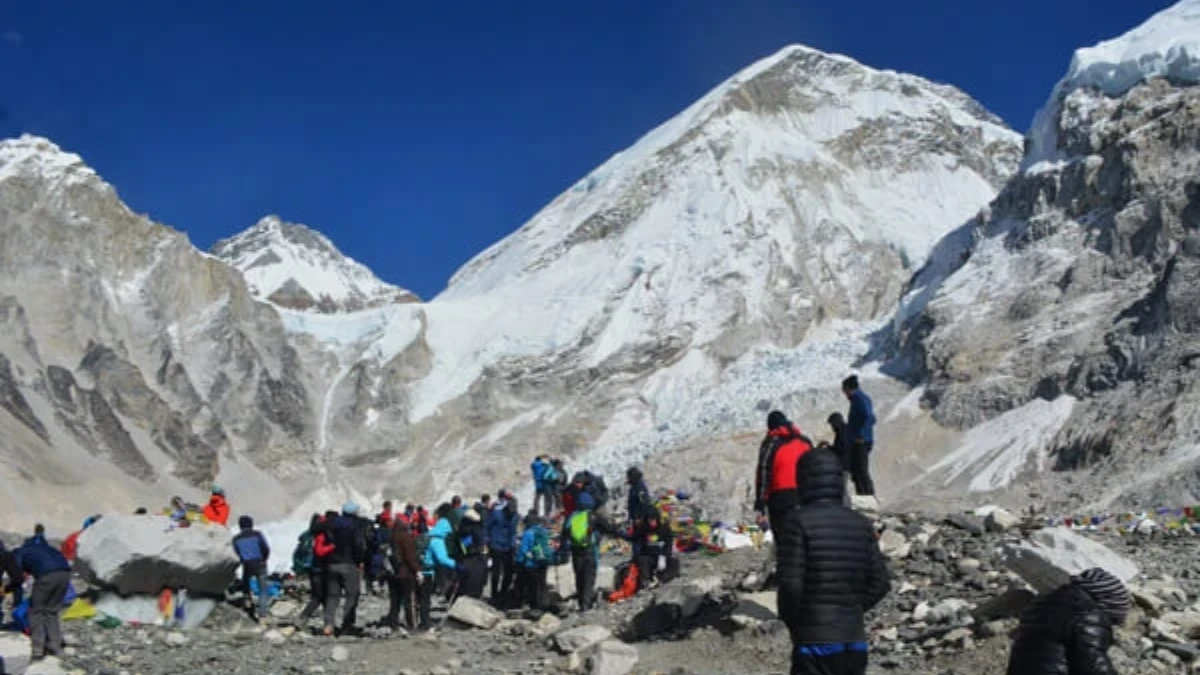
What is the weather like on the Everest trail in March?
There is no weather station at Base Camp with a long record, so I use the four stations along the route that have one: Lukla (2,786 m), Namche Bazaar (3,450 m), Tengboche (3,857 m) and Dingboche (4,410 m, modelled data, not an instrument record). Each cell is the average daily high, then the average daily low, in degrees Celsius. February and April are alongside so you can see how fast March moves.
| Station | February high / low | March high / low | April high / low |
|---|---|---|---|
| Lukla 2,786 m | 8.9 / -1.6 | 13.3 / 2.6 | 16.6 / 5.7 |
| Namche 3,450 m | 6.4 / -6.5 | 9.6 / -3.0 | 12.8 / 0.8 |
| Tengboche 3,857 m | 4.0 / -9.7 | 8.0 / -6.1 | 12.1 / -4.0 |
| Dingboche 4,410 m (modelled) | 1.5 / -14.2 | 4.7 / -10.5 | 8.5 / -7.0 |
Sources: Lukla, Nepal Department of Hydrology and Meteorology (DHM) 1991 to 2020 normals. Namche, FAO FAOCLIM database. Tengboche, FAO and the Australian National University record. Dingboche, a computer model of the location, so a guide and not a measurement. The sources are listed in the notes at the end.
The rain is low. Total precipitation in March, in millimetres, is 45.3 at Lukla, 31 at Namche, 27.2 at Tengboche and 12 at Dingboche (modelled). That is a good deal drier than October at Lukla (102.9 mm), though not as dry as November (6.2 mm). The numbers say March is dry and cold, with snow, not rain, as the likely wet weather at height.
I have no station data above Dingboche. Lobuche, Gorak Shep and Base Camp are higher and colder than Dingboche, so expect lows well below the modelled -10.5. There is no measured figure for Gorak Shep, so I don't quote a range.
Is early March different from late March?
Yes, and the table shows the direction: the monthly average sits between February's cold and April's warmth, so the first days of March are closer to February and the last days closer to April. I have no weekly station figures, so what follows is guide experience, not data. In the first half of the month, snow is possible above Lobuche and nights are at their coldest. In the second half the trail is usually drier and firmer and the days are longer. That is why we prefer the last two weeks of March for most trekkers.
At Gorak Shep, the last settlement below Base Camp at 5,164 m, from December to February most accommodation is closed, trails are snow-covered and the cold is very intense. March is the start of the spring season, so the lodges open up again, but I would ask us to confirm the lodge for each night above Dingboche before you fly, especially in the first week.
How crowded is March?
There is no month-by-month count of trekkers on the Everest trail. The Nepal-wide picture is this. Nepal Tourism Board figures for 2024 show 128 thousand international arrivals in March, 111 thousand in April and 90 thousand in May, against 124 thousand in October and 114 thousand in November. That is all of Nepal, not Everest, but it makes March the single busiest month of 2024 across the country. I used to say March was clearly quieter than April on the trail, and the national numbers do not back that up.
What I can say from our own trips is that Everest in March is busier than in winter and thinner than in October, and that the crowds build as the month goes on. Spring (March and April) and autumn (October and November) are the best times to trek to Gorak Shep. Our crowd view is in the best-time guide: March is "building", April is "high". That is our judgement and not a count. Related: Spring 2027 Trekking in Nepal: When to Book and Which Treks to Plan Now.
Will the Lukla flight run in March?
There is no published month-by-month cancellation rate for Lukla. The airport regularly closes from mid to late morning when strong south-west winds begin, and a sudden loss of visibility closes it because there is no go-around. March is dry, which helps, but it is not a guarantee.
The flight home matters as much as the flight out. Our flight guide, Nepal domestic flights for trekkers, says the fixed-wing flights move to Manthali airport in Ramechhap from roughly 15 March to 15 May, which means a hotel pick-up between midnight and 2 am and a four to five hour drive. Before about 15 March the flight normally leaves from Kathmandu. The dates are set by the Civil Aviation Authority of Nepal, not by us, and they can shift. A helicopter flies Kathmandu to Lukla direct all year and is included on our Luxury tier. Never book your international flight for the same day as your Lukla return. Leave 24 hours, or 48 if you can.
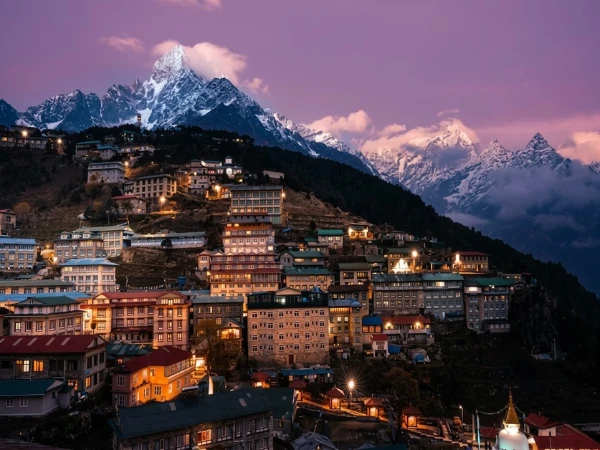
When do the rhododendrons bloom?
The tree rhododendron, Nepal's national flower, flowers in early and mid spring, with red, pink or white blooms. Sagarmatha National Park's entry lists rhododendron among the trees of the subalpine forest. Beyond that, the bloom timing is from our guides: the lower forests between Lukla and Namche start to flower in the second half of March, the display builds through April, and it moves higher up the valley as the weeks pass. Timing changes with the winter, and a cold year runs late. If flowers are the main reason you are going, April is the surer month, and the part of March you want is the last week. See EBC in April.
Is the trek harder in March?
The altitude is the same as in any month, and the acclimatisation days are the same: two nights at Namche and two at Dingboche on our 12-day itinerary. What changes is the cold. A sleeping bag that is too thin is the most common March mistake, because the modelled nights at Dingboche are more than ten degrees below freezing and Lobuche and Gorak Shep are colder. Trails are generally walkable, but snow patches higher up are normal early in the month. Ask us about traction for your dates rather than assuming either way. Our altitude sickness guide has the protocol.
What should I pack for March?
This is advice from running the route, not data.
| Item | Why in March |
|---|---|
| Warm sleeping bag or liner | The coldest nights of the spring trek, from Dingboche up. |
| Down jacket | Dawn, dusk and every lodge dining room in the evening. |
| Insulated gloves, hat, thermal layers | Early March can feel like February above Tengboche. |
| Sunscreen, hat and sunglasses | The World Health Organization's fact sheet says UV rises with altitude, and snow on the ground adds to it. |
| Light layers for the lower trail | Lukla's average high is 13.3 degrees, so walking days below Namche are mild. |
On our Everest Base Camp trek we lend a down jacket and a sleeping bag (see the package page for what each tier includes), so the cold is a comfort question and not an extra cost. The full kit list is in our Everest Base Camp packing list.
How does March compare with other months?
| Comparison | What the numbers and our experience say |
|---|---|
| March and October | October is warmer (Dingboche modelled low -5.3 against -10.5) but wetter at Lukla (102.9 mm against 45.3) and the busiest month on the trail. March is colder. See EBC in autumn. |
| March and April | April is warmer (Dingboche -7.0) and has the better flowers. April has more Lukla rain (58.7 mm). See EBC in April. |
| March and November | Dingboche lows are close (-10.5 in March, -11.0 in November). November is almost dry (Lukla 6.2 mm). March has the flowers and lengthening days. See EBC in November. |
When should you NOT trek to Everest Base Camp in March?
Skip the first week of March if cold nights worry you, because it is the coldest part of the spring season. Skip it if you hate early starts, because from about 15 March the Ramechhap flight means a pick-up between midnight and 2 am. Skip it if you want guaranteed quiet, since it is a busy month nationally. And skip any month if you cannot spare a buffer day at the end.
Is the Everest region open right now?
As at 29 September 2026, the date of my latest status update, the Everest region was open and unaffected by the late-August Rasuwa flood and the late-September rain, which hit other river systems. This can change, so I keep the live position region by region on my late-September floods travel update, and I recheck before every departure.
What does the trek cost and how do I book?
Prices do not change with the month. The 12-day Everest Base Camp trek is US$1,399 Budget, US$2,499 Standard and US$4,999 Luxury for one person, with a lower price per person for larger groups. Budget has no porter. Standard has one porter for two trekkers. Luxury has a dedicated porter for each trekker and a return helicopter to Lukla. Kathmandu hotels are not included in any trek tier. A 10 per cent deposit holds your dates and the balance is paid in Kathmandu. The deposit is non-refundable, but you can reschedule for free, with at least 72 hours' notice, to any date within one year.
There is no fixed March 2027 date on the trek page at the moment. We run a private departure for even one person, so tell me the week you want.
March is cold but clear, and the last two weeks are the gentler ones. Our Everest Base Camp Trek (12 Days) is private (your group only, no strangers). There is no fixed March 2027 date listed, so WhatsApp us with your week and I will confirm it.
Tell me your dates on WhatsApp, +977 9810351300, or email [email protected], and I will tell you what that week usually does, including the years it went wrong.
Sources: Nepal Department of Hydrology and Meteorology (Lukla, 1991 to 2020), FAO (Namche Bazaar and Tengboche), the Australian National University (Tengboche), the Nepal Tourism Board (monthly arrivals, 2024) and the World Health Organization (UV and altitude). Dingboche figures are modelled.
About The Everest Holiday
We are a family company in Kathmandu, three generations of Himalayan guides, registered in 2016 and a member of the Trekking Agencies' Association of Nepal, number 1586. When you book with us you deal with the family, not a call centre.
Every booking helps fund our Nagarjun Learning Center. We fully run the centre at Saldum, where 70 children learn with a teacher I pay for personally.
Written by Shreejan Simkhada, CEO of The Everest Holiday and third-generation Himalayan guide. TAAN Member #1586.
Planning a trip to Nepal?
Drop us your details and tell us what you have in mind. We will put together a personalised plan and get back to you.
Not sure which Nepal trek is right for you?
Take our free 2-minute quiz and get personalised recommendations based on your fitness, experience, and travel style.
Find Your Perfect Trek →Need Help? Call Us+977 9810351300orChat with us on WhatsApp
Latest Travel Blogs
Trekking in Nepal in September 2027: Weather, Best Treks and Departures
Plan a September 2027 trek in Nepal: monsoon-tail weather, why Upper Mustang works, which treks to avoid and our departures on 6, 13, 20 and 27 September.
Read More
Trekking in Nepal in March 2027: Weather, Best Treks and Departures
Plan a March 2027 trek in Nepal: weather figures, the treks that suit the month, crowds, festivals and our departures on 8, 15, 22 and 29 March.
Read More
Trekking in Nepal in April 2027: Weather, Best Treks and Departures
Plan an April 2027 trek in Nepal: weather figures, the treks that suit the month, crowds, the Manthali flights and our departures on 5, 12, 19 and 26 April.
Read More Chat with Shreejan