
Not everyone who comes to Nepal wants to spend a week walking uphill. Some people want temples, wildlife, lakeside sunsets, and the kind of cultural depth that you cannot get from a trail. Some people are travelling with parents or children who cannot trek. Some people have bad knees. And some people simply prefer a comfortable hotel bed to a teahouse bunk at 3,000 metres.
This itinerary is for all of you. Seven days, three cities, zero trekking. You will see UNESCO World Heritage temples, ride through jungle looking for rhinos, watch the sun rise over the Himalayas from a hilltop, and eat some of the best food in South Asia. And you will do it all without putting on hiking boots.
What Is the Best 7-Day Nepal Itinerary Without Trekking?
This is Nepal's golden triangle: the cultural capital, the wildlife heartland, and the lakeside adventure city. Each destination offers something completely different, and the journey between them is part of the experience.
| Day | Location | Highlights |
|---|---|---|
| 1-2 | Kathmandu | UNESCO temples, ancient squares, Pashupatinath, Boudhanath |
| 3 | Drive to Chitwan | Scenic highway through middle hills |
| 4 | Chitwan | Jungle safari, canoe ride, Tharu cultural show |
| 5 | Drive to Pokhara | River valleys, terraced hillsides |
| 6 | Pokhara | Lakeside, Sarangkot sunrise, caves, boating |
| 7 | Return to Kathmandu | Flight or drive, departure |
Day 1: Arrive in Kathmandu
Your driver meets you at Tribhuvan International Airport and transfers you to your hotel in Thamel or Lazimpat. The rest of the day is yours to adjust to the timezone and soak in the city. If you arrive early enough, walk to the nearest neighbourhood temple, find a rooftop cafe, order a masala tea, and watch Kathmandu happen below you. The city is loud, colourful, chaotic, and immediately fascinating.
Evening: Welcome dinner at a traditional Nepali restaurant. Try your first dal bhat, the national staple of lentil soup with rice and an array of vegetable sides. Most restaurants offer a Nepali thali set that gives you a taste of everything.
Budget: Hotel 20 to 80 USD per night depending on standard. Airport transfer included in most tour packages. Dinner 5 to 15 USD.
What are the best cultural sites to see in Kathmandu?
This is the day that justifies coming to Nepal even without trekking. Kathmandu Valley has seven UNESCO World Heritage Sites within a few kilometres of each other, and you can visit the four most important ones in a single day:
Morning: Boudhanath Stupa. One of the largest Buddhist stupas in the world. Walk clockwise around the stupa spinning the 108 prayer wheels. The surrounding neighbourhood is Little Tibet, filled with Tibetan refugees, monasteries, and shops selling singing bowls, prayer flags, and thangka paintings. Arrive early before the tour buses. The morning light is perfect for photography.
Mid-morning: Pashupatinath Temple. Nepal's most sacred Hindu temple complex, where cremation ceremonies take place openly on the ghats along the Bagmati River. Non-Hindus cannot enter the main temple but can observe the ghats and explore the surrounding temples and shrines. This is not a tourist attraction; it is a living spiritual site. Be respectful, ask before photographing, and give yourself at least an hour to absorb the atmosphere.
Afternoon: Kathmandu Durbar Square. The ancient royal palace complex with detailedly carved wooden temples dating to the Malla dynasty (12th to 18th century). The 2015 earthquake damaged several structures, and reconstruction continues, but the square remains one of the most architecturally rich sites in Asia. Walk through the narrow lanes of the old city surrounding the square for a glimpse of how Kathmandu lived before tourism.
Late afternoon: Swayambhunath (Monkey Temple). Climb 365 steps to the hilltop stupa for a panoramic view of the entire Kathmandu Valley. The name comes from the hundreds of monkeys that live on the temple hill. Hold your belongings tight and your sunglasses tighter. The monkeys are quick and have no respect for personal property.
Budget: Entry fees total roughly 2,000 to 3,000 NPR (13 to 20 USD). A private car with driver for the day costs 40 to 60 USD. Lunch at a local restaurant 5 to 10 USD. A guide who knows the history and significance of each site costs 25 to 40 USD for the day and is worth every rupee.
How do you get from Kathmandu to Chitwan?
The drive from Kathmandu to Chitwan takes five to six hours through Nepal's middle hills. The highway follows the Trisuli River gorge before descending into the Terai lowlands where the landscape flattens into subtropical jungle and farmland. The temperature rises noticeably as you drop from 1,400 metres to 150 metres.
You arrive in Sauraha, the gateway village to Chitwan National Park, by early afternoon. Check into your jungle lodge, have lunch, and spend the evening on a guided village walk through the Tharu community. The Tharu people have lived alongside the jungle and its wildlife for centuries, and their elongated mud houses, unique art, and agricultural traditions are genuinely interesting.
Evening: Tharu cultural dance performance. The stick dance (performed by the men) and the peacock dance (performed by the women) are lively, loud, and impossible not to enjoy. Most jungle lodges arrange this in-house.
Budget: Private vehicle Kathmandu to Chitwan 80 to 120 USD (or tourist bus 12 to 20 USD). Jungle lodge 30 to 100 USD per night including meals. Tharu dance usually included with the lodge.
How much does a Chitwan National Park safari cost?
A full day in one of Asia's best national parks. Chitwan is a UNESCO World Heritage Site and home to one-horned rhinoceros, Bengal tigers, sloth bears, gharial crocodiles, wild elephants, and over 500 bird species.
Morning: Jeep safari (3-4 hours). A 4x4 vehicle takes you deep into the park with a naturalist guide. Rhino sightings are almost guaranteed. Deer, wild boar, langur monkeys, and dozens of bird species are common. Tiger sightings are rare but possible, especially in the morning. The drive through sal forest and grassland is immersive, and the silence of the jungle, broken only by birdsong and the occasional alarm call of a deer, is completely different from any other Nepal experience.
Afternoon: Canoe ride on the Rapti River. A dugout canoe glides silently along the river bordering the park. Mugger crocodiles bask on the banks. Gharial crocodiles, with their distinctive narrow snouts, surface occasionally. Kingfishers dart between the trees. The guide points out animal tracks on the shore. This is unhurried, peaceful, and photogenic.
Late afternoon: Guided nature walk. A shorter walk through community forest with your naturalist, focusing on plants, birds, and animal signs.
Budget: Chitwan National Park entry fee 2,000 NPR (13 USD) for foreigners. Jeep safari 25 to 40 USD per person. Canoe ride 10 to 15 USD. Nature walk 10 to 15 USD. Most jungle lodges offer a full-day activity package for 50 to 80 USD including lunch. For more on what to expect, read our Chitwan safari guide.
How do you get from Chitwan to Pokhara?
The drive from Chitwan to Pokhara takes six to seven hours through the Siddhartha Highway, one of Nepal's most scenic roads. You climb from the jungle lowlands back into the hills, passing through the town of Butwal and ascending along the Kali Gandaki river valley. If the weather is clear, the Annapurna and Dhaulagiri ranges appear on the horizon as you approach Pokhara.
Arrive in Pokhara by late afternoon. Check into your lakeside hotel, walk along Phewa Lake, and watch the mountains turn pink at sunset. Pokhara moves at a completely different pace from Kathmandu. It is quieter, greener, and built around the lake and the mountain views.
Evening: Dinner at a lakeside restaurant. Pokhara's restaurant scene is excellent: Nepali, Tibetan, Italian, Korean, and Indian food all available within walking distance. Budget 8 to 20 USD for a good meal.
Budget: Private vehicle Chitwan to Pokhara 100 to 140 USD (or tourist bus 12 to 20 USD). Lakeside hotel 25 to 100 USD per night.
What can you do in Pokhara in one day?
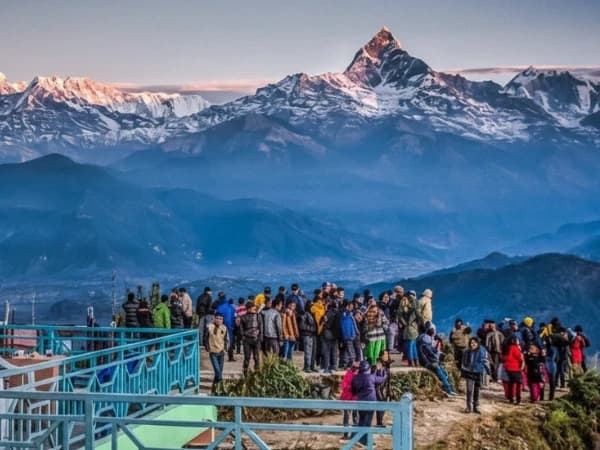
Pre-dawn: Sarangkot sunrise. Wake at four thirty, drive thirty minutes to Sarangkot viewpoint at 1,600 metres. Watch the first light hit the Annapurna range, Machhapuchhre (the Fishtail), and Dhaulagiri. On a clear morning, the mountain panorama is one of the most famous views in Nepal. The sunrise itself takes twenty to thirty minutes, and most visitors stand in silence watching the peaks change colour. Drive back to the hotel for breakfast.
Morning: Pokhara sightseeing. Visit Davis Falls (a waterfall that disappears into an underground cave), Gupteshwor Cave (a sacred Hindu cave directly below the falls), and the International Mountain Museum (the best museum in Nepal, covering the history of Himalayan mountaineering from the 1950s to today). All three are within a few kilometres of each other.
Afternoon options (choose one or more):
- Phewa Lake boating: Rent a brightly painted wooden boat (5 to 10 USD per hour) and row to the Tal Barahi temple on the island in the middle of the lake. The Annapurna range reflects in the water on still mornings.
- Paragliding: Tandem paragliding from Sarangkot with views of the lake and mountains. 70 to 100 USD for a thirty-minute flight. No experience needed.
- World Peace Pagoda: A short hike or drive to the Japanese-built Buddhist stupa on a hill south of the lake. The view from the pagoda encompasses the lake, the city, and the entire Annapurna range.
- Lakeside shopping and cafes: Pokhara's lakeside strip has bookshops, handicraft shops, yoga studios, and cafes where you can sit for hours watching the mountains.
Budget: Sarangkot transport 15 to 25 USD return (car). Museum entry 500 NPR (3.50 USD). Davis Falls entry 100 NPR. Boating 5 to 10 USD. Paragliding 70 to 100 USD. Lunch and dinner 15 to 30 USD total.
Should you fly or drive from Pokhara to Kathmandu?
Fly from Pokhara to Kathmandu (twenty-five minutes, 120 to 180 USD one way) or drive (six to seven hours, 12 to 22 USD by tourist bus). The flight gives you aerial views of the Himalayan range and saves half a day. The drive gives you one last look at Nepal's hill country.
If your international flight departs in the evening, you have time for last-minute shopping in Thamel: pashmina shawls, singing bowls, Nepali tea, thangka paintings, handmade paper products. Read our shopping guide for what to buy and what to avoid.
Transfer to the airport for your departure flight.
How much does a 7-day Nepal cultural tour cost?
Budget Traveller (tourist bus, budget hotels)
| Return flights UK to Kathmandu | 650 USD |
| Nepal visa (15 days) | 30 USD |
| Travel insurance (7 days) | 40 USD |
| Hotels (6 nights at 25 USD average) | 150 USD |
| Tourist buses (KTM-Chitwan-Pokhara-KTM) | 50 USD |
| Chitwan activities (full day package) | 70 USD |
| Kathmandu guide and entry fees | 50 USD |
| Pokhara activities (Sarangkot, boating, museum) | 35 USD |
| Meals (7 days at 15 USD) | 105 USD |
| Personal spending and transport | 80 USD |
| Total | 1,260 USD |
Comfortable Traveller (private car, mid-range hotels, domestic flight)
| Return flights UK to Kathmandu | 750 USD |
| Nepal visa (15 days) | 30 USD |
| Travel insurance (7 days) | 50 USD |
| Hotels (6 nights at 60 USD average) | 360 USD |
| Private car KTM-Chitwan-Pokhara | 250 USD |
| Domestic flight Pokhara-KTM | 150 USD |
| Chitwan full day activities + lodge meals | 100 USD |
| Kathmandu guide and entry fees | 60 USD |
| Pokhara activities + paragliding | 130 USD |
| Meals (7 days at 25 USD) | 175 USD |
| Personal spending, tips, shopping | 150 USD |
| Total | 2,205 USD |
Who is a Nepal tour without trekking best for?
- First-time Nepal visitors who want an overview before deciding whether to return for trekking
- Families with children or elderly parents who cannot manage multi-day treks
- Couples on honeymoon or anniversary wanting culture, wildlife, and mountain views without the physical demands of trekking
- Photographers who want temples, wildlife, and mountain landscapes in one trip
- Travellers with limited time who want the best of Nepal in one week
- People recovering from injury or surgery who want to travel but cannot trek
How can you extend a 7-day Nepal itinerary?
Seven days is enough for the golden triangle, but if you have more time, consider adding:
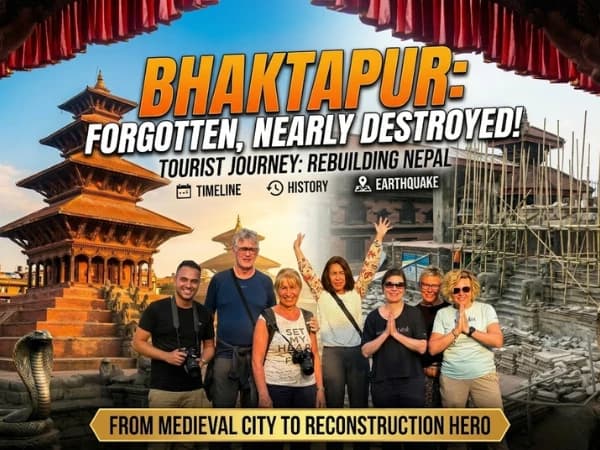
- Bhaktapur (1 day): The best-preserved medieval city in the Kathmandu Valley. Pottery workshops, Nyatapola Temple, and the famous juju dhau (king curd). Add this to Day 2.
- Nagarkot sunrise (1 night): A hilltop village east of Kathmandu with a Himalayan panorama stretching from Dhaulagiri to Everest on clear mornings. Stay overnight, watch sunset and sunrise, return to Kathmandu.
- Lumbini (1-2 days): The birthplace of the Buddha. Add this between Chitwan and Pokhara. Monasteries built by countries from around the world, the sacred garden, and the Ashoka pillar marking the exact birthplace.
- Poon Hill trek (4 days): If you decide you want a gentle taste of trekking after all, this short trek from Pokhara offers mountain views without extreme altitude or difficulty.
Common Questions About a Nepal Cultural Trip
Is Nepal worth visiting if I do not trek?
Absolutely. Nepal has seven UNESCO World Heritage Sites in the Kathmandu Valley alone, one of Asia's best national parks, a lakeside city with Himalayan views, and a food and cultural scene that rivals anywhere in South Asia. Trekking is one part of Nepal, not the whole story.
Is seven days enough?
For the Kathmandu-Chitwan-Pokhara triangle, yes. You will feel the pace is comfortable, not rushed. If you want to add Lumbini, Nagarkot, or Bhaktapur, add two to three more days.
Is this itinerary suitable for children?
Yes. The jeep safari in Chitwan is exciting for children, the Monkey Temple is entertaining, and Pokhara boating is relaxing. Children under 10 often get reduced entry fees. The drives between cities are long for small children, so consider flying at least one leg.
Do I need a guide for this itinerary?
Not legally, but practically yes for Kathmandu sightseeing and Chitwan safari. The temples and squares have centuries of history that you will miss without someone explaining what you are looking at. Safari guides are required for national park entry. In Pokhara, you can explore independently.
What about the currency?
Nepal uses Nepali rupees (NPR). ATMs are available in all three cities. Cards are accepted at hotels and larger restaurants but not at smaller shops, temples, or national park counters. Carry cash for daily spending. Current exchange rate: 1 USD equals roughly 151 NPR.
Is it safe?
Nepal is one of the safest countries in Asia for tourists. Petty theft exists in crowded areas (as in any country), but violent crime against tourists is extremely rare. Read our Nepal safety guide for a full assessment.
Why Plan Your Nepal Cultural Trip With Us?
We are known for trekking, but we also arrange complete cultural tour packages covering this exact Kathmandu-Chitwan-Pokhara route. Every tour is private to your group, with your own car and driver, and we handle all hotel bookings, safari arrangements, and domestic flights.
- Over 300 reviews, 4.9-star TripAdvisor rating
- Private tours only: your group, your pace, no strangers
- Family-run company since 2016 with three generations of Nepal expertise
- TAAN member (#1586), government registered
- Every booking supports the Nagarjun Learning Center: education for 70 children in rural Nepal
Want to plan your non-trekking Nepal trip? WhatsApp us at +977 9810351300 or email [email protected] with your dates and group size.
View our UNESCO Heritage Sites tour | Read: Top 10 Things to Do in Nepal
Cultural week without trekking? Kathmandu-Pokhara tour. Our Kathmandu & Pokhara Tour (7 Days) is private (your group only, no strangers), 2026 dates open, From USD $749. WhatsApp us for tailored 2026 dates and current departures.
 Chat with Shreejan