

Last updated 3 October 2026. The entry fee is the foreign-visitor fee on the Nepal Tourism Board heritage fee page. Dates and history are from UNESCO and the Nepal Tourism Board. Where something comes from our own guides' experience, I say so.
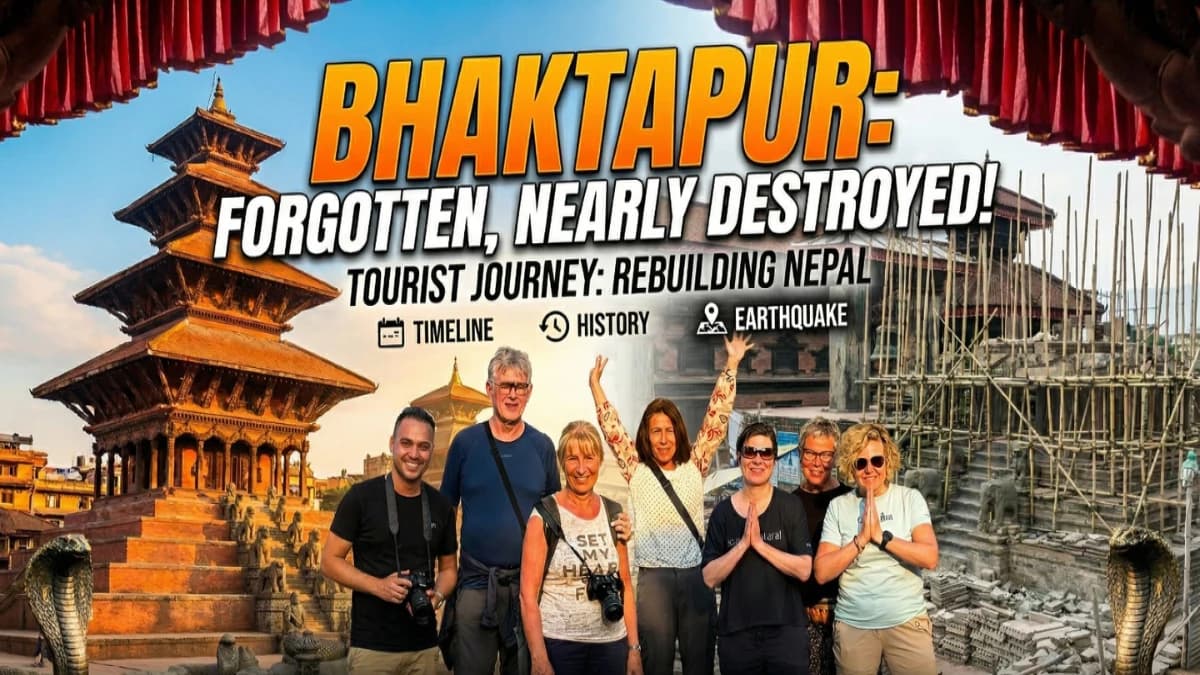
Bhaktapur is the best day trip from Kathmandu for anyone who wants to see a Newar city that still works like one. Foreign visitors pay US$18 or NPR 1,800 to enter, it is about 12 km east of Kathmandu on the Arniko Highway, and a half day covers the three main squares while a full day lets you slow down. The city is part of the Kathmandu Valley World Heritage Site that UNESCO inscribed in 1979, it lost many buildings in the 2015 earthquake, and it is still rebuilding.
I am Shreejan Simkhada. My family has guided in Nepal for three generations, and Bhaktapur is the place I send people who tell me they have "done" the Kathmandu Valley after one afternoon in Durbar Square. This page is what I would tell a friend: what the ticket costs, how to get there, what is in each square, what the earthquake took and what has come back, and when to go so you do not spend the day behind a tour group.
What does it cost, and what do you need to know before you go?
| Detail | Information |
|---|---|
| Entry fee, foreign visitors | US$18 or NPR 1,800 (Nepal Tourism Board, read 3 October 2026). Children under 10 free. For groups of 11 to 20, one tour leader goes free. |
| Opening hours | There are no official opening or ticket-counter hours that we know of for Bhaktapur. The squares are public streets. Ask at the ticket checkpoint for the current hours. |
| Time to allow | Half a day for the squares, a full day with the museums and back streets (our estimate). An overnight stay is better if you can manage it. |
| Museums | The National Art Museum in Bhaktapur is NPR 150 for foreign visitors and is closed on Tuesdays (Nepal Tourism Board). |
| Distance and route from Thamel | About 12 km east on the Arniko Highway. Roughly 30 to 60 minutes by road depending on traffic (our guides' experience, not an official figure). |
| Photography | Common in the squares. Ask before photographing people, and do not photograph inside shrines (our guides' practice). |
The Nepal Tourism Board says it publishes fees "as per the information provided by the concerned departments" and asks visitors to report differences to [email protected]. Fees change, so treat the figure as a guide and check at the checkpoint. An older version of this page gave about NPR 1,500, which is out of date.
If you are staying overnight, ask at the ticket office whether your ticket can be extended for a second day. Related: Pashupatinath Temple Guide: Evening Aarti, Etiquette and What Non-Hindus Can See.
How do you get to Bhaktapur from Thamel?
Bhaktapur lies on the Arniko Highway, the road that leads east to the Chinese border. The Nepal Tourism Board gives the distance as 12 km from Kathmandu, and other sources give about 13 km. In daytime traffic our guides plan on 30 to 60 minutes by taxi or private vehicle, and the road is quicker early in the morning. There are local buses too, but I would not make them part of a first visit unless you enjoy crowded journeys. Agree the price with a taxi driver before you get in, and ask whether he will wait or come back for you, because the return ride is where tourists tend to pay too much.
If you would rather not sort the transport yourself, our one-day UNESCO World Heritage Site tour is private, with an English-speaking guide and a private vehicle (the Standard option also includes lunch and the heritage entrance fees, the Budget option does not). Tell us if you want Bhaktapur in your day.
How old is Bhaktapur, and what does the name mean?
Bhaktapur means "City of Devotees". Locally it is called Khwopa. Chronicles put its foundation in the 12th century, though there were settlements here since at least the Licchavi dynasty, and it was the capital of Nepal in the first half of the Malla dynasty, until 1482, when the kingdom split into three. After the Malla kingdom split into three, Bhaktapur remained a wealthy Newar kingdom until the Gorkhali conquest in 1769. The Nepal Tourism Board puts the city at an altitude of 1,401 m, covering 6.4 square kilometres, and says it is also famous for pottery and woodcarving.
The same history is why Bhaktapur feels different from Kathmandu. The old city was planned around its squares and tanks, the streets are laid in brick, and the people who live in the old houses are mostly Newars whose families have been there for generations.
What is in Bhaktapur Durbar Square?
The square is the old royal palace complex of Bhaktapur. The kingdom's rulers lived here from the 15th century until the conquest of 1769. At its height the palace had 99 courtyards, and today only about 15 of the courtyards around the Taleju shrine survive. The monuments you will walk past, roughly in the order you meet them:
- The Palace of Fifty-Five Windows. The Nepal Tourism Board dates the palace to the 15th century. Construction was completed in 1698 under Bhupatindra Malla (who ruled 1696 to 1722), probably as a remodel of an older palace damaged by an earthquake in 1681. It adds that the present front dates from 1856, when Dhir Shumsher Rana had the eastern part demolished and a British-style building put up, and that the 1934 earthquake destroyed the western half and its namesake lattice window, which was then reconstructed in its present form. Sources differ on exact dates, so treat the years as approximate. The palace also holds some of the best preserved murals of the Malla period.
- The Golden Gate (Lun Dhwakha). The entrance to the inner courtyards of the palace was built between 1751 and 1754, and the Nepal Tourism Board calls it a masterpiece of repoussé art. Look at it closely. Most visitors give it a minute, and it deserves ten.
- The statue of Bhupatindra Malla. The king sits on a tall stone pillar in front of the palace, facing the Taleju shrine in gilt bronze.
- The big bell. The Nepal Tourism Board calls it the Bell of Barking Dogs and says King Ranjit Malla erected it in 1737 on the terrace of the Batsala temple. The offering date was 6 January 1737.
- The Vatsala temples. The Nepal Tourism Board calls the stone temple of Batsala Devi a beautiful example of Shikhara-style architecture. The two Vatsala temples were consecrated in 1695 by Jitamitra Malla, and the Vatsala temple was demolished in the 2015 earthquake.
After the Gorkhali conquest the palace square fell into disrepair, the earthquakes of 1833 and 1934 reduced it to its present size, and the palace grounds have since been used as government offices, schools and private houses. It is a place to walk slowly and look up.
What can you see at Taumadhi Square?
Taumadhi Square is a short walk from the Durbar Square and holds the most famous building in Bhaktapur, the Nyatapola. The Newar name means "something with five storey". King Bhupatindra Malla commissioned it, building took six months from December 1701 to July 1702, it is 33.23 m high, and it is the tallest temple in Nepal and one of only two five-storey temples in the Valley. It has survived four major earthquakes, including the one in 2015.
The five-level plinth carries pairs of stone guardian figures, and the Nepal Tourism Board says each pair is believed to be ten times stronger than the pair below. The temple is dedicated to a Tantric form of the mother goddess, Siddhi Lakshmi, and the building itself is closed to the public. Its doors open only once a year, in July, on the anniversary of its founding.
Next to it stands the Bhairavnath Temple, dedicated to Bhairav, the god of terror. The Nepal Tourism Board says only the head of Bhairav is in the inner sanctum. This is the temple at the centre of the Bisket Jatra festival, described below.
Where is Pottery Square, and what else is worth a detour?
Dattatreya Square takes its name from the Dattatreya Temple, which the Nepal Tourism Board says is dedicated to a three-headed combination of Brahma, Vishnu and Shiva and is said to be built from the trunk of a single tree. It dates to the reign of King Yaksha Malla (1428 to 1482). Near it is a monastery with carved peacock windows. From here the lanes lead down to Pottery Square, where in our guides' experience potters work in the open and set their pots to dry in the sun. This is working life, not a show, so ask before photographing people and do not block the potters' work.
The Nepal Tourism Board also lists Siddha Pokhari, a large rectangular water tank at the bus stop that dates back to the Licchavi period, and notes that for a small city Bhaktapur has the largest number of public water tanks built within its limits. The city also holds the National Art Museum, which is NPR 150 and closed on Tuesdays.
What did the 2015 earthquake do to Bhaktapur?
On 25 April 2015 a major earthquake damaged many buildings in the square. The main temple lost its roof, the Vatsala Devi temple was demolished, and in total 116 historical and cultural monuments were damaged. It was not the first time. Earthquakes in 1767, 1833 and 1934 did most damage to the old palace complex, and the square lost most of its courtyards and buildings that way. The Nyatapola came through the 2015 earthquake, which is one reason it is so loved here.
What you see today is a mix of finished restoration, work in progress, and gaps. Scaffolding and workshops are part of the visit. I would rather tell you that than promise a postcard. For the wider story of the 2015 damage across the Valley, our Kathmandu Durbar Square guide covers what happened to Kasthamandap and what is being rebuilt.
What is Bisket Jatra?
Bisket Jatra is the main annual festival of Bhaktapur, held in April around the Solar New Year. It is based on the solar calendar, unlike most Nepali festivals, and its signature event at Taumadhi is a tug-of-war between the upper and lower halves of the town as they pull the chariot of Bhairava. A pair of long red banners is raised during the festival, which historians say is the oldest part of the tradition. If you are in the country in April, plan Bhaktapur around it, and expect large crowds.
Dates move from year to year. For other festivals, including Dashain and Tihar, see our festival calendar for 2027.
What should you eat in Bhaktapur?
The dish most visitors are told to try is juju dhau, a sweet, thick buffalo-milk curd set in a clay pot, often called "king curd" in English. It is a local speciality, and you will find it at shops around the squares. With it, try a bara (a lentil patty, often served with egg or minced meat) from a street stall, and if you have time sit down to a Newari set meal on a leaf plate. Other dishes you will see on menus are choila (spiced grilled meat), chatamari (a rice-flour crepe often called Newari pizza) and yomari (a sweet steamed dumpling). These are from our guides' local knowledge, and I don't quote prices. Ask what is in a dish before you order if you are vegetarian.
How should you behave in Bhaktapur?
- Dress modestly in and around the temples, with shoulders and knees covered.
- Do not climb on temple plinths or statues, even if you see others do it.
- Ask before photographing people, particularly potters at work and anyone at prayer.
- Remove your shoes before entering a shrine or monastery, and do not walk through a ritual in progress.
- Be polite and unhurried with the shopkeepers. Bhaktapur is known for woodcarving and pottery, and a polite "no, thank you" costs nothing.
The wider rules for Nepal are in our travel etiquette guide.
When is the best time to visit, and is it crowded?
From our guides' experience, which is not an official figure, the squares are quietest early in the morning and in the evening, and tour groups arrive in the middle of the day. If you can stay overnight, you see the city before the day visitors arrive and after they leave. The Valley is clearest and driest in autumn (October and November) and spring (March to May). The monsoon months of June to September bring rain and humidity, but fewer visitors.
Is Bhaktapur worth the fee compared with Kathmandu and Patan?
It is the most expensive of the three royal squares for foreign visitors. At NPR 1,000 each, Kathmandu and Patan are cheaper, and both tickets include a museum (Nepal Tourism Board). Bhaktapur's US$18 or NPR 1,800 buys you a city that is less hurried and smaller, with fewer palaces than it once had but a street plan that still follows its medieval pattern. If you only have time for one, the honest answer depends on what you want. For royal architecture and the Living Goddess, Kathmandu. For craftsmen and metalwork, Patan. For a city to walk around, Bhaktapur. Our Patan guide and the overview of all seven UNESCO zones in the Valley will help you choose.
What can you combine with Bhaktapur?
- Changu Narayan, a Vishnu temple on a ridge above Bhaktapur. UNESCO says it holds one of the earliest inscriptions in the Valley, from the 5th century AD, and the fee is NPR 300.
- Nagarkot for a mountain view if the weather is clear: see our Nagarkot guide.
- Dhulikhel and Namobuddha on the same road east: see our Dhulikhel guide.
- Thangka painting, a Bhaktapur craft: our guide to thangka art in Bhaktapur shows where to see it being made.
Do you need a guide, and how do you book one?
You do not need one to walk in, but a guide changes the visit. The carvings, the guardian figures and the festival traditions are hard to read without someone to explain them. We can build Bhaktapur into a private day with a guide and a vehicle, or into a longer trip such as our 7-day Kathmandu and Pokhara tour or our 7-day cultural itinerary.
WhatsApp: +977 9810351300
Email: [email protected]
We have over 300 reviews on TripAdvisor, Google and Trustpilot. Every booking helps fund our Nagarjun Learning Center.
Written by Shreejan Simkhada, CEO of The Everest Holiday, from a family of guides across three generations. TAAN Member #1586. Last updated 3 October 2026.
 Chat with Shreejan