

Is the Poon Hill Ghorepani trek worth it?
If someone asks me, "What's the one trek I should do if I've never been to Nepal?" I'll tell them Poon Hill every single time. Not because it's the highest or the hardest. Because it gives you everything Nepal is about in just a few days: the mountains, the culture, the food, the people, and a sunrise that'll make you forget every alarm clock you've ever cursed.
Poon Hill & Ghorepani trek at a glance
- Cost: from USD $499 per person (budget), $749 standard, $1,235 luxury. Private group, all permits and logistics sorted
- Duration: 4–6 days from Pokhara, a teahouse trek with no camping
- Difficulty: easy to moderate, no real altitude concern (Poon Hill 3,210m)
- Best time: October–November for the clearest skies, late March–April for the rhododendron bloom
See the Ghorepani Poon Hill Trek & 2027 Dates or WhatsApp us
Poon Hill sits at 3,210 metres above sea level, on a forested ridge above the village of Ghorepani (2,860m) in the Annapurna region of western Nepal. From the top, you get an unbroken panorama stretching from Dhaulagiri (8,167m) in the west to Annapurna South (7,219m), Machhapuchhre (6,993m, the famous fishtail peak), and the entire Annapurna massif to the east. On a clear morning, you can count more than twenty peaks over 6,000 metres without turning your head.
It's not a technical climb. There's no glacier crossing, no altitude sickness drama, no days of walking through grey moraine. It's a proper Himalayan trek on well-maintained stone steps and dirt trails, through rhododendron forests that explode into red and pink every spring, past terraced rice paddies, and through Gurung and Magar villages where people still live the way their grandparents did.
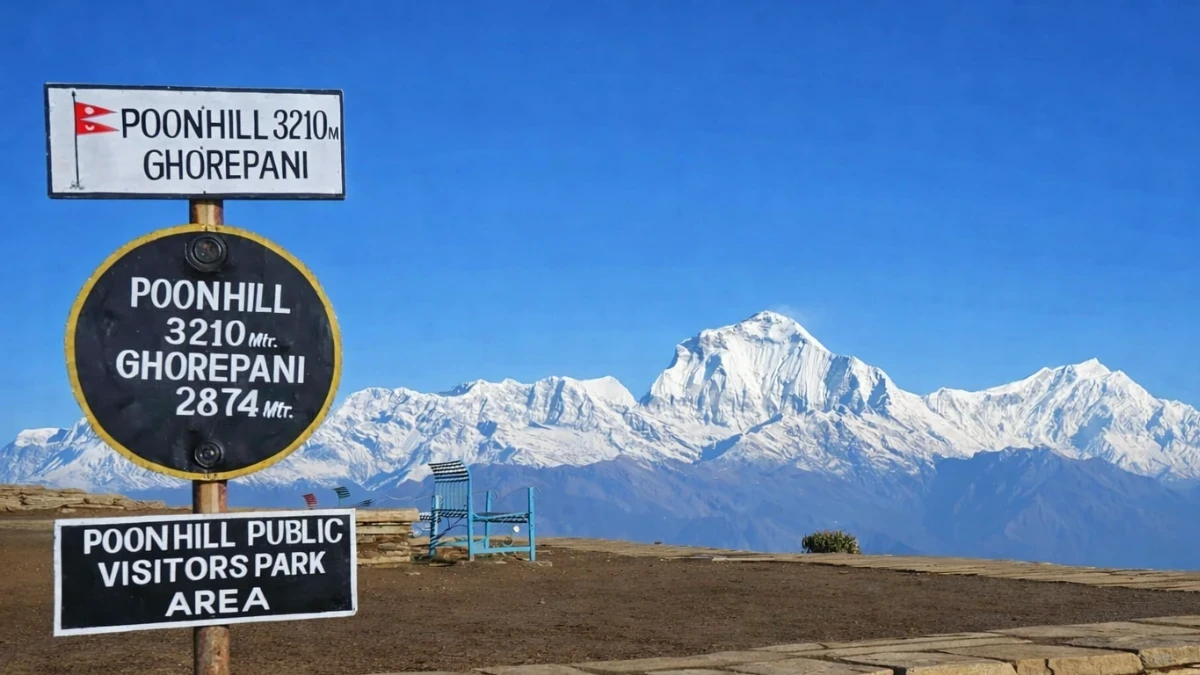
Most trekkers do the Poon Hill trek in four to five days from Nayapul, near Pokhara. You can also reach Ghorepani as part of the longer Annapurna Base Camp trek or the full Annapurna Circuit. More on that later. Either way, Poon Hill is one of those places that earns its reputation honestly.
What is the Poon Hill sunrise actually like?
Let's talk about the bit everyone comes for.
Your alarm goes off at around 4:00 or 4:30 in the morning, depending on the season. In October, sunrise is roughly 5:45. In March or April, it's closer to 6:00. Your guide will know the exact time. Trust them on this.
You'll pull on every layer you've got, grab your headtorch, and step outside into properly cold air. Ghorepani sits at 2,860m, and at that hour the temperature can drop to minus five or lower in autumn and winter. Your breath comes out in clouds. The stars are absurd: more than you've ever seen from any city.
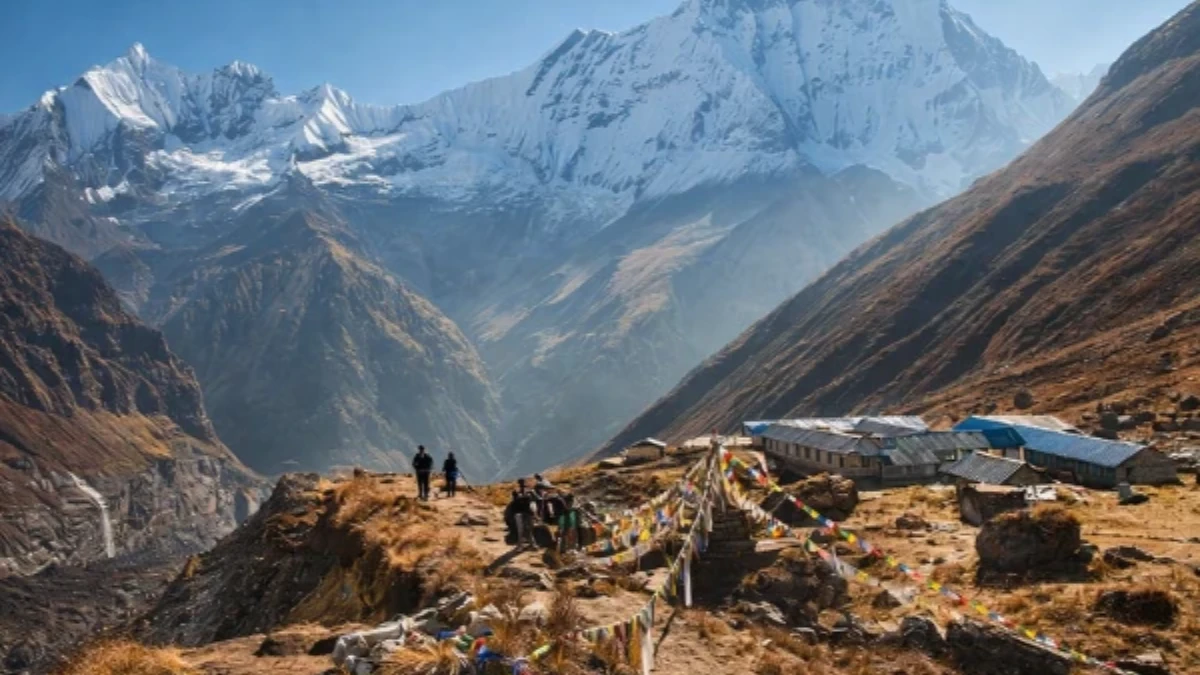
The walk from Ghorepani to the Poon Hill viewpoint takes between 45 minutes and an hour. It's a steady climb of about 350 metres on stone steps. The path is wide and well-trodden, but in the dark you'll want that headtorch. You'll be walking with dozens of other trekkers, so there's a strange sort of camaraderie, everyone stumbling uphill in silence, half-asleep, united by the same mad idea that this will be worth it.
It is.
You arrive at the top while it's still dark. There's a viewing tower, a couple of tea stalls that open absurdly early, and a growing crowd of people wrapped in sleeping bags and down jackets. Grab a cup of tea (NPR 100-150 at the top, expensive by trail standards, but you won't care) and find a spot facing east.
What happens next is hard to put into words without sounding like a greeting card, so I'll just describe it plainly. The sky behind the Annapurna range turns from black to deep blue to pale orange. Then the first light catches the summit of Dhaulagiri, just the tip, a tiny triangle of gold against a dark sky. Over the next twenty minutes, the light slides down the peaks one by one: Annapurna I, Annapurna South, Hiunchuli, Machhapuchhre. The mountains change colour from gold to pink to white as the sun rises higher. The valleys below stay in shadow, so you're looking at these enormous illuminated peaks floating above a sea of darkness.
The whole thing lasts maybe forty-five minutes. People take hundreds of photos. None of them quite capture it. You'll try anyway.
After sunrise, you walk back down to Ghorepani for breakfast. Dal bhat never tastes better than it does after a pre-dawn mountain climb. Related: Photography Trek in Nepal: Routes, Seasons and Camera Tips for Himalayan Shots.
How Do You Get to Ghorepani and Poon Hill?
From Kathmandu
You'll need to get to Pokhara first. That's either a 25-minute flight from Tribhuvan International Airport or a six to seven hour drive along the Prithvi Highway. The drive is scenic, it follows the Trisuli River gorge for much of the way, but the road is winding and busy. Tourist buses leave Kathmandu early morning and cost around USD $10-15. If you'd rather fly, tickets run USD $80-130 one way depending on the season.
From Pokhara to the Trailhead
The classic starting point is Nayapul, about a 90-minute drive from Pokhara Lakeside. Your trekking company will arrange this, it's usually a private jeep or shared vehicle. From Nayapul, you can also drive a bit further to Birethanti (1,025m), which is where you'll register your ACAP (Annapurna Conservation Area Project) permit and TIMS card.
Some trekkers start from Tikhedhunga, which cuts about two hours of flat road walking from the first day. We usually recommend this unless you're keen on walking every metre.
Permits You'll Need
- ACAP Permit, NPR 3,000 (approximately USD $23) for foreign nationals. This covers your entry into the Annapurna Conservation Area.
- TIMS Card, NPR 2,000 (approximately USD $15). Required for all trekkers in the Annapurna region.
Both can be arranged in Kathmandu at the Nepal Tourism Board office in Bhrikutimandap, or in Pokhara at the Tourism Office near the airport. If you're trekking with us, we sort all of this out before you even think about it.
What is the day-by-day Poon Hill Ghorepani itinerary?
Here's how the four walking days of the Poon Hill trek look (our full 6-day package adds the Kathmandu-Pokhara travel days on either side). You can stretch it to five days if you'd rather take it slow, and honestly, there's no shame in that, the villages along the way deserve more than a quick walk-through.
Day 1: Nayapul to Tikhedhunga (1,540m)
Drive from Pokhara to Nayapul. Walk along the Modi Khola river valley, passing through Birethanti where you'll check your permits. The trail is mostly flat and follows the river, with a gradual climb towards the end. You'll pass through small Magar villages and cross a few suspension bridges. Total walking time: about four to five hours.
Tikhedhunga is a small village with a handful of lodges. Nothing fancy, but the food is good and the setting is quiet.
Day 2: Tikhedhunga to Ghorepani (2,860m)
This is the big day. You'll climb about 1,300 metres in elevation, and the famous stone staircase from Tikhedhunga to Ulleri (2,070m) is the most talked-about section, roughly 3,300 stone steps straight up. It sounds brutal, and it is a proper workout, but the steps are even and well-built. Take it slow. Stop for tea in Ulleri and look back at the valley you've just climbed out of.
From Ulleri, the trail enters dense rhododendron and oak forest. If you're here between late March and mid-April, the forest is genuinely spectacular, massive rhododendron trees covered in red, pink, and white blooms, with shafts of sunlight coming through the canopy. Even outside flower season, the forest is beautiful: mossy, quiet, and full of birds.
You'll pass through Banthanti and Nangethanti before reaching Ghorepani in the late afternoon. Total walking time: six to seven hours. You'll be tired, but the view of Dhaulagiri from Ghorepani's main street as the sun goes down makes up for everything.
Day 3: Poon Hill Sunrise, then Ghorepani to Tadapani (2,630m)
Early morning climb to Poon Hill for sunrise (described above). After breakfast back in Ghorepani, you'll head east through more rhododendron forest towards Tadapani. This section of trail is quieter and the forest is particularly dense. You might spot langur monkeys and, if you're very lucky and very quiet, a Himalayan thar (a wild mountain goat).
The trail dips and climbs through Deurali before descending to Tadapani. From Tadapani, you get excellent views of Machhapuchhre and the Annapurna range from a completely different angle than Poon Hill. Total walking time: five to six hours.
Day 4: Tadapani to Nayapul via Ghandruk (1,940m)
Descend through forest to the large Gurung village of Ghandruk, one of the most beautiful settlements in the Annapurna region. Ghandruk has a small museum dedicated to Gurung culture, traditional stone houses with slate roofs, and outstanding views of Annapurna South and Machhapuchhre. It's worth spending an hour here.
From Ghandruk, descend steeply to Kimche, then drive back to Nayapul and on to Pokhara. Total walking time: five to six hours, mostly downhill. Your knees will have opinions about this.
Where do you stay and eat on the Poon Hill trek?
The Poon Hill trek follows a well-established teahouse route, which means you don't need to carry a tent or cooking gear. Every village along the trail has lodges, simple but clean guesthouses with twin rooms, shared bathrooms, and a common dining room warmed by a wood or gas stove in the evenings.
What to Expect from Lodges
- Rooms: Twin beds with mattresses, pillows, and blankets. Most rooms don't have heating, so bring a good sleeping bag or rent one in Pokhara (around NPR 100-150 per day). In peak season, lodges in Ghorepani fill up, so having your guide book ahead is important.
- Bathrooms: Shared squat and western toilets. Hot showers are available in most lodges for NPR 300-500 (solar or gas heated). Don't expect consistent water pressure.
- WiFi and charging: Available in most lodges for NPR 200-500. Speeds are slow but enough to send messages. Charging is usually NPR 200-300 per device per charge.
- Room cost: NPR 300-1,000 per night (roughly USD $2-8). Lodges keep room prices low and make their money on food, so you're expected to eat at the lodge where you sleep. This is standard practise across all teahouse treks in Nepal, don't eat at one lodge and sleep at another.
Food on the Trail
Every lodge has a surprisingly extensive menu. The star of the show is dal bhat, rice, lentil soup, vegetable curry, and pickles, which comes with free refills. You'll eat a lot of it. Other options include fried rice, noodle soup, momos (Nepali dumplings), chapati, porridge, pancakes, and eggs cooked every way imaginable.
Expect to spend NPR 500-800 per meal (USD $4-6). A full day's food typically costs NPR 2,000-3,000 (USD $15-23). Tea and coffee are NPR 80-150 per cup. Prices go up with altitude, everything has to be carried in by porters or mules, so you're paying for transport, not luxury.
The food is fresh and cooked to order. Stick to cooked food and boiled or treated water, and you'll be fine. Bring water purification tablets or a filter bottle, buying plastic water bottles on the trail creates waste, and there are fewer places to buy them than you'd think.
What Should You Pack for the Poon Hill Trek?
The Poon Hill trek doesn't require any technical gear. Here's what you actually need:
- Footwear: Sturdy trekking boots with ankle support, already broken in. Trail shoes are fine for experienced trekkers, but boots are safer on the stone steps.
- Layers: Base layer (merino or synthetic), fleece or light down jacket, waterproof shell jacket. Mornings are cold, afternoons can be warm. You'll be taking layers on and off all day.
- Sleeping bag: Rated to minus five or minus ten. Lodge blankets aren't always enough, especially in Ghorepani.
- Headtorch: Essential for the Poon Hill sunrise walk. Bring spare batteries.
- Rain protection: Waterproof jacket and a rain cover for your bag. Even in the dry season, mountain weather changes fast.
- Sun protection: Sunscreen, sunglasses, and a hat. UV is strong at altitude even when it doesn't feel hot.
- Water: Reusable bottle plus purification tablets or a filter. Two litres capacity minimum.
- Walking poles: Not essential but very helpful on the stone stairs, especially on the way down. Available to rent in Pokhara for NPR 100-200 per day.
- Small daypack: If your porter is carrying your main bag, you'll want a small pack for water, snacks, camera, rain jacket, and layers.
- Cash: Bring enough Nepali rupees for the whole trek. There are no ATMs between Nayapul and Ghorepani. Budget NPR 3,000-5,000 per day for food, drinks, hot showers, WiFi, and charging.
When Is the Best Time for the Poon Hill Trek?
Autumn (October to November), Peak Season
This is when most people come, and for good reason. The monsoon has just ended, the air is washed clean, and visibility is at its absolute best. Temperatures are comfortable during the day (10-20 degrees at Ghorepani) and cold at night (down to minus five). The rhododendrons aren't in bloom, but the skies are consistently clear. The downside: lodges are full, the trail is busy, and you'll share Poon Hill viewpoint with a hundred other people at sunrise.
Spring (March to May), Rhododendron Season
March and April bring the rhododendron bloom, and the forest between Ulleri and Ghorepani becomes genuinely extraordinary. The flowers are at their peak from late March to mid-April. Temperatures are warmer than autumn, but visibility can be slightly hazier as pre-monsoon moisture builds. Late May gets hot at lower elevations and afternoon clouds are common. If you care about flowers more than perfectly clear peaks, spring is your season.
Winter (December to February)
Cold, quiet, and beautiful. Daytime temperatures at Ghorepani hover around zero, and nights can drop to minus fifteen or lower. The trail is much less crowded, and lodge prices drop. Snow is possible above 2,500m, the trail can be icy, and some lodges close for the season. You'll need serious cold-weather gear, but the views on a clear winter morning are extraordinary. Not recommended for first-time trekkers.
Monsoon (June to September)
We don't recommend this period. Rain is heavy and daily, the trails are slippery, leeches are everywhere below 2,500m, and the mountains are hidden behind clouds most of the time. If you absolutely must trek during monsoon, the rain shadow areas north of the Annapurna range (Upper Mustang, Dolpo) are better options.
How hard is the Poon Hill Ghorepani trek?
The Poon Hill trek is rated as easy to moderate by most agencies. That's broadly fair, but let's be specific about what "moderate" actually means.
The total elevation gain over the trek is roughly 2,000 metres, and you'll descend about the same. The hardest single section is the stone staircase from Tikhedhunga to Ulleri, about 1,300 steps of continuous climbing that takes one to two hours depending on your fitness. It's not dangerous, but it's tiring if you're not used to sustained uphill walking.
You don't need previous trekking experience. You don't need to be an athlete. But you do need to be comfortable walking five to seven hours a day on uneven terrain with a daypack, and you need to be honest with yourself about your fitness. If you can walk uphill for two hours without stopping, you'll be fine. If you get out of breath climbing three flights of stairs at home, do some training first.
Altitude sickness is not a major concern on this trek. Ghorepani at 2,860m and Poon Hill at 3,210m are well below the altitudes where acute mountain sickness typically becomes a problem (usually above 3,500m). Some people feel mild effects, a slight headache, mild breathlessness, but serious altitude illness is extremely rare on this route. Drink plenty of water, walk at a steady pace, and listen to your guide.
The descents can be harder on your body than the climbs. The stone steps from Ghorepani down to Tadapani and from Ghandruk to Kimche are steep and sustained. Trekking poles make a real difference on these sections.
What treks can you combine with Poon Hill?
One of the best things about Ghorepani's location is that it connects to several longer treks in the Annapurna region. If you've got more time, here are your options:
Annapurna Base Camp (ABC) Trek
From Tadapani (Day 3 of the standard Poon Hill trek), you can continue east towards Chhomrong and then north into the Annapurna Sanctuary. This adds roughly five to seven days to your trek and takes you to Annapurna Base Camp at 4,130m, surrounded by a complete amphitheatre of peaks. The combination of Poon Hill sunrise followed by the ABC is one of the most popular trekking itineraries in Nepal, and for good reason, you get both the panoramic view and the up-close mountain adventure.
Annapurna Circuit
Ghorepani sits on the southern portion of the full Annapurna Circuit, which is widely considered one of the greatest long-distance treks in the world. The full circuit takes 12 to 21 days depending on your route and crosses the Thorong La pass at 5,416m. If you're planning the full circuit and have time, adding the Poon Hill side trip from Ghorepani is absolutely worth the extra day.
Khopra Danda and Khayer Lake
For trekkers wanting something quieter, the trail from Ghorepani south to Khopra Danda (3,660m) and the sacred Khayer Lake (4,500m) is remarkable and sees far fewer visitors. This route offers close views of Dhaulagiri and takes you through remote Magar villages that see perhaps a handful of trekkers per week. It's a lesser-known spot, and we've been recommending it more and more to experienced trekkers who've already done the classic routes.
A Few Honest Tips from Someone Who's Been There Many Times
- Book your Ghorepani lodge in advance during October and November. There aren't enough beds for everyone who wants one. Your guide should confirm your booking at least a day ahead. We always do this for our trekkers.
- Start the Poon Hill climb early. The viewpoint gets crowded. If you leave Ghorepani at 4:15 instead of 4:45, you'll have your pick of spots.
- Bring more cash than you think you'll need. Hot showers, charging, WiFi, snacks, and the inevitable extra cup of tea all add up. NPR 25,000-30,000 for a four-day trek is a safe amount.
- Don't skip Ghandruk. Many trekkers rush through it to get back to Pokhara. The Gurung museum is small but fascinating, the views from the village are outstanding, and the local apple brandy is worth trying.
- Carry your rubbish out. The Annapurna Conservation Area does a good job of trail maintenance, but it needs help. Don't leave anything behind, wrappers, bottles, or tissues.
- Tip your guide and porter. They carry your bags, find your lodges, translate for you, and make the whole thing possible. US$15 to US$20 per day for a guide and US$10 to US$15 per day for a porter is a guideline, and our tipping guide has the detail.
How do you book the Poon Hill Ghorepani trek?
We've been running treks to Poon Hill and throughout the Annapurna region since we founded The Everest Holiday in 2016. Our guides know these trails like their own back garden, because for many of them, they are. We keep our groups small (1 to 20 people), we sort all permits and logistics, and a portion of every booking supports the Nagarjun Learning Center, providing free education and meals to 70 children in rural Nepal.
If you're thinking about the Poon Hill trek, whether as a standalone trip, as part of a longer Annapurna adventure, or as your very first Himalayan experience, we'd love to help you plan it.
Chat with Shreejan on WhatsApp: +977 9810351300
Email: [email protected]
Browse our Annapurna treks: www.theeverestholiday.com
Poon Hill is the classic short trek. Our Ghorepani Poon Hill Trek (6 Days) is private (your group only, no strangers), 2027 dates open, From USD $499. WhatsApp us for tailored 2027 dates and current departures.


 Chat with Shreejan