

Written by Shreejan Simkhada, CEO of The Everest Holiday and third-generation Himalayan guide. TAAN Member #1586.
Lumbini sits in the dusty plains of southern Nepal, about ten kilometres north of the Indian border, and yet it is the single most important place in the Buddhist world. This is where, somewhere around 563 BCE, Queen Maya Devi gave birth to Siddhartha Gautama, the man who would later become the Buddha. Today the site is a UNESCO World Heritage location (listed since 1997), spread across a four-square-kilometre Sacred Garden plus a vast Monastery Zone that holds prayer halls and stupas built by Buddhist nations from around the world. The site is managed by the Lumbini Development Trust, the Nepal government body responsible for its conservation and master plan.
This guide covers what Lumbini actually is on the ground in 2026: what to see at the core site, how to get here from Kathmandu, Pokhara or Chitwan, what the day looks like hour by hour, where to stay, what it costs, and how to combine the visit with Chitwan safari or a Buddhist circuit. Where we have run trips through Lumbini in the past six months, we have written what we saw, not what the brochures say.
Lumbini at a glance
| Detail | 2026 |
|---|---|
| What it is | Birthplace of the Buddha (c. 563 BCE); UNESCO World Heritage Site since 1997 |
| Where | Rupandehi district, southern Nepal (Terai), about 10 km north of the Indian border |
| Sacred Garden entry | NPR 500 foreign, NPR 100 SAARC, free for Nepali (Maya Devi Temple included) |
| From Kathmandu | About a 30-minute flight to Bhairahawa (25 km away), or 280 km and 9 to 11 hours by road |
| Days needed | One full day for the core site; two days to add Tilaurakot and a morning meditation |
| Best time | October to March, dry and 18 to 28°C; avoid the April to June heat, which passes 38°C |
| Combine with | Chitwan safari (4 hours east), Pokhara (6 hours north), or our 7-day Nepal Buddhist Circuit |
Is Lumbini worth visiting?
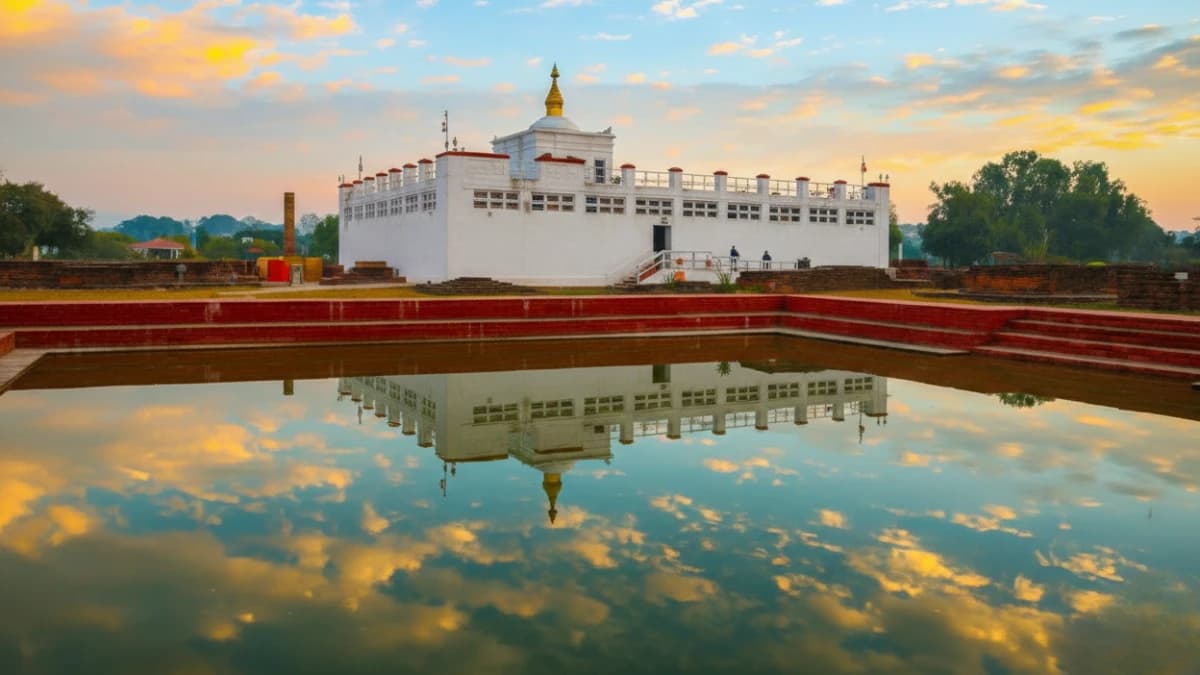
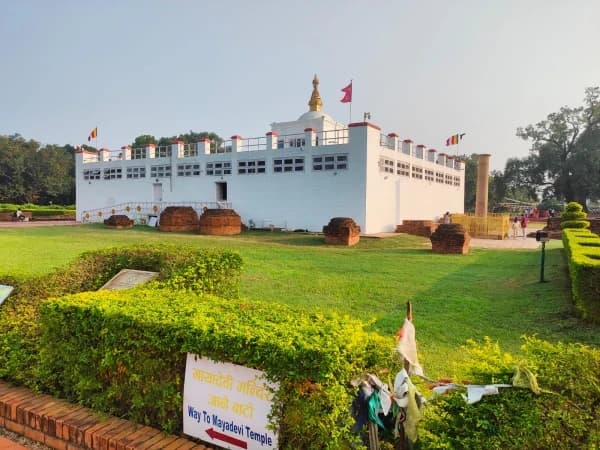
The reason Lumbini draws around 1.5 million pilgrims and travellers each year is not just history. It is the sense of arrival. Walk through the gate to the Sacred Garden and the noise of the highway falls away in about twenty paces. The Maya Devi Temple itself is a single-storey white structure that protects the marker stone identifying the exact spot where the birth is believed to have happened. Around it stand the Ashoka Pillar (placed by Emperor Ashoka in 249 BCE, with an inscription confirming the birthplace), the Sacred Pond where Queen Maya is said to have bathed before giving birth, and a 2,500-year-old grove of ancient trees draped in prayer flags.
For Buddhists, the site sits alongside Bodh Gaya (where Buddha attained enlightenment), Sarnath (first sermon) and Kushinagar (parinirvana) as the four primary pilgrimage points. For non-Buddhist travellers, the appeal is different but real: Lumbini is one of the very few places in Nepal where the experience is contemplative rather than scenic. The Monastery Zone gives you a one-afternoon comparative tour of how a dozen Buddhist traditions express the same beliefs in entirely different architecture.
What can you see in Lumbini's Sacred Garden?
Maya Devi Temple
The temple is open daily, roughly 6 AM to 6 PM (the gate may open earlier for early-morning meditation; closing time tightens in winter). You walk barefoot or in socks once inside. Cameras are not permitted within the temple itself. Phones included. The central object is the marker stone, behind a glass barrier, identifying the location archaeologists have confirmed as the birth site. Above it, a stone bas-relief from roughly the 4th century AD depicts the nativity scene: Queen Maya holding the branch of a sal tree, the newborn Siddhartha standing beneath her.
Most visitors spend ten to twenty minutes inside. Pilgrims often sit on the floor and meditate for longer; staff are quiet about this and will not rush anyone who is clearly absorbed.
The Ashoka Pillar
Just outside the temple, in the open courtyard, stands a sandstone pillar erected by Emperor Ashoka the Great when he made his pilgrimage to Lumbini in 249 BCE. The Brahmi inscription on it (translated: "Here was born the Buddha, sage of the Sakyas") is the earliest written evidence we have that places the birth of the Buddha at this specific site. It is also one of the better-preserved Ashoka pillars in South Asia. Look for the iron rod that runs through the top: it was added in the modern era to stabilise the column after centuries of damage.
Pushkarini, the Sacred Pond
A short walk to the west, the Sacred Pond is a rectangular brick-edged pool fed by groundwater. Tradition says Queen Maya bathed here before giving birth, and that the newborn Buddha was given his first ritual bath in the same water. Today it is a quiet spot where pilgrims walk the perimeter clockwise (Kora) and where the morning light is strikingly photogenic. The grove of trees around it is the Bodhi grove area, with prayer flags strung between trunks.
Eternal Peace Flame
Lit in 1986, the Eternal Peace Flame burns continuously in the central plaza of the Sacred Garden as a symbol of non-violence. It is a useful navigation point: you can orient most of the site from here.
What is the Monastery Zone in Lumbini?
This is the part of Lumbini that surprises first-time visitors. Stretching for roughly three kilometres north of the Sacred Garden is a planned zone, divided down a central canal into East Monastic Zone (Theravada tradition) and West Monastic Zone (Mahayana and Vajrayana). More than thirty countries and Buddhist organisations have built monasteries, stupas, prayer halls and meditation centres here. The result is a slow, walkable comparative architecture museum.
The standouts most visitors find memorable:
- German Monastery (Tergar Monastery / German Tara Foundation), possibly the most architecturally striking on the entire site; tile-and-glass exterior, sweeping interior fresco work, and a quiet meditation hall open to the public.
- Royal Thai Monastery. White marble exterior, instantly recognisable golden roof corners, ornate gold-leaf interior. Comparable in feel to temples in Bangkok.
- Myanmar Golden Temple, modelled after the Shwedagon Pagoda; pure gold leaf paint and a long inner gallery.
- Drubgyud Choling Gompa (Korean Buddhist Temple), multi-tiered traditional Korean wooden architecture, complete with a giant statue of Manjushri.
- Lumbini International Buddhist Society (Vietnam), newer construction with a striking lotus motif in the main hall.
- World Peace Pagoda (Japan) at the far northern end of the Monastery Zone: pure white dome and a long approach lined with prayer flags, popular for sunset photography.
You will not see all thirty in one visit. Most travellers cover six to ten, working in a clockwise loop from the Sacred Garden, ending at the World Peace Pagoda at the far end. Bicycles are available for hire at the entrance (about NPR 200 for the day in 2026) and make this much easier than walking. The distance between the Sacred Garden and the Peace Pagoda is roughly three kilometres each way.
How do you get to Lumbini from Kathmandu?
From Kathmandu
The shortest option is the daily Yeti Airlines or Buddha Air flight from Kathmandu to Bhairahawa (Gautam Buddha International Airport), which takes about thirty minutes. Bhairahawa is roughly twenty-five kilometres from Lumbini. A taxi from the airport runs around NPR 1,500 to 2,000 in 2026.
By road, Kathmandu to Lumbini is about 280 kilometres but takes nine to eleven hours on a good day because of the Mahendra Highway and the climb out of the valley. Tourist buses leave Sorhakhutte in Kathmandu around 7 AM; sleeper buses run overnight from Naya Buspark. We have generally found the flight more pleasant unless travellers specifically want to see the Chitwan and Bardiya foothills along the way, in which case the road takes you through that landscape.
From Pokhara
Pokhara to Lumbini by road is about 190 kilometres and six to seven hours. Tourist buses depart from Lakeside in the morning. This is the more popular route because Lumbini fits naturally into a Pokhara, Lumbini and Chitwan loop for travellers already in Nepal for the Annapurna region.
From Chitwan
If you are already in Sauraha or Meghauli for jungle safari, Lumbini is a four-hour drive west along the Mahendra Highway. Most travellers we send through Chitwan add Lumbini either as a one-night side trip or as a one-day stopover en route back to Kathmandu.
From India (Sunauli border)
Lumbini is also one of the most popular cross-border entry points for Indian Buddhist pilgrims and overland travellers. The Sunauli border post is about twenty-eight kilometres south of Lumbini. From the Indian side you can reach Sunauli from Gorakhpur (the closest railway hub) in roughly three hours by shared jeep or taxi.
How many days do you need in Lumbini?
Honest answer: one full day is enough to see the Sacred Garden and four to six monasteries at a relaxed pace. Two days lets you cover the entire Monastery Zone, attend a morning meditation session at one of the international temples, and visit nearby sites like Tilaurakot (the ancient Kapilvastu, where the Buddha grew up). That ruin site is about twenty-seven kilometres west of Lumbini and is often skipped but is worth half a day for travellers with a serious interest in the Buddha's biography.
Three days is excessive unless you are joining a structured meditation retreat at one of the monasteries (the Korean, Vietnamese and German temples all host short-stay programmes that range from a single overnight to ten-day retreats).
What is the best time to visit Lumbini?
October to March is the dry and cool window. Daytime temperatures sit between 18°C and 28°C, mornings can be foggy in December and January, and nights are pleasant. This is also the peak pilgrimage season: expect higher visitor numbers from late November through February as Indian and Sri Lankan pilgrim groups travel.
April to early June is hot. Daytime can climb past 38°C and the air gets heavy and dusty. The Sacred Garden is shaded by trees, which helps, but the Monastery Zone is an exposed walk. Bicycles are essential at this time.
Late June through September is monsoon. The site stays open but the southern plains are humid and afternoon rain is daily. Some monasteries close their interior galleries for the wet season to protect the artwork. We do not generally send travellers in this window unless they have a specific reason to be there.
The full moon of Vesak (Buddha Jayanti) falls in April or May depending on the lunar calendar, is a special, intense time to visit. Pilgrim groups from a dozen Buddhist nations gather, prayer wheels turn continuously, and chanting goes through the night. If this appeals, plan ahead: lodge availability gets tight in the days around the festival.
Where should you stay in Lumbini?
Accommodation in and around Lumbini falls into three categories. Each has trade-offs we want to be honest about, because the difference between booking a comfortable room and a basic guest house matters more here than in many other Nepal destinations.
Inside the Monastery Zone (Pilgrim Lodges)
Several international monasteries run their own guest houses for pilgrims and supporters. Rates are modest (NPR 1,500 to 3,000 a night in 2026), the rooms are spartan but clean, and most include a simple vegetarian meal. The advantage is location: you can walk to the Sacred Garden in the early morning before the day's heat builds. The Korean Buddhist Temple, Vietnam Phat Quoc Tu Monastery and the German Tara Foundation all run small guest houses. They prefer guests who are arriving for genuine spiritual reasons and may ask about your purpose at check-in.
In Lumbini Bazaar (Outside the Park)
About one kilometre south of the main entrance is a small bazaar with mid-range hotels in the NPR 4,500 to 8,000 range. This is the most common choice for travellers on a regular tour. Rooms have hot water, air conditioning, and breakfast included. We have had reliable experiences with the Lumbini Garden New Crystal and the Buddha Garden, both of which sit in this band.
In Bhairahawa (25 km away)
If you want full-comfort hotel options, Bhairahawa has the larger commercial accommodation. Hotel Pawan and Hotel Yetkha offer rooms in the NPR 6,000 to 10,000 range. This makes sense for travellers arriving on an evening flight and visiting Lumbini the following morning, or for those continuing west to Bardiya the next day.
How much does it cost to visit Lumbini?
Entry to the Sacred Garden in 2026 is NPR 500 for foreign visitors (SAARC nationals NPR 100, Nepali nationals free). The Maya Devi Temple is included in this ticket. The Monastery Zone is free to walk through, although some individual monasteries request a small donation at the entry door (NPR 50 to 200 is typical and discretionary).
Tilaurakot ruins are a separate NPR 500 entry ticket if you make the day trip west.
Bicycle hire is NPR 200 to 300 for the day. A guided rickshaw inside the Monastery Zone is NPR 700 to 1,000 for a half-day loop, useful in hot weather or for travellers with mobility considerations.
Practical Tips
- Dress modestly. Shoulders covered, knees covered. This applies inside the Maya Devi Temple and any monastery interior. A light scarf works as cover for women in summer.
- Shoes off inside the temple and inside individual monastery prayer halls. Bring socks or slip-ons that come off easily: you will do this a dozen times in a day.
- No photography inside the Maya Devi Temple or inside most monastery prayer halls. Outdoor photography in the Sacred Garden is fine.
- Carry water. The Monastery Zone is large, and shops are clustered only near the entrance.
- Start early. The Sacred Garden is most contemplative in the first ninety minutes after opening (around 6 AM in summer). By 10 AM it is busy with tour groups.
- Mosquito repellent is genuinely useful from April through October.
- Cash. Most pilgrim-zone shops and bicycle hire stalls do not accept cards. The closest reliable ATMs are in Bhairahawa.
What destinations can you combine with a Lumbini trip?
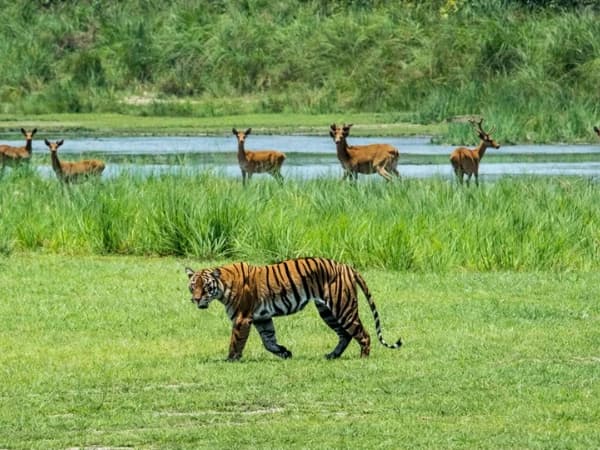
The natural pairing is with Chitwan jungle safari (four hours east) and Pokhara (six hours north). Many of our travellers combine all three into an eight to ten-day loop that pairs well with the Annapurna foothill treks. The Bardiya, Lumbini & Chitwan Photography Tour we run takes this template and adds Bardiya National Park to the west for tiger and one-horned rhino sightings in a less crowded setting than Chitwan.
For travellers more focused on the Buddha's biography itself, the deeper combination is Lumbini, Tilaurakot (where he grew up, west of Lumbini) + a flight or overland crossing to Bodh Gaya in India (where he attained enlightenment). This Buddhist circuit can be extended to Sarnath and Kushinagar, all in northern India, making a roughly two-week pilgrimage route. The Nepal half of it is our 7-day Nepal Buddhist Circuit Tour, which links Lumbini with the Kathmandu valley's Buddhist sites, Boudhanath and Namobuddha, and we arrange the onward India leg on request.
Common Mistakes
The two we see most often:
One: squeezing Lumbini into a single half-day visit. Travellers on tight schedules sometimes try to fly in, see the Maya Devi Temple, and fly out the same day. They miss the Monastery Zone entirely and leave with the impression that Lumbini is just "one temple." It is not. Plan one full day minimum.
Two: visiting in May without a hat or a bicycle. The Monastery Zone is an exposed walk of about three kilometres in midday heat. Either move your visit to October to March, or get a bicycle and start at 6 AM.
Frequently Asked Questions
Is Lumbini in Nepal or India?
Lumbini is in Nepal, in the Rupandehi District of Lumbini Province, about ten kilometres north of the Indian border at Sunauli. The Buddha was born in what is today Nepal, even though he spent much of his teaching career across the border in what is now Bihar, India.
How many days do I need in Lumbini?
One full day is the practical minimum. Two days lets you do justice to the Monastery Zone and add a visit to Tilaurakot (the ancient Kapilvastu). Anything longer is only worthwhile if you are joining a structured meditation programme at one of the monasteries.
Is Lumbini suitable for non-Buddhist travellers?
Yes. The site is one of the most visited UNESCO World Heritage locations in Nepal precisely because it works on multiple levels: historical (verified ancient archaeology), architectural (a comparative tour of Buddhist styles from twenty different countries), and contemplative (the Sacred Garden itself has a real quietness). Many of our non-Buddhist travellers list it as their favourite stop in Nepal outside the mountains.
What is the entry fee in 2026?
NPR 500 for foreign visitors, NPR 100 for SAARC nationals, free for Nepali nationals. This covers the Sacred Garden, the Maya Devi Temple, and the entire Monastery Zone. Tilaurakot, if you visit, is a separate NPR 500.
Can I attend meditation sessions at the monasteries?
Yes. The Korean Buddhist Temple, the Vietnamese Phat Quoc Tu and the German Tara Foundation all run scheduled meditation sessions that are open to visitors. Times vary; ask at the entrance of each. Some are conducted in the local language with English translation; others are silent.
Is Lumbini safe?
Yes. The Sacred Garden and Monastery Zone are heavily monitored and safe to walk. Stick to the Monastery Zone roads in the evening rather than the wider park perimeter. The town of Lumbini itself is small and quiet. Standard travel precautions apply: keep an eye on belongings in crowded areas during major pilgrim events.
Can I get from Lumbini to Kathmandu in one day?
Yes by flight (Bhairahawa to Kathmandu, thirty minutes plus airport time). By road it is a long single day. Nine to eleven hours depending on traffic conditions on the Prithvi Highway. Most travellers we work with prefer to break the journey overnight in Chitwan or Pokhara rather than do the full road day.
What is the best time of day to visit the Sacred Garden?
Early morning, between roughly 6 AM and 8 AM. The light is softer, the air is cooler, the temple is quieter, and the pilgrim groups have not yet arrived. Late afternoon (around 4 PM until closing) is the second-best window.
How We Can Help
We arrange Lumbini in two formats: as a one or two-day standalone visit from Kathmandu (flight in, hotel, sightseeing, return flight), and as part of a longer southern-Nepal loop that combines Lumbini with Chitwan or Bardiya safari plus Pokhara. Our Bardiya, Lumbini and Chitwan Photography Tour is the most comprehensive standalone option in our catalogue and runs as private departures throughout the year. For pilgrims who want Lumbini set within the wider Buddhist journey, our 7-day Nepal Buddhist Circuit Tour (from USD $999) ties it to Boudhanath, Swayambhunath and Namobuddha in the Kathmandu valley. Smaller two and three-day Lumbini visits are arranged on request: drop us an email or WhatsApp and we will send a detailed quote based on your dates, group size and accommodation preference.
Lumbini pairs with our Bardiya-Lumbini-Chitwan tour. Our Bardiya, Lumbini & Chitwan Tour (12 Days) is private (your group only, no strangers), 2026 dates open, From USD $1249. WhatsApp us for tailored 2026 dates and current departures.
Shreejan Simkhada is the CEO and co-founder of The Everest Holiday, a family-run trekking company in Kathmandu, and a third-generation Himalayan guide. TAAN Member #1586. Every booking helps fund our Nagarjun Learning Center.
 Chat with Shreejan