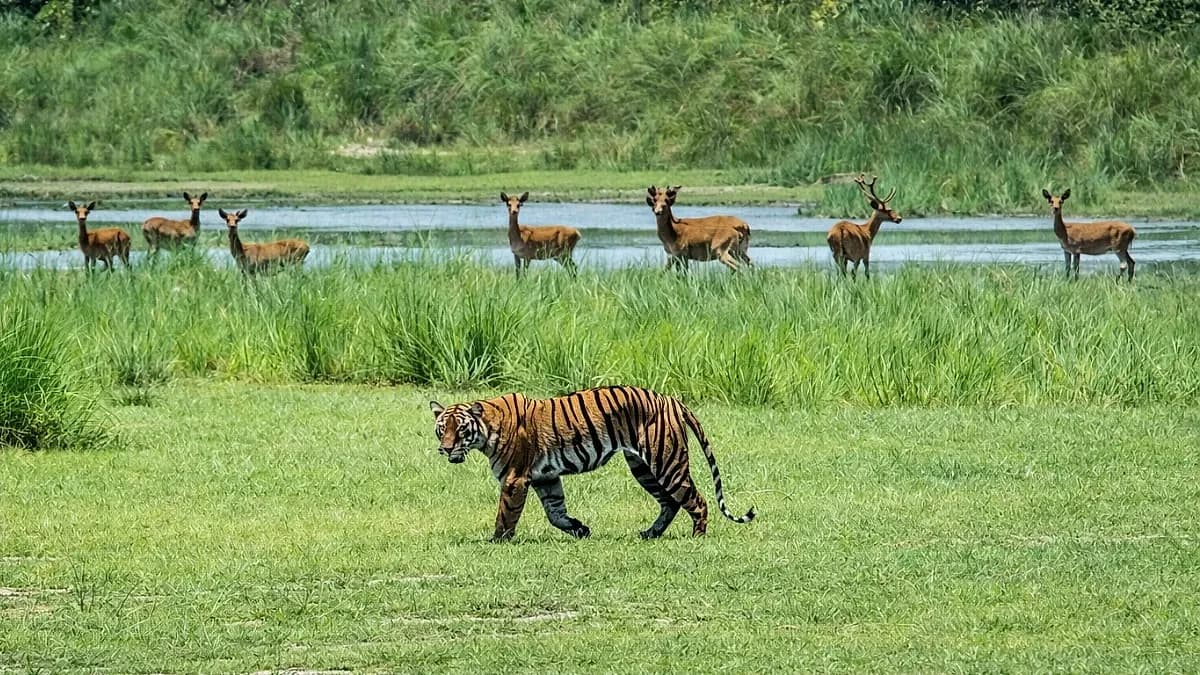
The jeep engine cuts, and your guide raises a hand. Through the sal forest, where the morning light falls in broken columns, a Bengal tiger moves along the far bank of the Karnali River. It pauses, turns its head, and for three seconds, you have a clear shot across open ground. Your shutter fires. Nobody in the vehicle breathes. Then the tiger slips back into the grass and disappears as quietly as it arrived. That's Bardiya, Nepal's largest national park, where the crowds that fill Chitwan haven't arrived yet and the wildlife behaves as though humans are a curiosity rather than a threat. This is the first chapter of a 12-day expedition from the remote western Terai to the sacred wetlands of Lumbini and the dense jungles of Chitwan.
By the time this tour ends, you'll have photographed wild elephants and one-horned rhinos in two different national parks; tracked Bengal tigers through riverine grasslands; watched endangered vultures feed at a conservation station; and spent golden-hour mornings in the marshes where the Sarus Crane stands taller than a child. It's not a holiday with a camera. It's a photography expedition across three of Nepal's most important ecosystems, guided by naturalists who know exactly where the light falls and the animals gather.
What Makes This Tour Stand Out
- Three full days of intensive tiger tracking in Bardiya National Park, Nepal's largest and most remote protected area, where Bengal tiger sighting rates are among the highest in the subcontinent.
- Photograph one-horned rhinoceroses in two separate national parks—Bardiya's Karnali floodplains and Chitwan's grasslands—giving you twice the opportunity and two distinct habitats to compare.
- Birdwatching in Lumbini's sacred wetlands, where the marshes around the Maya Devi Temple host Sarus Cranes, Bengal Floricans, and hundreds of migratory waterbirds against the backdrop of a UNESCO World Heritage Site.
- Visit a vulture conservation feeding station and photograph critically endangered species being brought back from the brink of extinction—a conservation success story happening in real time.
- Golden-hour and blue-hour shooting sessions planned around each location's best light conditions, with your naturalist guide positioning the vehicle for optimal angles.
- Cross three distinct ecosystems in a single trip: the Karnali floodplains of Bardiya, the cultural wetlands of Lumbini, and the dense sal forests and grasslands of Chitwan.
- Wild elephant herds, Gangetic dolphins, gharial crocodiles, and over 500 bird species across all three locations—the full spectrum of Terai biodiversity in 12 days.
- We handle all park permits, private safari vehicles, professional naturalist guides, and comfortable lodge accommodation for you, so you can focus entirely on your camera.
- Small group sizes create less noise, reduce disruption, and improve chances of close wildlife encounters. Your guide adjusts the pace around what the animals are doing, not around a fixed schedule.
12-Day Bardiya Lumbini and Chitwan Photography Tour Overview
This expedition begins with an overland journey from Kathmandu to the far-western lowlands, where Bardiya National Park stretches along the Karnali River. For three days, you'll track Bengal tigers, wild elephants, and one-horned rhinos through some of Nepal's densest jungle, with Gangetic dolphins surfacing in the river bends below. The park sees a fraction of the visitors that Chitwan receives, which means quieter trails, calmer wildlife, and better photography conditions.
From Bardiya, the route turns east to Lumbini, where the pace shifts completely. Marshes and grasslands ring the birthplace of the Buddha and harbor an astonishing variety of birdlife. Mornings here are spent in the wetlands with binoculars and long lenses; afternoons are spent in the temple gardens, where the stillness itself becomes a subject worth photographing.
The final leg brings you to Chitwan National Park, Nepal's most celebrated wildlife reserve. Jeep safaris through the core zone, canoe rides along the Rapti River, and guided jungle walks round out the portfolio with close-up encounters with rhinos, crocodiles, and the extraordinary birdlife of the sal forest. A visit to a vulture feeding station shows conservation at its most practical and moving.
Before You Arrive
We recommend arriving in Kathmandu by 4:00 pm the day before departure. This gives you time for a final gear check, a trip briefing with your naturalist guide, and a chance to ask about lens recommendations for each location.
Your Online Briefing
After you book, we'll send you an email with available times for a video call. This is your chance to discuss your photography goals, preferred subjects, and experience level. We'll go through the daily schedule, advise on camera settings and lens choices for each habitat, and answer every question you have.
Your Tour, Your Way
This is a private tour. Your group travels with your naturalist guide, at your own pace. We'll never add strangers to your group. Want to spend an extra hour at a waterhole where a tiger was spotted? Prefer to concentrate on bird photography in Lumbini rather than cultural sites? We adjust everything. Your Kathmandu hotel is not included in the package price, giving you the freedom to choose accommodation that suits your budget.
Compare Our Packages
| Standard | Luxury | |
|---|---|---|
| Price from | USD 1,599 | USD 1,999 |
| Meals | All meals included (B/L/D) | All meals + all drinks (except alcohol) |
| Lodge | Comfortable jungle lodge, private rooms | Premium jungle lodge / resort |
| Safari vehicle | Shared tourist vehicle | Luxury private vehicle |
| Guide | Professional naturalist guide | Senior naturalist guide |
| Extras | Tea, coffee, soft drinks included | Seasonal fruits, dry fruits, and all non-alcoholic drinks |
| Best for | Comfortable photography expedition | Premium wildlife experience |
Looking for a budget option? We can build a custom itinerary to match your budget — contact us for a tailored quote.
Same expert naturalist guides, same national parks, same extraordinary wildlife — choose the comfort level that fits you.
Your Tour, Our Family
When Hari Lal Simkhada helped international travellers experience the Himalayas in the 1960s, he could not have imagined his grandson would be designing wildlife photography expeditions across the Terai six decades later. His son, Ganesh Prasad Simkhada, went on to hold senior positions in Nepal's tourism and mountaineering institutions. Today, Shreejan Simkhada carries that legacy forward as CEO of The Everest Holiday, personally designing every itinerary and hand-picking the naturalist guide for your group.
For this photography expedition, your guide will be one of our experienced naturalists with profound knowledge of Bardiya, Lumbini, and Chitwan's wildlife behavior and habitats. Shreejan briefs every guide personally before your tour begins.
Need anything? WhatsApp Shreejan directly: +977 9810351300.
Why Photographers Trust Us
Three parks, twelve days, one guide who knows the light. Bardia's dawn mist, Lumbini's golden-hour stupas, Chitwan's afternoon river scenes — our guides know exactly when and where to position you for the shot.
Logistics that serve the lens. Early starts, flexible stops, and vehicle access to remote corners. We build the schedule around photographic opportunities, not around lunch times.
360+ five-star reviews. Family-run, government-registered, TAAN certified. Your camera is safe. Your memories are safer.
Solo Travellers Welcome
Traveling alone with a long lens and a sense of adventure? You're in good company. Many of our wildlife photographers book solo, and by the second safari drive, they're sharing hides and swapping lens tips with the rest of the group. Group size ranges from 1 to 20, and the intimate nature of wildlife photography means smaller groups work best.
You can book privately or let us list your date as a fixed departure so other solo photographers can join you. Either way, the experience stays personal, and the wildlife encounters stay unrushed.
Difficulty: Easy (1 out of 5)
This is a vehicle-based photography tour with no strenuous hiking or altitude concerns. Maximum altitude is 415 m (1,362 ft), well within the Terai lowlands. Days involve jeep safaris, boat rides, and short guided walks on flat jungle trails. The pace is set by the wildlife, not by physical effort. You'll need comfortable walking shoes and the stamina to sit quietly in a vehicle for 4-5 hours during safari drives, but no particular fitness level is required. The main physical demand is early mornings—wildlife doesn't wait for a lie-in. Be aware that the Terai is warm and humid, particularly in spring, so bring light, breathable clothing and a reliable insect repellent.
Trek With a Purpose — Changing Lives, One Frame at a Time
In 2019, Shreejan Simkhada and Shamjhana Basukala founded the Nagarjun Learning Center to give back to the communities that shaped their family. Today, 70 children receive free education and hot meals daily at the flagship center in Saldum Village, Dhading District. The center has expanded to 7 locations across Nepal, provided free medical care to over 600 people, and brought internet access to 65 children for the first time in their village's history.
A portion of every booking with The Everest Holiday supports the Nagarjun Learning Center, which the UN Partner Portal verifies and lists. When you photograph Nepal's wildlife, every frame helps change a life.