Nepal on a motorbike is a completely different experience from Nepal on foot. You cover more ground, see more of the country between the tourist highlights, and get the kind of freedom that a guided trek cannot offer. You also face costs that most travel blogs do not mention, because motorbike touring in Nepal comes with fuel, permits, insurance, and mechanical realities that trekking does not.
I handle the bookings for our motorbike tours and the question I hear most is simple: how much will it actually cost? Here is the honest answer, covering everything from bike rental to border permits.
May 2026 price note: Nepal's fuel costs have risen sharply due to the ongoing conflict in West Asia. Petrol is now around 219 rupees per litre in Kathmandu, up from roughly 160 rupees before the crisis. Diesel has also increased significantly, affecting support vehicle and transport costs. All prices below reflect current 2026 rates.
Is a Guided or Self-Guided Nepal Motorbike Tour Cheaper?
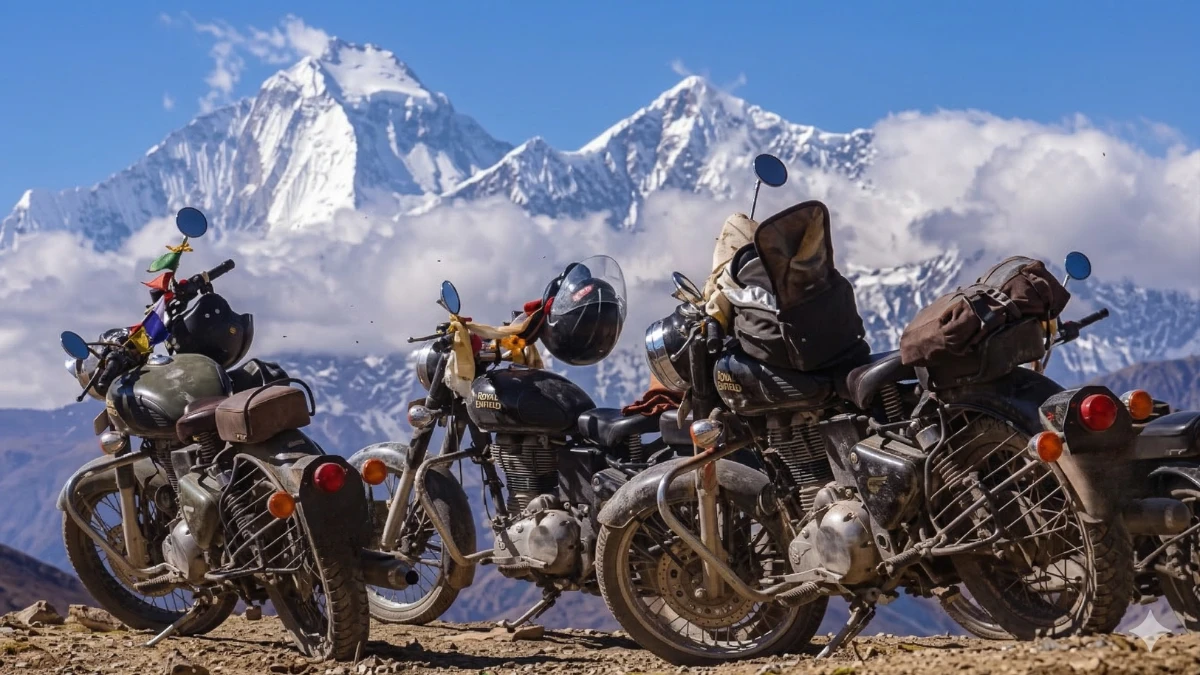
There are two ways to ride Nepal. A guided tour with a company like ours handles everything: bike, fuel, accommodation, meals, permits, support vehicle, mechanic. A self-guided trip means you rent a bike in Kathmandu and handle everything yourself.
The cost difference is significant, but so is the experience difference. Here is how they compare.
How Much Does a Guided Motorbike Tour Cost?
Our seven-day Nepal motorbike tour (Kathmandu, Chitwan, Lumbini, Pokhara, and back) is priced in three tiers:
Budget: 999 USD. Tourist hotel with shared room. Breakfast only. You cover your own fuel. No backup jeep. SIM card only.
Standard: 1,199 USD. Three-star hotel with private twin room. All meals included. Fuel included. Backup jeep with support team, spare parts, and first aid. Limited data SIM. All Chitwan activities included (jungle walk, wildlife safari, jeep safari, Tharu cultural dance, elephant breeding centre visit).
Luxury: 1,999 USD. Luxury hotel with private deluxe room. All meals plus unlimited non-alcoholic drinks. Fuel included. Backup jeep. Unlimited data SIM.
Group rates reduce the price by 5 to 40 percent depending on group size. A group of five to eight on Standard tier pays roughly 1,000 to 1,020 USD per rider.
Full details on our Nepal motorbike tour page.
What Does a Guided Motorbike Package Include?
On Standard and Luxury tiers, the package covers:
- Motorcycle (Royal Enfield Himalayan 411-450, Classic 350, or Honda CRF 250/300)
- All fuel for the motorcycle
- All accommodation (twin-share)
- All meals (Standard: three per day; Luxury: three plus drinks)
- English-speaking guide on motorcycle
- Backup jeep with support team, tools, and spare parts
- Chitwan National Park activities
- Airport transfers
- First aid kit and pulse oximeter
- Free luggage storage in Kathmandu
What Is Not Included in a Motorbike Tour Package?
- International flights to Kathmandu
- Nepal visa (30 to 125 USD)
- Motorcycle insurance (30 to 50 USD, arranged by us)
- Travel insurance covering motorbike riding (essential, see below)
- International Driving Permit (required, get this before you travel)
- Tips for guide and support crew
- Alcohol
- Delays caused by landslides, weather, strikes, or illness
How Much Does It Cost to Rent a Motorbike in Nepal?
If you prefer to ride independently, here is what renting a bike and covering your own costs looks like in 2026:
Motorcycle rental:
- Royal Enfield Himalayan 411cc: 35 to 55 USD per day
- Royal Enfield Classic 350: 30 to 45 USD per day
- Honda CRF 250/300: 40 to 60 USD per day
- Scooter (around Kathmandu/Pokhara only): 10 to 20 USD per day
Most rental shops are in Thamel, Kathmandu. A seven-day rental of a Royal Enfield Himalayan costs 245 to 385 USD. A fourteen-day rental: 490 to 770 USD. Longer rentals usually come with a daily discount.
Rental typically includes a helmet, basic tool kit, and third-party liability insurance. Full-cover insurance (covering damage to the bike) is extra: 15 to 30 USD per day. I strongly recommend it. Nepal's roads will test any motorcycle.
Fuel: Petrol is 217 NPR per litre and diesel is 225 NPR per litre in Kathmandu (as of May 2026) as of May 2026, following three price hikes driven by the West Asia conflict. Outside Kathmandu, prices can be 5 to 10 rupees higher. A Royal Enfield Himalayan averages about 30 kilometres per litre. Riding 100 to 150 kilometres per day, budget 4 to 7 USD daily for fuel, or roughly 30 to 50 USD for a seven-day tour.
Accommodation (self-arranged):
- Budget guesthouse: 8 to 20 USD per night
- Mid-range hotel: 25 to 50 USD per night
- Comfortable hotel in Pokhara or Chitwan: 40 to 80 USD per night
Food (self-arranged):
- Local dal bhat on the road: 3 to 5 USD
- Tourist restaurant meal: 6 to 12 USD
- Daily food budget: 15 to 30 USD
Self-Guided vs Guided: Total Cost Comparison
| Self-Guided (7 days) | Guided Standard (7 days) | |
|---|---|---|
| Bike rental | 280 USD | Included |
| Fuel | 40 USD | Included |
| Accommodation | 175 USD | Included |
| Food | 150 USD | Included |
| Bike insurance | 140 USD | Included |
| Chitwan activities | 60 USD | Included |
| Package price | N/A | 1,199 USD |
| Total | 845 USD | 1,199 USD |
Self-guided looks cheaper on paper, but consider what you lose: no backup jeep if the bike breaks down (it happens), no mechanic, no guide who knows the roads, no pre-arranged accommodation, and no support if something goes wrong in a remote area. For your first Nepal motorbike trip, a guided tour is worth the difference.
Upper Mustang Motorbike Tour: Special Permit Costs
Upper Mustang is the most popular advanced motorbike route in Nepal, but it requires a restricted area permit. In 2026, the Nepal government changed the permit system from a flat 500 USD fee to a daily rate of 50 USD per person per day. For a typical ten to fourteen-day Upper Mustang motorbike tour, that is 500 to 700 USD in permits alone.
Upper Mustang also requires an ACAP permit (3,000 NPR, about 20 USD) and a mandatory licensed guide. Independent travel is not permitted in this region. Our Upper Mustang motorbike tour packages include all permits and guide fees.
Insurance: Do Not Skip This
Standard travel insurance does not cover motorcycle riding. You need a policy that specifically includes motorbike touring, and ideally covers:
- Motorcycle accident and injury
- Third-party liability
- Medical evacuation
- Trip cancellation
- Gear and personal belongings
Budget 120 to 250 USD for a two-week policy with motorcycle cover. Providers like World Nomads and True Traveller offer adventure sports add-ons that include motorbike riding. Check the engine capacity limit as some policies exclude bikes above 125cc.
Do You Need an International Driving Permit for Nepal?
You need an International Driving Permit (IDP) to ride legally in Nepal. Get this from your home country's automobile association before you travel. It costs 15 to 30 USD in most countries and is valid for one year.
Nepal also accepts motorcycle licences from most countries, but police checkpoints outside Kathmandu will ask for an IDP. Without one, you risk a fine and potentially having the bike impounded.
The Full Cost: Two Scenarios
Guided Tour from the UK (Standard, 7 days)
| Return flights UK to Kathmandu | 700 USD |
| Nepal visa (30 days) | 50 USD |
| Travel insurance (motorbike cover) | 180 USD |
| Standard guided tour package | 1,199 USD |
| Kathmandu accommodation (2 extra nights) | 70 USD |
| Kathmandu meals and transport | 80 USD |
| Tips (guide + support crew) | 120 USD |
| IDP + misc | 40 USD |
| Total | 2,439 USD |
Self-Guided from India (14 days, Royal Enfield)
| Return flights Delhi to Kathmandu | 200 USD |
| Nepal visa (30 days) | 50 USD |
| Travel insurance (motorbike cover) | 150 USD |
| Royal Enfield Himalayan rental (14 days) | 630 USD |
| Bike insurance (full-cover, 14 days) | 280 USD |
| Fuel (14 days) | 70 USD |
| Accommodation (14 nights at 25 USD) | 350 USD |
| Food (14 days at 20 USD) | 280 USD |
| IDP + misc | 50 USD |
| Total | 2,060 USD |
When Is the Best Time to Ride a Motorbike in Nepal?
The best months for a Nepal motorbike tour are March to May (spring) and September to November (autumn). Spring offers warm weather and clear skies. Autumn has the best mountain visibility.
Avoid monsoon season (June to August). The roads become dangerous with landslides, river crossings, and poor visibility. December to February is cold at altitude but fine for lowland routes like the Kathmandu-Chitwan-Pokhara circuit. For seasonal advice across all Nepal activities, see our best time to visit Nepal guide.
What Are Nepal Road Conditions Like for Motorbikes?
Nepal's roads are not European motorways. The main highways (Prithvi Highway, Siddhartha Highway) are paved and generally in decent condition, though roadworks between Kathmandu and Pokhara can cause delays. Off-highway routes vary from gravel tracks to unpaved mountain roads with loose rocks, river crossings, and no guardrails.
Riding in Kathmandu itself is intense. Traffic rules are suggestions rather than laws, and the city has no concept of lane discipline. Most riders recommend getting out of Kathmandu as quickly as possible and enjoying the open road beyond the valley.
For Upper Mustang and other remote routes, expect unpaved roads, altitude above 3,500 metres, and limited fuel stations. A support vehicle is not a luxury on these routes.
What to Pack for a Nepal Motorbike Tour
Your riding gear is your most important investment. Nepal's roads throw dust, gravel, rain, and cold temperatures at you in the same day. Essential riding gear:
- Riding jacket with armour: bring your own or buy in Kathmandu for 50 to 150 USD
- Riding gloves: full-finger, padded, waterproof ideally
- Helmet: provided by rental companies, but if you are particular about fit, bring your own
- Riding boots: ankle protection is essential on Nepal's unpredictable surfaces
- Rain gear: a lightweight waterproof layer you can pull on quickly
- Neck gaiter or buff: for dust protection outside Kathmandu
- Sunscreen and sunglasses: the altitude UV is fierce even on cloudy days
Beyond riding gear, pack light. Your support vehicle (on guided tours) or a duffel strapped to the bike (self-guided) carries your luggage. One change of clothes per two days is plenty. For a complete list, see our Nepal packing guide.
Safety on Nepal's Roads
I will be honest: Nepal's roads require concentration and experience. The hazards are different from what you face in Europe, North America, or Australia:
- Oncoming traffic in your lane. Overtaking on blind corners is normal here. Stay left and stay alert.
- Animals on the road. Cattle, goats, dogs, and chickens do not move for motorcycles. Slow down through villages.
- Unpaved sections. Even main highways have stretches of gravel, especially during construction. The Prithvi Highway between Kathmandu and Pokhara has been under widening works since 2024.
- Altitude. Routes above 3,000 metres bring thinner air, which affects both you and the bike. Power drops noticeably on carburetted engines like the older Royal Enfield models.
- Night riding. Do not ride after dark. Many vehicles run without lights, road markings are non-existent outside cities, and potholes are invisible.
On guided tours, your guide knows the roads, the danger points, and the local driving patterns. They ride ahead and set the pace. The backup jeep follows behind with tools, spare parts, and a first aid kit. If the bike breaks down or you have an accident, help is immediately behind you.
Nepal Currency and Cash Tips for Riders
Carry Nepali rupees in cash. Card payments are unreliable outside Kathmandu and Pokhara. ATMs exist in larger towns (Chitwan, Pokhara, Lumbini) but are not guaranteed to work or accept foreign cards.
Budget 3,000 to 5,000 NPR per day (20 to 33 USD) in cash for personal spending on a guided tour, or 5,000 to 8,000 NPR per day (33 to 53 USD) for self-guided covering food, fuel, and accommodation. Withdraw enough cash in Kathmandu before you leave.
Tipping Your Guide and Crew
If you are on a guided tour, tipping is customary. Standard rates:
- Lead guide/rider: 10 to 15 USD per day
- Support vehicle driver: 5 to 8 USD per day
- Mechanic (if separate): 5 USD per day
For a seven-day tour, budget 100 to 150 USD total in tips. These go directly to the people who made your ride safe and enjoyable. More on tipping culture in Nepal.
Other Popular Routes and Their Costs
Our seven-day Kathmandu-Chitwan-Lumbini-Pokhara circuit is the most popular route, but Nepal offers several other motorbike routes at different price points:
- Upper Mustang motorbike tour (10-14 days): The classic high-altitude desert ride. Restricted area permit at 50 USD per day adds significantly to cost.
- Lower Mustang loop (5-7 days): Jomsom to Muktinath and back. No restricted permit needed. More affordable.
- Annapurna Circuit by road (7-10 days): Follows the trekking route by road via Manang and Thorong Phedi approach. Some sections are extremely rough.
- Kathmandu Valley day rides (1-3 days): Nagarkot, Dhulikhel, Bhaktapur loop. Good warm-up before a longer tour.
How Do You Book a Nepal Motorbike Tour?
We require a deposit to secure your booking, paid through Himalayan Bank Limited's secure payment gateway. The balance is due sixty days before departure. You need a valid motorcycle licence and an International Driving Permit.
If you are not sure which route suits your experience level, message us. I will recommend a route based on your riding background, fitness, and how much time you have.
View our Nepal motorbike tours and book your ride
A motorbike tour through Nepal is not a trek and it is not a holiday. It is controlled chaos on two wheels, with Himalayan views that no car window can frame properly. The roads are terrible and the scenery is extraordinary and the combination is why people keep coming back for more.
Check our Nepal Motorbike Tour for the full route, bike options, and what is included.
WhatsApp:+977 9810351300
Email:[email protected]
Written by Shreejan Simkhada, CEO of The Everest Holiday and third-generation Himalayan guide. TAAN Member #1586.
For travellers who'd rather cycle than motor, our Nepal mountain biking guide covers cost, routes, and rental options for self-powered adventure.
Best Motorbike Routes in Nepal
Nepal’s most rewarding motorbike trips are not the longest ones — they are the ones that combine paved highways with proper mountain riding and at least one cultural or scenic high point. Five routes account for most of what guided and self-guided riders actually do here.
-
Kathmandu to Upper Mustang — 5 to 7 days. The signature Nepal route. Riding through the Kali Gandaki gorge, past Jomsom, into the restricted area of Lo Manthang at 3,840 metres. The terrain shifts from green Pokhara valleys to high-altitude desert that looks more like Tibet than Nepal. The road is rough above Muktinath — gravel, dirt, occasional river crossings — but the landscape is the payoff. Requires a restricted-area permit (USD 50 per day).
-
Kathmandu to Pokhara via Bandipur — 2 days. The classic introduction. Paved roads, manageable traffic outside Kathmandu, an overnight in the hilltop Newari town of Bandipur, and big views of the Annapurna and Manaslu ranges all the way. Good first ride for anyone new to Nepali roads.
-
Pokhara to Muktinath via Beni — 3 to 4 days. Paved to Beni, rough but rideable to Jomsom, then a proper off-road climb to Muktinath temple at 3,800 metres. Pairs well with a side trip to the Thorong La viewpoint — a non-trekking way to see Annapurna Circuit scenery.
-
Kathmandu to Lumbini to Chitwan — 4 to 5 days. A lowland Terai route. Flat, fast, and hot. Visit the birthplace of the Buddha at Lumbini and finish with a jungle safari in Chitwan National Park. Easier riding than the mountain routes, very different culturally.
-
Manaslu Loop (Arughat to Larke La road section) — 6 to 8 days. The newest road-accessible big-mountain ride. Recent road extensions now reach much higher into the Budhi Gandaki valley than they did five years ago. For experienced riders only — sections are unsurfaced, washed out in monsoon, and crossing into restricted area requires permits.
Our Nepal Motorbike Tour covers Kathmandu, Chitwan, Lumbini, Pokhara, and back — a 7-day guided version of route 4 combined with route 2 in reverse.
Safety Essentials — The Tips That Actually Matter
Nepal’s mountain roads reward respect and punish complacency. Our guides and mechanics have ridden every route on this list, and the same eight rules keep coming up:
-
Drive on the left. Nepal inherited left-hand traffic from its historical ties with Britain. If you are coming from a right-hand-drive country, spend your first day on quieter roads building muscle memory before tackling the Prithvi Highway.
-
Use your horn. A quick beep before blind corners is a communication tool, not rudeness. Trucks paint “Horn Please” on their rear panels for good reason. Staying silent on mountain roads is more dangerous than honking.
-
Never ride after dark. Non-negotiable. Mountain roads rarely have guardrails, reflectors, or street lights. Animals wander, pedestrians walk in the lane, and broken-down trucks sit unlit. Plan your daily distance so you reach your stop by 4:00 PM.
-
Plan fuel stops. Petrol stations thin out fast once you leave the Kathmandu Valley. On Upper Mustang or the Manaslu road, you can go 100+ kilometres between pumps. Carry a 5-litre spare and top up at every opportunity, even if your tank is half full.
-
Respect the altitude. Above 3,000 metres, carburetted engines lose noticeable power as oxygen thins. More importantly, altitude affects your reaction time. Symptoms of altitude sickness make riding genuinely dangerous — never gain more than 500 metres of sleeping altitude per day above 3,000 metres.
-
Bring a proper helmet. The cheap open-face helmets sold in Thamel offer minimal protection. Bring your own full-face helmet with a visor, or hire one from a reputable tour operator. On our guided tours, certified helmets are provided as standard.
-
Watch for monsoon damage. June to September brings landslides that can block highways overnight. Outside monsoon, expect loose gravel, potholes the size of bathtubs, and stretches where the road is simply compacted dirt. Always scan 20 to 30 metres ahead and ride at a speed that lets you stop within your line of sight.
-
Carry travel insurance that covers motorbikes. Many policies exclude bikes above 125cc. Most rental Royal Enfields are 400cc-plus. A specialist motorcycle add-on is essential. Medical evacuation by helicopter from a remote area can cost USD 5,000 to USD 15,000.
International Driving Permit — What You Actually Need
You legally need an International Driving Permit (IDP) to ride a motorbike in Nepal. Your home licence on its own is not enough. The IDP translates your home licence into a format Nepali authorities accept, and it must be carried alongside your original licence — neither is valid without the other.
Nepal is a signatory to the 1949 Geneva Convention on Road Traffic but not the 1968 Vienna Convention, so IDPs issued under the 1949 convention are the correct format. In practice, both versions are accepted at checkpoints.
How to get one before you travel:
-
United States: AAA offices, USD 20, two passport photos, processing one business day in person or 4 to 6 weeks by post.
-
United Kingdom: Post Office, GBP 5.50, online or in branch.
-
Australia: Local automobile association (NRMA, RACV, RACQ), approximately AUD 50.
-
Canada: CAA offices, approximately CAD 25.
Apply at least two weeks before departure. For motorbikes, you need Category A on the IDP (any engine size above 50cc). Your home licence must already include the motorcycle endorsement — the IDP cannot grant permissions your home licence does not have.
What happens on the road. Many rental shops in Thamel and Lakeside do not ask to see an IDP. This gives travellers a false sense that paperwork does not matter. It does. Police checkpoints are common on every major highway — the Prithvi Highway between Kathmandu and Pokhara alone has several. Officers routinely ask foreign riders for documentation. Without an IDP you face an on-the-spot fine of NPR 1,000 to 5,000, the bike may be held until you produce the correct documents, and in serious cases the motorbike can be impounded.
The insurance reality. If you are involved in an accident while riding without a valid IDP, your travel insurance claim will almost certainly be denied. This applies to medical evacuation, third-party liability, damage to the rental bike, and personal injury claims. A USD 20 permit protects you from a USD 15,000 evacuation bill.
Daily Rental Costs by Bike Type (2026 Rates)
If you are renting independently rather than joining a guided tour, the daily rate depends on the bike. These are the May 2026 ranges from established Thamel and Lakeside rental shops:
| Bike type | Daily rate (USD) | Best for |
|---|---|---|
| Royal Enfield Himalayan / Classic 350 | USD 25 to 40 | Mountain highways, long-distance touring |
| Honda XR150 / CRF250 | USD 15 to 25 | Off-road trails, gravel roads, adventure riding |
| Honda Dio / Aviator scooter | USD 8 to 12 | City exploration, short day trips |
| Bajaj Pulsar 150 to 220 | USD 10 to 18 | Budget touring on paved roads |
Weekly rentals usually come with a 10 to 15 percent discount, and monthly rates can drop to USD 400 to 600 for a Royal Enfield. Negotiate on anything longer than three days.
Deposits: Royal Enfields typically require USD 400 to 500 cash deposit, scooters USD 200. A few shops accept a passport photocopy instead of cash — never hand over your original passport. Some established shops accept card pre-authorisation but this is still rare. Get a written receipt for any cash deposit.
Fuel cost reality (May 2026): Petrol is around NPR 219 per litre in Kathmandu (USD 1.65), up from roughly 160 rupees before the West Asia conflict. A Royal Enfield Himalayan gets 25 to 30 km per litre, so a full riding day of 150 to 200 km costs about USD 9 to 12 in fuel. Scooters are more economical at 40 to 50 km per litre.
Inspect before you ride: brakes (front and rear, critical on mountain descents), tyres (tread depth, pressure, cracks), chain tension, lights, horn, mirrors. Take photos of any existing damage before you hand over the deposit. Note the odometer reading.
Insurance limits. Most rental shops do not offer comprehensive insurance — you are responsible for damage. Third-party liability is minimal. Your travel insurance may or may not cover motorbike use above 125cc — check the policy before you fly, and add a motorcycle rider if you need one.
Ready to ride Mustang? Our Upper Mustang Motorbike Tour (11 Days) is private (your group only, no strangers), 2026 dates open, From USD $1990. WhatsApp us for tailored 2026 dates and current departures.