
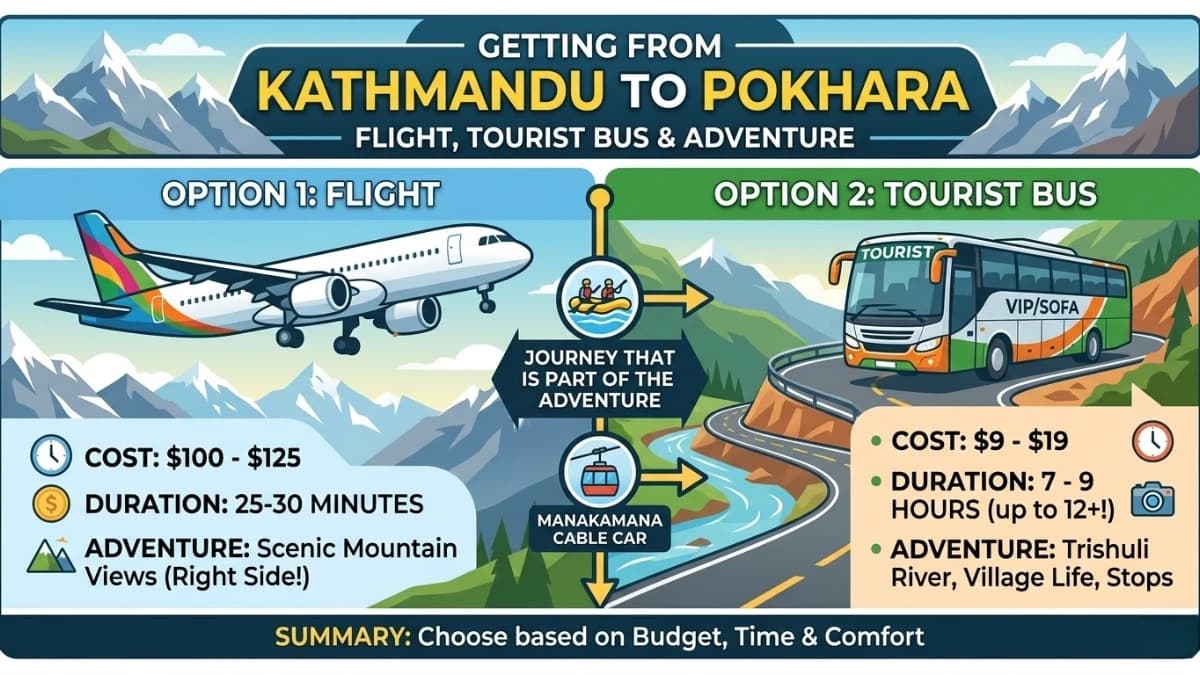
Short answer: Kathmandu to Pokhara is about 200 km. You can fly in about 25 minutes, for roughly USD 70 to 130 one way depending on the airline and season. Or you can take a tourist bus or private car, which takes about 6 to 7 hours, sometimes more. The flight saves a day; the road is cheaper and shows you the hills. We check road conditions 48 hours before departure. Both are options on our Kathmandu and Pokhara tour.
Update, 7 October 2026: The late-September floods damaged roads elsewhere in Nepal, so check with us before you book. We check 48 hours before departure; if the road is not open we move your dates free.
The distance between Kathmandu and Pokhara is two hundred kilometres. In most countries, that is a two-hour drive. In Nepal, it is either a twenty-five-minute flight above the clouds or a six-to-seven-hour bus journey along a road that serves simultaneously as highway, market, school route, and obstacle course for an alarming variety of vehicles travelling in creative interpretations of lane discipline.
Both options get you there. Both have their merits. And both, in ways that only Nepal can manage, are experiences worth having.
How Long Is the Flight from Kathmandu to Pokhara?
Domestic flights between Kathmandu and Pokhara operate daily on carriers including Buddha Air, Yeti Airlines, and Shree Airlines. The flight takes twenty-five minutes, costs seventy to one hundred and thirty dollars one way depending on the carrier and season, and on a clear day provides aerial views of the Himalayan range that justify the cost even if you could teleport for free.
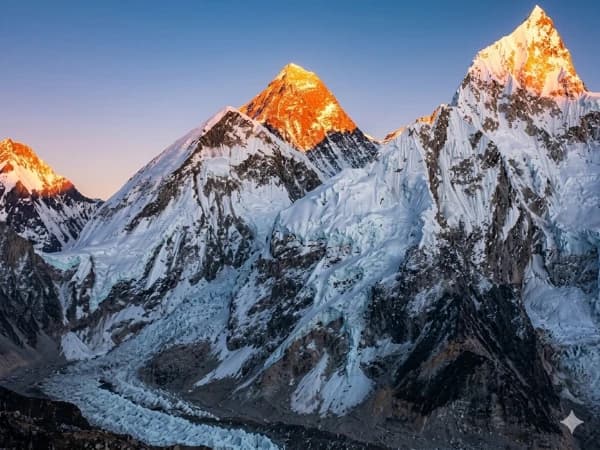
The aircraft are small: ATR-72 or similar turboprops seating fifty to seventy passengers. Sit on the right side for mountain views on the Kathmandu-to-Pokhara route. The peaks appear within minutes of takeoff: Ganesh Himal, Manaslu, the Annapurnas, Machhapuchhre, a white wall stretching across the horizon that makes the flight feel less like transport and more like a scenic tour you happen to arrive somewhere at the end of.
The downsides: flights cancel when weather deteriorates, particularly during monsoon and in winter fog. Cancellations are less frequent than Lukla flights but they happen. And the airport experience, check-in, security, boarding, adds two to three hours to the twenty-five-minute flight time, making the door-to-door journey four to five hours.
What Is the Tourist Bus from Kathmandu to Pokhara Like?
Tourist buses depart from Kathmandu's Sorakhutte bus station every morning between six thirty and seven thirty. The journey takes six to seven hours with one lunch stop in the riverside town of Kurintar or similar. The bus arrives in Pokhara's lakeside tourist area by early afternoon.
The cost: eight to fifteen dollars for a standard tourist bus. Twenty to thirty-five dollars for a "deluxe" or "micro" bus with better seats, fewer passengers, and air conditioning that may or may not function. The price difference between standard and deluxe is small enough that deluxe is almost always worth paying.
The road has improved dramatically in recent years. The Prithvi Highway, Nepal's main east-west artery, has been widened and resurfaced along most of its length. The journey that once took ten terrifying hours now takes six to seven merely adventurous ones. The scenery is genuinely beautiful, the road follows the Trisuli River through a gorge that deepens and narrows before opening into the Pokhara valley. Terraced hillsides. Suspension bridges. Small towns where the bus stops and vendors pass fruit and snacks through the windows.
The honest assessment: the bus ride is long, occasionally bumpy, and requires a tolerance for driving standards that differ from those in countries with enforceable speed limits. But it shows you Nepal in a way that a flight cannot, the farmland, the rivers, the towns, the life that exists between the two cities that most tourists see.
Should You Hire a Private Car from Kathmandu to Pokhara?
For trekkers who want the road journey without the bus experience, a private jeep or car with driver costs one hundred to one hundred and fifty dollars for the one-way trip. The vehicle leaves when you want, stops when you want, and arrives in approximately the same time as the bus, slightly faster because it does not make scheduled stops.
Most trekking companies arrange private transfers as part of their packages. If your Annapurna trek includes ground transport from Kathmandu to Pokhara, it will typically be by private vehicle rather than tourist bus.
How Much Does Each Option Cost in 2026?
| Option | Cost (USD) | Time | Best For |
|---|---|---|---|
| Domestic flight | 70–130 | 25 minutes | Short trips, nervous travellers |
| Tourist bus (standard) | 8–15 | 6–7 hours | Budget travellers, seeing the countryside |
| Tourist bus (deluxe or micro) | 20–35 | 6–7 hours | Better seats and air conditioning |
| Local bus | 5–8 | 8–9 hours | Adventurous backpackers only |
| Private car/jeep | 100–150 | 6–7 hours | Families, groups, comfort |
Prices vary by season and carrier, so treat them as a guide. Prices are per person for flights and buses. Private car price is for the vehicle, so it gets cheaper the more people share it. A group of four in a private car pays roughly the same per person as a tourist bus but arrives faster with door-to-door service.
Flight, Bus or Private Car: Which Is Best?
Fly if you are short on time, if the weather is likely to be clear, or if you want the aerial mountain views. The flight saves five to six hours of travel time and delivers a spectacle that the road cannot match.
Take the bus or private vehicle if you want to see Nepal between the cities, if you enjoy road journeys, if you are on a budget, or if you are connecting the walk with a stop along the way, the riverside resort town of Kurintar, the hilltop village of Bandipur, or the rafting put-in at Fishling where the Trisuli River offers some of the best white water in Nepal.
The first time, take the bus. See the road. Watch the country pass. Eat a samosa at a rest stop. Wave at children. Grip the armrest on the hairpin turns. Arrive in Pokhara slightly rattled and thoroughly Nepali. The second time, fly. See the mountains from above. Arrive in twenty-five minutes feeling like you cheated. Both are the right choice. Both are Nepal.
We arrange Kathmandu to Pokhara transport as part of our Kathmandu-Pokhara-Chitwan Tour and Kathmandu-Pokhara Tour.
Kathmandu to Pokhara is 200 kilometres. In most countries, that is a two-hour drive. In Nepal, it is a twenty-five-minute flight, a six-to-seven-hour tourist bus, or an eight-hour local bus. The flight is fast and the views are extraordinary. The bus is slow and the views are also extraordinary, just for longer. Pick based on your time, not your budget: the flight costs roughly USD 55 to 120 more than the bus.
We arrange Kathmandu-Pokhara transport on all our Annapurna region treks.
WhatsApp:+977 9810351300
Email:[email protected]
Written by Shreejan Simkhada, CEO of The Everest Holiday and third-generation Himalayan guide. TAAN Member #1586.
Kathmandu-Pokhara is day 1 on our tour. Our Kathmandu & Pokhara Tour (7 Days) is private (your group only, no strangers), 2027 dates open, From USD $749. WhatsApp us for tailored 2027 dates and current departures.
 Chat with Shreejan