
This is the question I hear most from first-time climbers: should I do Mera Peak or Island Peak? Both are in the Everest region. Both are above 6,000 metres. Both are classified as trekking peaks by the Nepal Mountaineering Association. And both are regularly sold as achievable for people with no previous climbing experience.
But they are very different climbs, and choosing the wrong one can turn what should be the best two weeks of your life into something you are not ready for. I have seen it happen. I have also seen people pick the right peak and come back completely transformed.
Here is an honest comparison from someone who books both of these climbs regularly and hears the feedback from every client who comes back down.
How Do Mera Peak and Island Peak Compare?
| Mera Peak | Island Peak | |
|---|---|---|
| Altitude | 6,476m (21,247 ft) | 6,189m (20,305 ft) |
| Duration | 14 days | 14 days |
| Difficulty | 5/5 (very challenging) | 5/5 (very challenging) |
| Technical skill needed | Low to moderate | Moderate to high |
| Route | Remote Hinku Valley | Classic Everest trail via Namche |
| Crowds | Very few people | Busy (most-climbed 6,000m peak in Nepal) |
| Views from summit | Five 8,000m peaks visible | Close-up Lhotse south face |
| Standard price | 4,999 USD | 4,999 USD |
| Budget price | 3,499 USD | 3,499 USD |
Altitude: Mera Is Higher, But That Is Not the Whole Story
Mera Peak stands at 6,476 metres. Island Peak is 6,189 metres. That 287-metre difference matters less than you might think. Both peaks take you well above the altitude where your body starts struggling, and the real challenge on both is the summit day push from high camp.
What matters more is how you gain altitude. Mera Peak's approach through the Hinku Valley gives you gradual altitude gain over several days. You sleep at progressively higher camps and have a full acclimatisation day at Khare (5,045m) before attempting the summit. The altitude builds slowly.
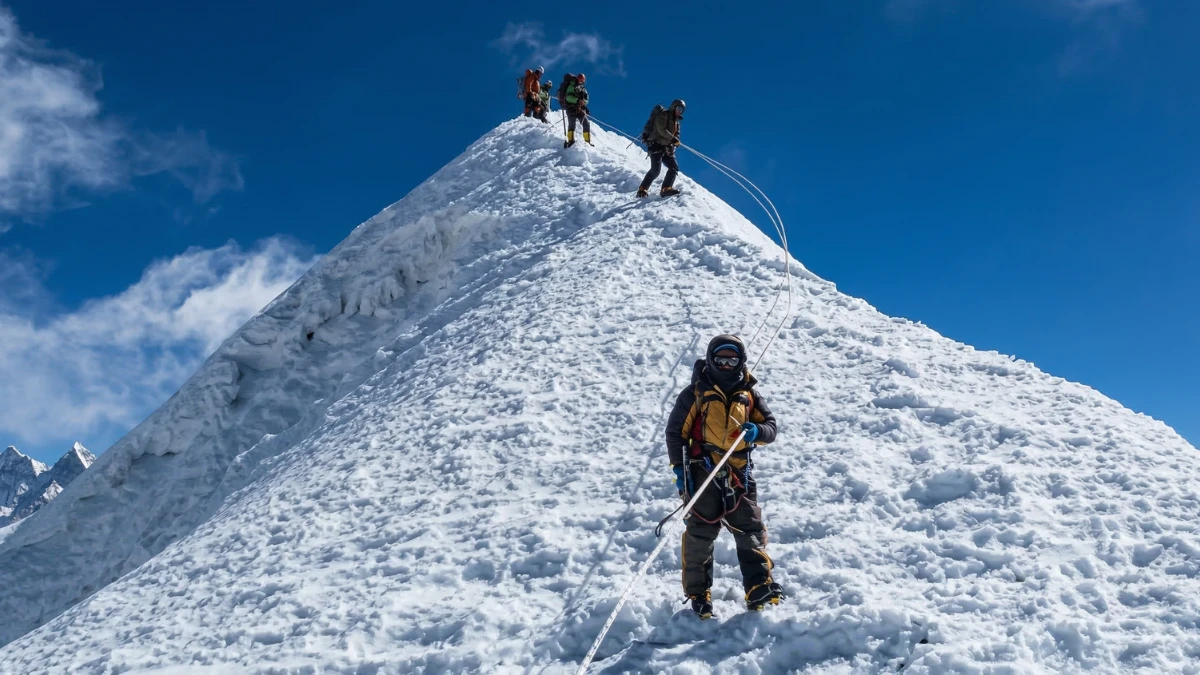
Island Peak's approach follows the classic EBC trail through Namche Bazaar and Dingboche, with two built-in acclimatisation days. You are well acclimatised by the time you reach base camp at 5,087 metres. But the summit push involves a steep, exposed headwall that adds technical difficulty on top of the altitude.
If altitude alone worries you, both peaks have good acclimatisation profiles. The difference is what happens on summit day.
Technical Difficulty: This Is Where They Really Differ
This is the most important difference between the two peaks and the one most people underestimate.
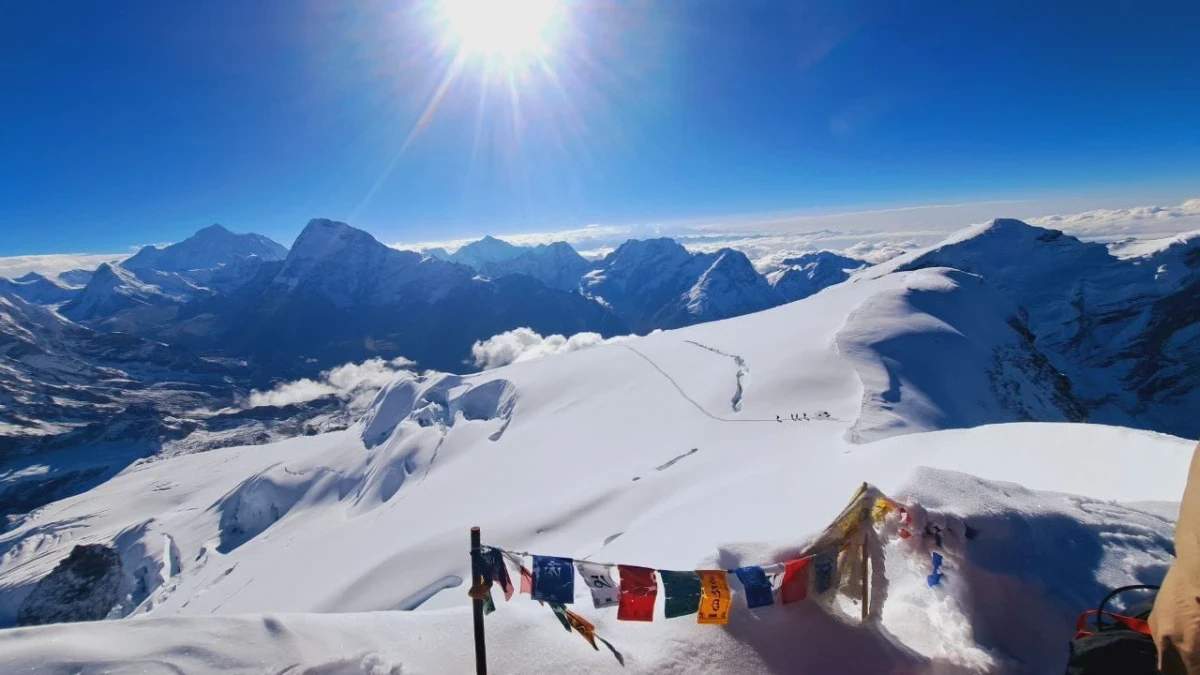
Mera Peak is primarily a high-altitude trek with a long summit day. The route follows glaciated terrain that requires crampons and basic rope work, but there are no steep ice walls, no exposed ridges requiring technical climbing, and no sections where a fall would be catastrophic. If you can walk in crampons on moderate slopes and follow a fixed rope, you can climb Mera Peak. Your climbing Sherpa provides training at Khare before the summit attempt.
Island Peak has a genuinely technical section. The summit push involves crossing a glacier, ascending a steep ice headwall on fixed ropes (roughly 45 to 60 degrees), and traversing a narrow, exposed summit ridge with significant drops on both sides. You need to be comfortable with crampons on steep ice, ascending fixed ropes with a jumar, and moving across exposed terrain where concentration matters. Your Sherpa trains you beforehand and is roped to you throughout, but the physical and mental demands are real.
If you have never done any mountaineering, Mera Peak is the safer first choice. If you have trekked at altitude before and want a taste of genuine technical climbing, Island Peak will challenge you more. For a broader look at Nepal's beginner peaks, read our trekking peaks guide. Related: Peak Climbing for Beginners in Nepal: Your First Mountain Above Six Thousand Metres.
Which Has the Better Approach Trek?
Mera Peak's approach goes through the Hinku Valley, a remote and rarely visited valley east of the main Everest trail. You fly to Lukla like everyone else, but then you head south and east instead of north towards Namche. Within a day you leave the crowds behind entirely. The Hinku Valley feels genuinely wild: dense rhododendron forest gives way to alpine meadows, yak pastures, and glacial moraines. You might see ten other trekkers in the entire valley during peak season.
Island Peak's approach follows the classic Everest Base Camp trail through Namche Bazaar, Tengboche, and Dingboche. This is the busiest trekking corridor in Nepal. You pass through Namche Bazaar, visit Tengboche Monastery, and walk alongside dozens of other trekkers heading for EBC. From Dingboche, you branch off east to Chhukung and then to Island Peak base camp, where the crowds thin out.
If you want solitude and wilderness, choose Mera. If you want the iconic Everest trail experience combined with a summit, choose Island. Related: Thaknak: The Hinku Valley Night Below Khare on the Mera Peak Route.
Which Summit Has Better Views?
Mera Peak's summit is famous for its panorama. On a clear day, you can see five of the world's fourteen 8,000-metre peaks: Everest, Lhotse, Makalu, Cho Oyu, and Kangchenjunga. The view stretches from eastern Nepal to the Tibetan Plateau. Many climbers say Mera's summit view is the best they have ever seen.
Island Peak's summit gives you a close-up, intimate view rather than a wide panorama. The south face of Lhotse towers directly above you, Ama Dablam dominates the western horizon, and the Imja glacier spreads out below. It is dramatic and immediate rather than sweeping.
Both views are extraordinary. Mera wins on breadth, Island wins on proximity to the big peaks.
How Do the Costs Compare?
The pricing is closer than most people expect:
| Tier | Mera Peak (14 days) | Island Peak (14 days) |
|---|---|---|
| Budget | 3,499 USD | 3,499 USD |
| Standard | 4,999 USD | 4,999 USD |
| Luxury | 9,999 USD | 9,999 USD |
The two peaks are priced identically at every tier, so cost is not the thing that should decide between them. Pick on the route and the technical difficulty instead. Both prices fall with group size: 3,299 USD per person at five to eight climbers on the Budget tier, 3,199 at nine to twelve, and 2,999 at thirteen or more, with the same steps on Standard and Luxury. Both trips require Lukla flights, which are about 254 USD each way, or about 508 USD return, on the fare list our ticketing agent works from, effective 3 August 2026.
Both packages include all climbing gear, permits, an expedition-qualified climbing Sherpa, and guide services. Neither includes international flights, Nepal visa, Kathmandu accommodation, travel insurance, or tips.
The total trip cost from the UK, including flights, visa, insurance, and tips, runs roughly 3,200 to 4,500 USD for Standard tier on either peak. For detailed cost breakdowns of each peak individually, we will be publishing separate cost guides soon.
Fitness and Training
Both peaks require excellent cardiovascular fitness. You need to be comfortable walking five to eight hours per day over steep, uneven terrain at altitude. Three months of targeted preparation is the minimum.
For Mera Peak, focus your training on endurance: long hill walks with a loaded pack, stair climbing, and cardiovascular conditioning. The summit day is a long grind (ten to twelve hours round trip from high camp) on moderate terrain. Stamina matters more than technical skill.
For Island Peak, add upper body strength to your endurance training. The fixed rope section on the headwall requires pulling yourself up steep ice using a jumar and ice axe. Your arms, shoulders, and core need to be strong enough for sustained effort at altitude where your body is already working hard just to breathe.
Previous trekking experience is strongly recommended for both peaks. If you have never trekked above 4,000 metres, consider doing a trek like Annapurna Base Camp or Everest Base Camp first, then come back for a peak the following season.
For training advice specific to altitude, read our altitude sickness prevention guide.
Success Rate
Mera Peak is generally more forgiving than Island Peak. Summit success varies by season, operator and how well each climber is acclimatised and prepared. We do not quote a percentage because there is no official figure.
- Mera Peak: most well-acclimatised, well-prepared climbers reach the summit in settled weather. Bad weather or poor preparation can end an attempt early.
- Island Peak: well-prepared climbers with experienced operators do well, but the technical headwall turns back some who are poorly acclimatised or not comfortable on steep ice.
The gap comes down to two things: the technical section on Island Peak, and preparation. Weather, altitude sickness, and fatigue affect both equally, but the steep ice headwall on Island Peak turns back climbers who are physically capable but not comfortable on exposed terrain. On Mera, the route is more forgiving. If your fitness and acclimatisation are adequate, the mountain is less likely to stop you.
Best Season
Both peaks share the same climbing seasons:
- Autumn (September to November): Clearest skies, most stable weather, busiest season. October and November are ideal.
- Spring (March to May): Warmer temperatures, rhododendron blooms on the approach, slightly more precipitation. April and May are best.
Avoid monsoon (June to August) and deep winter (December to February) for either peak. The best time to trek in Nepal guide covers seasonal details.
Can You Combine Both?
Yes. We offer a combined Mera Peak and Island Peak expedition for climbers who want both summits in a single trip. The combined trip takes twenty-one to twenty-five days and costs more than either individual peak, but less than doing them separately because you share the approach logistics.
Most people who do the combined trip climb Mera first (to build confidence and acclimatise) then cross into the Khumbu for Island Peak. This is the sequence I recommend for first-time climbers.
Do You Need Insurance for This Trek?
Both peaks require travel insurance that covers helicopter evacuation up to the summit altitude of the peak (6,476 metres for Mera Peak, 6,189 metres for Island Peak), with mountaineering and climbing included. This is not optional. A standard travel policy will not cover you at these altitudes, and a helicopter rescue from high camp can cost 6,500 to 10,000 USD without insurance.
Budget 150 to 300 USD for a policy with adequate altitude cover. Providers like World Nomads, Global Rescue, and IMG offer plans specifically designed for peak climbing in Nepal. Your policy must explicitly state coverage to the summit altitude of the peak, with mountaineering and climbing included. Read our insurance guide for recommended providers and what to look for in the fine print.
On the mountain itself, both expeditions carry first aid kits, pulse oximeters, Diamox altitude medication, and emergency oxygen. Your climbing Sherpa monitors your condition throughout. If you show signs of serious altitude sickness, you descend immediately. There is no negotiation on this.
Combine with Everest Base Camp
Island Peak has a natural advantage here. Because the approach follows the EBC trail, many climbers add Everest Base Camp to their Island Peak itinerary. You trek to EBC first, visit Kala Patthar for sunrise over Everest, then descend to Dingboche and head east to Chhukung for the Island Peak climb. We offer a combined Island Peak plus EBC package that covers both in a single trip of eighteen to twenty days.
Mera Peak is harder to combine with EBC because the approach goes through a different valley. You would need to trek back to Lukla after the Mera summit, then start the EBC trail from scratch. It is possible but adds significant time and cost. Most Mera climbers treat it as a standalone expedition.
My Recommendation
Choose Mera Peak if:
- This is your first climb above 6,000 metres
- You want the highest trekking peak in Nepal
- You prefer solitude over the busy Everest trail
- You want the best panoramic summit view in the Himalayas
- You are fit but have no technical climbing experience
Choose Island Peak if:
- You want to combine a peak with the classic Everest trail
- You want a taste of technical ice climbing
- You have some previous climbing or mountaineering experience
- You want to stand directly beneath the Lhotse south face
- You plan to climb bigger peaks in the future and want a stepping stone
If you genuinely cannot decide, start with Mera. Build your confidence. See the five 8,000-metre peaks from the summit. Then come back for Island Peak the following season, knowing exactly what you are getting into.
View Mera Peak expedition details | View Island Peak expedition details
Mera if you want altitude and solitude. Island Peak if you want technical experience and the Khumbu atmosphere. Both are achievable for fit first-time climbers. The honest answer is that neither is wrong, and if you have time, doing both in one expedition is the dream combination.
We run both peaks. Tell us your fitness level, dates, and budget and we will recommend the right one.
WhatsApp:+977 9810351300
Email:[email protected]
Written by Shreejan Simkhada, CEO of The Everest Holiday and third-generation Himalayan guide. TAAN Member #1586.
Mera or Island? Mera is the right first peak. Our Mera Peak Climbing (14 Days) is private (your group only, no strangers), 2026 dates open, From USD $3499. WhatsApp us for tailored 2026 dates and current departures.
 Chat with Shreejan