

There is a moment on every trek, usually somewhere above four thousand metres, when the trail flattens and the peaks rise around you like the walls of a cathedral, when the thought arrives: what would it be like to stand on top of one of those? Not Everest. Not one of the eight-thousanders that require months of preparation and the GDP of a small country. But one of the smaller peaks. The ones that look climbable. The ones where the summit ridge is visible from the trail and the snow on the approach does not look vertical. The ones that whisper: you could do this.
Nepal's trekking peaks exist for that whisper. Classified by the Nepal Mountaineering Association as peaks that can be climbed by experienced trekkers with basic mountaineering training, they range from 5,587 to 6,476 metres and offer genuine summit pushes (crampons, ice axes, fixed ropes, and the view from above) to people whose climbing résumé begins and ends with steep hiking. They are not easy in any absolute sense. They are easy relative to the technical mountains that surround them, which is a different thing entirely.
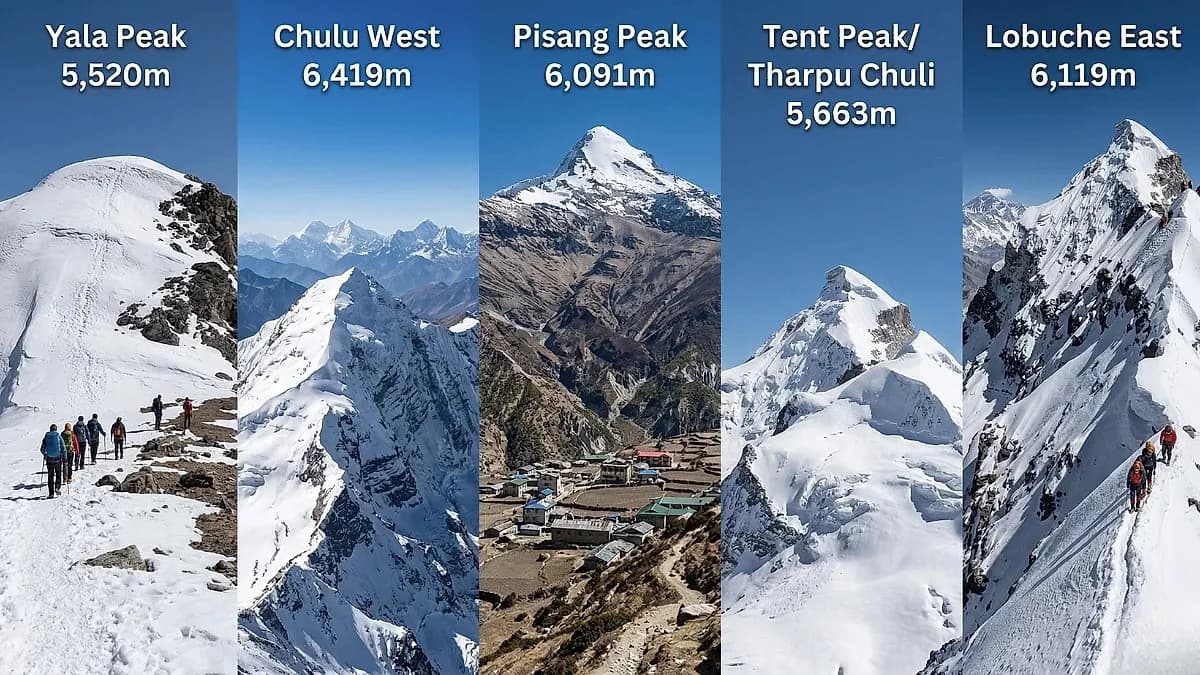
These five peaks represent the most accessible summit pushes in Nepal: the ones with the highest success rates, the most forgiving terrain, and the best reward-to-risk ratios for trekkers stepping into mountaineering for the first time.
Is Yala Peak the easiest trekking peak for beginners in Nepal?
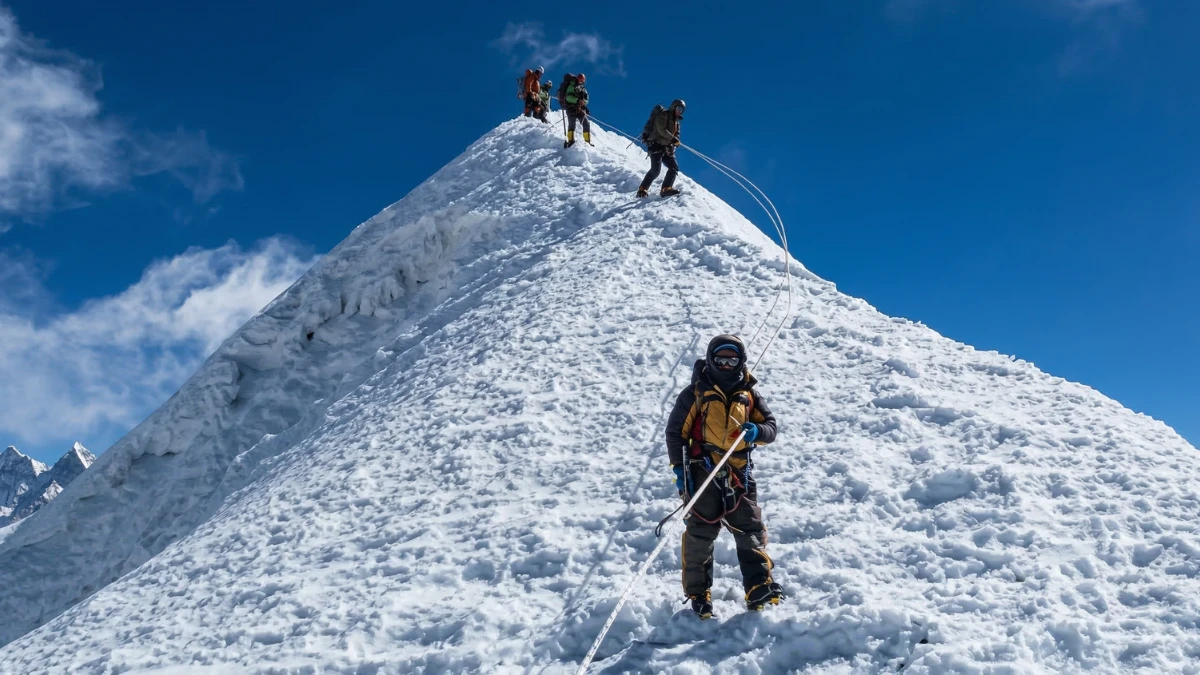
If Nepal's trekking peaks were a staircase, Yala Peak would be the first step. Sitting above the Langtang Valley, a short distance from the cheese factory at Kyanjin Gompa, Yala Peak is the lowest and technically simplest of the commonly climbed trekking peaks. The summit can be reached without fixed ropes on good conditions days. The route involves glacier walking and a scramble over rocky terrain, but no sustained steep ice or technical climbing.
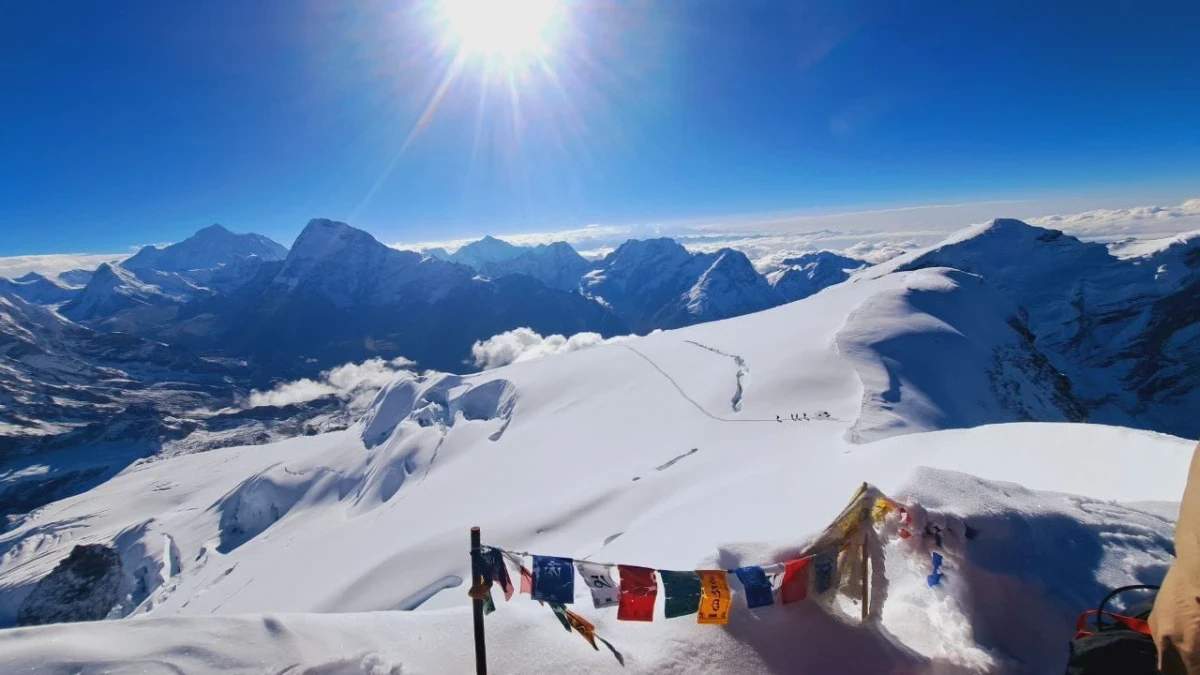
The approach is the Langtang Valley trek itself, seven to eight days from Kathmandu to Kyanjin Gompa, through beautiful forest and along the Langtang River. From Kyanjin Gompa, the summit attempt is a single long day, starting before dawn, crossing the glacier, ascending the rocky shoulder, and reaching a summit that offers views of Langtang Lirung (7,227 metres), Shishapangma (8,027 metres, in Tibet), and the entire Langtang range.
The altitude, 5,520 metres, is demanding but lower than Island Peak or Mera Peak, making altitude sickness less of a concern for properly acclimatised trekkers. The Langtang Valley's acclimatisation profile (gradual gain over seven days) is excellent preparation for the summit day.
Duration: 10-12 days total (Kathmandu to Kathmandu). Technical difficulty: Low, scrambling and glacier walking. Fitness required: High, the summit day is 8-10 hours. Best season: October-November, March-May. Cost: the NMA permit is USD 350 per climber in spring and autumn for a group of one to four, falling to USD 200 in winter and monsoon, plus the trek package.
Who it suits: Trekkers who want their first summit push with the least technical barrier. The Langtang Valley trek is excellent in its own right, and Yala Peak adds a summit without adding significant complexity or duration.
How technical is Chulu West for Annapurna Circuit trekkers?
Rising above the Annapurna Circuit trail near Manang, Chulu West offers the rare opportunity to combine one of Nepal's great treks with a trekking peak summit. The peak sits on the northern rim of the Annapurna range, and its summit provides a perspective on the Circuit that the trail cannot, looking down on the Manang Valley from above, with Annapurna II and III dominating the southern horizon.
The climb is more serious than Yala Peak. The route involves glacier travel, a high camp at approximately 5,700 metres, and a summit push that includes steep snow slopes (up to forty-five degrees in sections) requiring fixed ropes and jumar technique. The altitude, 6,419 metres, puts Chulu West in the same zone as Island Peak and demands thorough acclimatisation.
The advantage of Chulu West is its integration with the Annapurna Circuit. Trekkers walk the Circuit's eastern approach to Manang, acclimatise over several days (the same acclimatisation that the Circuit requires for Thorong La), then divert to Chulu West base camp for the climbing portion before returning to the Circuit and crossing Thorong La. The result is a three-week trip that combines Nepal's most varied trek with a six-thousand-metre summit.
Duration: 20-24 days including the full Annapurna Circuit. Technical difficulty: Moderate, steep snow, fixed ropes, jumar use. Fitness required: Very high, the combination of Circuit and peak climbing is demanding. Best season: October-November. Cost: Chulu West sits in the NMA’s higher fee band, so the permit is USD 500 per climber in spring and autumn for a group of one to four, and USD 350 in winter and monsoon, plus the trek and climb package.
Who it suits: Experienced trekkers who want to combine the Annapurna Circuit with a significant climbing achievement. Requires more mountaineering comfort than Yala Peak but less technical skill than Island Peak's headwall.
3. Pisang Peak (6,091m), The Panoramic Summit
Another Annapurna Circuit peak, Pisang Peak rises above the village of Upper Pisang on the Circuit's eastern approach. The peak is less popular than Chulu West but offers a summit that is technically accessible and scenically spectacular, the view from the top encompasses the entire Annapurna range, the Manang Valley, and the peaks of the Chulu group.
The route from Upper Pisang to base camp (approximately 4,380 metres) takes one day. High camp is established at approximately 5,500 metres. The summit push involves glacier travel and a steep snow ridge that requires fixed ropes. The final ridge is exposed, narrow with drops on both sides, but not technically difficult for a climber comfortable with crampons and an ice axe.
Pisang Peak's appeal is its combination of accessibility (it sits directly on the Annapurna Circuit route) and genuine mountaineering challenge. The peak is less crowded than Island Peak and offers a quieter, more personal summit push.
Duration: 18-22 days including the Annapurna Circuit. Technical difficulty: Moderate, glacier, steep snow, exposed ridge. Fitness required: Very high. Best season: October-November, April-May. Cost: NMA permit approximately $350 plus package.
Who it suits: Circuit trekkers who want a summit challenge without the additional cost and logistics of Chulu West. The exposed summit ridge provides a genuine mountaineering thrill.
Can you climb Tent Peak as an extension of the Annapurna Base Camp trek?
For trekkers on the Annapurna Base Camp route, Tent Peak offers a summit push within the Annapurna Sanctuary itself. The peak sits on the rim of the sanctuary amphitheatre, and its summit provides views directly into the heart of the Annapurna range, Annapurna I, Annapurna South, Machhapuchhre, and Hiunchuli surrounding you at close range.
The climb from ABC (4,130 metres) to the summit involves crossing a glacier, ascending steep snow slopes, and navigating a final rocky section to the summit. Fixed ropes are typically placed on the steeper sections. The altitude is moderate by trekking peak standards, 5,663 metres, making it accessible to well-acclimatised ABC trekkers.
Tent Peak's setting is its greatest asset. Standing on the summit, inside the Annapurna Sanctuary, surrounded by mountains above seven and eight thousand metres, you are in one of the most dramatic mountain amphitheatres on earth, and you are above it, looking down on the base camp and up at the peaks, in a position that the trail cannot reach.
Duration: 14-18 days including the ABC trek. Technical difficulty: Moderate, steep snow, glacier, some rock. Fitness required: High. Best season: October-November, April-May. Cost: Tent Peak is in the NMA’s higher fee band, so the permit is USD 500 per climber in spring and autumn for a group of one to four, and USD 350 in winter and monsoon, plus the package.
Who it suits: ABC trekkers who want to extend their trip with a summit attempt in one of the most spectacular settings in the Himalaya.
Is Lobuche East a better alternative to Island Peak on the EBC route?
Lobuche East sits directly on the EBC trail, rising above the village of Lobuche at 4,940 metres. For EBC trekkers who want a summit push without diverting to Island Peak (which requires a two-day detour from the EBC route to Chukhung), Lobuche East offers a six-thousand-metre peak that can be climbed as a side trip from the main EBC itinerary.
The climb is technically moderate. The route from Lobuche village ascends to a high camp at approximately 5,400 metres, then follows a glacier and steep snow slopes to the summit ridge. Fixed ropes are placed on the steeper sections. The summit ridge is broad and less exposed than Island Peak's knife-edge ridge, making the final approach less technically intimidating.
The views from Lobuche East are exceptional, Everest, Nuptse, Lhotse, Makalu, and Cho Oyu are all visible, and the Khumbu Glacier spreads below you like a frozen river of rubble and ice. The summit is high enough (6,119 metres) to provide a genuine sense of altitude achievement, and the integration with the EBC trek makes it logistically efficient.
Duration: 16-20 days including EBC trek. Technical difficulty: Moderate, glacier, steep snow, fixed ropes. Fitness required: Very high, the combination of EBC trek and peak climbing is demanding. Best season: October-November, April-May. Cost: NMA permit approximately $350 plus package.
Who it suits: EBC trekkers who want a summit without the detour to Island Peak. The broader summit ridge suits trekkers who are nervous about exposure.
What fitness and skills do you need for a trekking peak in Nepal?
All trekking peaks, regardless of difficulty classification, are real mountains. They involve real altitude, real cold, real physical demand, and real risk. The word "easy" is relative, relative to the eight-thousanders, relative to the technical peaks, relative to the mountains that require ropes and anchors and years of experience. None of these peaks is easy in the way that a beach holiday is easy.
Every trekking peak requires: physical fitness significantly above average, proper acclimatisation (the trek approach is designed to provide this), basic mountaineering skills (taught by your guide at base camp), appropriate gear (crampons, ice axe, harness, usually provided by your company), and the mental willingness to push through discomfort at altitude.
Every trekking peak also requires a licensed guide from a registered company. This is not optional and not a suggestion. The NMA climbing permit is issued to the company, not to the individual, and the company provides the guide, the climbing Sherpa, the fixed ropes, and the safety equipment that make the summit attempt possible.
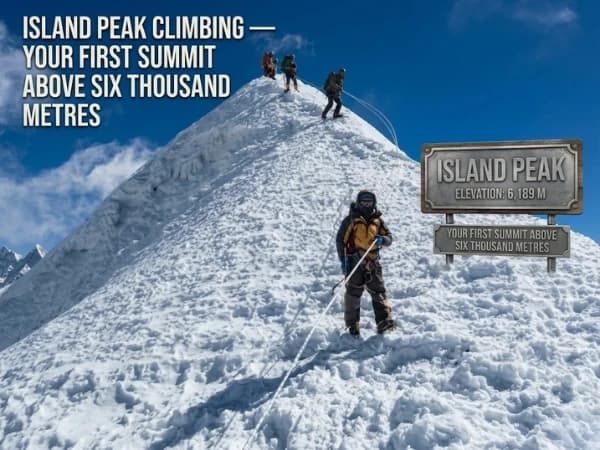
Choose your peak based on which trek you want to do (Langtang, Annapurna, EBC), how much time you have, and how much technical challenge you want. Yala Peak for the gentlest introduction. Tent Peak for the most dramatic setting. Island Peak for the most technical challenge. Mera Peak for the highest altitude. And any of them for the feel of standing on a Himalayan summit, looking at mountains that most people only see from below, and knowing that you walked, and climbed, to where you are standing.
The whisper on the trail was right. You can do this. The mountain is waiting.
See our peak climbing packages: Mera Peak (14 days) and Island Peak (14 days).
Trekking peaks in Nepal are called "easy" by mountaineering standards, which means they are still harder than anything most people have ever done. But that is the point. Standing on a 6,000-metre summit that you climbed yourself, looking at Everest or Annapurna from eye level, is a feeling that no teahouse viewpoint can replicate.
We run peak climbing expeditions for beginners. No prior trips needed, just fitness and determination.
WhatsApp:+977 9810351300
Email:[email protected]
Written by Shreejan Simkhada, CEO of The Everest Holiday and third-generation Himalayan guide. TAAN Member #1586.
Easy trekking peaks: Mera is the right intro. Our Mera Peak Climbing (14 Days) is private (your group only, no strangers), 2027 dates open, From USD $3499. WhatsApp us for tailored 2027 dates and current departures.
 Chat with Shreejan