

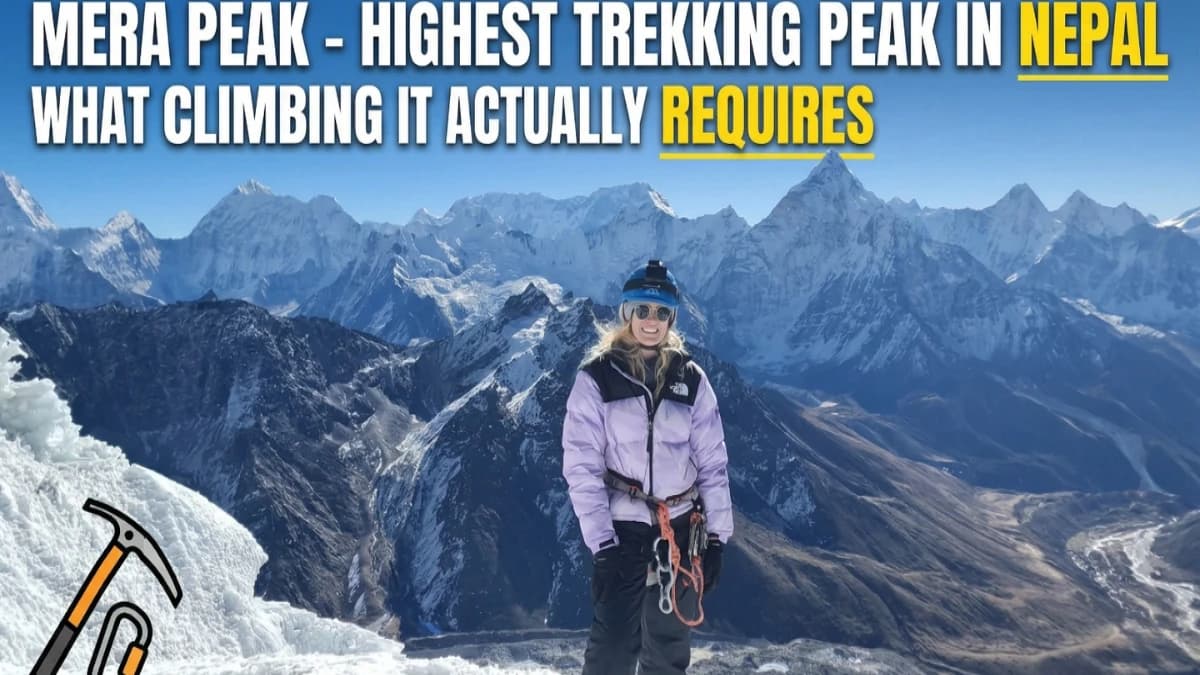
At 6,476 metres, Mera Peak is the highest of Nepal's trekking peaks, the category of mountains that the Nepal Mountaineering Association designates as climbable by experienced trekkers with basic mountaineering training rather than by dedicated technical climbers. The distinction matters. A "trekking peak" is not a "trekking hill." Mera Peak rises above six thousand metres into the zone where supplemental oxygen becomes relevant, where weather kills in hours rather than days, and where the margin between summit and retreat is measured in judgment calls that your guide makes with your life in the calculation.
And yet. Mera Peak has one of the highest success rates of any six-thousand-metre peak in the Himalaya. Its standard route, the north face, involves sustained glacier travel, a high camp at approximately 5,800 metres, and a summit push that is long and exhausting but technically straightforward. No vertical ice climbing. No overhanging rock. No technical skill beyond the ability to walk in crampons, use an ice axe for self-arrest, and clip a jumar onto a fixed rope. The mountain's gift is that it offers a genuine high-altitude summit (higher than Kilimanjaro, higher than any peak in Europe or North America) to people whose climbing experience begins and ends with steep hiking.
The mountain's demands are that those people be fit, acclimatised, mentally prepared for five days above five thousand metres, and willing to accept that "trekking peak" does not mean "easy peak." "Mera is serious." The altitude is serious. The cold is serious. The weather windows are real. And the summit day, twelve to sixteen hours from high camp and back, is the most physically and mentally demanding single day that most climbers will ever experience.
How Do You Get to Mera Peak Base Camp?
Mera Peak sits in the Hinku Valley, south of the Everest region, in a landscape that very few trekkers visit. The standard approach begins with a flight to Lukla and then heads south and east, away from the EBC crowds, through the Inkhu Khola valley, over the Zatr La pass (4,610 metres), and into the remote Hinku Valley.
The approach trek takes five to six days from Lukla to Mera Peak base camp. The trail passes through dense rhododendron and bamboo forests at lower altitudes, crosses several high ridges, and descends into the Hinku Valley, a glacial valley flanked by dramatic peaks, including Mera itself, whose massive bulk dominates the valley head.
The approach is part of Mera's appeal. Unlike the crowded EBC trail that Island Peak shares, Mera's approach takes you through genuine wilderness. You may not see another trekking group for days. The teahouses are few and basic, some sections require camping. The forest is thick and alive with birds. The transition from subtropical forest to alpine glacier, compressed into five days, is one of the most dramatic ecological transits in Himalayan trekking.
Base camp sits at approximately 5,300 metres on the edge of the Mera Glacier. By the time you arrive, you have been walking for five days, and your body has begun the acclimatisation process, but at 5,300 metres, the process is far from complete. This location is where the climbing begins.
How hard is the Mera Peak climb and what does summit day involve?
The trek from Base Camp to High Camp ascends from 5,300m to 5,800m. The route crosses the Mera Glacier, a broad, relatively gentle glacier with crevasses that your guide navigates. You walk roped to your climbing Sherpa, wearing crampons and carrying an ice axe. The glacier is not steep, but it is long, and the altitude makes every step deliberate. High camp is established on the glacier or on a rocky outcrop at approximately 5,800 metres. The tents are pitched on snow or rock. The wind is constant. The views, Everest, Lhotse, Makalu, Kanchenjunga, and Cho Oyu visible on a clear day, are staggering. You eat a minimal dinner, try to sleep, and fail.
Summit Day. The alarm goes off at midnight or one in the morning. You dress in the dark, every layer, crampons, harness, ice axe, and headlamp. The temperature is minus fifteen to minus twenty-five. Hot tea. A few biscuits. Then walking.
The route from high camp to the summit follows the glacier upward in a long, grinding ascent. The terrain is snow and ice, gentle (rarely above thirty degrees) but unrelenting. You walk in the dark for four to five hours, following the headlamp of the climber ahead, placing each foot deliberately on the frozen surface. The cold is absolute. Your world shrinks to the circle of your headlamp, the rhythm of your breathing, and the crunch of crampons on hard snow.
Sunrise arrives at around five-thirty. The peaks emerge from darkness, first Makalu to the east, then Everest, then the entire Himalayan chain turning gold against the darkening western sky. The beauty is almost impossible to process at this altitude. Your brain, operating on fifty percent of its usual oxygen, registers the light and the colour but struggles to attach meaning to what it sees. You keep walking.
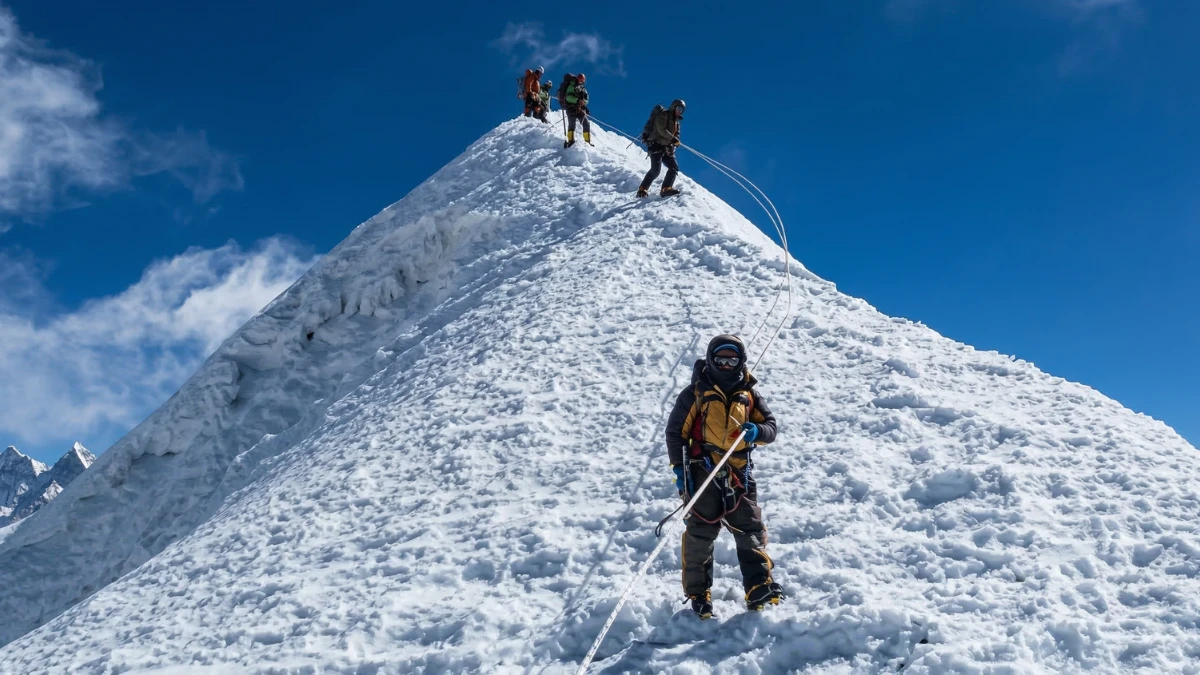
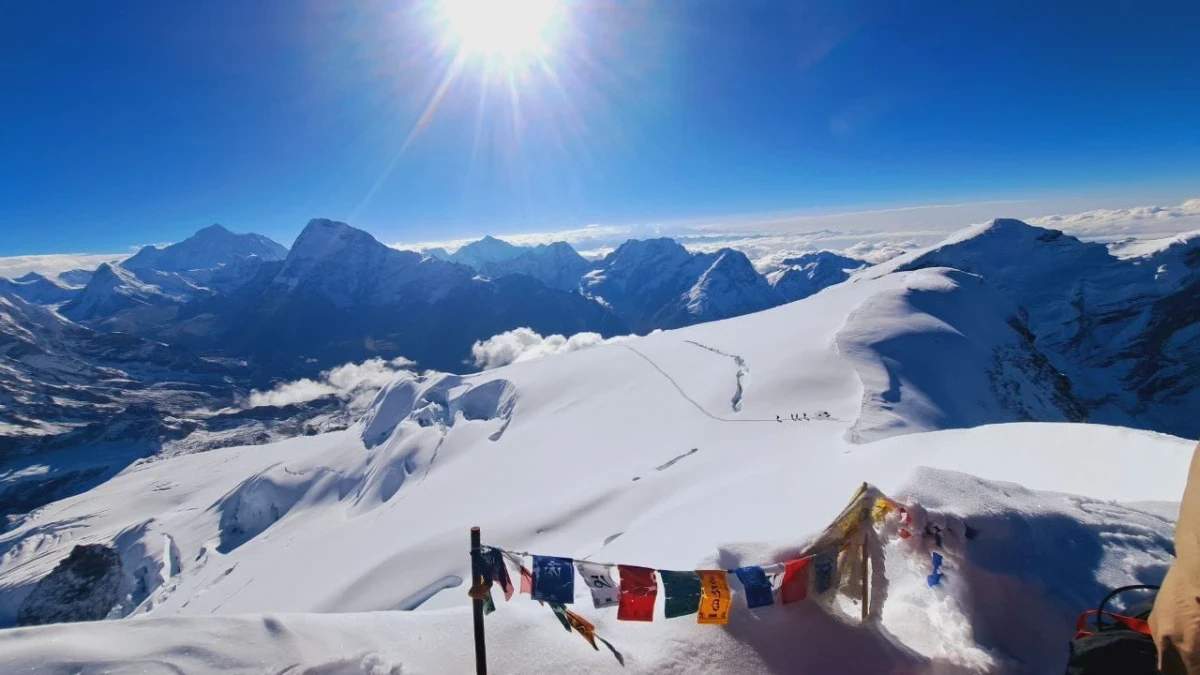
The final approach to the summit ridge involves a steeper section, perhaps forty degrees, that requires more careful crampon technique. A fixed rope may be set on this section. You clip in, plant your ice axe, and climb. The summit ridge is broad and relatively safe, wider than Island Peak's knife-edge ridge, and the highest point is marked by prayer flags and the frozen remnants of previous expeditions' offerings.
The summit of Mera Peak at 6,476 metres. Five of the world's six highest peaks are visible, Everest, Kanchenjunga, Lhotse, Makalu, and Cho Oyu. The panorama is the widest and most complete Himalayan view available from any trekking peak. You are standing higher than any mountain in the Americas, higher than any mountain in Europe, and higher than any mountain in Africa. And you got here by walking.
The descent reverses the route. Down the summit slope. Across the glacier. To high camp by mid-morning. Down to base camp in the afternoon. The descent is faster than the ascent, gravity and increasing oxygen do their work, but it is not easy. Fatigue, dehydration, and the psychological release of post-summit relaxation create a window of vulnerability that your guide manages by maintaining pace and attention until you are safely below 5,000 metres.
Mera Peak or Island Peak: which trekking peak should I climb?
Both are trekking peaks. Both are climbable by non-mountaineers. The differences matter.
Altitude: Mera (6,476m) is nearly 300 metres higher than Island Peak (6,189m). This difference is significant at extreme altitude, the additional 300 metres means noticeably less oxygen, greater cold stress, and a higher risk of altitude-related illness. The summit day on Mera is longer and more demanding.
Technical difficulty: Island Peak's headwall, a steep, 300-metre ice wall that requires fixed ropes and sustained jumar use, is more technically demanding than anything on Mera's standard route. Mera is a long glacier walk with moderate slopes. Island Peak involves genuine vertical climbing. Trekkers who are nervous about steep ice may prefer Mera. Island Peak is preferred by hikers seeking the exhilaration of technical climbing.
Duration: Mera requires eighteen to twenty-one days total (Kathmandu to Kathmandu). Island Peak requires fourteen to seventeen days and can be combined with the EBC trek. Mera demands more time but offers a more remote and real taste of the place.
Remoteness: Mera's Hinku Valley approach is genuinely remote, no other trekkers, few teahouses, camping sections. Island Peak's approach follows the busy EBC trail to Chukhung. Trekkers who value solitude choose Mera. Trekkers who want the dual achievement of EBC and a summit should choose Island Peak.
Views from the summit: Mera wins. The wider panorama, five eight-thousanders visible, and the higher vantage point make Mera's summit view arguably the best available from any trekking peak in Nepal. Related: Easy Trekking Peaks in Nepal: Five Summits for Trekkers Who Want More Than a Trail.
What fitness and experience do you need to climb Mera Peak?
Mera requires significantly more preparation than a standard trek, but it does not require mountaineering experience.
Fitness: High. You need to be comfortable walking eight to ten hours per day at altitude for multiple consecutive days. Cardiovascular fitness is critical, running, cycling, stair climbing, and hiking with a loaded pack are the best preparation. Start training three to four months before departure. The summit day alone is twelve to sixteen hours of sustained effort at extreme altitude.
Previous experience: A multi-day high-altitude trek is strongly recommended before attempting Mera. EBC, Annapurna Circuit, or any trek that takes you above 4,500 metres will teach you how your body responds to altitude and give you confidence in the teahouse/camping environment. Trekkers who attempt Mera as their first trek are taking an unnecessary risk, not because the climbing is technical, but because they have no baseline understanding of how their body handles altitude.
Technical skills: Walking in crampons, using an ice axe for balance (not technical ice climbing), clipping into fixed ropes with a jumar, and basic rope work. All of these are taught during a training session at base camp before the summit attempt. No previous training is required, but trekkers who have done a weekend mountaineering course (available worldwide) will feel significantly more comfortable.
Mental preparation: The summit day is mentally as well as physically demanding. The cold, the dark, the altitude, the fatigue, and the knowledge that you are above six thousand metres create a psychological pressure that tests resolve. The trekkers who summit are not always the fittest. They are the ones who can maintain motivation through discomfort, who can break the effort into small manageable pieces (one step, one breath, one step), and who trust their guide's judgment about when to push and when to turn back. Related: Island Peak Training Plan: How to Prepare for Your First Himalayan Summit.
How much does Mera Peak cost and what permits are required?
Duration: eighteen to twenty-one days, from Kathmandu to Kathmandu. The typical itinerary includes two to three days in Kathmandu (arrival, preparation, briefing), five to six days trekking to base camp, two to three days at base camp and high camp (including a rest/acclimatisation day), one summit day, three to four days trekking out, and one to two buffer days for weather.
Permits: NMA climbing permit (approximately three hundred and fifty dollars in peak season), Sagarmatha or Makalu-Barun National Park entry (depending on approach route), and TIMS card. Your trekking company handles all permit applications.
Season: October-November (best, stable weather, cold but manageable) and March-May (good, warmer but more afternoon cloud). December-February is possible, but extremely cold. June-September is not recommended due to monsoon precipitation on the glacier.
Gear: standard trekking gear plus climbing-specific items, crampons, ice axe, harness, helmet, and a sleeping bag rated to minus twenty or below. Most companies provide climbing gear (crampons, harness, ice axe) as part of the package or for rental. The sleeping bag should be your own or a high-quality rental, a cheap bag at 5,800 metres is a serious problem.
Cost: typically two thousand five hundred to four thousand US dollars, depending on service level, group size, and inclusions. Budget packages exist at lower prices but may cut corners on guide ratios, equipment quality, and high camp provisions, these are not areas where savings are wise.
What Mera Teaches
Every trekking peak teaches something. Island Peak teaches that you can climb a wall you thought was impossible. Mera teaches something different: that you can endure.
The summit is not technically difficult. There is no single crux moment where you either succeed or fail. Instead, there are twelve hours of continuous effort, step after step after step, where the cumulative weight of altitude, cold, fatigue, and darkness presses against your will. The mountain does not throw a wall at you. It throws time at you. And the question it asks is not "can you climb?" but "can you keep going?"
Mera teaches its lesson at two in the morning, on a glacier at 6,200 metres, when the summit remains invisible in the dark above and your body demands that you stop. Not the view (though the view is staggering). It is not the altitude record, although standing above 6,400 metres is extraordinary. But the knowledge, earned through hours of sustained effort in conditions that your everyday life never demands, is that endurance is not a fixed quality. It is a choice. Made over and over. Step by step. Breath by breath. Until dawn, when you see the summit and realise that your choice to keep going has become a kind of strength.
That strength goes home with you. It goes back to the office, the kitchen, the gym, and the places where endurance is needed, but the stakes are lower, and the views are worse. And it remains, long after the altitude headache fades, long after the frostbitten fingertips heal, long after the photographs stop getting likes, as the specific, personal, unchallengeable proof that you climbed to 6,476 metres under your own power and did not stop.
See our Mera Peak Climbing (14 days) page for the full itinerary and what is included.
Mera Peak is the highest trekking peak in Nepal, and the word "trekking" is doing a lot of work in that sentence. The summit day involves crampons, a rope, and a pre-dawn start across a glacier. It is not technical climbing, but it is real mountaineering. The view from 6,476 metres (five of the world's six highest mountains visible from one spot) is worth every step.
See our Mera Peak Climbing package for the full itinerary and what is included.
WhatsApp:+977 9810351300
Email:[email protected]
Written by Shreejan Simkhada, CEO of The Everest Holiday and third-generation Himalayan guide. TAAN Member #1586.
Mera Peak: Nepal's highest trekking peak. Our Mera Peak Climbing (14 Days) is private (your group only, no strangers), 2026 dates open, From USD $3499. WhatsApp us for tailored 2026 dates and current departures.
 Chat with Shreejan