
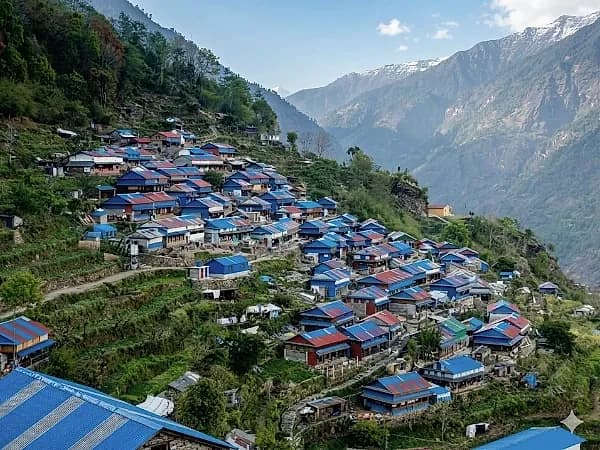
There is a moment on the walk into Dhakmar when people stop talking. You come over the rise, the valley opens, and the whole western wall of it is red. Not a rusty brown, not a streak of colour in the rock. Red, two kilometres of it, standing over a village of maybe a dozen houses and a few fields of barley.
I have brought guests to Upper Mustang who came for Lo Manthang and went home talking about this. It is the last village you sleep in before the walled city, and most itineraries treat it as a bed for the night. That is a waste of the best light in Mustang.
Dhakmar at a glance
| Also written | Dhakmar, Dhakmar Village, Drakmar |
| Altitude | 3,820 m / 12,533 ft |
| Where | Upper Mustang, north of Ghami, south of Ghar Gompa, Mustang district |
| Known for | The red cliffs, over two kilometres of them, and the wind |
| Why they are red | Iron oxides in the sedimentary rock: haematite, goethite, limonite |
| The other reason they are red | The blood of a demoness subdued by Guru Rinpoche, by local account |
| On our trek | Night of day four. Syangboche to Dhakmar, 17 km, six to seven hours |
| The day after | Dhakmar to Lo Manthang via Ghar Gompa, two passes above 4,000 m |
| Permit | Upper Mustang restricted-area permit, USD 50 per person per day, plus ACAP and TIMS |
Where is Dhakmar and how do you get there?
Dhakmar sits in a side valley in the north of Upper Mustang, between Ghami and the monastery at Ghar Gompa. On our Upper Mustang Trek you reach it on day four, walking 17 kilometres from Syangboche in six to seven hours. It is your fourth night above 2,800 metres, and at 3,820 metres it is the highest you have slept so far.
That placement is deliberate. Dhakmar is the staging post for the hardest day of the trek: the following morning you climb to the Mui La at 4,170 metres, drop to Ghar Gompa, then cross the Choku La at around 4,290 metres before Lo Manthang appears below you. Seventeen kilometres, seven to eight hours, two passes. You want to have slept well and started early, and that is what Dhakmar is for.
The road system now reaches most of Mustang, so you will see jeeps. You can be driven past the cliffs in a few minutes. I would rather you walked under them.
Why are the cliffs red?
The geological answer is iron. The sedimentary rock here is loaded with iron oxide minerals, haematite, goethite and limonite, and where the rock has been cut and weathered the iron shows. It is the same chemistry that colours the ground in parts of Utah and central Australia, and in Mustang it runs for over two kilometres in a single face.
The answer you will hear in the village is different, and every guide in Mustang tells it the same way.
The demoness, and the three places she is buried
Guru Rinpoche, Padmasambhava, is the figure who carried tantric Buddhism across the Himalaya in the eighth century. The story here is that when he set out to found the temple at Lo Gekar, a demoness obstructed the work, and he fought and subdued her. Her blood soaked the cliffs above Dhakmar, which is why they are the colour they are.
The rest of her is in the landscape too, and this is the part I like, because it ties three days of walking into one thread. Her entrails became the long prayer wall at Ghami that you pass on the way back south, said to be the longest mani wall in Nepal. Her heart lies under Ghar Gompa itself, half a day north of where you are standing.
I am not going to tell you it happened. I will tell you that when you have walked under two kilometres of red rock at first light, and stood in the courtyard at Lo Gekar a few hours later, the story explains that landscape better than the iron oxide does. It is local legend and we tell it as legend, which is a different thing from telling it as fact and a different thing again from leaving it out.
What is there to see in the village itself?
Not much, and that is the point. Dhakmar is small: a scatter of flat-roofed houses built in the traditional way, barley fields that are startlingly green against the red, stacks of firewood and dung on the roofs, and chortens at the edge of the settlement. There are a handful of simple guesthouses and no shops worth the name.
What there is instead:
- The cliffs at first and last light. The colour is strongest in the hour after sunrise and the hour before sunset. In the middle of the day it flattens out. If you are carrying a camera, this is the reason to stay the night rather than pass through at noon.
- The caves. There are man-made cave openings high in the cliff face, as there are throughout Mustang. Some are ancient burial and meditation caves. Do not try to climb to them, the rock is loose and there is no rescue within a day of here.
- The wind. It arrives most afternoons and it is genuinely strong. It shapes the whole day here and it is why we walk in the morning.
- The night sky. No electricity to speak of, no light for forty kilometres, and you are at 3,820 metres in a rain shadow. On a clear night it is the best sky on the trek.
How hard is the walk in, and how do you sleep at 3,820 metres?
The day in from Syangboche is a long one but not a technical one. Seventeen kilometres, up and down through dry gullies, with the last stretch running under the cliffs. By this point you have had three nights of gradual gain and your body has done most of the work of acclimatising.
Dhakmar is where a few people first notice the altitude, usually as a poor night's sleep or a headache in the evening. That is normal and it is not the same as altitude sickness. Drink more than you feel like, eat dinner even if you do not want it, and tell your guide rather than deciding to be brave about it. Our guides carry an oximeter and check anyone who is quiet at dinner. They do not carry bottled oxygen, and I would rather say that plainly than have you assume otherwise: the treatment for altitude sickness is to go down, and on this route going down is always possible.
Accommodation is a village guesthouse, which means a simple room, a shared bathroom and a stove in the dining room fed with dung and scrub. It is warm in the one room where everyone sits and cold everywhere else. Bring the down jacket into dinner.
Permits and rules, for 2027
Upper Mustang is a restricted area and the rules are the same in both seasons. The permit is USD 50 per person per day, with no ten-day minimum any more, so a shorter trip no longer means paying for days you do not use. On top of it you need the Annapurna Conservation Area permit and a TIMS card, and the restricted-area permit does not replace TIMS whatever you read elsewhere.
Permits are issued by the Department of Immigration through a registered agency, never directly to an individual, and a licensed guide is compulsory. Solo trekkers have been able to hold a restricted-area permit since March 2026, but the agency and the guide are still required, and no more than seven trekkers can go on one guide's permit. The full budget is in our Upper Mustang trek cost guide and the wider rules in the restricted-area permits guide.
When should you come?
Upper Mustang sits in the rain shadow of Annapurna and Dhaulagiri, which is the whole point of it. It stays walkable through the monsoon when the rest of Nepal is washed out, and the working season runs March to November in 2026 and again in 2027.
May and June are warm and busy, particularly around the Tiji festival at Lo Manthang, which falls on 1 to 3 June 2027. September and October are clear, quiet and cold at night, and the red is at its best against a hard blue sky. Winter empties these villages, because the families move down to lower ground and take the village with them.
Whatever month you choose, the wind comes up in the early afternoon. Everything here is planned around being somewhere sheltered by then.
Common questions
How high is Dhakmar?
3,820 metres, or 12,533 feet. It is the highest night of the first half of our trek and 20 metres below Lo Manthang.
Can you visit Dhakmar without the full Upper Mustang trek?
Not cheaply. The restricted-area permit applies from the moment you pass Kagbeni, so the cost is the same whether you walk or drive. If you are paying the permit, walk it.
Is there a monastery at Dhakmar?
There are chortens and a small local shrine, but the monastery everyone comes for is Ghar Gompa, half a day north, and Lo Manthang's four great gompas beyond that. Dhakmar is a farming village, not a monastic centre.
Is there phone signal or electricity?
Patchy and limited. Solar lighting in the guesthouses, some charging for a fee, and a mobile signal that comes and goes. Treat it as off the grid and tell your family so.
What is the food like?
Dal bhat, noodles, potatoes, eggs, soup. On our standard and luxury tiers all meals are included, and the potatoes in this part of Mustang are genuinely good, which is not something I say about every village.
Nearby on the same route
- Ghar Gompa, the eighth-century temple half a day north, and the reason for the legend
- Lo Manthang, the walled capital, over two passes from here
- Kagbeni, the checkpoint village where Upper Mustang begins
- Tsarang, the old royal seat on the eastern side of the loop
- The Tiji festival, 1 to 3 June 2027, which fills every bed in Lo Manthang
Most people remember Lo Manthang because it is the destination. They remember Dhakmar because of the light on the cliffs at six in the morning, and because of what the village says happened there.
WhatsApp: +977 9810351300
Email: [email protected]
Written by Shreejan Simkhada, CEO of The Everest Holiday and third-generation Himalayan guide. TAAN Member #1586.
Dhakmar is the night before the hardest and best day of our Upper Mustang trek. Our Upper Mustang Trek (10 Days) is private, your group only and never strangers, with 2027 dates open, from USD 1,290. WhatsApp us for dates and current departures.


 Chat with Shreejan