
The Upper Mustang trek costs from USD 1,290 per person on our Budget tier, USD 1,930 on Standard and USD 3,500 on Luxury, for the 10-day trip, and those prices already include your restricted-area permit, your Annapurna Conservation Area permit and your TIMS card. The permit itself is USD 50 per person per day, charged for the days you spend inside the restricted zone. A licensed guide is compulsory, and since 22 March 2026 you can book as a solo traveller. This page sets out what the number covers, what sits on top, and where the old figures you may have read elsewhere have gone wrong.
If you want a price for your own dates and group size, message us on WhatsApp and we will work it out with you.
How much does the Upper Mustang trek cost in 2027?
The headline rate is for one person. Each tier gets cheaper per person as the group grows, down to USD 1,140 on Budget, USD 1,780 on Standard and USD 3,350 on Luxury for a larger group. Our website prices hold for 2027, so the figures below are the ones to plan with for both seasons. The price is set by tier and group size only. It does not rise or fall by month.
| Tier | From (1 person) | Larger group, per person | What changes between tiers |
|---|---|---|---|
| Budget | USD 1,290 | USD 1,140 | Shared room in a teahouse. No porter. Meals on the trail are not included. |
| Standard | USD 1,930 | USD 1,780 | Private twin room, all meals with seasonal fruit once a day, one porter for every two trekkers. |
| Luxury | USD 3,500 | USD 3,350 | Private deluxe room with bathroom where available, all meals plus fruit, nuts and soft drinks, one porter per trekker, private vehicle. |
Our Upper Mustang Trek - 10 Days page has the day-by-day itinerary and the full inclusions for each tier. Every trek we run is private, so you only walk with your own group.
How much does the Upper Mustang permit cost now?
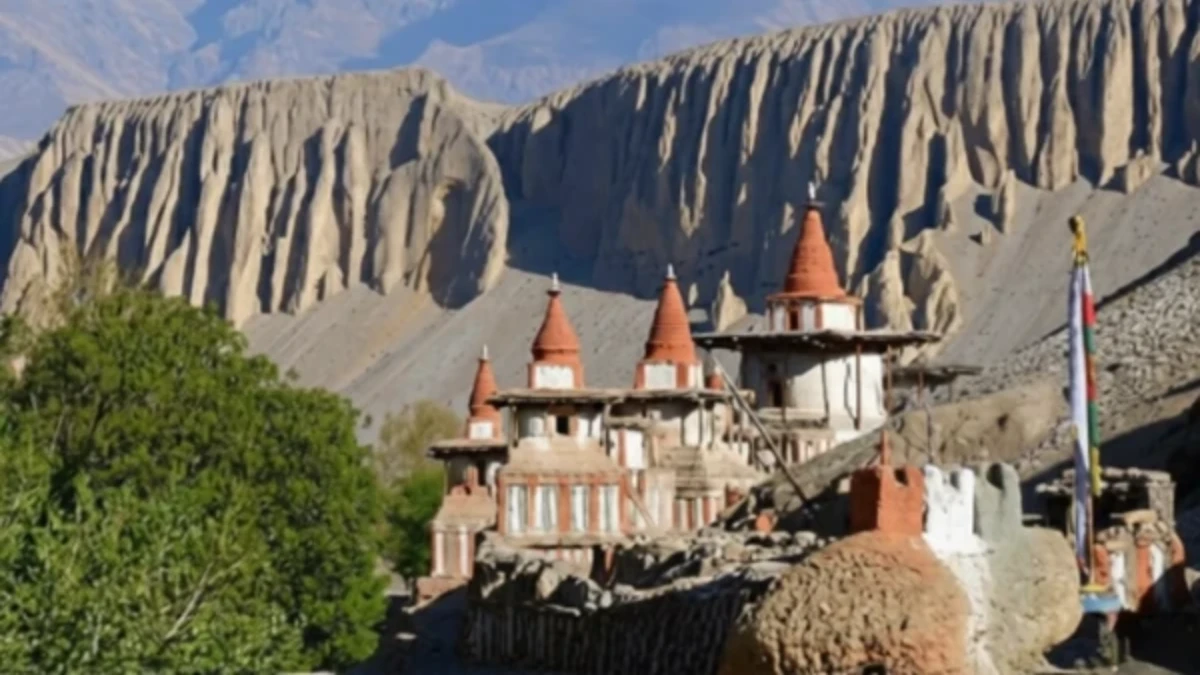
The Department of Immigration lists Upper Mustang at USD 50 per person per day. On its trekking route and permit fee page, checked on 4 October 2026, the covered area is Lo Manthang, Lo Gekar Damodarkunda and the upper wards of Baragung Muktichetra. Until December 2025 the permit was a flat USD 500 for the first 10 days. That flat fee is gone, and it is still quoted on older pages, including some encyclopaedia entries, so check the date on anything you read.
The sum is simple: USD 50 multiplied by the days you spend inside the zone. As arithmetic, not a quote, 6 days is USD 300, 8 days is USD 400 and 10 days is USD 500. The immigration portal accepts a minimum of one day. How many chargeable days your own itinerary uses depends on where the checkpoint falls on your route, and we confirm that when we file your application. On our trek the permit is already inside the price above, so you do not pay it a second time.
Two more things belong with the permit:
- TIMS is separate. A restricted-area permit does not replace it. The TIMS card is NPR 2,000 for foreign nationals. Upper Mustang is on the Nepal Tourism Board list of routes that need a licensed guide and an agency-issued card.
- ACAP is separate. The Annapurna Conservation Area permit is NPR 3,000 for foreign nationals.
All three permits are included in all three of our tiers. Allow time too: we need a minimum of 48 hours to file a restricted-area permit, counted in government working days, so Nepali weekends and public holidays do not count. For the full picture of what changed this year, read Nepal's trekking permit rules changed.
Can you trek Upper Mustang solo, and does it cost more?
Yes. Since 22 March 2026 the Department of Immigration no longer requires two trekkers for a restricted-area permit, and the application form now reads "minimum 1 trekker". The conditions are the ones that always applied. The application goes through a registered agency, a licensed guide must accompany you, and the agency carries responsibility for rescue. The same notice sets a limit of seven trekkers per licensed guide, so a group of eight or more needs a second guide named on the permit.
Solo does not mean unguided. You cannot walk apart from your guide in a restricted area, because the guide is named on the permit and the checkposts check it. For the price, the one-person rate above applies, since a guide, a vehicle and a room do not split between people. Two tier details matter for a solo trekker:
- Budget: no porter, as on every Budget booking.
- Standard: porters are shared one per two trekkers, so a solo trekker has none. Your guide carries up to 10 kg of your load, and you can add a porter of your own.
- Luxury: you keep your own dedicated porter.
If you are weighing Upper Mustang against its lower neighbour, our Upper versus Lower Mustang comparison sets out the permit and effort differences.
What does each tier include, and what does it leave out?
Every tier includes airport transfers, road transport between Kathmandu and Kagbeni where the walking starts, the three permits, a licensed English-speaking guide, a first aid kit with an oximeter, and free luggage storage in Kathmandu while you trek. A sleeping bag, down jacket and, on Standard and Luxury, a duffle bag are lent if you do not own them. The vehicle changes by tier: local bus or sharing jeep on Budget, a shared tourist vehicle on Standard, a private vehicle on Luxury.
| Item | Budget | Standard | Luxury |
|---|---|---|---|
| Restricted-area permit, ACAP, TIMS | Included | Included | Included |
| Licensed guide | Included | Included | Included |
| Porter | None | 1 per 2 trekkers | 1 per trekker |
| Meals on the trek | Not included | Breakfast, lunch, dinner, fruit daily | All meals, fruit, nuts, soft drinks |
| Rooms | Shared | Private twin | Private deluxe |
| Kathmandu hotels | Not included | Not included | Not included |
| International flights, visa, insurance | Not included | Not included | Not included |
The Kathmandu hotel is quoted separately on every tier, so tell us what standard you want and we will price it with the trek.
What do you pay on top of the package?
Plan for these, because none of them is in the package price:
- International flights. These depend on where you start from.
- Nepal visa. Paid in cash in US dollars on arrival: USD 30 for 15 days, USD 50 for 30 days, USD 125 for 90 days.
- Travel insurance. Buy it before you leave home. It must cover medical costs and emergency helicopter rescue, and we need your details within a week of booking. Our insurance guide explains what to look for.
- Trail extras. We suggest roughly USD 30 per day for snacks, hot showers, charging and similar small items. On Budget your own meals and drinks come out of that too, so allow more.
- Tips. Our tipping guide suggests USD 15 to 20 per day for a guide and USD 10 to 15 per day for a porter, shared at the end of the trek.
- An extra porter. USD 25 per day, plus 13% VAT and a 3.5% bank charge on top. It is never a net figure.
Payment is simple. A 10% deposit confirms the booking and you pay the balance in Kathmandu. Cash in US dollars carries no extra charge, and paying the balance by card adds 3.5%. We do not take Nepali rupees from foreign guests.
How do you get to Upper Mustang, and does it change the price?
Our itinerary drives you from Kathmandu to Kagbeni and back, and that is inside the price on all three tiers. It is about 350 km by road each way and takes roughly 10 to 14 hours, so day one and day ten are mostly spent in a vehicle. You can see the full day-by-day distances in our Upper Mustang distance and difficulty guide.
Some trekkers prefer to fly Pokhara to Jomsom and save a day on the road. It is worth knowing the limits before you build a plan around it. Jomsom airport runs flights between about 06:00 and 12:15 in good weather, high winds usually stop operations after midday, and visibility is too poor for visual flying about 15% of the time. That is why flights here are often delayed or cancelled. Fares change each season, so we do not print one here. Our domestic flights guide covers how the flights work. If you fly, add a spare day so a grounded flight does not eat into your plan.
When is Upper Mustang cheapest, and what about Tiji?
The package price does not change by month, so the season does not save you money on our trek. It changes what you get for it. Upper Mustang sits in the rain shadow of the Annapurna and Dhaulagiri ranges, with precipitation of roughly 250 to 400 mm a year, so it can be walked in the months when the rest of Nepal is wet. We cover the trade-offs of a summer trip in Upper Mustang in Monsoon: the drive up the valley is rougher in the wet and flights are less dependable.
The Tiji festival in Lo Manthang is the one time of year that behaves differently. Its dates follow the Tibetan lunar calendar and move every year, and rooms in Lo Manthang fill early. Read our Tiji festival guide, then ask us for the dates and a quote before you plan around it.
What should you budget for the whole trip?
Add the package to the items you pay separately. These are the pieces we can put a figure on from our own price list. Flights, insurance and your Kathmandu hotel depend on you, so ask us for those.
| Cost item | Budget | Standard | Luxury |
|---|---|---|---|
| Trek package, 10 days (one person) | USD 1,290 | USD 1,930 | USD 3,500 |
| Nepal visa, 30 days | USD 50 | USD 50 | USD 50 |
| Trail extras at about USD 30 a day, over 10 days | About USD 300 | About USD 300 | About USD 300 |
| Kathmandu hotel, flights, insurance | Quoted separately | Quoted separately | Quoted separately |
| Tips | Your choice | Your choice | Your choice |
How does Upper Mustang compare with other restricted treks?
Upper Mustang is charged per day, while most other restricted areas charge by the week. These are the figures on the Department of Immigration's fee page, checked on 4 October 2026.
| Restricted area | Permit fee, foreign nationals |
|---|---|
| Upper Mustang | USD 50 per person per day |
| Upper Dolpo | USD 500 for the first 10 days, then USD 50 per day |
| Manaslu | USD 100 a week (September to November), USD 75 a week (December to August) |
| Nar Phu (Manang) | USD 100 a week (September to November), USD 75 a week (December to August) |
| Tsum Valley | USD 40 a week (September to November), USD 30 a week (December to August) |
| Lower Dolpo | USD 20 a week, then USD 5 per day |
A permit fee alone does not tell you the cost of the trek. Upper Mustang also needs a long road transfer and, on the permit, one licensed guide for every seven trekkers. Our guide to Nepal's restricted-area permits lines the areas up side by side.
How can you lower the cost without cutting safety?
- Go in a group. The per-person price falls as the group grows, because the guide, vehicle and permits are shared.
- Choose the tier honestly. If you are happy to carry your own pack and buy your own meals, Budget saves USD 640 against Standard. Be sure you want that for 10 days at altitude.
- Book early for Tiji. Rooms in Lo Manthang fill early, so a late booking can cost you the dates you wanted.
- Do not cut the guide. It is the one thing you cannot drop. A licensed guide is compulsory on every restricted-area route, and we always trek with one.
Is Upper Mustang worth the price?
If you have done Everest Base Camp or the Annapurna Circuit and want something different, yes. The kingdom of Lo was closed to outsiders until 1992, and the walled capital of Lo Manthang, at 3,840 metres, was founded in 1380. The permit keeps visitor numbers low, which is a large part of what makes the walk special. Our village guides show what you pay for day by day, from Chele, the gateway into the walled kingdom, to Dhakmar's red cliffs and the Chungsi cave near Samar. For the full story of the region, read Inside the Last Forbidden Kingdom on Earth.
The honest trade-offs are the long drive, the wind, and the fact that you cannot wander off alone. Lodges in the smaller villages are simple, and mobile data is unreliable north of Kagbeni.
What happens if your plans change?
Plans change? You can reschedule free, with at least 7 days' notice for restricted areas, to any date within one year. If you cancel instead, the deposit and anything else you have paid are not refunded. If we cannot run the trip ourselves, we refund what you paid, less taxes, bank or card charges and any money already spent on permits or flights. Please read this before you pay the deposit, and talk to us if your dates are uncertain.
Ready to plan it?
Tell us your dates, the number of people and the tier you are leaning towards, and we will confirm the price and the permit days. See the Upper Mustang Trek - 10 Days for the full itinerary, or explore the wider Upper Mustang region.
WhatsApp: +977 9810351300
Email: [email protected]
Written by Shreejan Simkhada, CEO of The Everest Holiday, from three generations of family guides. TAAN member 1586. Permit figures re-checked against the Department of Immigration and Nepal Tourism Board pages on 4 October 2026.
Ready for the forbidden kingdom? Our Upper Mustang Trek 10 Days includes your restricted-area permit, ACAP and TIMS, a licensed guide and the walled city of Lo Manthang. From USD 1,290. WhatsApp us for departures.
 Chat with Shreejan