

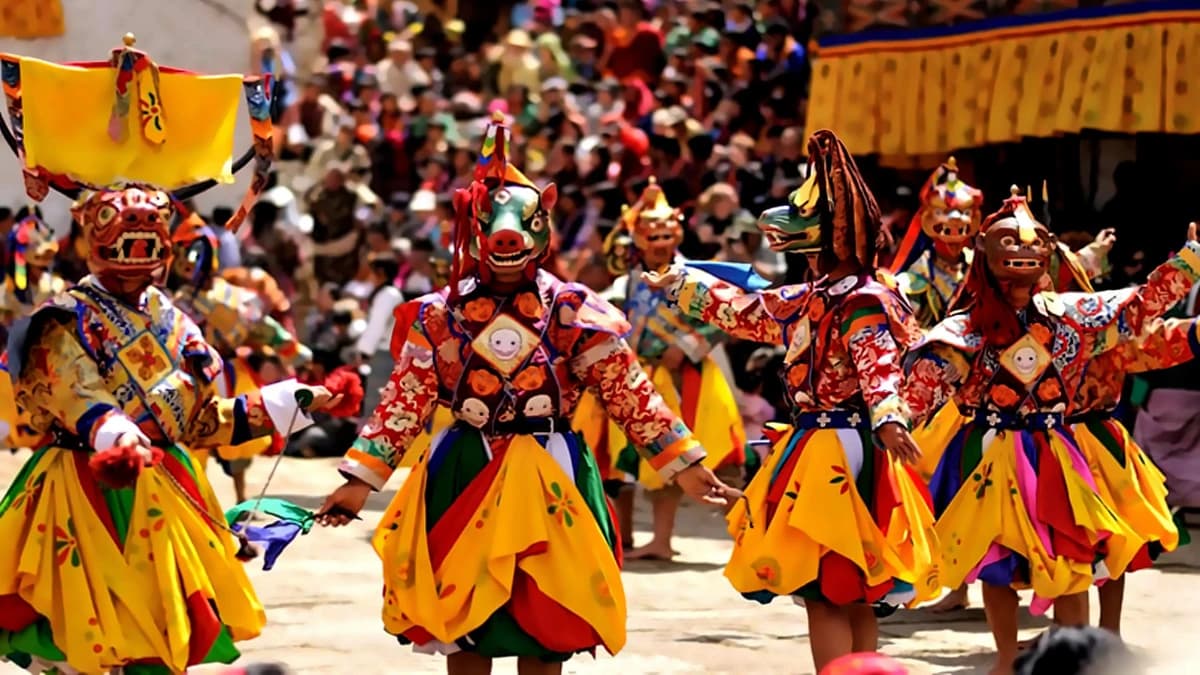
Short answer: Tiji is a three-day spring festival in Lo Manthang, the walled capital of Upper Mustang, in which monks perform masked dances that act out the victory of good over a demon, as a ritual for the health of the world. Dates follow the Tibetan calendar, so check them before you book. Time your visit on our Upper Mustang trek.
In Mustang's high desert, where the wind blows away everything soft and lush, spring comes, and the world turns inside out. The Tiji Festival arrives in Lo Manthang, transforming the ancient walled city into a spectacular stage for one of the Himalayas' most captivating performances. For three days, monks turn into dancers, demons come to life, and the whole community comes together to see a narrative that has been told for a long time. The event isn't fun in the way that things are fun today. It is a public exorcism that is not meant for tourists but for the health of the world itself. It is a mix of ritual, prayer, and cosmic drama. To see Tiji is to know that certain places still believe in unseen forces, conflicts that go on beyond human sight, and the power of dance to bring equilibrium to a universe that is always on the verge of catastrophe.
When and Where Does the Tiji Festival Take Place?
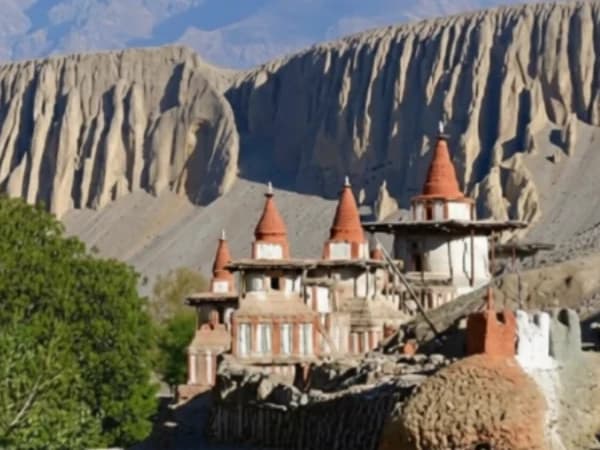
Lo Manthang, the walled capital of Upper Mustang, hosts the Tiji Festival. This rite is not done anywhere else. These dances don't happen anywhere else. The celebration takes place in the courtyard of the Thugchen Gompa, which is in the old city with whitewashed walls. For centuries, monks have done the same movements there.
The dates change every year since they follow the Tibetan lunar calendar. Tiji usually falls in May or early June, when the severe Mustang winter has let go and the passes are open. In 2026 it was held on 14 to 16 May. For 2027 the dates are provisionally 1 to 3 June, and the monastery confirms them each year, so check with us before you book flights. The preparations begin weeks in advance, and the effects continue long after the final dance, even though the event lasts for three full days.
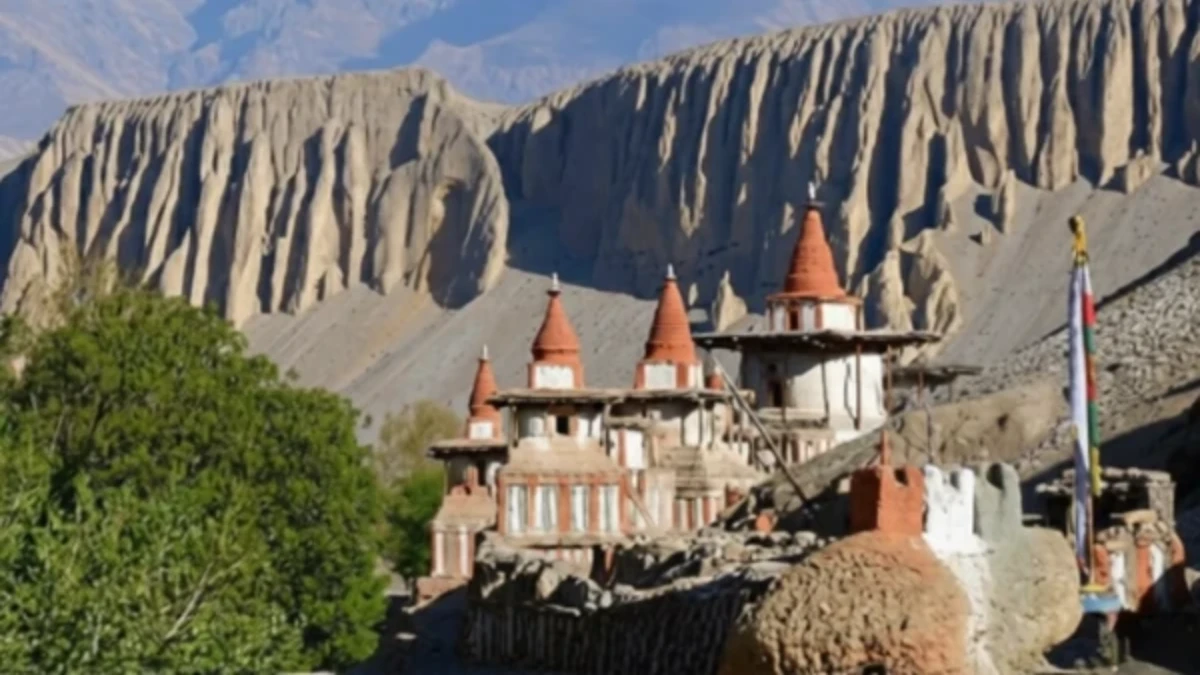
For the residents of Lo Manthang, Tiji is more than just a religious holiday. It marks the start of the year's possibilities: the return of warmth, the reopening of trade channels, and the slow awakening of a region that has been sleeping under winter for months. The celebration hovers between winter and spring, order and chaos, and safety and danger.
What does the Tiji festival mean and celebrate?
There are many meanings to the word "Tiji," and they don't all translate easily. The Tibetan term "Tenpa Chirim" means "the religion of the Buddha" and "the hope for world peace." But like all holy words, its significance goes beyond what you find in a dictionary.
For the inhabitants of Lo Manthang, Tiji symbolises "getting over problems." It means "bringing balance back." It signifies "the yearly cleaning of the darkness that has built up." The celebration is meant to fight against things that endanger not just individuals but the whole community, such as disease, conflict, natural disasters, and spiritual pollution.
The name has a lot of history behind it. When a monk says it or a traveller asks about it, the word keeps alive traditions that could have died out otherwise.
What is the story behind the Tiji festival dances?
The main story of Tiji is much older than Buddhism. This is the story of a world full of bad things and the heroes who fought them. The three days of dancing bring this cosmic drama to life and show what is typically hidden.
There was once a scary demon who tormented the country, according to the narrative. This scary entity was something older and scarier than a living, breathing monster. It was a force of complete chaos, denial, and everything that goes against life and goodness. Its name was heavy, but its goals were clear: to destroy enlightenment, wreck the dharma, and throw the world into a black hole from which no one could ever escape.
Someone with guts stood up to this evil. The god Dorje Jono, who had unlimited love and strength, came down to the messy world as a fighter. The ensuing war rocked the fundamental underpinnings of reality and endured beyond the passage of time. The triumph of good was not due to its victory, but rather to a different outcome. The demon wasn't killed, but its wild power was used to protect instead of destroy.
Tiji tells this story. But the tale isn't there. It tells the story through dance, ritual, and being a part of the cosmic drama. When the monks put on their robes and masks, they become the powers that they represent. Everyone is watching the conflict because it is happening right now.
What Happens During the Three Days of Tiji?
The festival's climax happens at the end of each of the three acts. The three together are like a deep spiritual awakening.
Day One: The Invite
At first, everything is fairly low-key. The monks who come to the Thugchen Gompa to pray make it a holy place. Everything is still calm and pleasant. People from the area and guests are looking at the entrances and talking in quiet voices outside the monastery.
Finally, the dancers show up. They start to move slowly to create the stage for where the action will take place. The clothes and masks they wear are just amazing. The brocade robes stand out against the dull countryside with their strange colours, and the masks show either heavenly peace or fierce defence.
The dances on the first day establish the story and the characters. The demon is there, but it isn't fully awake yet. The guardians get ready. The audience observes, waiting for the fight to get worse tomorrow.
The Battle of the Second Day
The second day clarifies the fight. The dances get angrier and more violent. The drummers maintain rhythms seemingly designed to influence people's thoughts. Monks rehearse routines that take years to master.
The monster appears in full form, with its mask deformed into terrifying patterns. As it circles the courtyard, it frightens everyone and everything in its path. Children in the audience clutch onto their parents' hands. Even adults who have seen the scene a lot may feel the strain.
The protectors fight the demon. They dance around, toward, and through it. Their movements tell a story about battle, but not the kind of war that people see. It's a spiritual battle, a clash of forces that only the mind can perceive. The monster fights back. It issues threats. For a brief moment, it seems to be in control.
Then things change. The guards push harder. Their motions become more synchronised and stronger. The creature begins to back off, but it does not give up yet.
The Third Day: The Win
The last day brings an end. The protectors trap the demon and force it to change, which is the most exciting part of the dances. The devil stops being scary and embraces its new duty as a protector instead of a destroyer, and as a channel for power instead of chaos. This always moves the audience.
The win isn't destruction; it's integration. The monster joins the order it used to threaten. Chaos fits into the bigger picture. The world is back to normal, balanced, and ready for another year.
Monks throw sanctified water and grain over the throng. The ritual gives everyone fresh protection. Kids laugh and run after each other. Older people grin because they have witnessed the story that keeps their world together again.
How do the monks train for the Tiji festival dances?
It takes the monks who do Tiji years to memorise their parts. The dances are not choreographed in the way that we think of them now. They are passed down from generation to generation of practitioners, and each movement has a meaning that must be kept exactly as it is.
Young monks start by watching. They stay around the boundaries of the courtyard for years, learning the sequences just by being there. They start to learn the easier roles after a while. They don't get to the main characters for years. It could take them decades to properly understand what they're doing.
The masks they wear aren't just costumes. The deity that each mask depicts lives in it, making it a sacred thing. Wearing it changes the person who wears it. During the dance, the monk turns into a god.
The costumes also have meaning. The colours, patterns, and materials all come from traditions that have been around for hundreds of years. Brocade from faraway places. Silk that used to go over trade routes that are now closed. People mixed paint according to secret recipes.
For the event
Tiji believes that the people who live in Lo Manthang are the most important, and the tourists come next. Keep this difference in mind. Even if no one from outside the event came, it would still happen. There is no money behind it; it exists because the community needs it.
It took people from the nearby villages days to walk there. They enjoy the season by camping in empty places like courtyards, visiting family, and talking to each other about what's going on. As they run through the crowd, kids are beaming with joy. Older people get the best seats because they are a blessing at the event.
People from other countries are welcome, but they aren't the main focus of the event. They take pictures, think about what they see, and then write about it. But they don't stop the event to take pictures. The dances keep going even if no one is watching. No one knows about the ritual, but it keeps happening.
Tiji's power comes from being real. What looks like a show for tourists isn't really one. Luckily, outsiders can see the community's annual gathering, which shows its deepest truths.
What is the atmosphere like at the Tiji festival?
During Tiji, the courtyard of Thugchen Gompa has an indescribable atmosphere. The sound of chanting and drumming echoes off the high walls until it becomes real. The smell of butter lamps and incense fills the air. The bright colours of the costumes and prayer flags were painful to see for those accustomed to the quiet landscape.
People are pushing from all sides. Monks go through them with the same confidence as people who live there. Kids push to the front, their faces just a few inches from the dancers. People don't even look at the dogs that walk by. The sun shines, then it goes behind clouds, and then it comes back.
The courtyard is quiet between dances. They make tea. People begin to speak again. People begin to laugh. Then the drumming starts again, and everyone pays attention again, drawn back into the drama that is happening in front of them.
Why is the Tiji festival spiritually important to Lo Manthang?
Tiji works on more than one level. It seems like fun at first glance: colourful, dramatic, and intriguing. On a deeper level, it is a religious ceremony that includes reading old texts and asking God to keep you safe. It connects people more deeply, bringing together people who are far apart to have a shared experience.
But the deepest level might be the most important one. Tiji shows that order can win over chaos, not just as a metaphor but as a real thing. Lo Manthang is in danger from a real demon. Some real protectors don't want it to happen. Every spring, the fight happens in the courtyard of the gompa. The world is safer after it's over than it was before.
People who have never seen Tiji may find this phenomenon hard to understand. But anyone who saw the last day, felt the change when the demon gave up, and watched the monks drop blessed grain over the crowd will tell you that something really happened.
Do you need a permit and guide for the Tiji festival?
People who want to see Tiji need to plan. The festival only happens in Lo Manthang, and getting there takes time, permits, and planning.
-
The Permit: Upper Mustang needs a special permit to enter a restricted area. It costs $50 per person for every day you spend inside the zone; the old flat $500 for ten days was scrapped in December 2025. No exceptions. No sales. This fee goes toward protecting the environment and preserving culture.
-
The Guide: A licensed guide must be with foreign tourists the whole time they are in Upper Mustang. There is no room for negotiation.
-
The dates of the festival are based on the Tibetan lunar calendar. Dates change from year to year, so check with trekking companies for the exact dates.
-
The Journey: Plan on at least two weeks for the round trip from Kathmandu. This includes the drive from Kathmandu to Kagbeni (our Upper Mustang trek goes in by road as standard, and Kathmandu to Pokhara and Pokhara to Jomsom flights, both ways, are available on request), trekking or driving to Lo Manthang, celebrating the festival, and then returning. Rushing through the experience reduces its enjoyment.
-
Accommodation: There are basic lodges in Lo Manthang, but they fill up quickly during Tiji. Plan and book through trekking companies.
-
Photography: Always ask before taking pictures of people. Be polite during ceremonies. There are times when cameras shouldn't be there.
You are a guest at someone else's most important event. Act in the right way. Look more than you take pictures. Talk less and listen more. Take what is given.
Finally,
The Tiji Festival is still going strong because it is important. The people of Lo Manthang still do this old play every spring, even though most people have forgotten their rituals and myths. They don't do it for tourists, money, or any other reason that people in the modern world would understand. They do it because the world needs it. They do it because chaos is always a possibility. They do it because their ancestors did it, and their children will do it too.
Seeing Tiji is like touching something that is almost gone. It's to stand in a courtyard in the high desert and watch monks turn into gods, to feel the drumming in your bones, and to know that some stories aren't just told but lived. The demon always comes back. The protectors always see it. And every spring, the best wins again in Lo Manthang.
Related Treks & Guides
Tiji is a three-day festival that turns Lo Manthang into the most colourful place in the Himalaya. Masked monks, drums, horns, and a 600-year-old story about a demon being chased from the kingdom. It happens once a year in May or early June, and if your Upper Mustang trek coincides with it, you will see something that no other trek in Nepal can offer.
We time our Upper Mustang Trek to coincide with Tiji when possible. Ask us about the festival dates for your year.
WhatsApp:+977 9810351300
Email:[email protected]
Written by Shreejan Simkhada, CEO of The Everest Holiday and third-generation Himalayan guide. TAAN Member #1586.
Tiji Festival is the Upper Mustang highlight. Our Upper Mustang Trek (10 Days) is private (your group only, no strangers), 2027 dates open, From USD $1290. WhatsApp us for tailored 2027 dates and current departures.

 Chat with Shreejan