Ghar Gompa (Lo Gekar): The Oldest Monastery on the Upper Mustang Trek

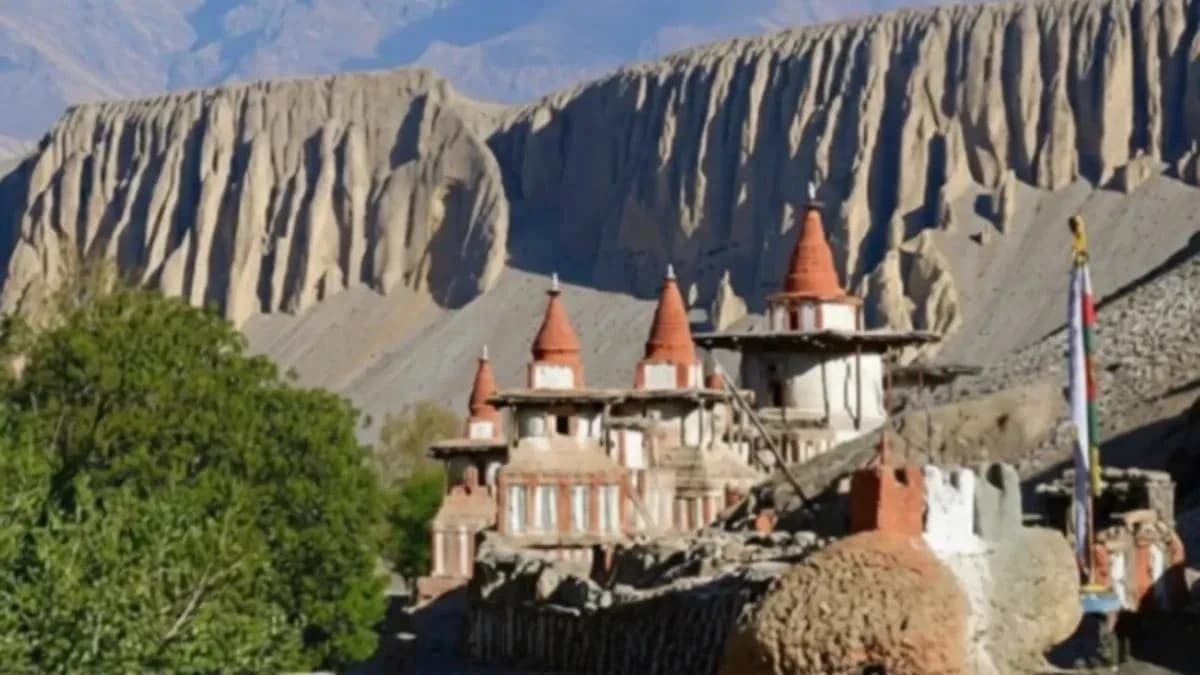
Short answer: Ghar Gompa, also called Lo Gekar, is a small old monastery at about 3,930 m in a side valley of Upper Mustang, half a day short of Lo Manthang. On our itinerary it comes on day five, the hardest day: 17 km and seven to eight hours over the Mui La (4,170 m) and the Choku La (about 4,290 m). Give yourself time there rather than rushing past. See our Upper Mustang trek.
Most people come to Upper Mustang for Lo Manthang. The walled city is the photograph everyone has seen, and it deserves the attention. But the place that stays with our guests is usually the one they had never heard of before they booked: a low, whitewashed temple sitting alone in a side valley at 3,930 metres, half a day short of the city, with carved stones stacked against its walls and nobody else there. That is Ghar Gompa, also called Lo Gekar.
I have walked into it with guests who were not Buddhist, who knew nothing about Padmasambhava, and who still went quiet inside. It is a small building in an enormous empty landscape, and it has been standing in some form for a very long time.
Ghar Gompa at a glance
| Also called | Lo Gekar, Lo Gekar Gompa, Ghar Gumba |
| Altitude | 3,930 m / 12,894 ft |
| Where | Upper Mustang, between Dhakmar and Lo Manthang, Mustang district |
| Municipality | Lo-Ghekar Damodarkunda Rural Municipality, which shares its name with the monastery |
| School | Nyingma, one of only two gompas in Upper Mustang that is not Sakya |
| Founded | By tradition in the eighth century, attributed to Guru Rinpoche (Padmasambhava) |
| What stands today | Largely a rebuilding from the late 1500s onwards |
| Known for | Carved and painted mani stones, old wall paintings, an image of Padmasambhava |
| On our trek | Day 5, Dhakmar to Lo Manthang via the Mui La (4,170 m) and the Choku La (about 4,290 m) |
| Permit | Upper Mustang restricted-area permit, USD 50 per person per day, plus ACAP and TIMS |
Where is Ghar Gompa?
It sits in a side valley north of Dhakmar, roughly two thirds of the way from Kagbeni to Lo Manthang. On our Upper Mustang Trek it falls on day five, the hardest walking day of the trip. You leave Dhakmar early, climb out of the red gullies to the Mui La at 4,170 metres, then drop into the valley where the monastery stands. After the visit you climb again, over the Choku La at around 4,290 metres, and the walled city of Lo Manthang appears below you.
Seventeen kilometres, seven to eight hours, two passes above 4,000 metres. It is a long day, and the monastery sits exactly in the middle of it, which is one reason so many groups rush through. We do not. The point of walking here is the stop, not the kilometres.
The rural municipality that governs this part of Mustang is called Lo-Ghekar Damodarkunda, and it shares its name with the monastery. That tells you how much weight the place carries locally, whatever the guidebooks say.
Why does Ghar Gompa matter?
Because of who is said to have built it. Tradition holds that Guru Rinpoche, Padmasambhava, founded the temple in the eighth century on his way to Tibet. He is the figure credited with carrying tantric Buddhism across the Himalaya, and sites connected to him are pilgrimage destinations rather than sightseeing stops. For Nyingma practitioners in particular, this is not a monument. It is a working place of practice.
You will see the claim that Ghar Gompa predates Samye, the first monastery in Tibet, and is therefore among the oldest Buddhist temples anywhere. Treat that as tradition rather than established fact. What is not in doubt is that a temple has stood on this ground for centuries, and that the building you walk into today is largely a restoration carried out from the late 1500s onward. Old and rebuilt are both true. The Himalaya is full of buildings that have been renewed many times over on the same sacred spot, and that renewal is part of the tradition, not a break in it.
Two details worth knowing before you go. Ghar Gompa is Nyingma, and that makes it unusual: almost every other monastery in Upper Mustang belongs to the Sakya school, which has shaped religious life in Lo since the kingdom was founded. And it is not run by a large monastic estate. It is owned and maintained by the village of Marang, which is why the caretaker who opens the door for you is a neighbour rather than an official.
It was also damaged in the 2015 earthquake. Restoration work began in 2021 with a grant of about US$285,000 from the United States Ambassadors Fund for Cultural Preservation, and municipal work on the site was still going on this year. If you find scaffolding or a closed chapel, that is why.
The demoness, the red cliffs and the mani wall
Every guide in Mustang tells this story, and it ties three landmarks on our route into one thread.
Guru Rinpoche, the story goes, fought and subdued a demoness who was obstructing the founding of the temple. Her blood soaked the cliffs, which is why the rock walls above Dhakmar, the village you slept in the night before, are that startling red. Her body parts became features of the landscape. The long mani wall near Ghami, the one you walk past on the way back south, is said to be her intestines. Ghar Gompa itself is said to stand over her heart.
I am not going to tell you it happened. I will tell you that when you have walked under the Dhakmar cliffs at first light, then stood in the courtyard at Lo Gekar a few hours later, the story does a better job of explaining that landscape than geology does. Local legend is part of the place. We tell it as legend. Related: Dhakmar (3,820m): The Red Cliffs of Upper Mustang and the Story Written Into Them.
What you actually see inside
The complex is small and low, built around a courtyard. The things worth slowing down for:
- The mani stones. Hundreds of slate slabs carved with mantras, many of them painted, stacked against the walls and around the compound. Some are very old. This is the detail people photograph and the detail they remember.
- The wall paintings. Frescoes inside the main chapel, worn in places, unrestored in others. Do not use flash.
- The image of Padmasambhava. The reason people come. Expect butter lamps and offerings rather than a museum display.
- The setting. Step back outside and look at where you are. A white building, a stand of poplars if the season is right, and empty ochre hills in every direction.
There is a caretaker. A small donation is appropriate and it goes towards maintaining the building. Take your hat off, walk clockwise, and ask before photographing anything inside. Some chapels do not allow photographs at all, and that decision belongs to the monastery, not to us.
How hard is the day that gets you there?
This is the day people underestimate. Two passes, both over 4,000 metres, with a descent between them, and Upper Mustang's wind arrives most afternoons like clockwork. We leave Dhakmar at first light specifically to be over the Choku La before it picks up.
By day five your body has had four days above 2,800 metres, so acclimatisation is usually not the problem. Stamina and wind are. Anyone in reasonable walking condition manages it. If you want the honest numbers across the whole route, our Upper Mustang distance and difficulty guide lays out every day.
You can also reach Ghar Gompa by jeep on the road system that now reaches much of Mustang, and some travellers do. You will see it. You will not arrive at it the way it was meant to be arrived at, and you will miss the Mui La entirely.
Permits: what Upper Mustang costs to enter
Upper Mustang is a restricted area. Since December 2025 the fee is USD 50 per person per day, with no ten-day minimum any more, so a shorter trip no longer means paying for days you do not use. On top of that you need the Annapurna Conservation Area permit and a TIMS card, and a restricted-area permit does not replace TIMS whatever you may read elsewhere.
Permits are issued by the Department of Immigration through a registered agency, never directly to an individual, and a licensed guide is mandatory. Solo trekkers have been able to hold a restricted-area permit since March 2026, but the agency and guide requirement still stands. The Department of Immigration publishes the current rules at immigration.gov.np, and the conservation area is managed by the National Trust for Nature Conservation through the Annapurna Conservation Area Project.
Full breakdown, including what the permits add to a trip budget: Upper Mustang trek cost and our restricted-area permits guide.
When to visit
Upper Mustang sits in the rain shadow of the Annapurna and Dhaulagiri ranges, which is the whole point of it. It stays walkable through the monsoon when the rest of Nepal is washed out, and March to November is the working season. May and June are warm and busy, particularly around the Tiji festival at Lo Manthang. September and October are clear and cold at night. Winter empties the villages as families move down to lower ground, and many monasteries are then hard to enter.
Whatever month you pick, the wind comes up in the early afternoon. Plan to be walking early and to be inside the monastery, not climbing towards it, by the middle of the day.
Common questions
Is Ghar Gompa the oldest monastery in Nepal?
It is often described that way, and by tradition it was founded in the eighth century, which would put it among the oldest anywhere. But the building standing today largely dates from a rebuilding in the late 1500s onwards, and there is no documentary record settling the eighth-century claim. We describe it as one of the oldest Buddhist sites in Nepal by tradition, and leave the superlative alone.
Can I visit Ghar Gompa without trekking to Lo Manthang?
Physically yes, by jeep, since the road reaches most of Mustang now. But the restricted-area permit applies the moment you pass Kagbeni, so there is no cheaper or simpler way in. If you are going to pay the permit, walk it.
How high is Ghar Gompa and will I feel the altitude?
3,930 metres. On our itinerary you reach it on day five, after four nights of gradual gain, and the two passes either side are higher than the monastery itself. Most people are fine. The day is long rather than dangerous.
Do I need a guide?
Yes. A licensed guide and a registered agency are compulsory for the restricted-area permit, and that has not changed with the solo permit rule. Practically, you also want someone who can ask the caretaker to open the chapel.
Nearby on the same route
- Lo Manthang, the walled capital, half a day beyond over the Choku La
- Kagbeni, the checkpoint village where Upper Mustang begins
- The Tiji festival, the three days that fill every bed in Lo Manthang
- Jomsom, the airstrip and road head for the whole region
Ghar Gompa is the reason I keep going back to Mustang. Lo Manthang is the destination, but this quiet temple in a side valley is where the trek stops being a walk and starts being something else.
WhatsApp:+977 9810351300
Email:[email protected]
Written by Shreejan Simkhada, CEO of The Everest Holiday and third-generation Himalayan guide. TAAN Member #1586.
Ghar Gompa is on day five of our Upper Mustang trek. Our Upper Mustang Trek (10 Days) is private (your group only, no strangers), 2027 dates open, From USD $1290. WhatsApp us for tailored dates and current departures.
Planning a trip to Nepal?
Drop us your details and tell us what you have in mind. We will put together a personalised plan and get back to you.
Not sure which Nepal trek is right for you?
Take our free 2-minute quiz and get personalised recommendations based on your fitness, experience, and travel style.
Find Your Perfect Trek → US$1,290
Thamdanda and Surke: The Road Head for Everest Base Camp by Road
Thamdanda is the road head where our Everest Base Camp trek by road starts and ends on foot. How to get there from Phaplu and what the first walk to Paiya is like.
Read More
Poon Hill Trek Permits 2027: ACAP, TIMS, Cost and What You Need
Poon Hill needs two permits: ACAP at NPR 3,000 and a TIMS card at NPR 2,000. Who arranges them, where they are checked, SAARC rates and the 2027 trek prices.
Read More
Mera Peak Climbing Itinerary 2027: 14 Days, Day by Day
Mera Peak in 14 days, night by night. The Hinku valley, a full rest day at Khare, Mera High Camp at 5,780 m, summit day, 2027 prices and the best months.
Read More Chat with Shreejan