

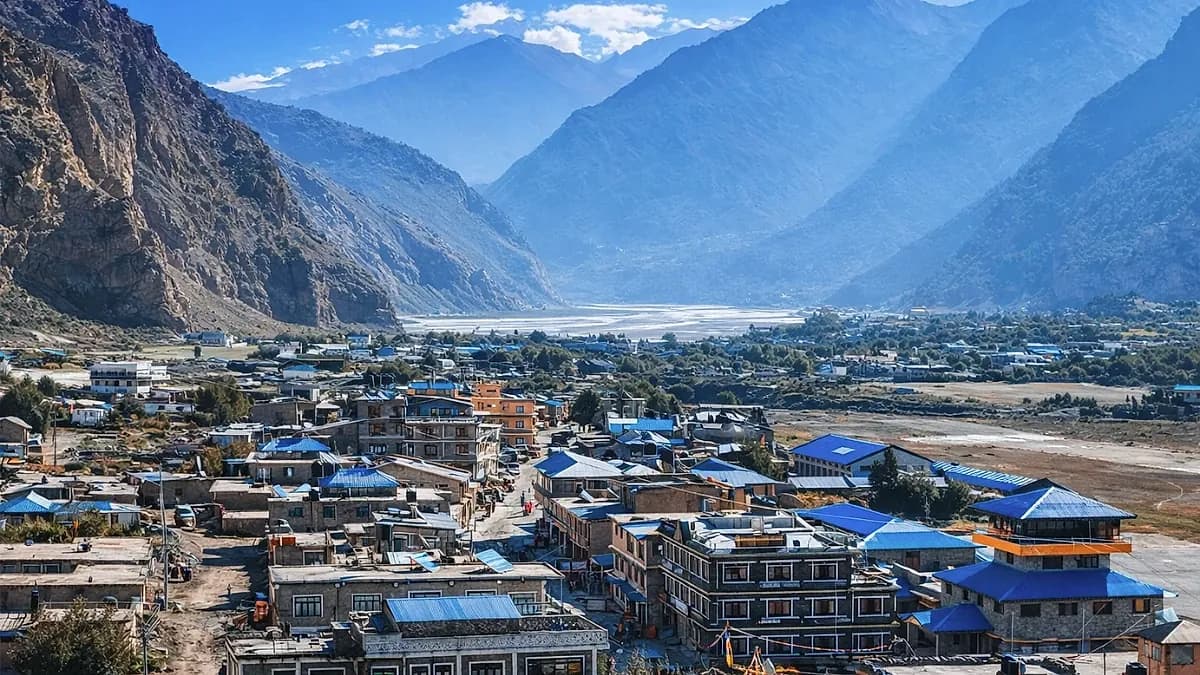
The wind built a town in the high Himalayas. The Kali Gandaki River cuts through two of the world's tallest mountains and into Jomsom, which is in the middle of the deepest gorge on Earth. The air transforms into a powerful natural force. There are no pleasant winds here. Every afternoon, the wind comes here like a train, blowing down the valley with enough force to knock a grown man off his feet and send loose things flying toward Tibet. Jomsom is the most important settlement in the Mustang region, perhaps because this happens daily. It is the administrative centre, the transit hub, the business centre, and the main entry point for most travellers. To reach Jomsom, you must know that places are defined by their experiences, not their possessions.
Jomsom quick facts
Short answer: Jomsom is the district headquarters of Mustang, at about 2,720 m on the Kali Gandaki river. Most visitors fly in from Pokhara in 20 to 25 minutes, in the morning only because of the afternoon wind. Foreigners paid about USD 165 one way on agency listings. The Beni to Jomsom road was damaged in late September. As of 14 October 2026 the Besisahar–Chame road and the Beni–Jomsom road are repaired and open to vehicles again. We still check road and trail conditions 48 hours before every departure.
| Detail | What to know |
|---|---|
| Altitude | About 2,720 m (8,920 ft). Muktinath, the pilgrimage site above it, is at about 3,800 m. |
| Flight from Pokhara | 20 to 25 minutes. Planes fly in the morning, from about 6:30 until late morning, before the afternoon wind builds. |
| Fare for foreigners | About USD 165 one way on agency listings. Confirm the price when you book. |
| Baggage on the flight | About 10 kg checked plus 5 kg hand baggage on agency listings. Extra weight is charged. |
| By road | The Beni to Jomsom jeep road was damaged in late September and is repaired and open to vehicles again as of 14 October 2026. See the access update below. |
| Best months | September to November and March to May. Winter is cold and flights are less reliable. |
| Rooms | About NPR 500 to 2,000 a night, from simple lodges to hotels with private bathrooms. |
| Permits if you walk on | Annapurna Conservation Area permit NPR 3,000 and TIMS card NPR 2,000. Upper Mustang, beyond Kagbeni, also needs a restricted area permit at USD 50 per person per day. |
If Muktinath is your goal, our Muktinath Tour by Flight, 5 Days flies Kathmandu to Pokhara and Pokhara to Jomsom, then drives to Muktinath, Kagbeni and Marpha with a licensed guide and a spare day for the weather. It starts from USD 1,780 per person for 2 to 4 travellers on the Budget option, or USD 2,485 for one traveller. Pay in USD or EUR. Rescheduling is free on 72 hours notice. The 10% deposit itself is not refunded if you cancel.
Jomsom access update, 6 October 2026
Floods and landslides damaged the Beni to Jomsom to Korala road in about 46 places in late September. On 5 October OnlineKhabar reported that some sections had reopened, including two-way traffic from Ghansa to Korala, traffic around Tatopani and one-way traffic from Rahughat to Sirubari. A large landslide at Baiseri was still blocking the road, and the Department of Roads expected about six more days to reopen the whole route. As of 14 October 2026 the Besisahar–Chame road and the Beni–Jomsom road are repaired and open to vehicles again. We still check road and trail conditions 48 hours before every departure. Flying from Pokhara is still the quickest way in.
The walking trail is a separate matter. In our 29 September update we found no report of damage to the Annapurna Circuit trail itself, and TAAN described the Manang and Mustang trails as operational on 11 September. We check access again before every departure and will tell you plainly if a plan needs to change. Last checked: 6 October 2026.
Where Is Jomsom?
Jomsom is in a favourable spot in Nepal's Mustang District, in the Gandaki Province. It is around 2,700 metres (8,858 feet) above sea level. The settlement runs along the east bank of the Kali Gandaki River, where the valley widens to make room for what looks like a floodplain.
The landscape here is so dramatic that it's almost funny. The valley gets smaller as it goes south, toward the gap that separates Annapurna from Dhaulagiri, two mountains that are both more than 8,000 metres high. As you go north, the valley slowly opens up to the Tibetan plateau. The terrain gets drier with every mile. Jomsom is right in the middle, where the steep, forested slopes of the south meet the stark, wind-scoured hills of the north.
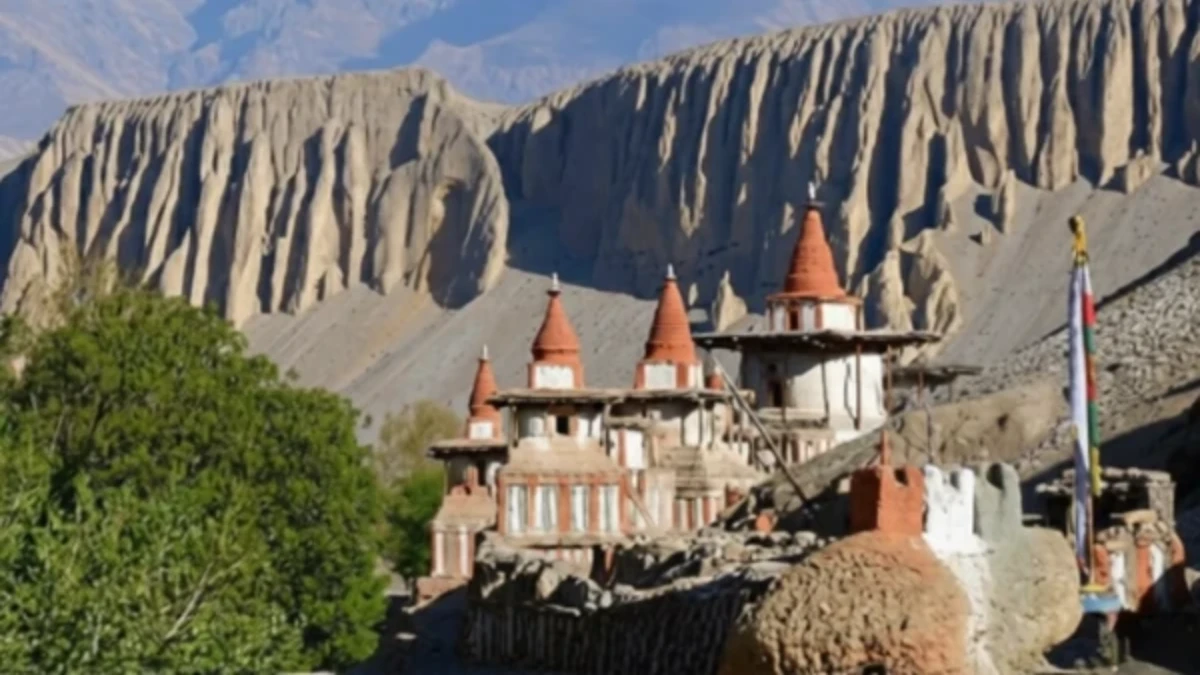
The river that gives this valley its shape has a milky grey colour with glacial sediment and braids across a vast bed of stone and sand. It is a network of channels that can be walked across when it is dry. It turns into a raging river during the monsoon that eats everything in its path. The village is sheltered from the highest flood levels since it is on a terrace that has been inhabited for hundreds of years.
The hills of Jomsom are brown and ochre, and they rise in tiers. The wind and rain shadow effect that makes this area drier than any other part of Nepal has deprived it of vegetation. Apple orchards make surprise green patches where irrigation is allowed, but outside of their borders, the landscape goes back to its natural state of stark beauty.
How Do You Get to Jomsom?
Jomsom is conveniently located because it is simple to travel there. There is a unique airport in the upper Kali Gandaki valley that has facilitated its expansion.
-
By Air: People who have done the flight from Pokhara to Jomsom say it's the best. It takes twenty minutes to fly between Annapurna and Dhaulagiri, with the wings appearing to touch the mountains on either side. The Jomsom runway is short, paved, and ends in a cliff that offers views out over the river. The pilots who touch down here are some of the best in the world. Most flights happen early morning, before the wind makes it impossible to land.
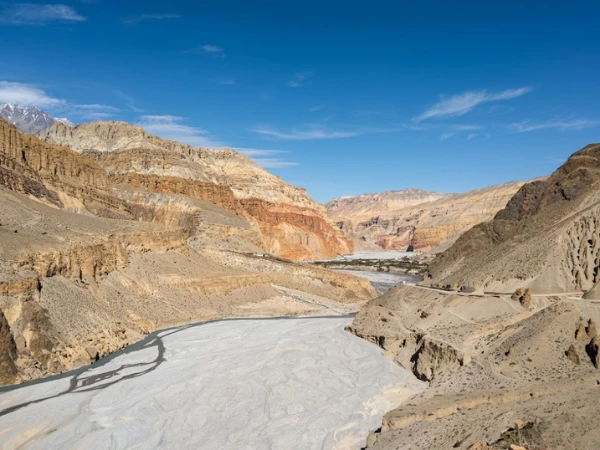
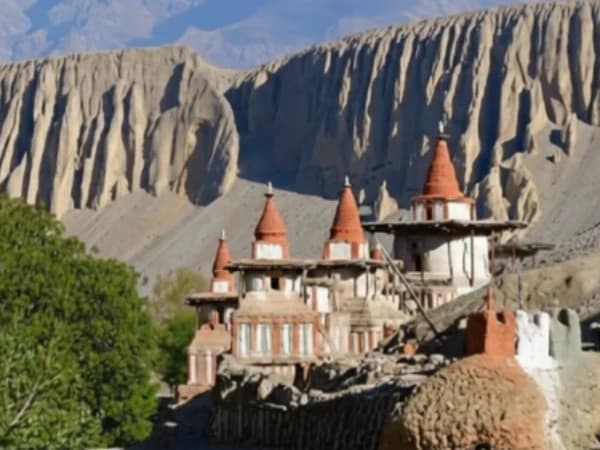
Traditional buildings in Upper Mustang -
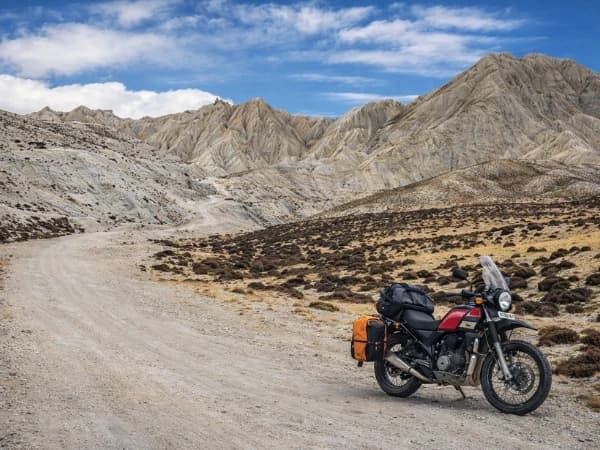
By road: A jeep road now connects Jomsom to the south, following the river all the way to Beni and finally to Pokhara. The trip takes a whole day, with difficult roads, creeks, and communities that have just lately been connected to the outside world. There is a difficult road from the north that goes to Lo Manthang, but only the most determined cars try it.
-
By Trail: Most people get there on foot. The walk from the south follows the Kali Gandaki via communities like Marpha, Tukuche, and Larjung. Each settlement has its charm and hospitality. People arriving from the east come down from Muktinath and follow the Jhong Khola until it meets the bigger river. People travelling from the north had to hike for days through the restricted areas of Upper Mustang to get here.
-
The Wind timetable: No matter how you get there, you'll quickly realise that Jomsom runs on a timetable set by the wind. The mornings are peaceful and unobstructed, making them perfect for getting around. The gale arrives in the afternoon, resulting in grounded flights and empty streets. Before noon, everything happens in Jomsom.
What Facilities Does Jomsom Have?
Jomsom is the district headquarters of Mustang and has better facilities than anywhere else in the area. Hikers stop here to rest, collect new supplies, and get healthier before continuing on their way.
-
Places to Stay: Jomsom has many places to sleep, from basic teahouses to nice hotels with their bathrooms and reliable hot water. The lodgings here are suitable for trekkers with both small and large budgets. Prices for rooms range from NPR 500 to 2000, depending on how comfortable they are and what you can see from the window.
-
Restaurants in Jomsom serve high-class food that tastes like it was made in a fancy kitchen after days of travelling. The menu has fresh vegetables on it. You can get actual coffee. The area is also famous for its apple products, such as juice, brandy, pie, and dried fruit. Thakali cooks serve their traditional set meals, and every breakfast is accompanied by freshly baked Tibetan bread straight from the pan.
-
Connectivity & Banking: This location has an ATM, making it one of the rare ones north of Pokhara. Before going to places where plastic doesn't matter, trekkers can get cash. There are mobile phone towers that make sure you can connect, and a few lodges have Wi-Fi for people who need to get back in touch with the outside world.
-
Stores and Goods: The market has all the things a hiker might need, like gas canisters, batteries, snacks, maps, and hiking gear. Shops also sell local goods, including apple brandy in recycled water bottles, handmade woollens, and, of course, the famed Mustang apples.
-
Transport Hub: Jeep stands are close to the airport and the main crossroads. They take people south to Beni, north to Kagbeni, and east to Muktinath. Small travel agencies make flight reservations. This area is where trips start and end.
The Health Post and the Pharmacy are two sites where you can get basic medical care. The sole option in the event of serious complications is to leave for Pokhara. But for common hiking problems like altitude sickness, stomach problems, and small injuries, Jomsom can help. Related: Marpha Village Guide: Apple Capital of Nepal on the Annapurna Circuit.
Main Attractions
The best way to discover Jomsom's hidden attractions is to venture beyond the town's practical side.
-
The Airstrip and Its Dance with Wind: The airport runway runs down the riverbed and provides daily drama. Seeing planes arrive in the morning calm and then sit still all afternoon in the gale teaches you something about life in this valley. The wind always wins.
-
The Kali Gandaki Riverbed: If you walk along the vast gravel banks of the river, you can see fossils in the stone. Ancient seas once covered this ground, and the proof is right in front of you. Pilgrims and collectors are both looking for shaligrams, which are sacred ammonite fossils.
-
The Apple Orchards: Around Jomsom, where irrigation reaches, apple trees grow in straight lines. They bloom pink and white in the spring. They bend with fruit in the fall. It feels like you're in another universe when you walk among them, with stone walls keeping the wind out.
-
The Views at Dawn: The mountains show themselves before the wind wakes up. A valley between Annapurna and Dhaulagiri seems made for them to show off. The town is still dark, but the mountain tops get the morning light first.
-
The Local Monasteries: There are small gompas all over the place surrounding Jomsom. They aren't as well-known as Kagbeni's monastery or Muktinath's temples, but they might be more valuable because they give peace and the ability to watch a prayer without crowds.
-
The Wind Itself: It may sound strange, yet the wind becomes an attraction. This is what Jomsom is all about: standing in it, feeling its power, and seeing it pull sand from the riverbed and take it toward Tibet. As they stroll, locals lean into it. People who come learn to do the same.
Major Activities to Do in Jomsom
Activities in Jomsom vary depending on the season. In the morning, you should walk around, and in the afternoon, you should find refuge.
-
Morning Flights and Arrivals: The morning flight schedule makes for a small show, if you're coming or just watching. The jets come into view over the southern hills, fly down to the runway, and land perfectly. It's a Jomsom tradition to watch from a rooftop with a cup of coffee.
-
The main street is busy in the morning as people explore the bazaar. Store owners let them in. Trekkers get ready by getting provisions. People in the area do business. This is how I spend my mornings: walking the length of the bazaar, saying hello to people as they pass by, and stopping at windows.
-
Walking the Riverbed: If the wind isn't too strong, you can walk for miles along the riverbed. Follow the braided channels, look for fossils, and watch the birds that live here. The mountains are always there, on both sides.
-
A short stroll south along the route will take you to Marpha, a picture-perfect village with whitewashed walls and small streets. It has a distillery, a monastery, and is very clean, so it's worth visiting. The walk there and back makes for a relaxing morning.
-
This attraction is not up for discussion: sampling Apple products. Sample items such as apple pie, dried apple slices, fresh apple juice, and the renowned apple brandy that comes in unlabelled bottles. Every lodge and store has its supplier and recipe and claims to be real. Give them all a try.
-
Afternoon Shelter: When the wind comes, everything goes inside. You can read, write in a diary, play cards with other travellers, or just sit by the window and watch the dust blow by. The wind needs a break, and you give it one.
-
Sunset Photography: The wind usually dies down as night falls. The light from the west hits Dhaulagiri, changing the colours every minute. Get to a high place, wait, and watch.
What Is Jomsom Known For?
Jomsom has a unique and important location in the geography of travel in the Himalayas. People like it because it's the "Air Gateway to Mustang," which is the only spot in the area with regular flights. It's where the new world meets the old world.
It is well-known among trekkers as the spot where permits are checked, supplies are acquired, and excursions are planned. The Jomsom-Muktinath walk is popular with both pilgrims and explorers, and Jomsom is where it all starts.
For people who adore apples, Jomsom is like heaven on earth. In the rain shadow of the Himalayas, Jomsom produces apples with a unique flavour. Trekkers have made the brandy they made famous.
But the most important thing about Jomsom is that it is known for its wind. People who have been to Jomsom in the afternoon will never forget it. In every story written about this place, the wind is a character. It changes the landscape and the lives of everyone who lives or passes through here.
Places to stay and tea houses
Jomsom has the most lodging in the Mustang region, so it can accommodate all travellers.
-
Budget Lodges: Simple rooms with shared restrooms, thin walls, and thick blankets. These are for people who want to save money while hiking. The cuisine is basic, the place is welcoming, and the people are fantastic.
-
Mid-range hotels include private rooms with bathrooms, working hot water, and maybe even TVs. These are comfortable but not too flashy. The owners can usually speak more than one language and can help you secure permits, transportation, and guides.
-
Comfortable Lodges: Some establishments rival hotels in quality, offering heated rooms, restaurant services, and wind-sheltered gardens. These are for folks who have walked a long way and want to unwind.
-
The Common Elements: No matter how much money you have, you can always expect polite service, great food, and staff who know what tourists need. The owners have been welcoming guests for generations and know everything there is to know about their business.
-
What to Expect: The showers are scorching. The power stays on even after dark. The food includes vegetables you haven't seen in days. You can converse with other travellers. A comfortable bed ensures a restful night's sleep.
The Best Time to Go
The seasons in Jomsom affect everything about the trip.
-
The best time of year is fall, from September to November. The monsoon has cleansed the air, making it so clear that the mountains look like they are right next to you. It's warm throughout the day and cold at night. The wind is still there, but it's not too bad. This season is when most people travel.
-
In the spring, from March to May, the apple blossoms bloom and turn the orchards pink and white. The days get longer, the temperatures go up, and the passes start to open. This month is the time of year when many people go on pilgrimage to Muktinath.
-
Winter (December to February): It's frigid. The temperature can reach 10 degrees during the day, but it can drop considerably below freezing at night. As snow blocks the airport, flights become less reliable. Many lodges closed. For those who come, winter brings peace and the stark beauty of frozen landscapes.
-
Monsoon (June to August): The mountains keep the rain from falling here, but the trails from the south become dangerous. Clouds at Pokhara can cause flights to be cancelled. The river is brown and enraged. This is the peaceful time of year for people who are comfortable with uncertainty.
Weather and Climate
Jomsom is in a climate zone that is hard to put into words.
-
The Rain Shadow: The steep mountains to the south keep almost all of the moisture from the Indian Ocean. Pokhara gets 4,000 millimetres of rain a year, but Jomsom only gets 300. The river that runs by here would never let you guess that the surrounding area is a desert.
-
The Wind: The wind comes every afternoon. It starts as a light breeze at noon, then turns into a storm by mid-afternoon, and it howls all night until dying down at sunset. The temperature difference between the Tibetan plateau and the lowlands to the south, which is channeled down the deepest gorge on earth, is what causes it.
-
Temperature Swings: Without humidity to keep them in check, temperatures go up and down a lot. A winter day can go from 10 degrees to minus 10 in only a few hours. During the summer, temperatures can reach 25 degrees during the day and drop to 10 degrees at night. The sun warms the air, and the cold comes back in.
-
The Light: The air is clear, the sun is at the right angle, and the snow and river reflect light in a way that is unlike any other place. Photographers go after it. Painters are frustrated that they can't get it. Everyone is just amazed.
-
The Sky: At night, when there is no light pollution and little atmosphere, the stars look like they are a lot more than city people can fathom. The Milky Way stretches across the sky, and on nights when there is no moon, the darkness feels like it might be touched.
Flying to Jomsom: times, fares and weather
- The Pokhara to Jomsom flight takes 20 to 25 minutes over the gap between Annapurna and Dhaulagiri.
- Flights run in the morning only. Strong valley wind usually stops landings after midday, so a delayed morning flight can mean a day lost.
- Foreigners pay about USD 165 one way on agency listings. Our Muktinath tour includes the flights in the price.
- Cloud in Pokhara or wind at Jomsom can cancel a flight. Keep a spare day in your plan, as our 5-day tour does on day 3.
- Pack a small bag for the flight. Agency listings give about 10 kg checked and 5 kg hand baggage.
Hotel & Contacts
|
Hotel |
Contacts |
|
Hotel Snowland |
+977 9856034321 / 069-420110 |
|
Hotel Mustang View |
+977 9851038450 |
|
Hotel King’s Way |
+977 9851038502 |
|
Hotel Hidden Paradise |
+977 9851038421 |
|
Hotel Moonlight |
+977 9851038488 |
Related Treks & Guides
- Lower Mustang Motorbike Tour
- Upper Mustang Motorbike Tour
- Mustang Mountain Bike Tour
- Kagbeni
- Lo Manthang Guide
Jomsom is where the Annapurna Circuit meets the desert. Below here is green Nepal: rice paddies, rhododendron forests, waterfalls. Above here is brown Mustang: wind-scoured canyons, cave dwellings, Tibetan monasteries. The contrast is extraordinary and it happens in the space of one day's walk.
Jomsom is on both our Annapurna Circuit Trek and the gateway to our Upper Mustang Trek.
WhatsApp:+977 9810351300
Email:[email protected]
Written by Shreejan Simkhada, CEO of The Everest Holiday and third-generation Himalayan guide. TAAN Member #1586.
Jomsom is the gateway to Upper Mustang. Our Upper Mustang Trek (10 Days) is private (your group only, no strangers), 2027 dates open, From USD $1290. WhatsApp us for tailored 2027 dates and current departures.
 Chat with Shreejan