

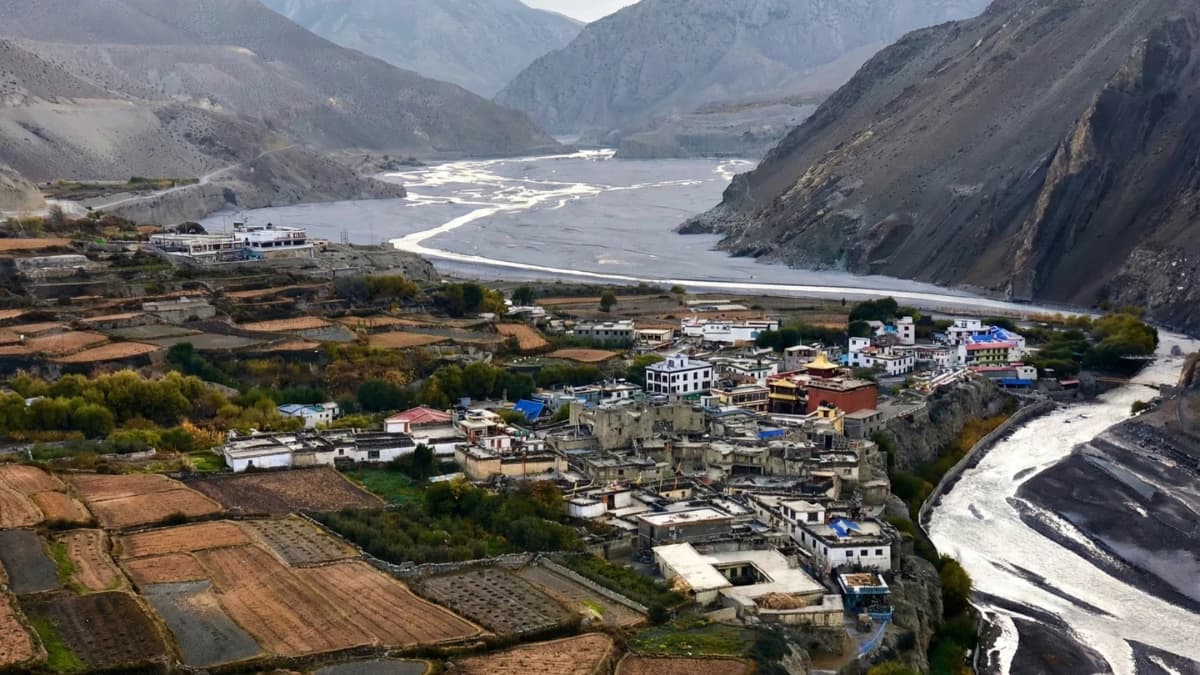
Short answer: Kagbeni (2,804 m) is an old earth-walled village where the Kali Gandaki and Jhong rivers meet, at the point where the road to Upper Mustang turns north, below Muktinath. It is a stop on the Annapurna Circuit and the gateway to Upper Mustang. It is on our Upper Mustang trek and Annapurna Circuit trek.
Some places seem like they were never meant to be found. One of them is Kagbeni. For hundreds of years, this community has mastered the art of avoiding notice. It is hidden between two of the highest mountains on earth. But for those who do locate it, Kagbeni is something they will never forget. It is a settlement made of earth, with walls the same colour as the desert around it. The narrow lanes are meant to mislead the wind that blows down from the Tibetan plateau. When you enter Kagbeni, it's like walking into a painting that has lost its colours, and only the important things are left: mud, stone, prayer flags, and the sound of water running through the deepest gorge on Earth. The monastery is not a place for big gestures. It is a sanctuary of quiet strength, where every wall tells a narrative of how people have survived the weather.
Where Is Kagbeni?
Kagbeni is located at the point where two rivers meet, and two mountains look at each other over an old split. The settlement is on a barren terrace above the Kali Gandaki River, where the Jhong Khola flows down from the holy shrine of Muktinath to join the main river.
The height here is exactly 2,804 metres. The height is not so high as to obstruct the lungs' oxygen supply, but it is high enough to perceive the thinness of the air and the dryness of the wind. This is the rain shadow. Clouds from the south hit the Annapurna wall and turn into ghosts, bringing nothing except dust.
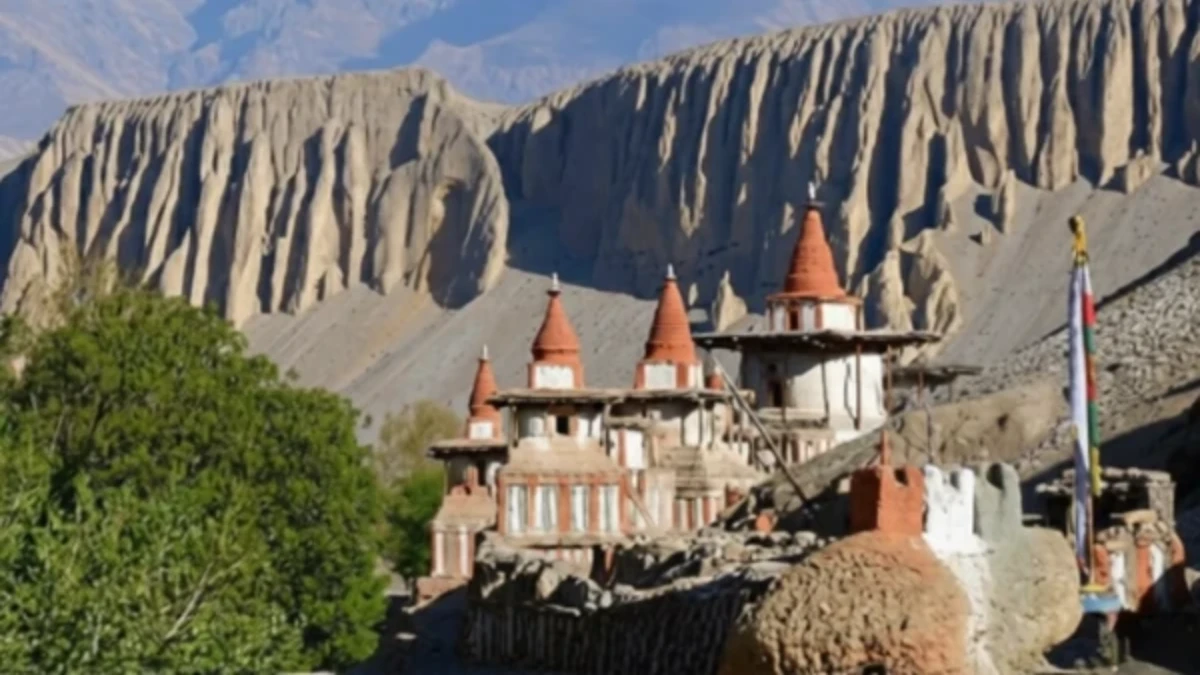
Annapurna rises silently to the east. Dhaulagiri accomplishes the same thing to the west. The Kali Gandaki has created a trench so deep that scientists still disagree on how deep it is. Kagbeni's buildings cling to the high bank, as if afraid of falling into the chasm it guards.
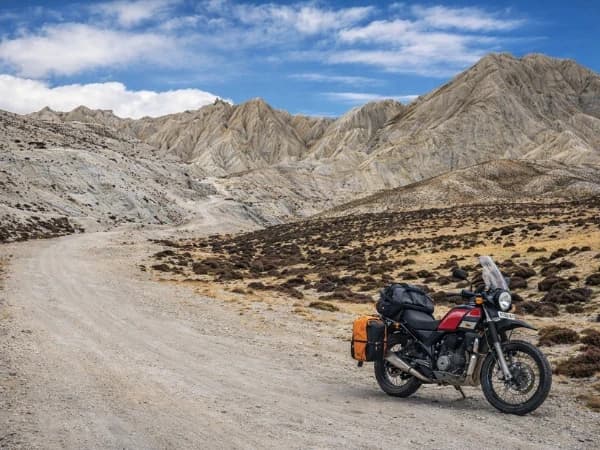
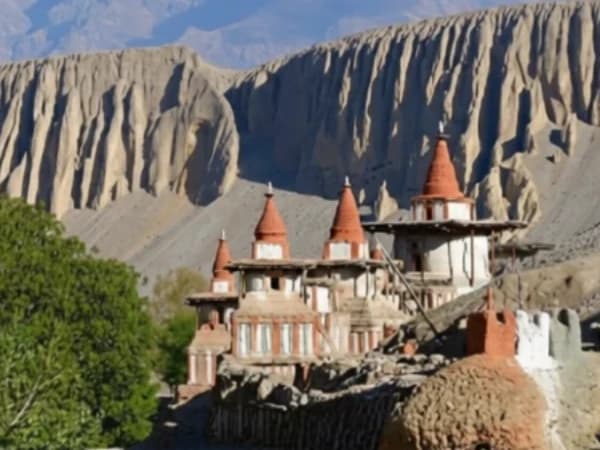
The area around the settlement is not green. When the sun sets, the mineral cliffs look red, brown, ochre, and sometimes purple. Like the remains of an old city, strange rock formations rise from the valley bottom. The wind has shaped them into shapes that look like buildings, animals, and faces. The hamlet has endured for a thousand years because it knows how to get life out of this stubborn ground, even though nothing grows here without help.
How Do You Get to Kagbeni?
You can reach Kagbeni by flying, driving, or walking for weeks. Regardless of the circumstances, the journey becomes an integral part of the narrative.
-
The Flight Path: Small planes fly between Annapurna and Dhaulagiri from Pokhara, going through a tiny space that feels too small for wings. The flight lasts less than twenty minutes, but it shows you more mountains than most people see in their whole lives. You land at Jomsom, where the runway ends at a cliff.
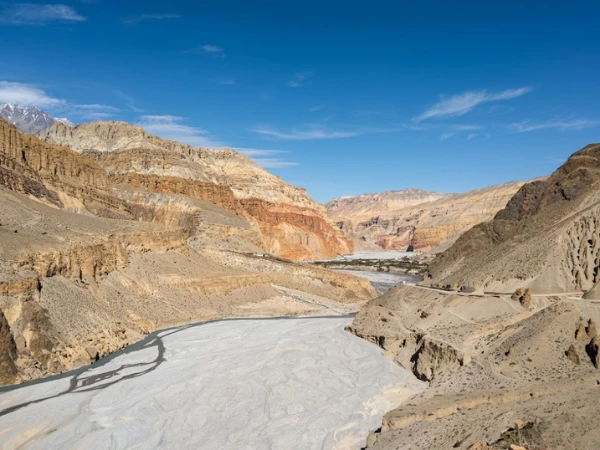
Traditional buildings in Upper Mustang -
The Road Journey: Jeeps now take a day-long drive from Pokhara to Jomsom via roads cut into cliffs. The terrain changes every hour. The jungle turns into a pine forest, the pine forest turns into bare rock, and the bare rock turns into the desert that surrounds Kagbeni.
-
The Trekker's Approach: Most people come on foot. Some arrive from the south and travel up the Kali Gandaki valley through settlements that get more Tibetan with every mile. Others come from the east, having crossed the Thorong La mountain after days of trekking. They then went down via Muktinath and followed the Jhong Khola to where it meets the bigger river.
-
The Border Within: Kagbeni is a line that can't be passed without the right paperwork. Upper Mustang is a separate realm that is beyond the village and needs special licenses and government guides to go to. The police checkpoint at the edge of town reminds us that some doors only open for people with the right keys.
Facility
Kagbeni has learned how to greet visitors without turning into a stereotype. The amenities are there to help, not to change.
-
Places to Sleep: Visitors can now stay in stone buildings along the main lane. Some provide basic rooms with soft blankets and restrooms that everyone can use. Some have built attached bathrooms and solar-heated showers for people who are willing to pay more. The walls are still made of clay, the windows are still small, and the sense is still real.
-
Places to Eat: Small kitchens serve food that connects two worlds. Dal bhat is served with Tibetan bread. Along with apple pie prepared from fruit harvested in neighbouring orchards, noodle soup is on the menu. Metal stoves use valuable wood to heat the dining rooms, and the windows gaze out over scenes that have not altered in hundreds of years.
-
What You'll Find: There are a couple of stores selling basic items such as cookies and batteries. There is also a small health centre available for emergencies. When the river gets low, the electricity flickers. Phone signals that change with the weather. That's all there is to it.
-
You won't find any of the typical tourist traps here, such as ATMs, nightclubs, or souvenir shops peddling mass-produced goods. Kagbeni is not a caricature of itself but rather the real thing.
What Are the Main Things to See in Kagbeni?
The things to see in Kagbeni are not the kinds of things you take pictures of and forget. They slowly settle within you and show themselves over time.
-
The Village Itself: The best thing to do is walk around the alleys. You can touch both walls at once because the houses are so close together. The hallways take corners for no reason, open into small squares, and end in courtyards where women sit weaving or sifting grain. The settlement looks like it sprang from the ground instead of being built on it because everything is created from the same earth.
-
The Ancient Monastery: The red-walled gompa, which is at the top of the town, has been watching over Kagbeni for hundreds of years. In the faint light, the murals slowly fade, but anyone who looks intently can still see their hues. The monks who oversee the prayer chambers possess knowledge that remains undocumented.
-
The River Confluence: The water changes as the Jhong Khola and the Kali Gandaki meet. You can see why the ancients thought these sites were holy when you stand here and watch two currents merge. The boom echoes down the valley, a continual reminder of the power that formed this gorge.
-
The Desert Walks: The area around Kagbeni is excellent for exploring. Some trails lead into side canyons where the rock patterns make no sense. Layers of colour on the cliffs reveal the Himalaya's geological history. The whole valley looks like fire when the light is right.
-
The Wind at Evening: The wind starts to blow as the sun goes down behind Dhaulagiri. It begins as a whisper and grows into a roar as it moves through the gorge with a force that has changed everything here: the rocks, the trees, the houses, and the people. When you stand in it, it feels like you're standing in something old and alive.
Things to Do That Are Important in Kagbeni.
In Kagbeni, doing and being are often the same thing. The tasks are easy, repetitive, and very fulfilling.
Let the alleys take you where they will; don't have a plan. Go left, go right, follow a sound, and halt at a door. Your mere wandering about shows you more than any guided tour.
-
Find a rock at the brink of the Kali Gandaki and sit down. Look at the lake, the light, and the people who pass the suspension bridge from time to time. Let the sound fill your head so much that you can't hear your thoughts.
-
Going to the Monastery at Dawn: The monks start their prayers before the sun rises over the village. The sound of drumming and chanting comes down from the red walls. It mixes with the wind and the river to make a sound that is unique to this area.
-
To get to the checkpoint, walk to the edge of town where the trail goes north. Stand at the gate and look toward Upper Mustang, the kingdom that no one is allowed to enter. You can't get in without a permit, but you may stand at the door and picture it.
-
Eating Apple Pie: The apples from the Mustang orchards are unlike any others. They are tiny, dense, and very sweet. The pie that is fashioned from them has become famous among hikers. Go to a bakery, order a slice, and you'll see why.
- As twilight falls, climb to the ridge above the hamlet to see the sunset. First, the light goes away from Annapurna, then Dhaulagiri, then the cliffs, and finally the settlement below. The cold comes soon once the light goes out.
How Does Kagbeni Gain Its Popularity?
In the minds of mountaineers, Kagbeni is a legendary landmark. The "Gateway to the Forbidden" is the name given to the final settlement before Upper Mustang imposes its borders on all save an elite few.
The point where the rainy south gives way to the dry north is well-known among hikers as the confluence of rivers and civilisations. As you can see in the faces, the language, the architecture, and the cuisine of the villagers, Nepal begins to feel less like Nepal and more like Tibet at this point.
Historiographers will hear rumblings about the ancient salt trade in Kagbeni, when goat and mule caravans travelled between Tibet and India. Throughout its thousand-year history, the village has retained the traits of a rest station, a site of trade and rest.
Pilgrims travel through Kagbeni on their way to Muktinath, a Hindu and Buddhist sacred site with 108 water spouts and an eternal flame.
Kagbeni, however, leaves an indelible impression on most visitors, a village that offers nothing but generosity to those who are open to it.
Tea Houses and Other Lodging Options
When you sleep in Kagbeni, you're sleeping in the past. Both the walls surrounding you and the welcome you get have been around for a very long time.
-
Most lodgings are actually just converted houses that have been extended to accommodate guests. Houseguests are treated as permanent family members by the host family, who live downstairs or next door. The aroma of home-cooked meals wafts through the air as children peek through open doors and grandmas spin prayer wheels in the corner.
-
With the rooms, you may anticipate low windows, sturdy walls, and a bed covered with blankets. Overnight, the chill permeates every surface, and the only defence against it is the presence of blankets. While some rooms now have private restrooms, in the past, guests would have to use a public facility across the hall or in the courtyard.
-
The Cuisine: Our family's meals are prepared in the kitchen, gathered around the central heating burner. On most days, you'll get dal bhat, and on exceptional occasions, you might have momo. Without fail, tea is served with it.
-
What makes staying at an accommodation in Kagbeni unique is the atmosphere, which is more like being welcomed than hosted. The boundary between client and visitor begins to dissolve after the second night, and you might find yourself pitching in to wash dishes or tutor the kids in English.
-
Anticipated Experience: Do not anticipate opulence. In every way, you can anticipate hospitality. You can be sure that you will recall the names and faces of your servers long after you have forgotten the specifics of your accommodation.
The Best Time to Go
There is no subtlety to the Kagbeni seasons. Everyone has their own unique requirements for guests.
-
March through May is spring, a time of rising temperatures, a gradual easing of the winds, and the appearance of the river's rare patches of green. As pilgrims make their way to Muktinath, the trail becomes more verdant with each passing season. The weather is perfect: sunny days, mild evenings, and unobstructed vistas.
-
Fall (September–November): The ideal time of year. The dust has been washed away by the monsoon, allowing for such a clear view that the mountains appear as though they are touching. Warm days, cool nights, and an eye-watering azure sky characterise this weather. At this time, the majority of tourists arrive.
-
During winter (December–February), the cold is intentional. A high of 10 degrees is possible throughout the day, while nights drop well below freezing. The wind slices everything to ribbons. Some lodges shut down, and the community begins to isolate itself. Winter in Kagbeni offers peace for those who are brave enough to withstand the weather.
-
During the monsoon season (June–August), the mountains obstruct the rain; therefore, it rarely falls here. However, the paths coming from the south become extremely dangerous due to landslides and muck. The river is murky and brown from silt, and visibility is low. These months are reserved for the most intrepid of travellers.
The Climate and Weather
Everything in Kagbeni is defined by the fact that it is located in the rain shadow.
-
The Drought: Centimetres, not metres, are used to measure yearly rainfall. Clothing dries in minutes, and lips split without continual care due to the air's low moisture-holding capacity. Even though the river flowing by would have you believe otherwise, the terrain is actually a desert.
-
Every single day, the wind blows in the afternoons. It carries the chilly air and dust from the high plateau as it forcefully winds its way through the gorge. In the late afternoon, it rips through the town, causing doors to rattle and prayer flags to be pulled. Then, just as abruptly, it halts.
-
The Light: The light here acts differently since there is no humidity to distort it. Hard edges characterise shadows. More lively hues are produced. Beyond all else, sunsets are the longest and brightest I've ever seen. There are equal parts joy and frustration for photographers weeping.
-
Temperature Fluctuations: Day and night are seasonal concepts. In the span of a few hours, the weather might go from warm to cold. Even if the mud walls gradually release the heat they receive from the sun, by midnight it's freezing outside again.
-
The Change of the Seasons: Mild weather and less wind are hallmarks of spring. Perfection is brought by autumn. The winter weather is very cold. The monsoon brings... less than in other places, but enough to show that the mountains are still masters of the clouds.
Hotel & Contacts
|
Hotel |
Contacts |
|
Hotel Mustang Gateway & Yac Donald's Restaurant |
+977 9857650508 / 069-421000 |
|
Red House Lodge |
+977 9851038325 / 01-4420592 |
|
Hotel Nilgiri |
+977 9810351300 |
|
Hotel Shangri-La and Thakali Banchhaghar |
+977 9846325236 |
Related Treks & Guides
- Lower Mustang Motorbike Tour
- Upper Mustang Motorbike Tour
- Mustang Mountain Bike Tour
- Lo Manthang Guide
- Jomsom Guide
- Ghar Gompa (Lo Gekar) Guide
- Tsarang (Charang) Guide
Kagbeni is the village that sits at the crossroads. South leads back to civilisation. North leads to Upper Mustang and the Forbidden Kingdom. The wind comes through every afternoon like clockwork, the apple brandy is surprisingly good, and the medieval mud houses look like they belong in a different century. Because they do.
Kagbeni is on our Annapurna Circuit Trek and is the checkpoint for the Upper Mustang Trek.
WhatsApp:+977 9810351300
Email:[email protected]
Written by Shreejan Simkhada, CEO of The Everest Holiday and third-generation Himalayan guide. TAAN Member #1586.
Kagbeni is the Mustang gateway village. Our Upper Mustang Trek (10 Days) is private (your group only, no strangers), 2027 dates open, From USD $1290. WhatsApp us for tailored 2027 dates and current departures.

 Chat with Shreejan