
Short answer: Chele sits at about 3,055 m on the east bank of the Kali Gandaki, and on our Upper Mustang trek it is the first night inside the restricted zone, on the second walking day from Kagbeni (2,804 m) through Tangbe and Chhusang. The last part is a steep climb up a red cliff. You need the Upper Mustang permit (US$50 a day) plus the Annapurna area fee. See our Upper Mustang trek.
Last updated 17 September 2026.
There is a moment on the second day of our Upper Mustang trek when the trip changes. You have followed the Kali Gandaki north out of Kagbeni, walked through Tangbe and Chhusang, and then you cross the river on a suspension bridge and climb a steep red cliff. At the top of that climb sits Chele, a small huddle of flat-roofed houses on the edge of the gorge. Stand there and look back the way you came, and you realise you have walked out of the Nepal most people know and into the old walled kingdom of Lo.
I am Shreejan Simkhada, and my family has guided in these mountains for three generations. Upper Mustang is the trek closest to my heart, so let me tell you honestly about Chele, which is a village most guides walk their clients straight through without a word. It deserves better than that.
Where is Chele, and how do you get there?
Chele (you will also see it written Chaile or Tsele) sits at about 3,055 metres on the east bank of the Kali Gandaki, in the Mustang district of north-central Nepal. On our Upper Mustang trek it is the first overnight stop inside the restricted zone, reached on the second day of walking.
The day there is short on the map and long on the legs. You leave Kagbeni at 2,804 metres and follow the river north through Tangbe, with its whitewashed houses and buckwheat fields, and on through Chhusang where the valley bends. Then comes the crux: you cross the Kali Gandaki and climb a steep, exposed red cliff to reach the village. It is not far, but the climb is the moment your body understands it is now at altitude in a dry, wind-scoured land.
Why does Upper Mustang really begin at Chele?
Below Chele, the villages still feel connected to the rest of Nepal. Above it, the trail enters the heart of Lo, the ethnically Tibetan region that was a forbidden kingdom to outsiders until 1992 and still asks every trekker for a special permit. Chele is the hinge between the two.
You feel it the moment you arrive. The prayer flags, the mani walls carved with the mantra of compassion, the chortens standing over the trail, the ochre and whitewash on the houses, the total absence of trees. This is the visual language of the Tibetan plateau, and Chele is where it takes over completely. For a Buddhist like me, walking up onto that cliff is the point where the pilgrimage properly starts.
What is the Seke language, and why does it matter at Chele?
Here is the fact about Chele that almost no trekker is ever told, and the one I find most moving. Chele is one of only five villages on earth where people still speak Seke.
Seke is a small language of the Sino-Tibetan family, spoken in just five Mustang settlements: Tangbe, Tetang, Chhusang, Chele and Gyakar. By the count recorded in the Endangered Languages Project, there are only around 700 speakers left in the world, and it is classed as endangered. Perhaps the strangest detail of all: roughly a hundred of those speakers now live in New York City, carried there by the same migration that has emptied so many Himalayan villages of their young. A language that grew up in the wind of the Kali Gandaki is now also spoken in a handful of apartments on the other side of the planet.
Linguists have quietly done the work of recording it. Martine Mazaudon documented the Tangbe dialect, and Honda described the Tetang and Chhusang varieties. When you sleep in Chele, you are sleeping in one of the last places this language is still a living, everyday thing rather than an entry in a database. I tell my trekkers this because it changes how you sit at the fire in the evening. You listen differently.
What is the Kali Gandaki gorge you climb out of?
The river you cross below Chele is not an ordinary one. The Kali Gandaki has cut a gorge between two eight-thousand-metre giants, Dhaulagiri to the west and Annapurna to the east, and by the common way of measuring gorge depth, from riverbed to flanking summit, it is among the deepest on earth. The river floor sits around 2,520 metres while Annapurna I rises to 8,091 metres almost directly above it, a difference of more than five and a half kilometres.
That gorge is also a road. For centuries it carried the salt trade between Tibet and India, mule trains moving salt down and grain up, and Mustang grew wealthy as the gatekeeper of that route. When you climb the cliff to Chele, you are climbing a wall of one of the great natural corridors of the Himalaya. The trail you walk is old in a way that is hard to feel anywhere else.
What permits do you need for Chele and Upper Mustang?
Chele is inside the restricted area, so the rules are strict and I would rather you hear them from me straight. You need the Upper Mustang restricted-area permit, which costs 50 US dollars per person per day, on top of the Annapurna Conservation Area permit. You cannot trek here alone in the old sense: a licensed guide and a registered agency are required, and a single guide may hold the permit for no more than seven trekkers.
Since March 2026 a solo trekker can get the restricted permit, but still only with a guide and an agency behind them. We arrange all of it as part of the trip. What you carry is your passport and your patience for the paperwork, which we handle in Kathmandu before you fly.
What is Chele actually like to stay in?
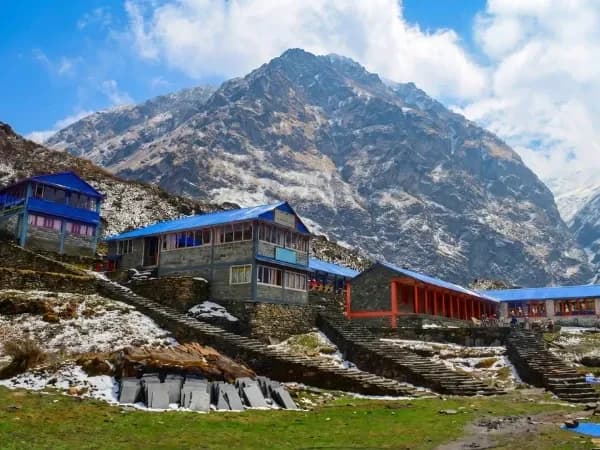
Small. Honest. Basic. Chele is a handful of homes and a few simple guesthouses run by local families, not a trekking town like Namche. Expect a plain room, a shared and simple toilet, and dal bhat cooked on a stove that also heats the room. The wind picks up in the afternoon and the temperature drops hard once the sun leaves the gorge, so the evening is spent indoors, together, over tea.
I will not dress it up with things I cannot stand behind. I have seen other write-ups give Chele a precise population, a house count, or a named monastery, and I cannot verify any of those, so I will not repeat them. What I can tell you is true is the shape of the day and the feel of the place: the climb, the cliff, the prayer flags, the first proper night of the high, dry, quiet country that makes Upper Mustang unlike anywhere else in Nepal.
When is the best time to trek through Chele?
Upper Mustang keeps different rules from the rest of Nepal, and this is the practical thing worth knowing. The region sits north of the main Himalaya, in the rain shadow of Dhaulagiri and Annapurna, so the monsoon that soaks the rest of the country in summer mostly never reaches it. That makes Chele and the trail beyond one of the few places in Nepal you can walk in June, July and August, when Everest and Annapurna are under cloud and rain.
Spring, from March to May, and autumn, from late September to November, are still the classic windows, with the clearest air and the kindest temperatures. The one thing that never changes is the wind. It gets up most afternoons and it is relentless, which is why we start early and aim to be off the day's climb before it builds. Winter is bitterly cold and many families move down the valley, so we do not run the trek then. If you can time your visit to the Tiji festival in Lo Manthang, a three-day masked ritual that drives out evil, you will see Mustang at its most alive, but the lodges fill a year ahead and it costs more.
How Chele fits our Upper Mustang trek
On our trek, Chele is the end of day two and the launch pad for everything that follows: the long climb the next day, then Samar and the cave of Guru Rinpoche, the red cliffs of Dhakmar, Ghar Gompa, and finally the walled capital of Lo Manthang. Chele is the doorway. It is worth pausing in it rather than rushing through.
If you want to walk this route with a family who treat it as a pilgrimage and not just a trek, message me on WhatsApp or email [email protected], and I will tell you honestly what it involves and when to go.
Written by Shreejan Simkhada, CEO of The Everest Holiday and third-generation Himalayan guide. TAAN Member #1586.

 Chat with Shreejan