

Most people who walk to Everest now fly into Lukla and start high. Junbesi belongs to the older way in, the long walk up through Solu that Hillary's generation took, and it is still one of the loveliest places on that route. It is a proper Sherpa village at 2,700 metres, sitting in a green bowl of terraced fields and pine, with a white monastery on the rise above it and apple trees in the gardens. I send people here on two of our trips, and it is the kind of stop that quietly becomes the part they talk about afterwards.
This is a short, honest guide to Junbesi: where it is, what you actually do there, the monastery above it, and why we still route two treks through it when almost everyone else skips straight to the airstrip.
Where is Junbesi and how do you get there?
Junbesi sits in Solu, the lower and gentler half of the Solukhumbu district, south-west of the high Khumbu that everyone pictures when they think of Everest. It is roughly a day's walk over the Lamjura La, the highest pass on the old Jiri approach, and it marks the point where the trail drops out of rhododendron forest into settled Sherpa country.
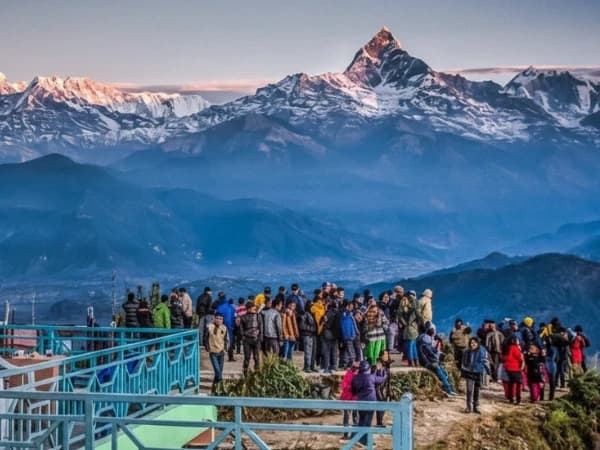
There are two ways to arrive, and we use both. On our Jiri to Everest Base Camp trek you walk in from the west, crossing the Lamjura La and coming down into the village on foot, the way the first Everest expeditions did. On our Pikey Peak trek you come at it from the other direction, dropping down off Pikey after sunrise and spending a full day in and around the village before the drive back to Kathmandu. Either way there is no airstrip and no crowd, which is rather the point.
What is there to see in Junbesi?
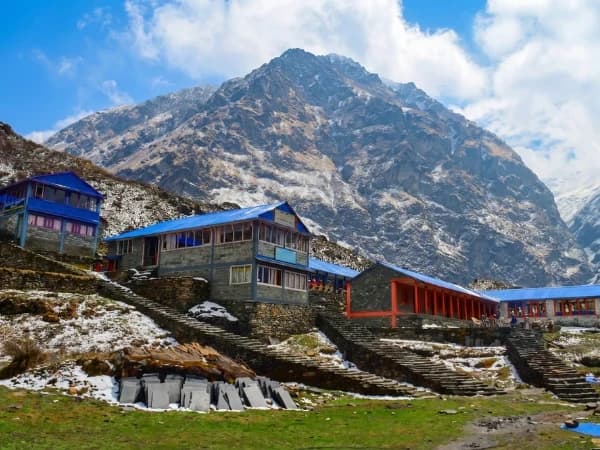
The village itself is the first thing. Junbesi is old and well kept, with a village gompa, whitewashed stone houses, prayer walls, and a mani wall you walk to the left of, the way you do everywhere in Sherpa country. In autumn the fields are gold with buckwheat and barley, and the gardens are heavy with apples. It is small enough to walk end to end in ten minutes and rich enough to sit in for an afternoon.
Above and behind the village are the monasteries, and they are the reason a lot of walkers remember Junbesi. The best known is Thubten Chöling, a large Tibetan Buddhist community a couple of hours up the valley to the north. There is also Serlo, a monastery and retreat centre on the hillside near the village, reached on a short climb through the pines. You do not have to be Buddhist to feel the difference these places make to a valley; you notice it in how quiet and ordered everything is.
What is Thubten Chöling monastery?
Thubten Chöling was founded by Trulshik Rinpoche, a senior Nyingma lama who was born in 1923 and died in 2011, and who established the monastery here in Solukhumbu after leaving Tibet. Over the years it grew into one of the largest monastic communities in the Nepal Himalaya, home to a great many monks and, especially, nuns who came to study and practise under him. Today it is a working community, not a museum, so if you visit you go softly, ask before you photograph anyone, and keep to the edges of whatever is happening.
Trulshik Rinpoche was one of the most respected teachers of his tradition, and his presence is a large part of why this corner of Solu carries the weight it does. His reincarnation was recognised a few years after his death. For a walker it is enough to know that the monastery you are looking at is not a tourist reconstruction but a real centre of learning that people crossed the mountains to build.
Why do our Everest and Pikey Peak treks stop here?
Because it is the best of Solu, and Solu is the half of the region most people never see. The Lukla flight is quick and it has its place, but it skips everything below Namche, and everything below Namche is where the farming villages, the orchards, the old monasteries and the everyday Sherpa life actually are. If you want to understand the people you will meet higher up, you meet them here first, at a height where you can still breathe easily and hold a conversation.
On the Jiri walk, Junbesi comes early, while your legs are still finding their rhythm and the altitude is nowhere near a problem, so you can enjoy it rather than endure it. On the Pikey Peak trek it is close to the end, a soft landing after the cold dawn on the ridge, and it lets the trip finish on culture rather than on a long drive. Both trips are built for people who would rather walk into the mountains than be dropped into them. If that is you, the full Jiri route and the Jiri versus Lukla comparison are both worth reading before you decide.
Is Junbesi hard to reach, and do you need to be fit?
Junbesi is not high, so altitude is not the issue here. At 2,700 metres you are well below the thin air that makes the upper Khumbu slow going. What the day asks of you is walking, not acclimatising: the Lamjura La on the Jiri side is a real pass, and the trail up and down through Solu is honest hill country. Anyone in reasonable walking condition manages it comfortably, especially with a guide setting a steady pace and a porter carrying the load. It is a gentler introduction to Nepal than the high passes, which is exactly why it suits first-time Himalayan trekkers and families who want the culture without the extreme.
When is the best time to visit Junbesi?
The same seasons that suit the rest of the region suit Solu, only warmer and greener because you are lower. October and November are the most reliable, with clear air and gold fields after the monsoon, and the apples are in. March and April bring the rhododendrons out on the Lamjura La and are the second-best window. December to February is cold but clear and very quiet, which some people love. The monsoon months from June to mid-September are green and wet and best left alone. Because Junbesi sits low, it stays a little kinder in the shoulder seasons than the high stops do.
Where do you sleep and eat in Junbesi?
There are simple, family-run lodges in the village, the same teahouse style you find all along these trails: a clean room, a shared dining room warmed by a stove in the evening, and honest hill food. Expect dal bhat, the rice-and-lentil plate that guides quietly rely on because you can eat it twice a day and keep walking, alongside noodles, potatoes, eggs, and Tibetan bread. Being in an orchard village, the apples turn up in season as pie and juice, which is a small and genuine pleasure after a pass. It is basic and it is comfortable, and the welcome is real.
How does Junbesi fit the wider Everest region?
Think of the Everest side of Nepal as a staircase. Junbesi is near the bottom of it, in the green farming country of Solu. Higher up you reach the Sherpa town of Namche, the monastery hill of Tengboche, and the herding villages like Khumjung and Phortse that send so many climbers to the high peaks. The people are the same Sherpa community the whole way up, and reading about who the Sherpa actually are makes far more sense once you have walked through a village like this one, where the mountains are still a backdrop to ordinary farming life rather than the only thing going on.
If you want the whole staircase, our classic Everest Base Camp trek takes you to the top of it; if you want the best of the bottom, with a proper Everest view thrown in, Pikey is the trip. Junbesi is where the two ideas meet.
Come and see it. A day in Junbesi tells you more about this region than a week of photographs, and it is the sort of place that makes people glad they walked in slowly. Message us and we will tell you honestly which of the two routes suits you.
Written by Shreejan Simkhada, CEO of The Everest Holiday and third-generation Himalayan guide. TAAN Member #1586.
 Chat with Shreejan