
The Everest Base Camp helicopter tour is the fastest way to stand at 5,364 metres and see Everest with your own eyes. You leave your Kathmandu hotel before dawn and you are back for lunch. No teahouses, no two weeks of walking, no acclimatisation schedule.
It is also the trip people ask us about most and understand least. The prices you see online range from about US$1,100 to well over US$6,000, and most pages never explain why. So here is the honest version, with the figures we actually charge, updated 11 September 2026.
How much does the Everest Base Camp helicopter tour cost in 2026?
There are only two products, and almost every price difference online comes down to which one is being quoted.
A seat on a full helicopter costs from US$2,299 per person. A landing flight carries four passengers because of the weight limit at altitude, and your pilot is also your guide, so all four seats go to passengers. That is the Budget price on our one-day Everest Base Camp helicopter tour, and Standard, with a break at the Everest View Hotel, is US$2,799. If you are fewer than four, message us before you book and we will try to place you with other travellers flying the same morning, so you still pay per seat.
A private helicopter is priced for your group alone. On our Luxury tier it is US$4,650 per person for two, US$3,499 each for three and US$2,999 each for four, with lunch and soft drinks at the Everest View Hotel. Groups of five or more need a second aircraft, and we quote those on request.
One thing worth knowing about the seat count. The aircraft seats five, but a landing flight can only take four passengers at that altitude, because thin air means less lift. That is why we sell four seats and not five, and why your pilot doubles as your guide. If a quote you are comparing puts five passengers on a landing flight, ask how.
That difference is the reason online prices look so far apart. One operator quotes you a seat, the next quotes you an aircraft, and the two numbers can differ by four or five times while describing exactly the same morning. A good share of the enquiries we get come from people who have compared a seat against an aircraft and concluded that somebody is fleecing them.
So when you compare, ask one question: is this per person, or for the whole helicopter? If the answer is not obvious on the page you are reading, that tells you something too. Related: Everest Mountain Flight 2026: Cost, Best Time and Is It Worth It.
What the price includes
- Return helicopter flight from Kathmandu to Everest Base Camp or Kala Patthar
- Landing at Base Camp or Kala Patthar, conditions permitting
- Sagarmatha National Park permits and entrance fees
- Domestic airport tax
- Passenger helicopter insurance
- Airport transfer on arrival and departure
- A company t-shirt and cap, which people seem to like more than we expected
On our Standard and Luxury options you also get a half hour to an hour on the ground at the Everest View Hotel at Syangboche, 3,880 metres. On Luxury, food and soft drinks there are included. Breakfast at the Everest View Hotel is not included on any of the three, and if another operator has told you it is, ask them to confirm that in writing.
Kathmandu hotel nights are not included in the tour price, on any of our trips. That is how we price every trek and tour we sell. If you want us to arrange the hotel we will quote it separately.
What you fly over
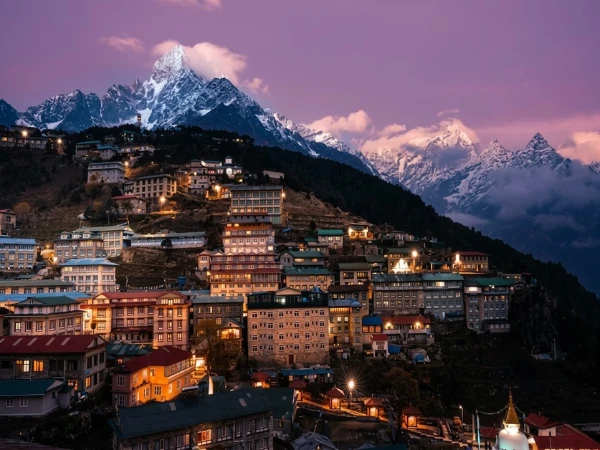
You lift off from Kathmandu at first light and you are in the middle hills within minutes. Terraced farmland gives way to forested ridges, then the range appears on the horizon. You pass Lukla, which trekkers spend two days reaching, then Namche Bazaar, then Tengboche Monastery on its ridge, and into the upper Khumbu with Ama Dablam, Lhotse and Nuptse standing up on either side. The whole thing takes about an hour.
If you want the longer account of what the morning actually feels like rather than what it costs, I have written that up separately: Everest Base Camp by helicopter.
Why you may not land at Base Camp itself
This is the part that gets glossed over, and it is the single most common complaint people have after flying with other operators.
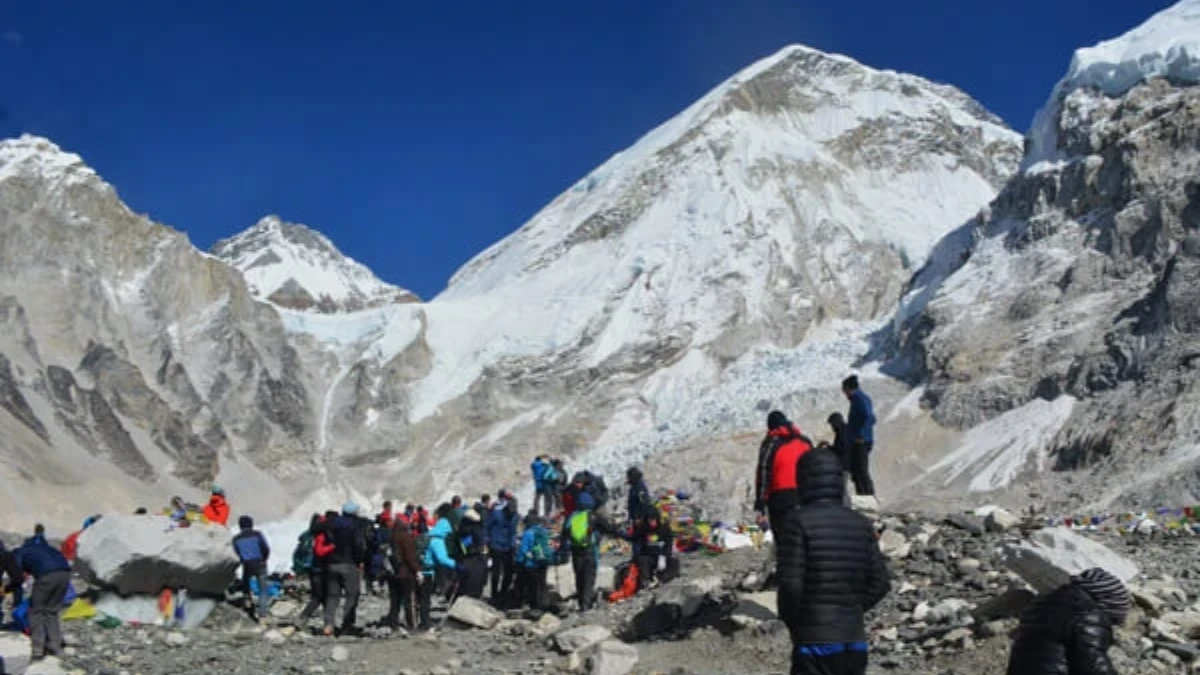
A helicopter that lifts a full cabin comfortably out of Kathmandu at 1,400 metres cannot lift the same load at 5,364 metres. Thin air means less lift. Every operator flying this route deals with the same physics: the aircraft drops most of the group at Pheriche or Lobuche, takes two passengers up to the landing site, comes back, and takes the next two. You will spend part of your morning waiting on a cold hillside while the helicopter shuttles.
That is normal, it is safe, and it is how the trip has always worked. What is not acceptable is not being told. If an operator has quoted you a full-cabin landing at Base Camp with no shuttle, ask them to put it in writing.
The second thing to know is that the landing is weather dependent and always has been. Cloud builds in the Khumbu through the morning, which is why every operator flies at first light. If we cannot land at Base Camp we land at Kala Patthar at 5,545 metres, which is the better viewpoint of the two in any case. If we cannot do either, we fly the valley and you see Everest from the air.
What happens if the weather cancels the flight
If the flight does not go at all, you have not lost your money. We rebook you for the next clear morning if you still have days in Nepal, or we refund the flight portion if you do not, less taxes, bank and card charges and any money already spent on your trip. We hold a buffer day in the plan wherever your schedule allows one.
Book this for the start of your Nepal trip, not the end. People who leave it for their last morning are the people who miss it.
When to go
October is the most reliable month, and it is also the busiest. Mid-November through early December gives you cold, clear, quiet mornings and is our own favourite window for this flight. March and April are warm and clear but hazier by mid-morning. December to February is spectacular and very cold. Between June and mid-September the monsoon closes the Khumbu in most mornings and we would rather you did not book at all than book and be disappointed.
Helicopter versus flying to Lukla
There is a practical argument for the helicopter that has nothing to do with luxury.
In the peak windows, roughly mid-March to mid-May and late September to the end of November, fixed-wing flights to Lukla do not depart from Kathmandu at all. They are moved to Manthali in Ramechhap, which means a pickup between midnight and 2 am and a four to five hour drive before you have flown anywhere. Helicopters are exempt from that arrangement and fly Kathmandu to Lukla directly all year.
A one-way fixed-wing seat to Lukla costs US$254 all in for a foreign national at current rates. The helicopter is many times that. What you are buying is not just speed, it is the removal of the night drive and the standby days.
Who this trip is not for
We turn people away from this one more than any other trip we sell, so it is worth being direct.
If you have a heart condition, uncontrolled high blood pressure, or a respiratory condition, speak to your doctor before booking. Going from 1,400 metres to 5,364 metres inside ninety minutes is a serious physiological event, even though you are only there for fifteen or twenty minutes. There is no gradual acclimatisation to soften it.
If you are pregnant, we will not take you. If you are travelling with children under a certain age we will talk it through with you first rather than take the booking online.
And if what you actually want is the Everest experience rather than the Everest photograph, the trek is the better trip and it costs less. Twelve days on foot to Base Camp starts at US$1,399 per person on our budget tier on the 12-day Everest Base Camp trek, which is less than a helicopter seat. You will arrive at the same place having earned it, and you will remember the walk longer than you will remember the flight. We would rather say that plainly than sell you the wrong trip.
Is the helicopter tour safe?
Nepal's aviation record is a fair question and you should ask it. What we can tell you is what we control. We fly with operators we have used for years, at first light when the air is stable, and with a hard rule that the pilot's call on the weather is final and is never argued with. No trip is worth pushing a marginal morning.
We have run treks and flights in this region since the company was registered in 2016, and the family has guided in Nepal for three generations before that. We have had rescues. We have never lost a guest.
How to book
The deposit is 10 per cent and the balance is payable in Kathmandu. We do not add a card surcharge. Others pass that on at around three and a half per cent, so on a trip of this size it is worth checking before you compare two prices.
Before you book anything with anyone, check the operator. Company registration with the Office of the Company Registrar, TAAN membership, a Department of Tourism trekking licence, and Nepal Rastra Bank certification to take foreign currency are all verifiable online in a few minutes. We hold all of them: TAAN member 1586, trekking agency licence 2090/072 and travel agency licence 2838/072, both issued by the Tourism Office in Kathmandu and valid to 2031.
One honest caveat, because it matters more than any badge: even fully licensed operators have been involved in things that went wrong. Documents are necessary. They are not sufficient. Talk to whoever you book with and see whether they will tell you the awkward parts of the trip as readily as the good ones.
If you want to ask us anything at all before you commit, message me on WhatsApp at +977 9810351300. I answer these myself.
Written by Shreejan Simkhada, CEO of The Everest Holiday and third-generation Himalayan guide. TAAN Member #1586. Prices verified 11 September 2026.

 Chat with Shreejan